
Heat Pump vs. Gas Furnace in Woodland CA: A Pre-Winter Upgrade Guide to Avoid Future AC Repair

Making the Right Heating Choice Before Winter Temperatures Drop
The chill in the morning air is starting to linger, and you are realizing that relying on an aging heating system for another season is a gamble you might not want to take. As you evaluate upgrade paths, looking at options comparisons for homeowners can feel overwhelming, especially when trying to balance immediate winter comfort with long-term system reliability. Our team at Thompson's Heating & Air frequently guides homeowners in Woodland CA through this difficult decision just as the weather begins to shift during the mid-fall pre-winter transition. We know replacing a struggling heater is stressful, but we also emphasize that whatever choice you make now will dictate your home's comfort and energy consumption for the next ten to fifteen years.
Whether you are exploring complete system upgrades or simply need reliable air conditioning services after a harsh summer, addressing your HVAC needs now can prevent the sudden need for emergency AC repair in Woodland when the seasons change again. Replacing an older, inefficient setup requires weighing the benefits of modern, high-efficiency technology against traditional heating methods. A dual-purpose system upgrade can simultaneously handle your immediate winter heating requirements and completely eliminate the need for standalone cooling services next summer. Making the right choice now secures your home's comfort, protects your indoor air quality, and ensures you are not left waiting for one of our technicians when the first real freeze hits the valley.
The Core Mechanics: Heat Transfer vs. Combustion
Understanding the fundamental differences between your heating options requires looking past basic definitions and examining how these systems actually manipulate air temperature. The choice between a heat pump and a gas furnace comes down to two entirely different mechanical processes: moving existing heat versus creating new heat. For homeowners in Woodland CA, our technicians find that understanding these mechanical differences is the foundation for evaluating long-term operational costs and overall indoor comfort.
How Gas Furnaces Generate Heat
Gas furnaces rely on a straightforward combustion process. When your thermostat signals a drop in temperature, the system opens a gas valve, ignites the burners, and creates a controlled fire inside a metal chamber called a heat exchanger. The blower motor then forces indoor air over the exterior of this blazing hot metal, rapidly warming the air before pushing it through your ductwork.
The traditional appeal: This combustion method generates a hotter, drier heat upon startup. In our experience, homeowners who have lived with gas furnaces for decades often prefer this rapid, high-temperature air delivery. The air coming out of the vents can easily reach 120°F or more, warming a cold room very quickly. However, this relies on a continuous supply of fossil fuels and requires precise safety mechanisms to vent harmful combustion byproducts, like carbon monoxide, safely out of your home.
How Heat Pumps Transfer Heat
Heat pumps utilize a completely different physical principle: heat transfer. Instead of burning fuel to create heat, a heat pump uses electricity and advanced refrigerants to absorb ambient thermal energy from the outdoor air, compress it to increase its temperature, and transfer it inside your home. Even when the air outside feels cold to the human skin, there is still abundant thermal energy present.
The efficiency advantage: Because they transfer heat rather than generate it from scratch, modern air-source heat pumps operate at exceptional efficiency levels. They can deliver significantly more energy in the form of heat than they consume in electricity. In mild climates, this makes them an incredibly efficient alternative to traditional combustion.
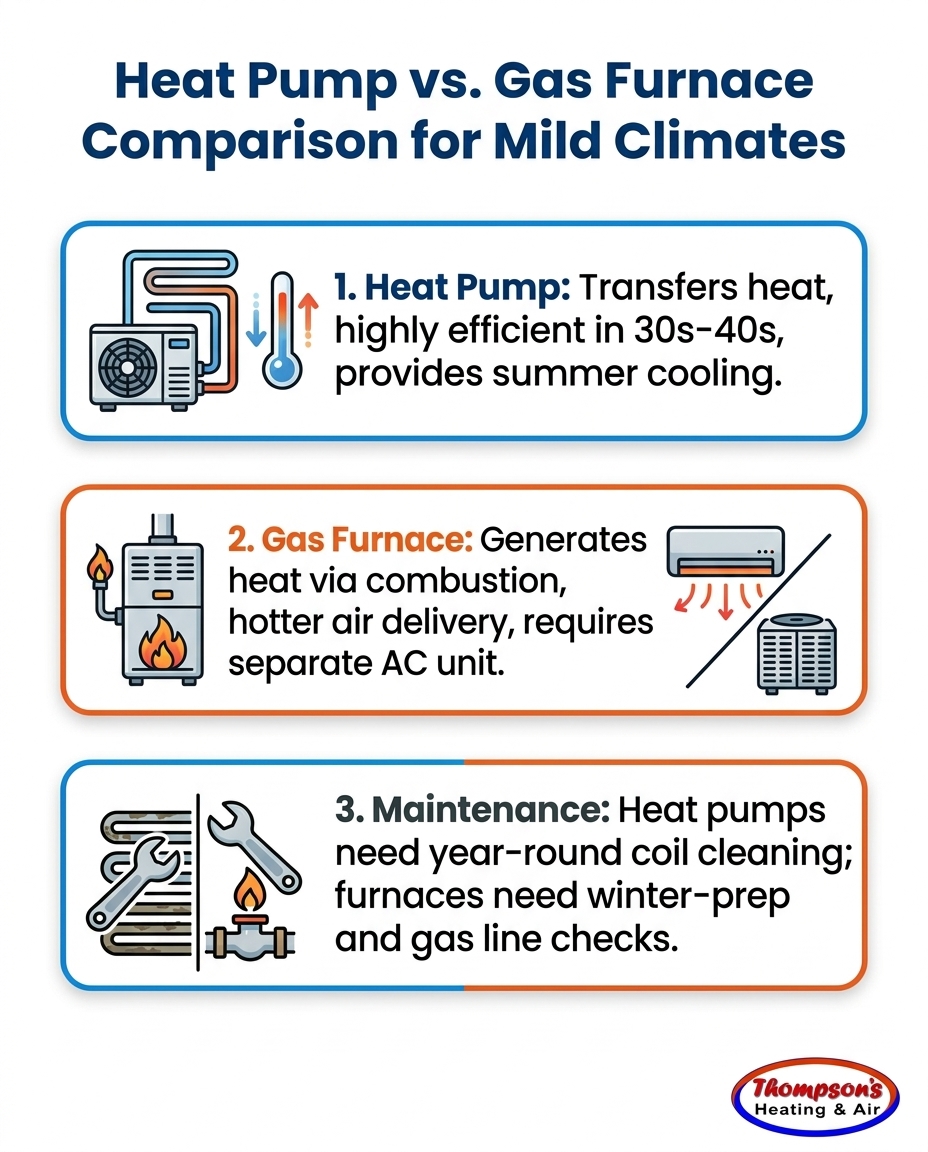
• Primary Mechanism — Gas Furnace: Burns natural gas or propane to create heat — Air-Source Heat Pump: Uses refrigerant to transfer ambient heat
• Air Temperature at Vent — Gas Furnace: Very hot (often 120°F+) upon startup — Air-Source Heat Pump: Warm and consistent (usually 90°F - 100°F)
• Energy Source — Gas Furnace: Fossil fuels (plus minor electricity for blower) — Air-Source Heat Pump: 100% Electricity
• Cooling Capability — Gas Furnace: None (Requires separate AC system) — Air-Source Heat Pump: Yes (Reverses cycle to cool the home)
Year-Round Operation: Why Your Heating Choice Impacts Summer Cooling
One of the most significant factors in this decision is how your choice of heating equipment impacts your home's cooling infrastructure. Unlike a gas furnace, which sits dormant during the summer months while a separate air conditioner does the heavy lifting, a heat pump is a unified, year-round comfort system. By utilizing a specialized component called a reversing valve, a heat pump simply reverses its refrigerant flow to absorb heat from inside your house and dump it outside, effectively becoming a high-powered air conditioner.
Evaluating Your Current Cooling System
Homeowners with an aging air conditioner may find that switching to a heat pump eliminates the need for a separate AC replacement down the line. Our installation crews frequently point out that if your current cooling equipment is over ten years old, uses outdated R-22 refrigerant, or has required frequent repairs, investing in a new gas furnace only solves half of your HVAC problem. You will still be left with a failing air conditioner that will inevitably require replacement. Evaluating the condition of your current cooling equipment is a critical step when deciding on a winter heating upgrade. Consolidating both heating and cooling into a single high-efficiency system streamlines your home's infrastructure and often provides a better return on investment.
The Dual-Function Advantage
The seamless transition between heating and cooling modes offers distinct advantages for homeowners in Woodland CA.
• Space-saving design: You only need one outdoor condenser unit and one indoor air handler, freeing up space in your yard and garage.
• Consistent indoor climate: Modern variable-speed heat pumps run continuously at lower capacities, maintaining a highly consistent indoor temperature rather than blasting on and off like single-stage furnaces.
• Streamlined warranties: Operating a unified system means you are dealing with a single manufacturer warranty for your entire year-round climate control setup.
Maintenance Demands and the Impact of Agricultural Dust
Because these systems operate differently, their maintenance requirements also diverge significantly. A gas furnace requires specific safety inspections focused on the heat exchanger, gas pressure, and venting systems before winter begins. A heat pump, however, runs continuously throughout all four seasons, meaning our maintenance teams see continuous wear and tear on its components.
Year-Round Coil Cleaning Requirements
Working locally, we see firsthand how the heavy agricultural dust in the Sacramento Valley uniquely impacts heat pump outdoor units year-round. Because heat pumps run continuously, their outdoor condenser coils are constantly exposed to environmental elements. During the harvest season, massive amounts of dust, dirt, and organic particulate matter are kicked up into the air.
The consequence of dirty coils: This agricultural dust coats the aluminum fins of the outdoor unit, acting as an unwanted insulator. When the coils are insulated by dirt, the system cannot efficiently transfer heat. This forces the compressor to work harder, run longer, and consume far more electricity to achieve the same indoor temperature. Scheduling routine AC maintenance for a heat pump is a year-round necessity, not just a summer task.
Filter Replacement Frequencies
Managing indoor air quality during the mid-fall pre-winter transition requires vigilance. Heavy dust doesn't just coat the outdoor unit; it makes its way into your home's return ducts.
1. Check filters monthly: During peak agricultural activity, standard 90-day filters may clog in just 30 days.
2. Upgrade filtration: Consider using MERV 8 to MERV 11 filters to capture fine agricultural dust without severely restricting airflow.
3. Protect the blower motor: A clogged filter forces the blower motor to strain against static pressure, leading to premature failure.
4. Monitor drainage: Neglecting heavy dust buildup can lead to systemic issues, much like understanding why AC drain lines clog in late summer due to accumulated debris mixing with condensation.
Energy Efficiency and Generic Incentive Eligibility
Comparing the efficiency metrics of both systems is vital for projecting your future utility usage. However, navigating the different rating systems can be confusing, as the industry uses separate acronyms to measure combustion efficiency versus heat transfer efficiency.
Understanding AFUE and HSPF Ratings
Gas furnaces are measured by AFUE (Annual Fuel Utilization Efficiency). This percentage tells you how much of the fuel consumed is actually converted into usable heat. For example, a 95% AFUE furnace turns 95% of its natural gas into heat, while the remaining 5% escapes as exhaust.
Heat pumps use HSPF (Heating Seasonal Performance Factor) to measure heating efficiency, and SEER2 (Seasonal Energy Efficiency Ratio) to measure cooling efficiency. Because heat pumps move heat rather than create it, their effective efficiency can exceed 300% under the right conditions. The mild winter climate in Woodland CA, with average low temperatures in the upper 30s to low 40s, falls perfectly within the optimal efficiency range for modern air-source heat pumps to operate at peak performance.
Navigating Tax Credits and Utility Rebates
The transition toward electrification has prompted significant government and utility support. Homeowners upgrading to high-efficiency systems may be eligible for various generic incentives.
• Federal Tax Credits: Under current clean energy initiatives, qualifying high-efficiency heat pumps often qualify for federal tax credits that offset a portion of the installation costs.
• Local Utility Rebates: Many regional utility providers offer rebate programs for homeowners who transition away from fossil fuels or upgrade to high-efficiency equipment.
• Manufacturer Promotions: System manufacturers frequently offer seasonal promotions during the spring and fall shoulder seasons.
It is always recommended to verify current incentive programs with a tax professional or your local utility provider before installation, as program requirements, efficiency minimums, and available funds change frequently. Proper, documented installation by a licensed professional is strictly required to qualify for any of these programs.
Emergency Breakdowns: Reliability When Temperatures Drop
Even the most efficient system is useless if it fails when you need it most. A sudden heating failure on a chilly Sunday morning requires immediate, reliable technical support. The difference between a minor inconvenience and a freezing weekend often comes down to the reliability of your chosen system and the expertise of your local service provider.
Response Times During Peak Seasons
When the first major cold front hits, local HVAC companies are flooded with no-heat calls from homeowners who skipped their fall maintenance. At Thompson's Heating & Air, we see how the reality of emergency weekend heating failures stretches response times, and parts availability can become a bottleneck. Taking action during the mid-fall pre-winter transition to proactively upgrade an aging, unreliable system ensures you bypass the panic of peak-season breakdowns entirely.
Choosing a Vendor with Heat Pump Expertise
Not all HVAC vendors possess the specialized knowledge required to properly diagnose and install advanced heat pump systems. The technical complexity of modern variable-speed refrigerant systems requires rigorous training. Recently, a Woodland homeowner reached out to our team needing specific technical details about how a heat pump would perform in their older home. Instead of pushing a high-pressure sales pitch, our staff provided knowledgeable, objective answers to their technical questions, allowing the customer to make a fully informed decision based on facts rather than fear.
Proper installation and honest diagnostics are critical to ensuring the longevity of whichever system you choose. Partnering with a team like ours that offers objective repair versus replace advice helps homeowners avoid unnecessary replacements and ensures that the equipment is sized correctly for the specific thermal envelope of the house.
Frequently Asked Questions About Heating Options in Northern California
Is a heat pump better than a gas furnace in California?
For many California homeowners, a heat pump is highly advantageous due to the region's generally mild winters. Because heat pumps transfer ambient heat rather than burning fossil fuels, they operate at exceptional efficiency in temperatures above freezing. Additionally, they provide both heating and cooling, which aligns well with California's year-round climate demands and statewide electrification goals.
At what temperature does a heat pump become inefficient?
Older heat pumps used to struggle when temperatures dropped below 40°F, but modern cold-climate heat pumps maintain high efficiency well below freezing. In the Sacramento Valley, where winter lows typically hover in the upper 30s to low 40s, a modern air-source heat pump will operate comfortably within its peak efficiency range without needing to rely heavily on supplemental auxiliary heating strips.
What are the maintenance differences between a heat pump and a furnace?
The primary difference is the frequency and focus of the maintenance. A gas furnace requires an annual pre-winter inspection focused on combustion safety, gas pressure, and heat exchanger integrity. A heat pump requires bi-annual maintenance (spring and fall) because it operates continuously year-round, making regular coil cleaning, refrigerant level checks, and frequent filter replacements critical to its survival.
How does agricultural dust affect a heat pump's performance year-round?
Agricultural dust acts as an insulating blanket on the heat pump's outdoor condenser coils. When the coils are coated in dirt and harvest particulate, the system struggles to transfer heat effectively between the refrigerant and the outside air. This restriction forces the compressor to work much harder, driving up electrical consumption and accelerating mechanical wear and tear on the unit.
Do heat pumps also provide air conditioning in the summer?
Yes, a heat pump provides full air conditioning capabilities. It uses a component called a reversing valve to switch the direction of the refrigerant flow. During the summer, it absorbs heat from inside your home and releases it outdoors, functioning exactly like a traditional central air conditioning system.
Secure Your Home's Comfort With the Right Heating System
Whether you prefer the familiar, rapid warmth of a traditional gas furnace or the highly efficient, year-round operation of a modern heat pump, securing professional guidance from Thompson's Heating & Air is the most important step. A clear, technically accurate evaluation of your home's ductwork, insulation, and current cooling equipment ensures you make an informed choice that benefits your household for years to come. Do not wait for an unexpected failure on a freezing morning in Woodland CA. Schedule a comprehensive consultation with our team today to review your options, evaluate your home's unique thermal requirements, and secure your family's comfort before the harsh winter weather arrives.



.avif)
.avif)
.png)
