
Will Running Your HVAC Fan Reduce Humidity? A Fall Maintenance Checklist for Woodland

Navigating the October Seasonal Transition in Woodland
You turn on your heater for the first time in months, and immediately a strange burning smell fills the house, reminding you that it is time to tackle your seasonal home maintenance checklist. That initial autumn chill often catches homeowners off guard, forcing dormant heating equipment into sudden action. At Thompson's Heating & Air, our team has helped countless local families navigate the critical transition period of mid-fall October, when your home's climate control system undergoes a massive operational shift. The mechanical strain placed on these systems is significant, especially when transitioning directly from heavy summer cooling into initial heating startup.
Your system has just finished months of grueling Air Conditioning cycles. Without proper AC maintenance during the peak of summer, internal components like blower motors, capacitors, and electrical relays are already fatigued. Expecting a fatigued system to flawlessly switch over to heating mode is a gamble that often results in inconvenient breakdowns.
This leaves you with a clear decision point: proactively schedule a pre-winter inspection now, or risk a sudden, total system failure during the first major cold snap of the year. Taking action in October gives you a valuable buffer. It allows you to address lingering summer wear and tear, clear out accumulated debris, and verify that your heating components are safe, clean, and ready to handle the heavy lifting of the winter months ahead.
Will Running Your HVAC Fan Reduce Humidity?
The Problem: As fall weather fluctuates, indoor air can start to feel stale or unusually clammy. Many homeowners notice this lingering moisture and try to solve it by switching their thermostat fan setting from "AUTO" to "ON." The logic seems sound—moving air should dry things out, right? Unfortunately, a pattern we see often is that this common misconception leads to the exact opposite result, making your home feel muggier while driving up your utility bills.
The Cause: To understand why this happens, we have to look at how your system actually removes moisture. An HVAC fan does not have the mechanical ability to dehumidify air on its own; it only circulates it. The actual dehumidification happens when warm indoor air passes over the freezing cold indoor evaporator coil. The moisture in the air condenses on the cold metal—much like water droplets forming on the outside of a cold glass of ice water on a summer day. That condensation then drips down into a drain pan and flows safely out of your house.
However, when you leave the fan set to "ON," the fan blows continuously, even when the outdoor compressor (which cools the coil) cycles off. The coil warms back up, but the fan keeps blowing air across it. This incoming air rapidly re-evaporates the moisture sitting on the coil and in the drain pan, blowing it right back into your living space. If you want to dive deeper into this mechanical process, you can read more about how running your AC fan continuously affects humidity.
The Solution: Leave your thermostat fan set to "AUTO." In this setting, the fan only runs when the cooling cycle is actively running. This allows the moisture extracted from your indoor air the time it needs to properly drain away between cycles, keeping your indoor humidity levels balanced. Providing this kind of honest, transparent advice on system settings is part of our commitment at Thompson's Heating & Air to helping homeowners maximize their comfort and efficiency without having to book unnecessary service calls.
The Physics of Dehumidification
The science of indoor moisture control relies on the relationship between temperature and condensation. Here is a closer look at the physics involved:
• Latent cooling extraction: When the compressor runs, refrigerant drops the indoor coil temperature drastically. As warm air hits this cold surface, it reaches its dew point, forcing the air to surrender its moisture.
• The drainage window: Once the cooling cycle ends, the system needs a quiet period. The collected water droplets need time to obey gravity, slide down the fins of the coil, and exit through the condensate drain line.
• The disruption of continuous airflow: A constantly running blower motor acts like a high-powered hairdryer blowing over a wet surface. It interrupts the drainage window, turning liquid condensation back into water vapor and distributing it through your ductwork.
The Impact of Agricultural Dust on Indoor Air Quality
Living in Woodland CA means enjoying the beauty and economic benefits of the Sacramento Valley, but it also means dealing with the realities of the local climate. In our years of servicing local HVAC systems, one of the most significant seasonal challenges the Thompson's Heating & Air team encounters is the heavy agricultural dust kicked up during the fall harvest season. Tractors, harvesters, and heavy winds combine to put a massive amount of particulate matter into the outdoor air precisely when you are preparing your home for winter.
This outdoor dust inevitably infiltrates your home through tiny gaps around doors, windows, and roof vents. Once inside, it gets pulled directly into your HVAC system's return vents. If you are not paying close attention to your indoor air quality in Woodland, this sudden influx of agricultural dust can severely impact your comfort and your equipment.
Heavy dust accumulation drastically shortens the lifespan of your air filters. A filter that normally lasts three months might clog completely in just four weeks during peak harvest season. When a filter clogs, your blower motor has to work twice as hard to pull air through the system, driving up energy costs and risking an overheated motor.
Furthermore, this dust is the primary culprit behind that alarming "burning dust" smell when you first turn on your furnace. Over the long summer, microscopic particles settle on the dormant heat exchanger or heating elements. When those elements heat up for the first time in mid-fall October, the settled dust vaporizes, sending a burnt odor through your vents. While this smell usually dissipates after a few hours, excessive dust buildup can insulate the heat exchanger, reducing its efficiency and potentially causing it to overheat.
• Primary Composition — Normal Household Dust: Pet dander, fabric fibers, human skin cells. — Harvest Season Agricultural Dust: Topsoil, organic plant matter, pollen, field dirt.
• Volume and Frequency — Normal Household Dust: Consistent, slow buildup year-round. — Harvest Season Agricultural Dust: Sudden, heavy spikes during late summer and fall.
• Filter Impact — Normal Household Dust: Standard 90-day replacement cycle is usually sufficient. — Harvest Season Agricultural Dust: Can blind (clog) a standard filter in 30 days or less.
• System Risk — Normal Household Dust: Gradual reduction in airflow if neglected. — Harvest Season Agricultural Dust: Rapid airflow restriction, leading to overheating and short-cycling.
Essential Fall Home Maintenance Checklist for HVAC Systems
Preparing your home for colder weather requires a proactive approach. While some mechanical tasks require a licensed professional, there are several vital steps you can take to protect your equipment and improve your indoor comfort. Follow this actionable checklist to get your system ready for the temperature drop.
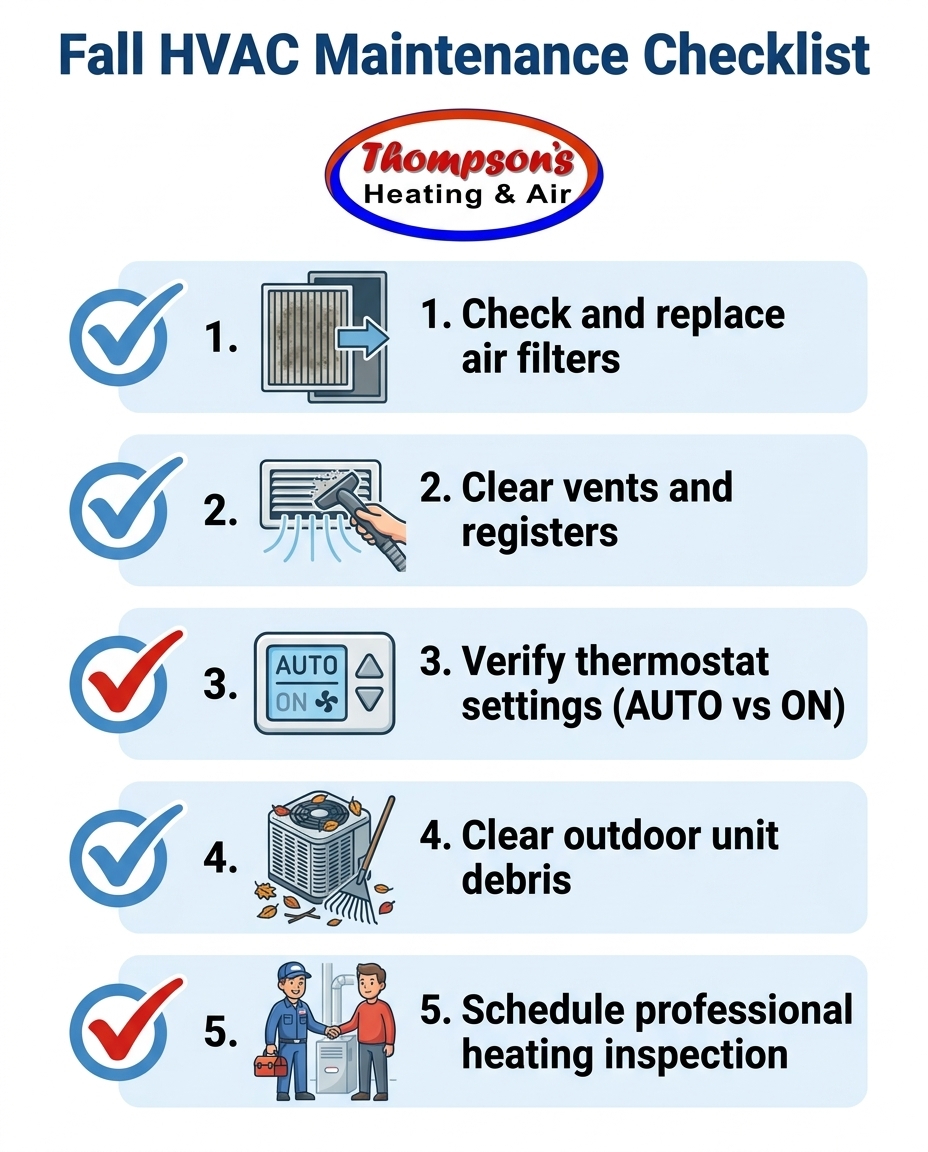
1. Inspect and replace air filters frequently: As discussed, the fall dust storms and heavy summer usage take a toll on your filters. Check your filter every 30 days during the autumn transition. A clean filter protects your blower motor and is the foundation of good air filtration.
2. Ensure all indoor vents and registers are unblocked: Over the summer, furniture, rugs, or curtains may have been moved, inadvertently covering floor or wall registers. Walk through every room and ensure there is at least two feet of clearance around every vent to maintain proper system airflow and prevent pressure imbalances.
3. Verify thermostat settings and power: Switch your thermostat from "COOL" to "HEAT" to ensure the communication wire is functioning. If your thermostat relies on batteries, October is the perfect time to install a fresh set. Remember to verify that the fan setting is on "AUTO" rather than "ON."
4. Clear debris from the outdoor unit: Falling autumn leaves, twigs, and dirt can easily get trapped inside the fins of your outdoor heat pump or AC condenser. Gently remove any visible debris from the top and sides of the unit, and trim back any bushes or vegetation to allow a minimum of two feet of clearance around the equipment.
5. Review potential upgrade incentives: If your system is over 15 years old and struggling to keep up, fall is the time to plan ahead. General federal tax credits or utility rebates may apply to qualifying high-efficiency heat pump upgrades. It is always wise to verify current programs with your utility provider or a tax professional to see what incentives you might qualify for before winter arrives.
What a Professional Pre-Winter Heating Inspection Includes
While clearing debris and changing filters are essential homeowner tasks, they represent only a fraction of what is required to safely transition a system into heating mode. A professional pre-winter inspection delves into the mechanical and electrical realities of your equipment, addressing the hidden wear and tear that DIY checklists simply cannot reach.
The strain of summer heat takes a hidden toll on electrical connections. Wires expand and contract during months of high-temperature operation, which can loosen terminal connections. A professional technician will measure the electrical amp draw on your motors and tighten all connections to prevent electrical shorts or component failures.
Skipping this level of professional maintenance carries real risks. Our emergency dispatch team at Thompson's Heating & Air sees this pattern every fall: a local homeowner experiences a sudden heater failure on a chilly Sunday morning during the first major cold snap because a neglected component finally gave out. We quickly reroute our technicians to service the unit and install the necessary part, successfully restoring the heating system before the house grows too cold. However, scheduling a proactive check with us in mid-fall October can often catch these failing parts—like a weak capacitor or a failing blower motor—before they lead to a sudden weekend outage.
Electrical and Safety Verifications
Modern heating systems are built with a series of critical safety mechanisms. If any of these sensors fail, the system can become a hazard to your home. A professional inspection includes rigorous testing of these components:
• Flame Sensors: In gas furnaces, the flame sensor detects whether a fire has successfully ignited when the gas valve opens. If the sensor is coated in summer dust or carbon buildup, it cannot read the flame, and it will shut the system down as a safety precaution. Technicians carefully clean and test this sensor.
• Limit Switches: The high-limit switch monitors the internal temperature of the furnace. If the system overheats (often due to a clogged filter or a failing blower motor), the limit switch cuts the power to prevent a fire or a cracked heat exchanger. Technicians verify that this switch is communicating correctly and tripping at the exact right temperature.
• Burner and Heat Exchanger Cleaning: A technician will inspect the heat exchanger for hairline cracks that could leak dangerous gases into the home. They also clean the burner assembly to ensure a crisp, efficient blue flame, rather than a lazy yellow flame that produces excess soot and wastes energy.
Frequently Asked Questions
Why does my heater smell like burning dust when I turn it on?
This is a very common occurrence caused by dust settling on the heat exchanger over the long summer months. When the furnace ignites for the first time in the fall, that accumulated dust vaporizes, creating a noticeable burning odor. The smell is usually harmless and should dissipate within a few hours, but if it persists, you should turn the system off and call a professional to ensure there isn't an electrical issue or a blocked vent.
Will running the HVAC fan reduce humidity in my house?
No, running the fan continuously will actually increase the humidity in your home. When the fan is set to "ON," it continues to blow air across the indoor coil even after the cooling cycle has stopped. This blows the moisture that recently condensed on the coil right back into your living space, making the home feel muggier and less comfortable.
What is included in a fall HVAC inspection?
A comprehensive fall inspection focuses on safety, efficiency, and electrical integrity. A licensed technician will clean the burner assembly, test the flame sensor and high-limit safety switches, inspect the heat exchanger for dangerous cracks, and measure the electrical amp draw on the blower motor. This ensures the system is mechanically sound and safe to operate before the heavy winter usage begins.
How do I prep my HVAC system for winter?
Start by replacing your indoor air filter and ensuring all of your room vents are completely unblocked by furniture or rugs. Next, head outside and clear any fallen leaves, weeds, or debris away from your outdoor heat pump or AC condenser. Finally, schedule a professional pre-winter tune-up to handle the electrical testing and internal component cleaning that requires specialized tools and training.
Should I leave my thermostat fan on 'AUTO' or 'ON' during the fall?
You should always leave your thermostat fan set to "AUTO" during the fall season. The AUTO setting ensures the fan only runs when the system is actively heating or cooling the air, which helps maintain proper humidity levels and saves significant energy. Leaving it "ON" wastes electricity and can disrupt the comfort balance in your home by circulating unconditioned air.
How often should I change my air filter during harvest season?
During the heavy agricultural harvest season in Woodland CA, you should check your air filter at least once every 30 days. The massive amount of outdoor dust and particulate matter kicked up by farming equipment easily finds its way indoors, clogging filters much faster than usual. If the filter looks gray or you cannot see light through it, replace it immediately to protect your blower motor.
Taking the time to complete your seasonal home maintenance checklist is the best way to protect your comfort and your wallet as the weather shifts. While changing filters and clearing vents are great first steps, ensuring your heating system is truly ready for winter requires a professional eye. A thorough, technical inspection provides the confidence that your system will operate safely, efficiently, and reliably when the cold weather finally sets in.



.avif)
.avif)
.png)
