
What We Found Inside a Duct System: Signs Your HVAC Filter is Clogged With Ash


The Hidden Toll of Wildfire Smoke on Your HVAC System
Here at Thompson's Heating & Air, we notice that with the arrival of the October post-wildfire season, many Woodland homeowners are finally opening their windows to let in the crisp autumn breeze, but they often overlook the signs your hvac filter is clogged with ash. While the skies outside may be clear, the late-summer smoke frequently leaves behind a lingering, invisible threat inside your ductwork. When dense smoke settles over the valley, your home's heating and cooling system pulls that polluted air directly into its respiratory system, rapidly overwhelming standard fiberglass filters.
The decision you face right now is incredibly important: determining if your system just needs a fresh filter, or if deeper, more permanent damage has occurred. A severely clogged filter does more than just stop air from flowing properly. It forces your blower motor to work twice as hard, driving up your energy bills and putting immense strain on internal components.
Most homeowners assume that once the smoke clears from the neighborhood, the danger to their home has passed. Unfortunately, our team knows the opposite is true. The ash that was pulled into your return vents during the peak of the fires is now sitting inside your unit, waiting to be disturbed. If left unaddressed, this hidden buildup directly threatens your indoor air quality and overall system efficiency as you prepare to switch from cooling to heating.
Why Wildfire Ash is More Dangerous Than Household Dust
To understand why smoke is so destructive to an HVAC unit, you have to look at the physical makeup of the ash itself. Wildfire smoke consists primarily of PM2.5—particulate matter that is 2.5 micrometers in diameter or smaller. To put that into perspective, a single strand of human hair is about 30 times larger than a PM2.5 particle. Because these particles are microscopic, they easily bypass basic fiberglass air filters that are only designed to catch large debris like pet hair and standard lint.
In our years of providing indoor air quality solutions, our team has seen how the specific topography of Woodland and Yolo County creates a natural basin that allows dense wildfire smoke from surrounding Northern California fires to settle heavily into our neighborhoods. When this smoke infiltrates your home, it brings a highly abrasive, powdery residue that behaves very differently than normal household dust.
The Chemical Reaction Inside Your System:
• Abrasive texture: Standard dust is mostly composed of soft organic matter. Wildfire ash contains microscopic silica and carbon, making it highly abrasive. When it bypasses your filter, it acts like fine sandpaper against your moving blower motor parts.
• The cement effect: When dry ash mixes with the natural condensation and humidity inside your air conditioner's evaporator coil, a dangerous chemical reaction occurs. The ash turns into a thick, cement-like paste.
• Insulating the wrong parts: This paste clings tightly to internal components, coating the coils and insulating parts that actually need to release heat. Once this paste hardens, it becomes nearly impossible to remove with standard brushing.
Because of this aggressive chemical reaction, standard maintenance routines often fall short. Taking proactive steps for keeping indoor air safe during wildfire smoke season requires understanding exactly what you are up against.
• Particle Size — Standard Household Dust: Large, visible to the naked eye — Wildfire Ash (PM2.5): Microscopic (2.5 micrometers or smaller)
• Texture — Standard Household Dust: Soft, fluffy, easily wiped away — Wildfire Ash (PM2.5): Abrasive, gritty, clings to surfaces
• Moisture Reaction — Standard Household Dust: Becomes damp and heavy — Wildfire Ash (PM2.5): Forms a hard, cement-like paste
• Filter Requirement — Standard Household Dust: Basic MERV 1-4 fiberglass filters — Wildfire Ash (PM2.5): Advanced MERV 11+ pleated filters
4 Clear Signs Your HVAC Filter is Clogged With Ash
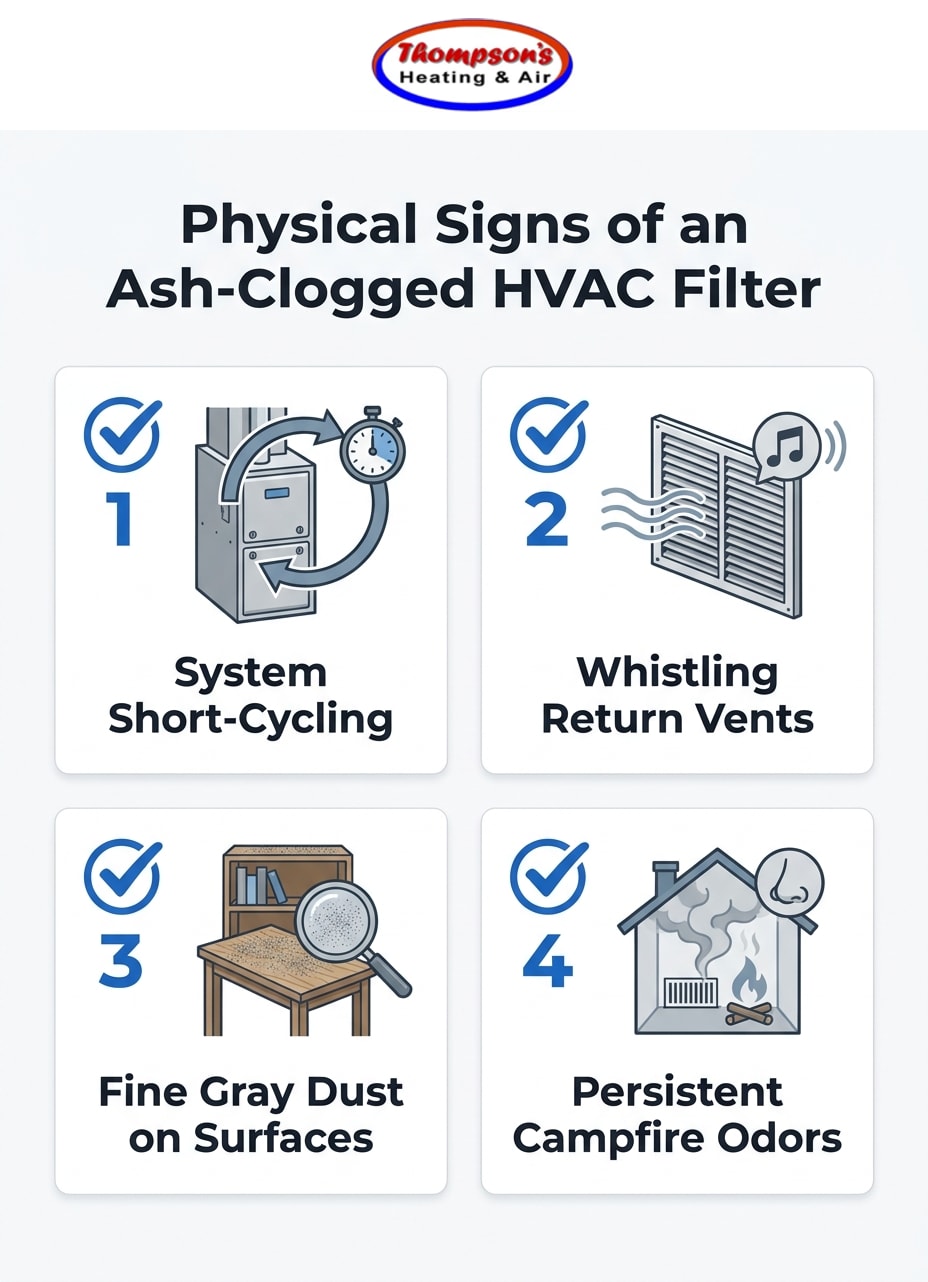
Our technicians at Thompson's Heating & Air have firsthand experience pulling completely caked, dark gray filters from local Woodland homes after fire season. We consistently see the same patterns of airflow restriction and system strain. If you suspect your home was exposed to heavy smoke, look for these four physical symptoms that indicate a filter is completely overwhelmed.
1. System Short-Cycling: Your furnace or AC turns on, runs for only a few minutes, and shuts off abruptly before reaching the target temperature. This happens because the clogged filter restricts airflow so severely that the system overheats, triggering a safety shutoff switch.
2. Whistling Return Vents: As the blower motor struggles to pull air through a wall of compacted ash, the increased static pressure forces air through tiny gaps around the filter frame, creating a high-pitched whistling, wheezing, or howling sound.
3. Fine Gray Dust on Surfaces: You notice a powdery, gray residue settling on your tables, countertops, and electronics just hours after you finish dusting. This means the ash has bypassed the filter entirely and is being blown directly into your living spaces.
4. Persistent Campfire Odors: A stale, acrid smoke smell circulates through the house every single time the HVAC system kicks on, even weeks after the outdoor air has cleared.
Listening for Airflow Restriction
Your HVAC system should operate with a steady, consistent hum. When you hear a whistling sound specifically coming from the large return vent (where your filter is housed), it is a cry for help from your blower motor. The motor is designed to move a specific volume of air per minute. When an ash-caked filter blocks that air, the motor ramps up its speed to compensate, straining against the restriction. This sounds like a vacuum cleaner whose hose has been blocked—a strained, high-pitched whine that indicates the motor is working dangerously hard.
Visual Inspections Around the Home
Distinguishing between normal dust bunnies and wildfire ash residue is fairly straightforward. Normal dust tends to clump together in fluffy gray balls, especially in corners or under furniture. Wildfire ash, on the other hand, is a fine, powdery film that smears when you try to wipe it with a dry cloth. Check the ceiling or wall immediately surrounding your supply vents (where the conditioned air blows out). If you see dark, sooty streaks fanning out from the vent louvers, ash is actively bypassing your filter and circulating through your ductwork.
The Dangers of Starting Your Furnace With an Ash-Coated System
Transitioning from summer cooling to fall heating brings a specific set of risks if your system is harboring summer wildfire ash. During our fall heating maintenance visits in the October post-wildfire season, we frequently see homeowners simply switch their thermostats from "cool" to "heat" on the first chilly morning without a second thought. If your system is coated in ash, this can be a costly mistake.
When your furnace ignites for the first time in autumn, the heat exchanger gets incredibly hot. If the filter is clogged with ash, the necessary airflow required to push that heat into your home is blocked. The heat exchanger will rapidly overheat, which can cause the metal to crack over time. A cracked heat exchanger is one of the most dangerous and expensive failures a furnace can experience, as it can allow carbon monoxide to leak into your home.
Furthermore, the sudden blast of heated air will dislodge settled ash from the blower compartment and ductwork. This settled particulate matter is instantly blown back into your living space, ruining your indoor air quality and aggravating allergies or asthma. The smell of burning ash can also be overwhelming, often tricking homeowners into thinking something is actively on fire inside their walls.
Starting a dirty, ash-coated system almost guarantees premature mechanical failure. The extra strain on the blower motor, combined with the insulating effect of the ash paste on internal sensors, forces the system to operate outside of its safe design limits. If you suspect your system is compromised, investing in professional indoor air quality testing can reveal exactly how much particulate matter is actively circulating through your home.
Filter Swap vs. Professional Cleaning: Knowing the Boundary
When dealing with smoke infiltration, our team always reminds Woodland homeowners that they need to know exactly what they can safely handle themselves and when they must call a licensed professional. Pushing past the boundary of DIY maintenance can result in permanently damaged equipment.
The DIY Boundary: You can and should safely remove and inspect your current filter. Turn your thermostat to the "off" position, slide the filter out, and hold it up to a light source. If you cannot see any light shining through the pleats, or if the filter is heavy and caked in dark gray powder, it goes straight into the trash. Do not attempt to vacuum or wash a disposable filter—you will only push the microscopic particles deeper into the fibers.
When to Upgrade Your Filter
Standard fiberglass filters (often blue or green) are completely ineffective against smoke. To capture PM2.5, you need to upgrade to a pleated filter with a MERV 11 to 13 rating. This specific rating is the sweet spot for residential systems. It is dense enough to trap microscopic ash and smoke particles, but not so restrictive that it chokes the airflow to your blower motor. Going higher than MERV 13 can actually cause the same airflow restrictions as a clogged filter, so stick to this recommended range unless a professional advises otherwise.
When to Call a Professional
If you pull your filter and notice a heavy layer of dark ash sitting inside the actual blower compartment, or if you see soot streaking out of your ceiling vents, the ash has bypassed the filter. This is the hard boundary where you must stop and call an expert.
Never attempt to vacuum out your blower motor, circuit boards, or evaporator coils yourself. The fins on an evaporator coil are as thin as paper and easily crushed by a vacuum attachment. Furthermore, the cement-like ash paste requires specialized, non-corrosive chemical cleaners to dissolve safely without destroying the copper tubing. A professional fall heating maintenance visit involves safely dismantling the blower assembly, applying the correct coil-cleaning solutions, and restoring the system to factory-safe specifications before the furnace is fired up.
Frequently Asked Questions About Wildfire Smoke and HVAC Systems
Can wildfire smoke ruin an HVAC unit?
Yes, heavy wildfire smoke can severely damage an HVAC unit if left unaddressed. The microscopic ash bypasses cheap filters, coats the blower motor, and mixes with moisture to form a hardened paste on the evaporator coils. This restricts airflow, causes the system to overheat, and can lead to premature motor failure or cracked heat exchangers.
How do I know if my AC filter is clogged with ash?
The most obvious physical signs are short-cycling (the unit turns on and off rapidly) and a high-pitched whistling sound coming from the return vent. You may also notice a persistent campfire smell when the system runs, or find a fine, powdery gray dust settling on your furniture shortly after you clean.
How often should I change my filter during fire season?
During active fire season with heavy smoke, you should check your filter every two to three weeks. While a high-quality pleated filter normally lasts up to 90 days, dense wildfire ash can completely clog a brand-new filter in a matter of weeks, requiring immediate replacement to protect your system.
What happens if ash gets into your ductwork?
When ash gets into your ductwork, it settles inside the metallic runs and continually recirculates into your living space every time the fan kicks on. This ruins your indoor air quality and coats your home in fine soot. Removing it requires specialized professional duct cleaning, as standard household vacuums cannot reach deep into the system.
Will running the fan help clear smoke from the house?
Running the fan will only help clear smoke if you have a high-quality MERV 11 to 13 filter installed. If you have a basic fiberglass filter, running the fan will simply pull the smoke from outside, push it through the useless filter, and circulate the toxic air faster throughout your home.
Protect Your Home's Air Quality Before Heating Season Begins
Catching an ash clog early is the single best way to protect your heating and cooling equipment from permanent damage. A clean, well-maintained system operates more safely, uses less energy, and ensures the air your family breathes is free of abrasive particulate matter. If you live in a smoke-prone area, evaluating your filtration setup is not just a seasonal chore—it is a necessity for your home's health.
If you have noticed any of the warning signs your hvac filter is clogged with ash, do not wait for the first freezing night to find out your furnace is struggling. Schedule a professional fall inspection with Thompson's Heating & Air today to clear out the summer soot, and explore advanced air filtration systems designed specifically to handle heavy particulate loads before heating season officially begins. (Note: Qualifying high-efficiency HVAC or heat pump upgrades may even be eligible for federal tax credits or local utility incentive programs, so it is a great time to evaluate your options with a tax professional or utility provider.)