
Will Running Your HVAC Fan Reduce Humidity? (And Other Fall HVAC FAQs)

Why Is There a Burning Smell When I Turn On My Heater?
Why does your house suddenly smell like a dusty campfire the moment you turn on the heat for the first time? When the first cold morning in October arrives here in Woodland, one of the most common homeowner questions answered by our team at Thompson's Heating & Air is whether that alarming burning odor means the house is in danger. The short answer is that, in our experience, this is a completely normal mechanical process. Throughout the long, dry summer months, your heating system sits completely dormant. During this extended downtime, microscopic household dust, pet dander, and airborne particles settle on the internal components of your furnace, particularly the heat exchanger and the heating elements.
When you finally switch your thermostat to "heat," those internal components rapidly heat up, often reaching temperatures well over 400 degrees Fahrenheit in a matter of seconds. This intense heat instantly incinerates the layer of settled dust, creating a distinct burning odor that is pushed through your ductwork and out of your vents. While the smell can be highly unsettling, it is simply the system clearing itself off. Understanding this process is a critical part of managing your indoor air quality during the seasonal transition, as proper fall preparation involves managing both heating quirks and indoor moisture levels.
However, knowing exactly what to expect from this dust burn-off is essential. While a brief dusty odor is harmless, persistent or chemical smells point to entirely different mechanical issues that require a different response from our technicians.
How Long Should the Heater Burning Smell Last?
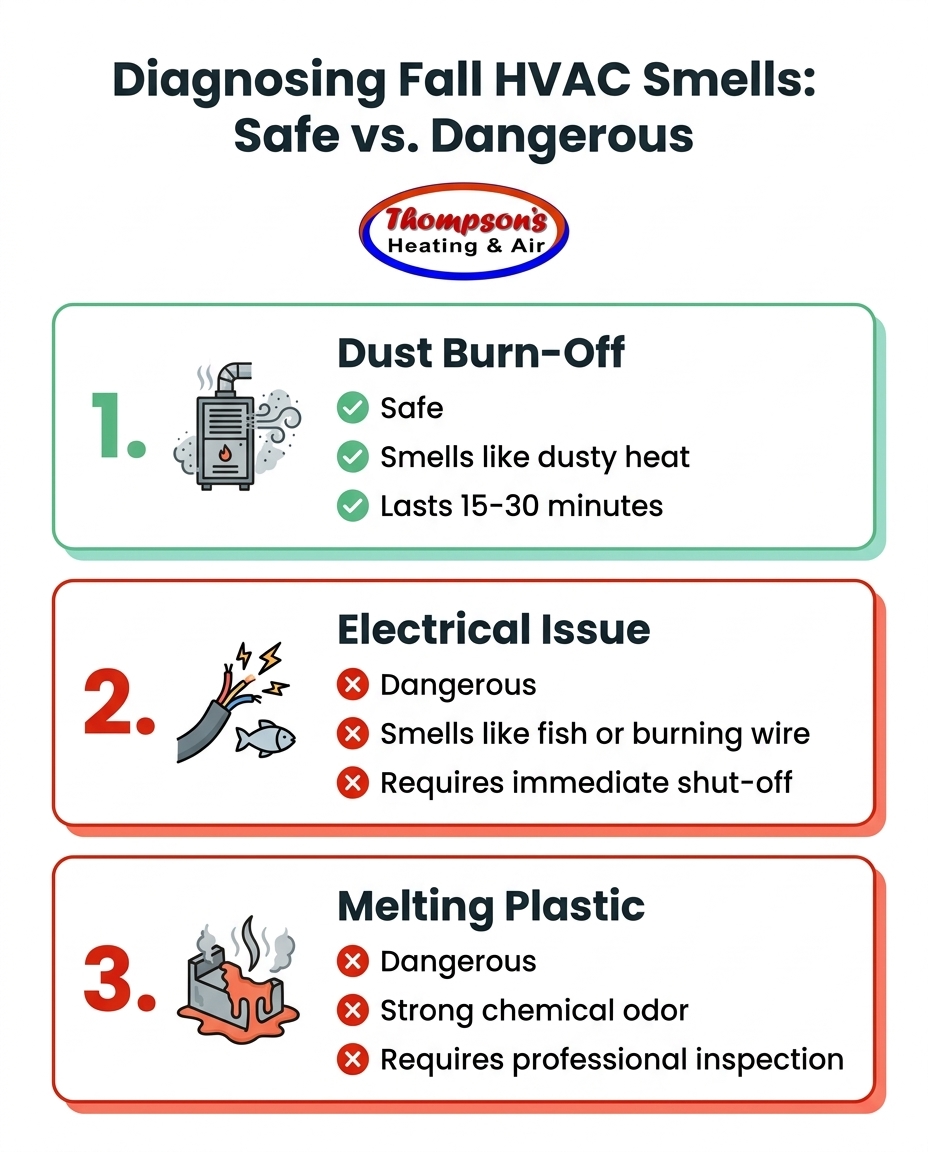
When dealing with a sudden odor from your vents, knowing the exact diagnostic timeline empowers you to evaluate the situation safely without immediately defaulting to panic. In our years serving Woodland homeowners, the standard benchmark we give for harmless dust burn-off is 15 to 30 minutes of odor duration. If your system is functioning correctly, the incinerated dust will clear out of the ductwork within this brief window, and the smell will steadily dissipate until it is completely gone.
Rather than shutting the system down in a panic the moment you smell dust, we recommend monitoring the situation closely. Opening a few windows to provide good cross-ventilation during this initial startup phase can help clear the air faster and prevent the odor from lingering in your living spaces. By providing honest, panic-free diagnostic thresholds, we hope to help homeowners confidently distinguish between a normal seasonal startup and a genuine emergency.
The 15 to 30-Minute Safe Window
If the smell dissipates within 15 to 30 minutes, your system is operating normally, and no further action is required. However, the intensity of this initial odor is directly tied to how much dust has accumulated inside the unit. Systems that have been neglected will produce a much stronger, longer-lasting smell. This is why our technicians stress that proactive heating maintenance is so critical before the cold weather sets in. A thorough cleaning of the heat exchanger and internal cabinet drastically reduces start-up odors and ensures the system operates safely and efficiently.
• 0 - 5 Minutes — Expected Odor Status: Strongest dusty burning smell — Recommended Action: Monitor system, open windows for ventilation.
• 15 Minutes — Expected Odor Status: Smell should be fading noticeably — Recommended Action: Continue monitoring, check airflow at vents.
• 30 Minutes — Expected Odor Status: Odor should be completely gone — Recommended Action: Close windows, resume normal operation.
• 60+ Minutes — Expected Odor Status: Smell persists or worsens — Recommended Action: Turn off the system at the thermostat and call a professional.
Will Running Your HVAC Fan Reduce Humidity During Fall Cooling?
Another frequent concern our team addresses during the fall transition is managing indoor moisture. Many homeowners mistakenly believe that keeping the air circulating constantly will dry out the house. So, will running your HVAC fan continuously reduce humidity? No, running the fan continuously often increases indoor humidity significantly. To understand why, you have to look at the difference between the "ON" and "AUTO" thermostat settings.
When your thermostat fan is set to "AUTO," the blower motor only runs when the compressor is actively cooling the air. Once the desired temperature is reached, both the compressor and the fan shut off simultaneously. This synchronized shutdown is crucial because it allows the moisture that the system just pulled out of the air to properly drain away into the condensate pan and out of your home.
Conversely, when you switch the fan to the "ON" position, the blower motor runs 24/7, regardless of whether the air conditioner is actively cooling. While this provides constant air circulation, it completely disrupts the mechanical physics of moisture removal. If you want to dive deeper into this specific mechanical quirk, understanding how running your AC fan continuously affects humidity is essential for maintaining a comfortable home during the unpredictable fall months.
The Evaporator Coil Effect: Why the 'ON' Setting Increases Moisture
To truly grasp why the "ON" setting acts like a humidifier, we have to examine the physics of the evaporator coil. During an active cooling cycle, warm indoor air is blown over the freezing cold evaporator coil. As this happens, condensation forms on the metal fins of the coil—exactly like water droplets forming on the outside of a cold glass of iced tea on a hot day. This condensation drips down into a drain pan and is channeled outside, effectively dehumidifying your home.
The problem with constant airflow: When the cooling cycle ends and the compressor turns off, the evaporator coil is still soaking wet. If your fan is set to "ON," it continues blowing warm indoor air over that wet coil. Instead of allowing the water to drain away, the constant stream of air acts like a blow dryer, re-evaporating up to 30% of that extracted moisture right back into your living space.
How Moisture Re-Evaporation Works
1. Extraction: The AC runs, pulling moisture out of the air and depositing it onto the cold evaporator coil.
2. Saturation: The cooling cycle ends, leaving the coil wet with condensation.
3. Re-evaporation: The fan continues running (because it is set to "ON"), blowing air over the wet coil.
4. Redistribution: The moisture evaporates back into the airflow and is pushed through the ductwork, raising the indoor humidity level.
Managing moisture correctly requires the right settings and the right equipment. If your home struggles with persistent humidity or stale air, relying on incorrect fan settings will only worsen the problem. Instead, our team frequently installs dedicated air purification systems or whole-home dehumidifiers to manage moisture and air quality without fighting against your HVAC system's natural cooling cycles.
Managing Sacramento Valley Fall Temperature Swings
Navigating the transition between heating and cooling is particularly challenging given the specific climate conditions of Woodland and the greater Sacramento Valley. As local HVAC professionals, we know that mid-fall weather in this region is notorious for wide daily temperature swings. It is incredibly common to wake up to a chilly 45-degree morning that requires the furnace, only to face a hot, sunny 85-degree afternoon that demands air conditioning.
Switching back and forth between heat and AC in a single day stresses your HVAC system and affects indoor humidity differently. Heating the air lowers the relative humidity, making the house feel dry, while running the AC later in the day pulls out even more moisture. Managing these extremes efficiently requires a strategic approach to your thermostat and your system maintenance.
• Utilize programmable schedules: Set your thermostat to heat only during the early morning hours, allowing the house to naturally warm up with the sun before the AC kicks in during the afternoon.
• Keep the fan on AUTO: Ensure your fan is set to AUTO so that the afternoon cooling cycles can properly drain away any moisture without re-evaporating it into the home.
• Check your air filters: Switching between heating and cooling moves a lot of air. A clogged filter will strain the blower motor and exacerbate any start-up burning smells.
• Don't skip the final cooling check: Before your air conditioner goes completely dormant for the winter, ensure it is properly serviced. Scheduling AC maintenance in Woodland ensures the coils are clean and the condensate drain is clear, preventing mold growth during the winter months.
When Should You Call a Professional for HVAC Odors?
While a brief dusty smell on the first cold morning in October is expected, other odors are clear danger signs that indicate a burning smell is NOT normal dust burn-off. Knowing the difference between a harmless nuisance and a severe hazard is critical for home safety.
If you smell melting plastic, rubber, or a sharp electrical burning odor (often described to our dispatchers as smelling like fish or burning wires), this is an immediate red flag. These odors indicate that wiring is overheating, a motor is seizing, or a critical electrical component is failing. Unlike dust burn-off, electrical smells will not dissipate over time; they will grow stronger and potentially lead to a fire hazard.
The golden rule for hazardous odors: If you detect a chemical, electrical, or plastic burning smell, turn off the system immediately at the thermostat. Do not wait 15 to 30 minutes to see if it clears. Furthermore, never attempt to open the furnace cabinet to diagnose electrical or combustion issues yourself. Diagnosing failing blower motors, cracked heat exchangers, or frayed wiring requires specialized tools and a licensed professional to ensure the system is safe to operate.
Frequently Asked Questions About Fall HVAC Transitions
Why does my heater smell like burning when I turn it on?
A burning smell when turning on the heater is usually caused by the sudden incineration of dust that has settled on the heat exchanger during the summer. Because the internal heating components reach over 400 degrees Fahrenheit, this dust burns off instantly. This is a normal mechanical process and generally nothing to worry about as long as the smell is brief.
How long does the heater burning smell last?
The normal dust burn-off smell should last between 15 and 30 minutes after you first turn on the heating system. If the system is particularly dusty, it might take slightly longer, but the odor should steadily decrease in intensity. If the smell persists for more than an hour, you should shut the system down and contact a professional.
Is it normal for a heater to smell like burning?
Yes, it is entirely normal for a heater to produce a dusty, burning odor the very first time it is used in the fall. However, it is not normal if the smell resembles melting plastic, burning rubber, or electrical wires. If you detect any chemical or electrical odors, turn the unit off immediately.
Does leaving the AC fan on increase humidity?
Yes, leaving the AC fan in the "ON" position can significantly increase indoor humidity. When the fan runs continuously, it blows warm air over the wet evaporator coil even after the cooling cycle has ended. This process re-evaporates the moisture that was just removed from the air and pushes it back into your living space.
Should I leave my AC fan on ON or AUTO?
For the best humidity control and energy efficiency, our team recommends leaving your AC fan on the "AUTO" setting. The AUTO setting ensures the fan only runs when the compressor is actively cooling, allowing condensation to properly drain away from the indoor coil between cycles. The "ON" setting should only be used temporarily if you need to quickly filter or circulate stagnant air.
Can a clogged air filter cause a burning smell?
Yes, a severely clogged air filter can restrict airflow so much that the blower motor overheats, leading to an electrical burning smell. Additionally, restricted airflow can cause the heat exchanger itself to run too hot, intensifying odors. Replacing your air filter before the first fall startup is one of the easiest ways to prevent these issues.
How can I reduce humidity in my home during the fall?
To reduce humidity during the fall, ensure your thermostat fan is set to AUTO, utilize exhaust fans in the kitchen and bathrooms, and ensure your AC condensate drain is clear. Because fall weather often features mild temperatures where the AC doesn't run long enough to naturally dehumidify the air, installing a dedicated whole-home dehumidifier is a solution we frequently recommend for persistent moisture issues.
Ensure a Safe and Comfortable Fall Season
Understanding your system's normal behaviors—from the brief 15 to 30-minute dust burn-off to the importance of the AUTO fan setting—prevents unnecessary panic and keeps your home comfortable. Having these common homeowner questions answered empowers you to operate your system safely. If you ever experience lingering odors, chemical smells, or persistent humidity issues, reach out to Thompson's Heating & Air to schedule a professional inspection to definitively rule out hazards and ensure your equipment is ready for the winter ahead.



.avif)
.avif)
.png)
