
Transitioning Your Heat Pump for Fall: Managing October's 40-Degree Temperature Swings

Why Does Your Heat Pump Struggle When Autumn Arrives?
Have you recently woken up to a surprisingly chilly house, wondering if transitioning your heat pump for fall has somehow broken your system? You check the vents, and instead of a robust blast of warm air, you feel a lukewarm breeze that leaves you reaching for a sweater. This is a common scenario during the October shoulder season, a time of year that often reveals hidden mechanical stresses within your HVAC equipment.
Unlike a traditional gas furnace that simply ignites a burner to create heat, your heat pump operates by moving thermal energy from one place to another. During the summer, it absorbs heat from inside your home and pumps it outside. When autumn arrives, the entire physical process must reverse. This mechanical reversal is not instantaneous, and the delay can easily mimic a system failure to an untrained ear.
As a homeowner, this leaves you facing a distinct decision point: do you need to call for an emergency repair, do you simply need to adjust your daily thermostat habits, or is it time to schedule routine pre-winter maintenance? The answer usually lies in understanding the difference between a normal operational delay and an actual mechanical malfunction. By taking the time to learn how your heat pump systems operate during these transitional months, you can avoid unnecessary panic and keep your home comfortable as the weather shifts.
The Mechanics of Transitioning a Heat Pump for Fall
To understand why your system behaves differently in the autumn, you have to look at the internal components responsible for heating your home. The most critical part of this process is the reversing valve. This heavy-duty brass component is the literal intersection where the flow of pressurized refrigerant changes direction.
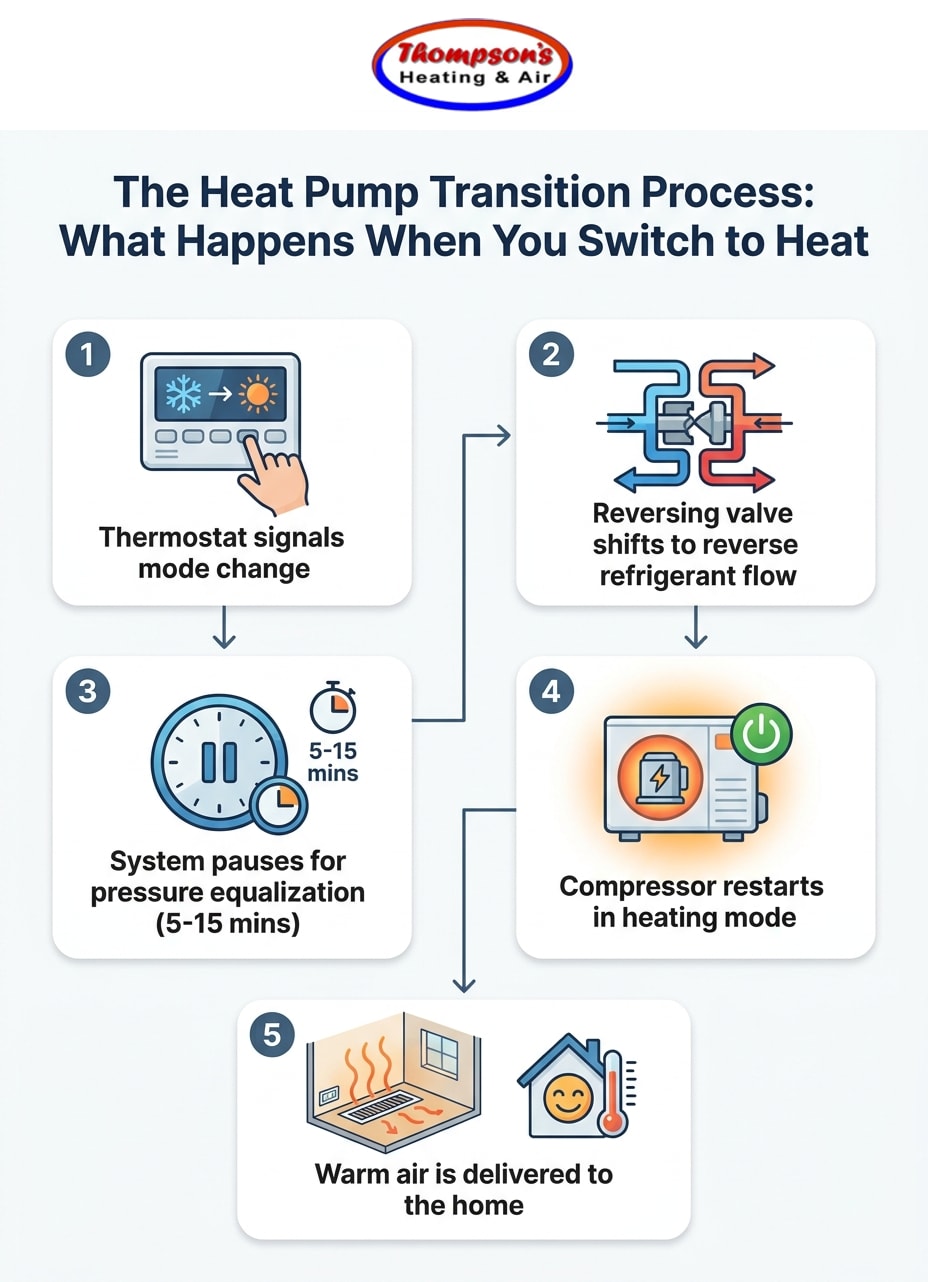
When your thermostat calls for heat after a long season of cooling, it sends an electrical signal to a solenoid on the reversing valve. The solenoid shifts a sliding mechanism inside the valve, rerouting the hot, high-pressure refrigerant vapor toward your indoor coil instead of the outdoor coil. Because the system operates under intense pressure, this shift cannot happen while the compressor is running at full speed. The system must pause, allow the internal pressures to equalize, and then safely restart in the opposite mode.
This equalization process naturally takes several minutes. If you are experiencing a 40-degree daily temperature swing, your system might be making this transition multiple times a week, or even multiple times a day. While it might feel like a frustrating delay when you are cold, this pause means the internal safety mechanisms are working exactly as designed. Once you understand this, the brief wait for warm air becomes much less alarming.
What Happens Inside the Unit During a Mode Switch?
• Refrigerant flow reversal: The thermostat energizes or de-energizes the reversing valve solenoid, physically changing the path of the chemical refrigerant.
• Pressure equalization period: The compressor temporarily shuts down so the high-side and low-side pressures can balance out, preventing extreme mechanical shock to the motor.
• The normal delay: Homeowners typically experience a 5 to 15-minute wait before the compressor restarts and warm air is reliably felt at the indoor vents.
If you suspect this transition is taking longer than fifteen minutes, or if the system seems to struggle to complete the cycle, it is usually a sign that you need professional heat pump maintenance to ensure the valve is shifting smoothly.
How Dramatic Day-to-Night Temperature Shifts Stress Your System
The mechanical stress of switching modes is magnified significantly by the specific climate of the Sacramento Valley. In many parts of the country, the transition from summer to winter is a slow, gradual decline in temperature. Here, early autumn weather is characterized by extreme diurnal temperature shifts. It is incredibly common to experience an 85°F afternoon that rapidly drops to a 45°F night.
These intense environmental changes force your HVAC equipment to run both a full cooling cycle and a full heating cycle within a single 24-hour period. When the afternoon sun beats down on your home, the system works hard to remove the heat. Just a few hours later, as the sun sets and the ambient temperature plummets, the thermal load of your house reverses completely. The system must suddenly switch gears to add heat back into the living space.
This rapid load change puts immense mechanical stress on the compressor, the electrical contactors, and the reversing valve. The constant expansion and contraction of metal parts, combined with the shifting of high-pressure fluids, accelerates normal wear and tear. However, high-quality heat pumps are specifically engineered to handle this exact type of workload.
As local climate experts serving Woodland CA and the surrounding areas, Thompson's Heating & Air understands the unique demands of Sacramento Valley weather. We provide honest advice to homeowners who might mistake this heavy seasonal workload for a broken unit. While the stress on the equipment is real, a well-maintained system will manage these daily swings without leaving you in the cold.
Normal Transition Delays vs. True Reversing Valve Malfunctions
Because the October shoulder season forces your equipment to change modes so frequently, it is the most common time of year for a failing reversing valve to finally get stuck. Telling the difference between a normal operational delay and a true mechanical failure can save you from a freezing night or an unnecessary emergency service fee.
When a heat pump is functioning normally, you might hear a distinct "whoosh" sound from the outdoor unit as the reversing valve shifts. This is the sound of pressurized refrigerant rapidly changing direction. Following this sound, the outdoor fan will temporarily stop, and you will experience the normal 5 to 15-minute delay before warm air arrives. During this short window, the air coming from your vents might feel lukewarm or even slightly cool as the indoor coil comes up to temperature.
Conversely, a malfunctioning reversing valve presents entirely different symptoms. If the internal slide gets stuck halfway, the refrigerant bypasses the compressor incorrectly. You might hear a continuous, loud hissing sound that never resolves into a normal operating hum. More noticeably, the system will run endlessly without ever producing warm air, and in severe cases, the outdoor unit may begin to build up a thick layer of solid ice because the defrost cycle is compromised.
• Air Temperature — Normal Transition Behavior: Briefly lukewarm, turning warm within 15 minutes. — Reversing Valve Malfunction: Continuously blows cold air while in heating mode.
• System Noises — Normal Transition Behavior: A single "whoosh" followed by a quiet pause, then a steady hum. — Reversing Valve Malfunction: Continuous loud hissing, grinding, or buzzing from the outdoor unit.
• Outdoor Unit Status — Normal Transition Behavior: Fan stops briefly, then resumes normal spinning. — Reversing Valve Malfunction: Unit may freeze over completely with solid white ice.
• Delay Length — Normal Transition Behavior: 5 to 15 minutes maximum. — Reversing Valve Malfunction: System runs for hours without ever heating the home.
The quick fix: If you suspect a malfunction, turn the thermostat off completely and wait 30 minutes before trying again. If the system still refuses to produce heat, leave it off to prevent compressor damage. Never attempt to test the reversing valve, manually unstick it, or check the refrigerant levels yourself. These diagnostic steps require specialized gauges and a licensed professional.
Smart Thermostat Strategies to Prevent Short-Cycling
How you manage your thermostat during a 40-degree daily temperature swing plays a massive role in how well your equipment survives the autumn. Many homeowners unknowingly damage their systems by constantly walking past the thermostat and manually toggling it from "Cool" to "Heat" and back again as the daily temperature fluctuates.
This rapid manual switching forces the system to stop and start abruptly. When a heat pump is forced to turn on and off in rapid succession without completing a full cycle, it is known as "short-cycling." Short-cycling prevents the compressor oils from circulating properly, draws excessive electrical current, and dramatically shortens the lifespan of the equipment.
To protect your system, it is highly recommended to use the "Auto" setting on your thermostat, but you must configure it correctly. The Auto setting allows the thermostat to automatically switch between heating and cooling based on the room temperature, removing the need for manual adjustments.
Setting the Ideal 'Deadband' for Autumn
1. Understand the deadband: The deadband is the mandatory temperature gap between your heating setpoint and your cooling setpoint. If this gap is too narrow, the system will fight itself all day.
2. Widen the gap: Keep at least a 3 to 5-degree difference between your heating and cooling targets. For example, set the cooling to activate at 76°F and the heating to activate at 68°F.
3. Allow natural cooling: Let the house naturally cool off in the evening as the sun goes down before the heat kicks on. A wider deadband prevents the system from switching to AC at 4:00 PM and immediately switching to heat at 6:00 PM.
4. Set realistic targets: Accommodate the natural thermal rhythm of your house. Expecting a perfectly flat 72°F all day and night during extreme weather shifts forces the equipment to run non-stop.
Essential Pre-Winter Preparation for Your HVAC System
Transitioning from daily thermostat management to long-term seasonal readiness is the best way to protect your investment. Before the deep winter freezes arrive in Woodland, CA, there are several essential maintenance steps that must be completed to ensure your heat pump operates at peak efficiency.
Airflow is the lifeblood of a heat pump. Because these systems rely on absorbing and transferring heat from the ambient air, any restriction in airflow drastically alters the internal pressure of the refrigerant. When pressures are skewed by poor airflow, the reversing valve struggles to shift, and the compressor has to work twice as hard to achieve the same result.
Taking a proactive approach to heating maintenance prevents minor airflow issues from escalating into complete system breakdowns during the first real freeze of the year. While a professional inspection is mandatory for the internal components, there are several things you can do right now to prepare the system.
• Clear the perimeter: Walk around your outdoor unit and remove any fallen autumn leaves, tall grass, or wind-blown debris. The unit needs a minimum of two feet of clear space on all sides to pull in enough air for the heating cycle.
• Replace indoor filters: A clogged indoor air filter chokes the blower motor and prevents warm air from reaching your living spaces. Change your filter at the start of the season, and check it every 30 days thereafter.
• Schedule a professional inspection: A licensed technician will test the defrost sensors, calibrate the thermostat, and manually verify that the reversing valve is shifting smoothly under load.
• Clean the coils: Summer dust and pollen insulate the outdoor coil, making it harder for the system to absorb ambient heat. A professional cleaning restores this heat transfer capability.
Frequently Asked Questions About Fall Heat Pump Transitions
During the rapid weather shifts of autumn, it is entirely normal to have questions about how your equipment is behaving. Whether you are managing a 40-degree daily temperature swing or wondering when your system will utilize heat pump auxiliary heat, understanding the basics can provide immediate peace of mind.
Is it bad to switch from AC to heat in the same day?
No, it is not inherently bad to switch from AC to heat in the same day, provided the system is given time to rest between cycles. Heat pumps are designed to switch modes, but you should allow at least a 5 to 10-minute pause between a cooling cycle and a heating cycle to let the internal refrigerant pressures equalize. Using the "Auto" setting on your thermostat with a proper 3 to 5-degree deadband handles this timing automatically and safely.
Why does my heat pump take so long to switch to heat?
Your heat pump takes a long time to switch to heat because the reversing valve must physically reroute the flow of highly pressurized refrigerant. Before the compressor can safely restart in the opposite direction, the system mandates a built-in delay to prevent mechanical damage to the motor. A wait time of 5 to 15 minutes is completely normal and indicates that your system's safety controls are functioning properly.
Why is my heat pump blowing cold air in the fall?
A heat pump blowing cold air in the fall is usually caused by the system temporarily entering its defrost cycle or a delay in the indoor coil warming up. When the unit first switches to heat, the air in the ductwork is still ambient temperature, which feels cool against your skin. However, if it blows cold air continuously for more than 20 minutes, you likely have a stuck reversing valve or a refrigerant leak that requires a professional.
At what temperature should I switch my heat pump to heat?
You should switch your heat pump to heat when the indoor temperature of your home drops below your personal comfort level, typically around 68°F. There is no specific outdoor temperature that dictates when you must switch modes, as your home's insulation and sunlight exposure dictate your indoor climate. Rely on how the house feels rather than staring at the outdoor thermometer.
How do I prepare my heat pump for winter?
You prepare your heat pump for winter by clearing all autumn debris from the outdoor unit, replacing your indoor air filters, and scheduling a professional pre-winter inspection. A technician needs to verify that the reversing valve operates smoothly, the defrost control board is functioning, and the refrigerant charge is exact. Early preparation prevents the system from failing during the first major frost.
Can extreme day-to-night temperature swings damage my heat pump?
Extreme day-to-night temperature swings will not immediately damage a well-maintained heat pump, but they do accelerate normal mechanical wear and tear. Running cooling and heating cycles back-to-back puts heavy daily mileage on the compressor and electrical contactors. Staying rigorous with your seasonal maintenance is the best way to ensure the system handles these daily swings without breaking down prematurely.
Ensuring Reliable Comfort Through Every Temperature Shift
Navigating the unpredictable weather of the October shoulder season doesn't have to be a source of constant anxiety. Understanding how your equipment physically transitions from cooling to heating brings immediate peace of mind when the unit pauses or makes unfamiliar noises during a rapid evening temperature drop. Those brief delays are simply the system protecting itself as it gears up to keep you warm.
Ultimately, proper thermostat management and professional oversight are the true keys to extending your equipment's lifespan. By setting a realistic deadband and keeping the outdoor unit clear of autumn debris, you reduce the mechanical burden on the compressor. If you notice persistent cold air or strange hissing sounds, don't wait for a total breakdown. Reach out to a professional to learn more about seasonal maintenance options, ensuring you receive a clear explanation of your system's health and reliable comfort all winter long.