
Why Your Heat Pump Runs Constantly Below 35 Degrees: The Balance Point Explained

The Chill of Late Fall: Is Your Heat Pump Struggling or Just Doing Its Job?
The first sharp freeze of the season is just around the corner, and if you are staring at your thermostat wondering why the system won't shut off, having the heat pump balance point explained can save you a lot of unnecessary worry. Here in Woodland, as overnight temperatures begin to plummet during November pre-winter cold snaps, our team at Thompson's Heating & Air frequently receives calls from homeowners noticing a distinct change in how their heating equipment behaves. The outdoor unit seems to run continuously, the air coming from the vents might feel slightly cooler than it did in October, and the "auxiliary heat" indicator may suddenly illuminate on the thermostat.
This behavior immediately raises a critical decision point for homeowners: is the continuous operation a normal seasonal transition, or is it a sign of a mechanical failure that requires professional attention before deep winter sets in? For most residential systems, running constantly as the temperature drops toward freezing is actually a sign that the equipment is functioning exactly as engineered. The key to understanding this shift in performance lies in a fundamental HVAC concept known as the balance point.
Before you panic about a failing compressor or a broken thermostat, it helps to understand the baseline mechanics of your heating equipment. By learning how heat pump systems operate under stress, you can confidently distinguish between normal cold-weather operation and a genuine system malfunction.
What is a Heat Pump Balance Point?
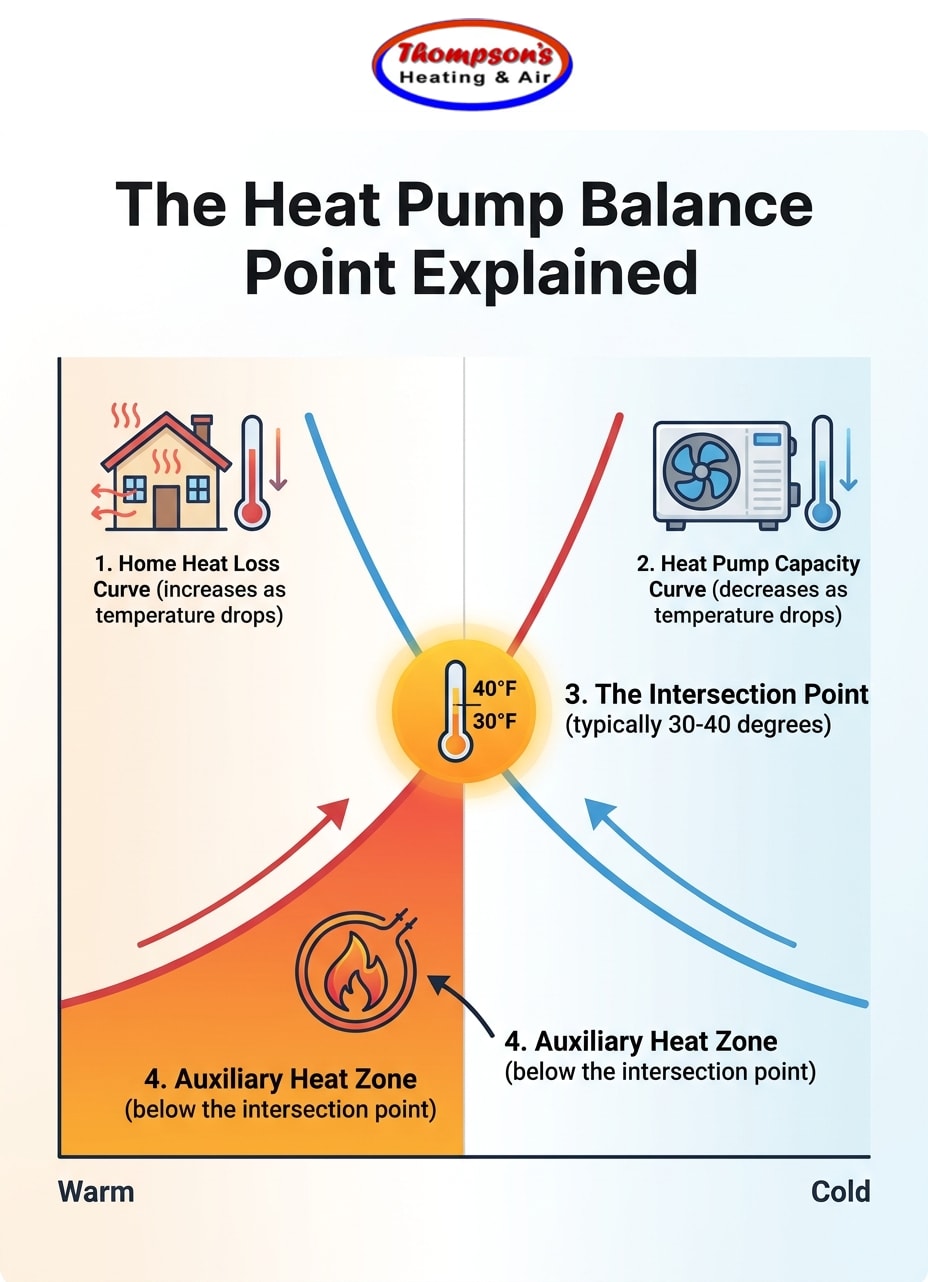
To grasp why your system runs non-stop on chilly nights, we first need to define the thermal balance point. In the simplest terms, the thermal balance point is the precise outdoor temperature at which your heat pump's maximum heating capacity exactly matches the amount of heat your home is losing to the outdoors. When the temperature drops below this specific threshold, the heat pump alone can no longer keep up with the heat loss, and the system must rely on a secondary heat source to maintain your indoor comfort.
Understanding this requires a quick look at how the equipment actually generates warmth. Unlike a traditional gas furnace that creates heat by burning fuel, a heat pump moves heat from one place to another. Even when it feels freezing outside, the ambient air still contains thermal energy. The system uses compressed refrigerant to absorb this outdoor thermal energy, compress it to increase its temperature, and transfer it inside your home.
The Physics of Extracting Heat from Cold Air
As the outdoor air gets colder, there is simply less ambient thermal energy available to extract. Consequently, the system has to work significantly harder and run much longer to harvest the same amount of warmth. The system's heating capacity steadily decreases on a sliding scale as the outdoor temperature drops. Eventually, the temperature outside reaches a critical threshold—most commonly around 35 degrees Fahrenheit for standard residential units.
At 35 degrees Fahrenheit, the system reaches an equilibrium. The amount of heat the equipment can successfully pull from the freezing outdoor air is equal to the amount of heat escaping through your home's walls, windows, and roof. If the temperature drops even one degree further, the system crosses the balance point. If you suspect your system is struggling to reach equilibrium even in mild weather, scheduling professional heat pump service can verify that the refrigerant levels and compressor are operating at peak efficiency.
The Magic Number: Why Heat Loss Surpasses Capacity at 35 Degrees
The Problem: As the outdoor temperature plummets, your home begins to lose heat at an accelerated rate, while your heating equipment simultaneously loses its ability to generate maximum warmth. This inverse relationship creates a deficit where the indoor temperature begins to drop below your thermostat setting.
The Cause: In our years of servicing homes throughout Yolo County, we've found that for the vast majority of standard residential air-source systems, the thermal balance point falls between 30 and 40 degrees, with 35 degrees Fahrenheit being the most typical "magic number." This specific threshold is highly common because of how standard single-stage compressors are manufactured and sized. HVAC systems are sized based on a Manual J load calculation, which accounts for your home's square footage, insulation quality, window types, and ceiling height. If a system is perfectly sized for your home's average cooling and heating needs, its capacity curve will naturally intersect with your home's heat loss curve right around the freezing mark.
The Solution: To bridge this gap, the system automatically activates a supplemental heating source. This ensures that even when the primary compressor can no longer keep up with the rapid heat loss, your indoor living space remains at the comfortable temperature you selected on the thermostat.
How Your Home's Heat Loss Accelerates
Think of your home as a bucket with small holes in it, and the heat pump as a hose filling that bucket with warm water. In mild weather, the "holes" (heat loss through walls and windows) are small, and the "hose" (the heat pump's capacity) is running at full pressure. The bucket stays full easily.
However, as the outdoor temperature drops to 35 degrees Fahrenheit, two things happen simultaneously:
• The holes get bigger: The greater the difference between the indoor and outdoor temperatures, the faster thermal energy escapes your home.
• The water pressure drops: The colder the outdoor air, the less heat the system can extract, reducing its output capacity.
The balance point is the exact moment the water draining out of the bucket equals the maximum amount of water the hose can supply.
Recognizing Normal System Behaviors During Cold Snaps
Translating the technical concept of the balance point into observable behaviors is crucial for homeowner peace of mind. When those November pre-winter cold snaps arrive, you will likely notice distinct changes in how your system sounds, feels, and operates. Reassure yourself that a system running almost constantly near its balance point is operating entirely by design.
Here is what you can expect to observe when your system reaches its capacity threshold:
1. Continuous Compressor Operation: The outdoor unit will run for hours at a time without cycling off. Because it is delivering a lower volume of heat, it must run continuously to maintain the indoor temperature. This does not mean the system is broken; it means it is working hard to extract every ounce of available thermal energy.
2. Activation of Auxiliary Heat: To bridge the gap between heat loss and capacity, the system will automatically engage its backup heat source. For most all-electric homes, these are auxiliary heat strips (essentially large electric resistance coils inside the air handler). You will likely see "Aux Heat" or "Emergency Heat" light up on your thermostat screen.
3. Warmer Air at the Vents: Standard heat pump air can sometimes feel lukewarm (around 90 to 95 degrees). However, when the electric resistance strips activate, the air coming from your vents will suddenly feel significantly hotter.
4. Different Operational Sounds: You may hear the click of relays in the indoor air handler as the high-voltage heat strips turn on and off to supplement the outdoor compressor.
This transition is entirely automatic. The thermostat constantly monitors the indoor temperature, and if it detects that the primary compressor is falling behind by a degree or two, it seamlessly brings on the backup heat. If you are curious about the specific mechanics of this process in Northern California, you can learn more about why auxiliary heat kicks on during Sacramento Valley frosts.
How Damp Fog and Humidity Change the Equation
While temperature is the primary factor in determining the balance point, humidity plays a massive role in how efficiently a system operates near freezing. This is particularly relevant given our local climate context. At Thompson's Heating & Air, we know firsthand how the dense winter Tule fog across the Sacramento Valley and Yolo County creates incredibly cold, damp conditions in the 30s. This specific combination of high humidity and near-freezing temperatures accelerates frost buildup on outdoor equipment.
When the outdoor coil is extracting heat from 35 degrees Fahrenheit air, the refrigerant inside the coil is actually much colder than freezing. As damp, foggy air blows across this super-chilled coil, the moisture instantly condenses and freezes, forming a layer of white frost or solid ice on the aluminum fins. A layer of ice acts as an insulator, preventing the system from absorbing heat and effectively raising the system's balance point.
The Automatic Defrost Cycle
To combat this, the system is equipped with an automatic defrost control board. When it senses too much ice buildup, it initiates a defrost cycle. Here is what happens during this normal, automated process:
• The system reverses: The reversing valve shifts, temporarily turning the system into an air conditioner. It takes heat from inside the house and sends it to the outdoor coil to melt the ice.
• The outdoor fan stops: The fan on top of the outdoor unit shuts off to allow the heat to build up rapidly and melt the frost.
• Steam appears: As the ice melts in the cold outdoor air, you may see a large plume of steam rising from the unit. This is completely normal and is not smoke.
• Auxiliary heat activates: Because the system is temporarily pulling heat out of your house to melt the outdoor ice, the thermostat automatically turns on the indoor auxiliary heat strips so you do not feel cold air blowing from your vents.
Once the ice is melted, the system seamlessly returns to normal heating mode. Because damp fog causes this cycle to happen frequently, keeping the outdoor coil clean is vital. Regular heat pump maintenance ensures that the defrost sensors and drainage pathways are clear, preventing the system from turning into a solid block of ice.
Thermal vs. Economic Balance Points Explained
While the thermal balance point is strictly about comfort and heating capacity, there is a secondary concept that affects your winter utility bills: the economic balance point. Understanding the difference between the two is crucial for homeowners looking to maximize their energy efficiency during November pre-winter cold snaps.
The economic balance point is the specific outdoor temperature at which running the electric heat pump becomes more expensive than running an alternative heat source, such as a natural gas or propane furnace. Electric resistance auxiliary heat strips require significantly more energy to operate than the heat pump's primary compressor. Therefore, relying heavily on auxiliary heat can cause a spike in energy consumption.
• Primary Focus — Thermal Balance Point: Indoor comfort and equipment heating capacity. — Economic Balance Point: Operating costs and energy efficiency.
• Trigger Condition — Thermal Balance Point: When heat loss exceeds the compressor's maximum output. — Economic Balance Point: When the cost of electricity outweighs the cost of fossil fuels.
• Typical Temperature — Thermal Balance Point: Usually between 30 and 40 degrees Fahrenheit. — Economic Balance Point: Varies widely based on local utility rates and fuel costs.
• System Action — Thermal Balance Point: Activates supplemental auxiliary heat to maintain temperature. — Economic Balance Point: Switches entirely to a secondary fuel source (in dual-fuel setups).
For homeowners concerned about the high energy draw of electric resistance strips, dual-fuel systems offer an excellent solution. A dual-fuel setup pairs an electric heat pump with a gas furnace. The system uses the highly efficient heat pump during mild weather, and when the temperature drops to the economic balance point, it shuts off the compressor entirely and switches to the gas furnace. If you are considering upgrading your equipment to manage winter costs better, exploring comprehensive home heating solutions can help you determine if a dual-fuel configuration makes sense for your property.
When to Call a Professional for Heating System Troubleshooting
While continuous operation and auxiliary heat activation at 35 degrees Fahrenheit are perfectly normal, there are times when these behaviors indicate a genuine mechanical issue. Knowing the difference between normal cold-weather operation and a failing system can prevent a minor repair from turning into a mid-winter emergency.
At Thompson's Heating & Air, we know that local climate expertise is required to properly configure the balance point for our mild-winter but highly humid Woodland microclimate, ensuring maximum efficiency without sacrificing comfort. In our years of field experience, we've seen that if the system is not configured correctly for the local environment, it may rely on expensive backup heat far too often.
Signs it is time to call an expert:
• Auxiliary heat activates in mild weather: If your "Aux Heat" indicator is on when outdoor temperatures are well above 40 degrees, the primary compressor is likely failing or low on refrigerant, forcing the system to rely entirely on backup heat.
• Unusually high energy bills: While a slight increase in energy usage is expected during cold snaps, a massive, unexplained spike in your utility bill often indicates that the system is stuck in emergency heat mode.
• The outdoor unit is encased in thick ice: While a light layer of frost is normal, a unit that looks like a solid glacier has a failing defrost control board, a bad reversing valve, or a broken fan motor.
• Short cycling: If the system turns on and off rapidly every few minutes instead of running in long, continuous cycles during cold weather, it is struggling with airflow issues or electrical faults.
• Cold air blowing during auxiliary mode: If the thermostat indicates that auxiliary heat is on, but the air from the vents feels cold, the electric heat strips or their associated relays have likely burned out.
Frequently Asked Questions About Heat Pump Cold Weather Operation
What is the balance point of a heat pump?
The balance point of a heat pump is the specific outdoor temperature—typically around 35 degrees Fahrenheit—at which the system's heating capacity exactly matches the home's heat loss. Below this temperature, the system cannot generate enough warmth on its own and requires auxiliary heat to maintain indoor comfort. It represents the exact intersection between equipment performance and structural heat loss.
Why does my heat pump run constantly below 35 degrees?
Your system runs constantly below 35 degrees because it is working at maximum capacity to extract the dwindling thermal energy from the cold outdoor air. Because its heating output decreases as temperatures drop, it must operate continuously to deliver the necessary warmth to your home. This continuous operation is a normal design feature, not a sign of a mechanical breakdown.
At what temperature does a heat pump need auxiliary heat?
Most standard residential air-source systems require auxiliary heat when outdoor temperatures drop between 30 and 40 degrees Fahrenheit. The exact temperature depends on the size of your system, the quality of your home's insulation, and the local climate conditions. During November pre-winter cold snaps, this transition frequently occurs overnight.
Is it normal for auxiliary heat to come on during a cold snap?
Yes, it is entirely normal and expected for auxiliary heat to activate during a cold snap. The backup heat strips are designed to bridge the gap when the primary compressor can no longer keep up with the rapid heat loss of your home. The thermostat handles this transition automatically to ensure your indoor living space remains comfortable.
How do you calculate a heat pump balance point?
Calculating the balance point requires plotting a home's heat loss curve (determined via a Manual J load calculation) against the manufacturer's performance data for the specific equipment model. The point where the home's heat loss (measured in BTUs) intersects with the equipment's heating capacity (also in BTUs) at a given outdoor temperature is the balance point. This calculation is typically performed by HVAC professionals during installation.
Does high humidity or fog affect my heat pump's balance point?
Yes, high humidity and dense fog can significantly impact system performance in near-freezing temperatures by accelerating frost buildup on the outdoor coil. When ice coats the coil, it acts as an insulator and reduces the system's ability to extract heat, effectively forcing the system to rely on auxiliary heat sooner than it would in dry conditions. Frequent defrost cycles are required to clear this ice.
Ensure Reliable Heating Through the Winter Months
Understanding how your system operates when the temperature drops to 35 degrees Fahrenheit provides valuable peace of mind during late fall temperature drops. Recognizing that continuous operation and the occasional use of auxiliary heat are expected behaviors allows you to trust your equipment as the seasons change. However, if you suspect your system is relying on backup heat too frequently, or if it struggles to maintain comfort during mild weather, it is wise to verify its readiness. Consider scheduling a professional tune-up with our team to ensure your equipment is correctly configured for the local climate, keeping your home warm and efficient all winter long.