
The Mechanics of Measuring Static Pressure to Diagnose Weak Airflow

That Stubbornly Hot Room: Why Scientific Airflow Diagnostics Matter
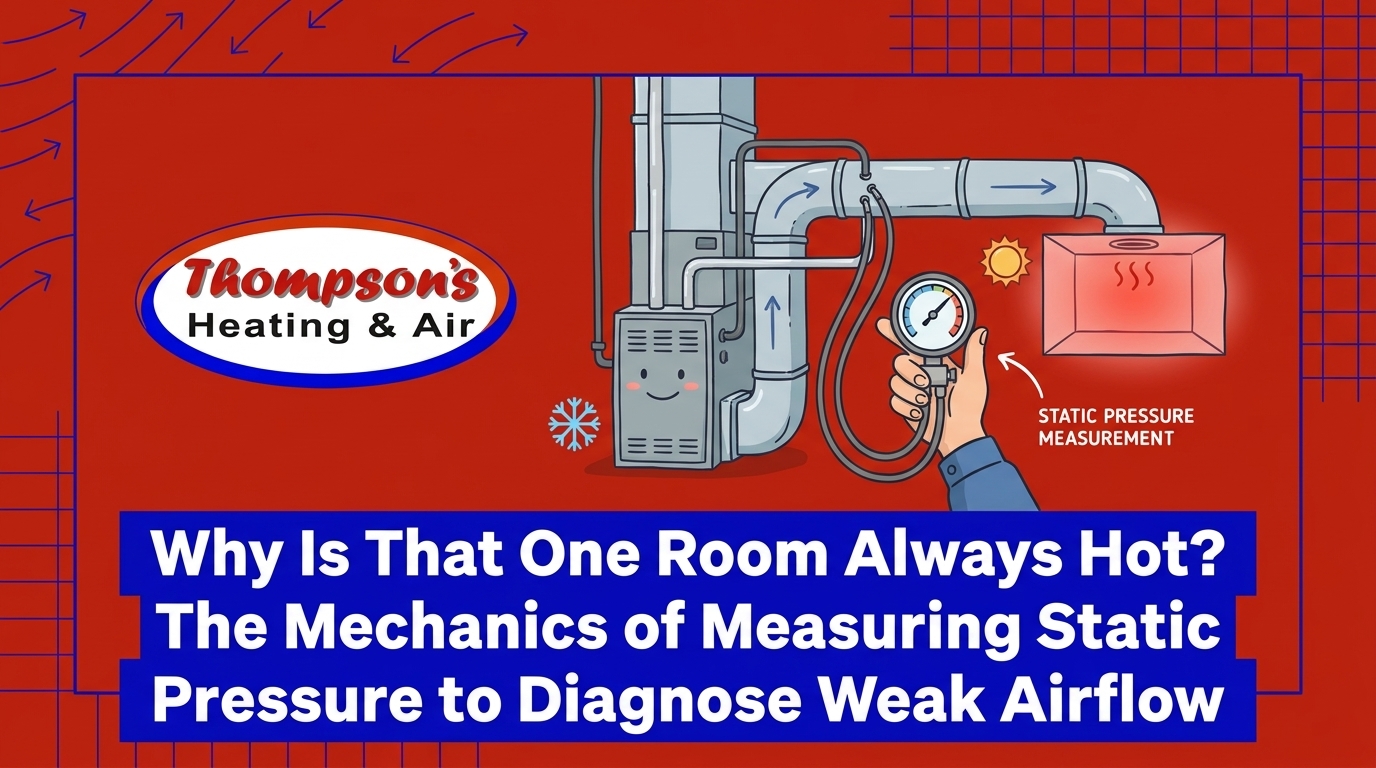
Your thermostat is set to 72 degrees, the central air is running continuously, yet that one back bedroom still feels like an absolute oven. If you are tired of sweating through the evening, understanding the mechanics of measuring static pressure to diagnose weak airflow is the key to finally solving this stubborn comfort issue. Every homeowner knows the frustration of a single room that refuses to cool down. The air conditioning unit hums along loudly, dumping freezing air into the hallway, but barely a trickle of conditioned air reaches the warmest areas of the house. During the intense August late-summer heat, this imbalance goes from a mild annoyance to a serious disruption of your daily life.
When facing weak airflow, a technician stands at a critical decision point: they can either guess the cause or use precise scientific measurements. Guessing usually involves blindly adding refrigerant or swapping out expensive components in hopes of a quick fix. However, simply throwing parts at a problem without identifying the root airflow restriction almost always fails to solve the underlying comfort issue. To truly fix the problem, professionals rely on a concept called static pressure to definitively pinpoint hidden duct or blower bottlenecks. If you are ready to stop guessing and start fixing, you need to rely on expertly designed air conditioning systems and targeted professional AC repair.
The urgency of accurate diagnostics becomes incredibly obvious when extreme weather hits. One local homeowner noticed their cooling system working poorly right as a severe heat wave approached. Because a technician arrived promptly the next day and accurately tested the airflow rather than guessing at the cause, they successfully restored the home's comfort before the extreme temperatures peaked. That is the difference between hoping for the best and measuring for success.
Taking Your HVAC System's Blood Pressure: What is TESP?
To understand why your back bedroom is starving for air, you first need to understand Total External Static Pressure (TESP). In simple terms, TESP is the measurement of resistance to airflow within your heating and cooling system. Every piece of ductwork, every filter, and every register creates a certain amount of friction that the blower motor must overcome to push air through the house.
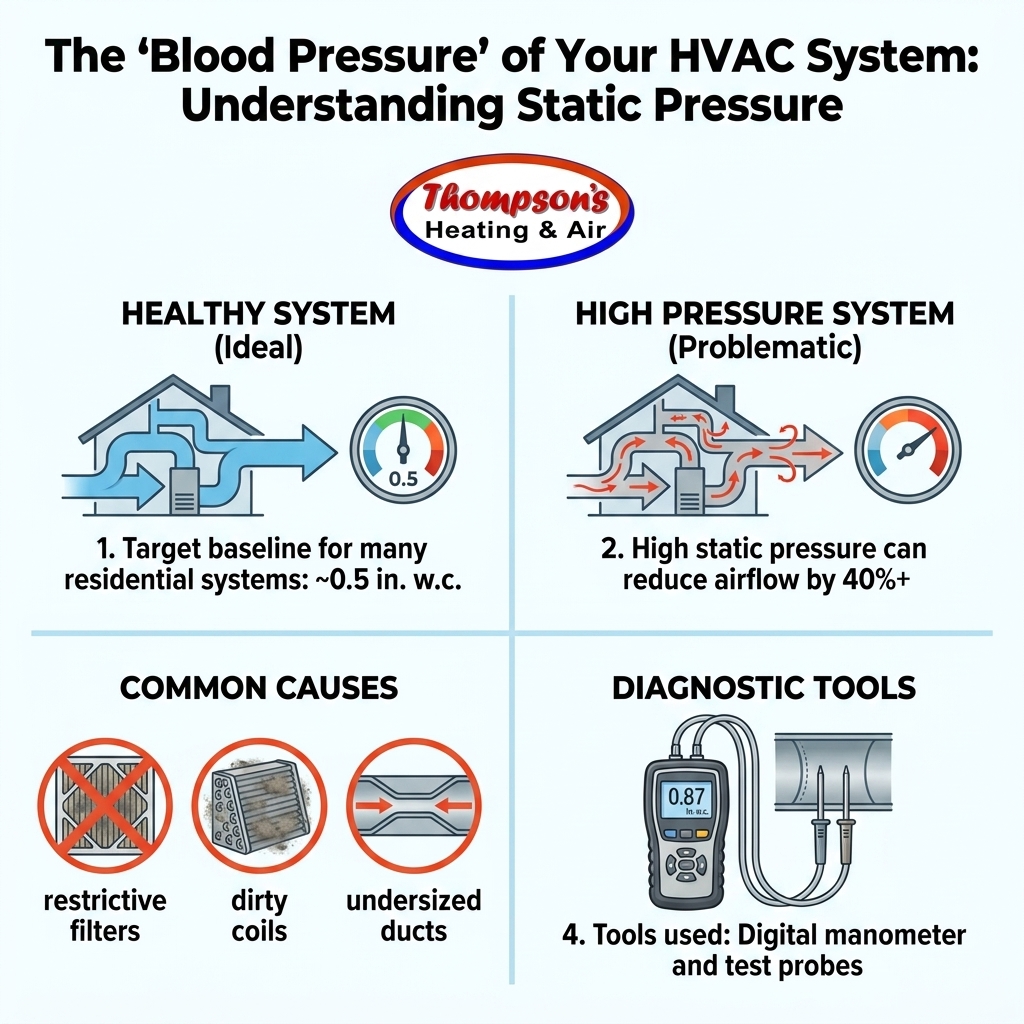
The easiest way to understand this concept is to use a medical analogy. Think of static pressure as the blood pressure of your HVAC system. Just as a doctor measures your blood pressure to check your heart health and arterial resistance, HVAC professionals measure static pressure to check blower health and duct resistance. If your blood pressure is too high, it means your heart is working dangerously hard to push blood through restricted arteries. If your HVAC system's static pressure is too high, it means your blower motor is straining against severely restricted ductwork, clogged filters, or dirty coils.
Most residential systems are designed to operate at a specific, healthy baseline. For the vast majority of standard home units, this target baseline is around 0.5 in. w.c. When the pressure spikes well above this number, the volume of air moving through the vents plummets, leaving distant rooms completely unconditioned.
Understanding Inches of Water Column (in. w.c.)
Professionals ensure accuracy by having static pressure measured in inches of water column (in. w.c.). But what does that actually mean? Instead of getting bogged down in overly dense engineering jargon, think of it as a highly sensitive way to measure very small amounts of pressure. One inch of water column represents the amount of pressure required to push a column of liquid water up by exactly one inch in a tube.
Because the air pressure inside your ductwork is relatively low compared to something like a car tire, standard pressure gauges (like PSI) are practically useless. The in. w.c. scale allows technicians to detect microscopic changes in resistance. Even a fraction of an inch of added resistance—say, jumping from 0.5 to 0.8 in. w.c.—can drastically alter airflow volume and completely choke off the air supply to your furthest rooms.
The Danger of Diagnostic Guesswork in HVAC Repair
One of the most frustrating experiences for a homeowner in Woodland CA is paying for a repair that doesn't actually fix the problem. Skipping static pressure tests often leads to misdiagnosing airflow problems entirely. A technician who operates by "feel" might notice the system struggling to cool and immediately assume there is a refrigerant leak or a failing compressor. They add coolant, charge you for the service, and leave—but your back bedroom remains just as hot as before.
This trial-and-error approach is incredibly costly. Parts are replaced blindly, yet the room remains hot because the actual issue—a crushed duct or a severely blocked coil—was never addressed. True airflow diagnostics prevent these unnecessary, invasive teardowns of the ductwork or equipment. By measuring the exact resistance in the system, a technician can definitively prove whether the problem is mechanical (a dying blower) or structural (a blocked vent).
A thorough, scientific examination often reveals a minor restriction rather than a need for catastrophic system replacement. For instance, another local customer recently assumed their 28-year-old system needed a total replacement because of terrible performance. However, a thorough examination using precise diagnostic tools revealed that only a minor tune-up was needed, saving them from an unnecessary replacement expense. This is why Thompson's Heating & Air uses precise scientific diagnostic tools rather than guesswork to accurately solve comfort issues the first time. If you want a definitive answer, you need expert AC repair in Woodland that relies on data, not assumptions.
How Professionals Measure Static Pressure (And Why It's Not a DIY Job)
Gathering these critical airflow readings requires highly specialized equipment and a deep understanding of HVAC mechanics. The process is fascinating, but it is strictly a job for licensed professionals. Here is a conceptual look at how technicians uncover the hidden restrictions in your home's ductwork:
1. Identifying the Test Points: The technician locates the exact points before the blower motor (the return side) and after the evaporator coil (the supply side) to get a complete picture of the system's resistance.
2. Creating Precise Access: Small, precise test ports must be drilled into the metal plenum. (Note: This is where DIY attempts become incredibly dangerous.)
3. Inserting the Probes: Specialized static pressure tips are inserted into the airflow stream. These probes must face directly into the air current to gather an accurate reading.
4. Reading the Differential: The technician connects the probes to a digital gauge and measures the exact pressure drop across the equipment.
We must explicitly warn against DIY attempts at this process. Obtaining accurate in. w.c. readings requires drilling precise test ports into the plenum and ductwork. Drilling into HVAC equipment without a license risks immediately puncturing the evaporator coil, destroying the heat exchanger, or damaging critical internal electrical components. A single slip of a drill bit can turn a simple diagnostic test into a catastrophic system failure.
The Role of the Digital Manometer
The specialized tool used for this diagnostic is called a digital manometer. This highly sensitive device captures precise pressure drops by comparing the return side pressure to the supply side pressure. By isolating these two halves of the system, the manometer paints a complete picture of system health. If the return pressure is massively high but the supply pressure is low, the technician instantly knows the blockage is located before the air ever reaches the blower motor.
Hidden Airflow Bottlenecks Exposed by Manometer Readings
Once the manometer provides the raw data, technicians can translate those numbers into real-world solutions. High static pressure readings almost always point to one of a few common hidden bottlenecks. During the intense August late-summer heat, these bottlenecks become painfully obvious as the system runs continuously trying to overcome the restrictions.
The Problem: Overly restrictive or deeply clogged air filters. The Cause: Homeowners often buy the thickest, highest-MERV filters available, thinking they are improving air quality. However, these dense filters act like a brick wall against the blower motor, causing the return static pressure to skyrocket. The Solution: Switching to a filter with a lower MERV rating that balances air filtration with healthy airflow.
The Problem: Undersized or crushed ductwork. The Cause: Many homes were built with ductwork that is simply too small for the size of the air conditioner. Additionally, flexible ducts in the attic can easily become crushed by stored boxes or degraded over time. This chokes the system and prevents conditioned air from reaching distant rooms. The Solution: Expanding the plenum, replacing the crushed sections of flex duct, or adding additional return air pathways.
The Problem: Dirty evaporator coils. The Cause: Cumulative dust buildup by late summer exacerbates dirty coils. When dust bypasses the filter, it cakes onto the damp evaporator coil, creating a physical wall of grime that blocks airflow and spikes supply-side static pressure. The system struggles right when the heat is worst. The Solution: A deep, chemical cleaning of the evaporator coil to restore the physical pathways for the air to flow.
Knowing what to check when your AC is not cooling properly starts with understanding that these bottlenecks artificially increase resistance, severely reducing cooling capacity when it is needed most.
• Clogged Air Filter — Common Symptoms: Whistling sounds at the return grille, weak airflow at all vents. — Impact on Static Pressure Readings: Extremely high Return-Side pressure; low Supply-Side pressure.
• Dirty Evaporator Coil — Common Symptoms: System runs constantly, air feels lukewarm, coil freezing over. — Impact on Static Pressure Readings: High pressure drop directly across the coil measurement points.
• Crushed Supply Duct — Common Symptoms: One specific room is stubbornly hot, while others are fine. — Impact on Static Pressure Readings: High Supply-Side pressure; specific branch shows massive resistance.
• Undersized Return Duct — Common Symptoms: Doors slam shut when AC turns on, loud rushing air noises. — Impact on Static Pressure Readings: High Return-Side pressure directly at the equipment inlet.
The Long-Term Impact of High Static Pressure on Your System
Ignoring high static pressure does more than just leave you with a stubbornly hot room; it actively destroys your HVAC equipment over time. The most immediate victim of restricted airflow is the blower motor. When the system faces high resistance, the motor has to work exponentially harder to push air through the house. Standard motors will overheat and eventually burn out, while modern variable-speed motors will ramp up to maximum capacity, consuming massive amounts of electricity and sounding like a jet engine in your hallway.
Furthermore, high static pressure severely reduces the overall airflow volume (CFM). During the cooling season, this lack of airflow means there is not enough warm indoor air blowing over the evaporator coil to keep it above freezing. As a result, the condensation on the coil freezes solid, turning your indoor unit into a block of ice and completely halting the cooling process.
The overall impact on system efficiency is staggering. High static pressure can reduce airflow by over 40%, meaning you are paying full price for electricity while only getting 60% of the cooling capacity. It is also important to note that these airflow principles apply year-round. A blocked duct or a restrictive filter will impact your winter heating cycles just as severely as your summer cooling cycles, causing furnaces to overheat and trip their safety limits. If you are experiencing winter shutdowns, accurate heating repair diagnostics will use the exact same static pressure principles to find the fault.
Frequently Asked Questions About HVAC Static Pressure
What is a normal static pressure for HVAC?
Most standard residential HVAC systems are designed to operate at a Total External Static Pressure (TESP) of around 0.5 in. w.c. However, this target can vary slightly depending on the specific type of blower motor and the manufacturer's exact specifications. If the reading climbs to 0.8 or 1.0 in. w.c., the system is essentially suffering from "high blood pressure" and is working dangerously hard to move air.
What causes high static pressure in ductwork?
High static pressure is caused by any physical restriction that blocks the flow of air. The most common culprits include overly dense or dirty air filters, crushed or kinked flexible ductwork, and evaporator coils that are caked in dust and debris. Even having too many supply vents closed off in unused rooms can artificially spike the pressure inside the ductwork.
How does static pressure affect AC cooling?
Static pressure directly dictates how much conditioned air actually makes it into your living spaces. When pressure is too high, the volume of air (CFM) drops significantly, meaning the cold air stays trapped in the ductwork or at the unit instead of reaching your rooms. This leads to hot spots, constantly running equipment, and eventually frozen evaporator coils.
What does inches of water column mean in HVAC?
Inches of water column (in. w.c.) is a highly sensitive unit of measurement used by professionals to gauge very low air pressures. It represents the amount of pressure required to push a column of water up by one inch inside a tube. Because HVAC air pressure is so subtle, this measurement allows technicians to detect even the smallest, most hidden airflow restrictions.
Can high static pressure damage an HVAC system?
Yes, ignoring high static pressure will cause long-term, catastrophic damage to your HVAC system. The blower motor will overheat and fail prematurely from the constant strain of pushing against blocked ducts. Additionally, the lack of proper airflow causes air conditioners to freeze up and furnaces to overheat, severely shortening the lifespan of the entire system.
Why shouldn't I try to measure static pressure myself?
Measuring static pressure requires drilling precise test ports directly into the metal casing of your HVAC equipment. If you drill in the wrong spot, you can easily puncture the delicate refrigerant coils or damage internal electrical components, resulting in thousands of dollars in damage. This diagnostic process requires specialized tools and licensed expertise to perform safely.
Restore Your Home's Comfort with Scientific Diagnostics
Finding the root cause of a stubborn hot room in Woodland CA requires precise measurement, not blind guesswork. The mechanics of measuring static pressure to diagnose weak airflow prove exactly where your system is struggling, whether it is a choked filter, a dirty coil, or an undersized duct. Reassure yourself that identifying the exact airflow bottleneck leads to accurate, lasting solutions rather than temporary, trial-and-error band-aids. If you are dealing with weak airflow and uneven temperatures, do not wait for the system to fail entirely—seek professional diagnostics to restore your home's comfort today.



.avif)
.avif)
.png)
