
Why We Look Beyond the Thermostat When a Room Won't Cool Properly

The Frustration of a Stubbornly Hot Room
Your central air is running constantly, but that one west-facing bedroom still feels like an oven. If you find yourself asking why we look beyond the thermostat when a room won't cool properly, you are definitely not alone. At Thompson's Heating & Air, it is a complaint we hear constantly from Woodland homeowners. It is incredibly frustrating to walk from a perfectly chilled living room into a bedroom that feels completely disconnected from the rest of the house. During those punishing August late-summer afternoons, that isolated heat can make sleeping or getting the kids ready for the back-to-school transition nearly impossible.
Before you spend money on a new smart control panel, understanding how your air conditioning systems distribute air can help you determine when it is time to call our team for professional AC repair.
In our years of serving the local community, we've found the most common instinct is to blame the thermostat. Homeowners often assume that if a room is hot, the control unit must be broken, miscalibrated, or simply outdated. They rush to the hardware store, buy a new digital model, wire it up, and wait for the relief that never comes. The reality our technicians see every day is that uneven cooling is rarely a control issue. In almost every case, a stubbornly hot room is the result of a physical airflow restriction or an overwhelming thermal load that the system simply cannot keep up with.
The real decision point: You can waste money on a superficial thermostat swap, or you can let professionals investigate the true root cause of the heat buildup. Upgrading your wall control might give you a nicer touchscreen, but it will not force cold air into a room that is suffering from poor duct design, heavy sun exposure, or inadequate insulation.
The Hallway Sensor vs. The Hot Bedroom
The Problem: You set your thermostat to 72 degrees, and the screen confirms the house is at 72 degrees. Yet, the back bedroom is sweltering. This massive temperature differential between the main hallway and the hot room leaves many homeowners convinced their equipment is failing.
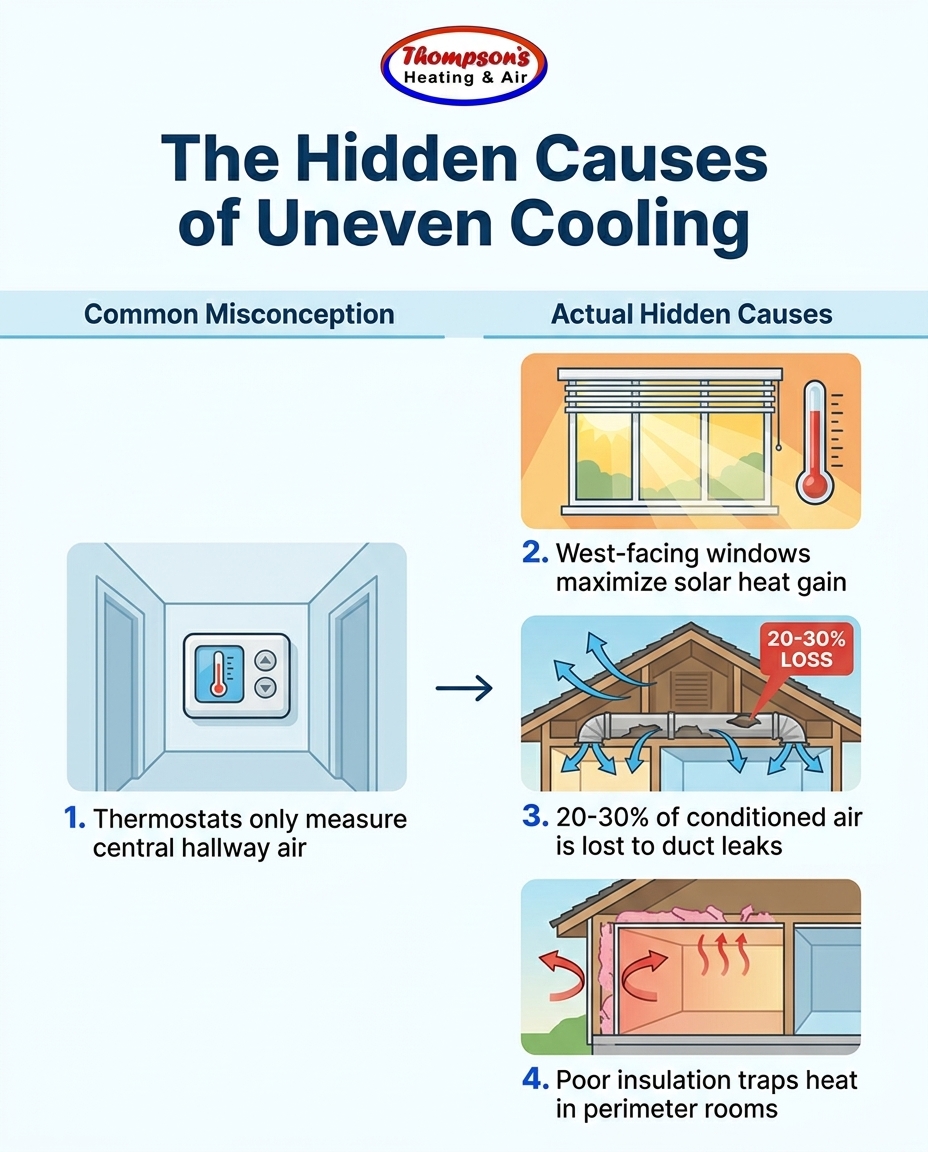
The Cause: In our experience evaluating local homes, standard central thermostats are incredibly literal devices. They only measure the ambient air immediately surrounding their internal sensors. In most homes, builders mount these thermostats in central, shaded hallways. These interior corridors have no exterior walls, no windows, and receive very little direct sunlight. Because the hallway reaches the target temperature quickly, the thermostat shuts the cooling cycle off, completely blind to the fact that a distant perimeter room is still baking in the afternoon sun.
This placement creates a massive blind spot for your HVAC system. The equipment is doing exactly what it is told to do based on the air in the hallway.
• Sunlight Exposure — Central Hallway (Sensor Location): Zero direct sunlight; heavily shaded — West-Facing Bedroom (Problem Area): Direct, intense afternoon sun rays
• Exterior Walls — Central Hallway (Sensor Location): None (surrounded by interior rooms) — West-Facing Bedroom (Problem Area): One or more walls exposed to outside heat
• Temperature Fluctuation — Central Hallway (Sensor Location): Highly stable and easy to cool — West-Facing Bedroom (Problem Area): Rapid heat gain throughout the day
• Cooling Demand — Central Hallway (Sensor Location): Very low thermal load — West-Facing Bedroom (Problem Area): Extremely high thermal load
The Solution: Recognizing this physical limitation is the first step toward real comfort. A brand-new thermostat, installed in the exact same shaded hallway, will read the exact same temperature and shut off at the exact same time. To solve the temperature differential between the main hallway and the hot room, our technicians have to look at the factors actively fighting your air conditioner.
The Unseen Force of Solar Heat Gain
Our team knows all too well that one of the most powerful forces working against your home comfort is solar heat gain. This refers to the increase in temperature inside a building caused by solar radiation hitting the exterior walls and passing through the glass windows. During those brutal August late-summer afternoons, the intense, dry summer heat of Woodland, CA creates a massive thermal load on your home. The late-summer sun angles are particularly aggressive on west-facing and south-facing walls, essentially turning those rooms into solar ovens.
The U.S. Department of Energy notes that windows account for a highly significant portion of residential heat gain. When the afternoon sun beats down on a west-facing window, the glass absorbs and magnifies that thermal energy, radiating it directly into the room. Even if your air conditioner is functioning flawlessly, the sheer volume of heat entering the space can completely counteract the cooling output coming from the air vents.
Why the thermostat cannot help:
• Radiant heat vs. ambient air: The sun heats the physical objects in the room (the floor, the bed, the walls), which then radiate heat back into the air long after the sun goes down.
• Overwhelmed capacity: The amount of cold air allocated to that specific room by the ductwork was likely calculated for average conditions, not the peak solar barrage of late summer.
• Continuous heat transfer: As long as the sun is hitting the glass, heat is continuously entering the space, fighting the intermittent cycles of your air conditioner.
If you have a room that only gets uncomfortably hot between 3:00 PM and 7:00 PM, solar heat gain is almost certainly the primary culprit. As we often tell our customers, no thermostat adjustment can block the sun.
Ductwork Dynamics and Hidden Airflow Loss
If the heat entering the room is half the battle, the mechanical delivery system is the other half. Your air conditioner might be producing plenty of cold air, but if that air gets lost before it reaches the bedroom, the room will never cool down. The ductwork hidden in your walls and attic is essentially the circulatory system of your home, and we frequently see how susceptible it is to physical disruptions that affect your indoor air quality and airflow.
Here is how our technicians typically see airflow get lost along the way:
1. Distance from the blower unit: Airflow operates on pressure. The further a room is from the indoor air handler, the less static pressure is available to push the air out of the vent. The furthest bedroom on the opposite end of the house naturally receives the weakest airflow.
2. Hidden duct leaks: According to ENERGY STAR, 20 to 30 percent of the air moving through typical residential duct systems is lost to leaks, holes, and poor connections. If the duct run leading to your hot room has a disconnected joint in the attic, you are paying to air condition your roof space instead of your bedroom.
3. Crushed or kinked flexible ducts: Flexible ductwork can easily be compressed by stored attic boxes or kinked around sharp corners, acting like a pinched garden hose that chokes off the air supply.
4. Closed registers: A common homeowner mistake we encounter is closing vents in unused rooms, hoping to force more air into the hot room. This actually increases static pressure in the system, which can cause the blower motor to work harder, freeze the evaporator coil, and disrupt the entire home's airflow balance.
The Impact of Poorly Sized Ducts
Even if the duct is perfectly sealed, it might simply be too small. If the duct supplying the hot room was not sized correctly during construction to handle the actual thermal load of the space, no thermostat adjustment will ever push more air through it. You will notice this if you put your hand over the register and feel only a weak, lazy trickle of air coming out while the rest of the house has strong, forceful airflow. The temperature differential between the main hallway and the hot room will remain severe until the physical duct sizing is addressed.
Insulation Deficiencies and Trapped Heat
Your home's building envelope plays a massive role in retaining cool air. You can pump freezing cold air into a room all day, but if the insulation is failing, the space will never hold the temperature. Poor attic insulation directly above a specific room allows intense heat to transfer straight from the roof down through the ceiling.
During August late-summer afternoons, an under-ventilated attic can reach temperatures well over 130 degrees—something our installers experience firsthand. If the insulation barrier separating that attic from your bedroom ceiling is thin, compressed, or missing, that 130-degree heat radiates downward. You are no longer just trying to cool a room; you are actively fighting a constant, aggressive influx of trapped heat.
Insulation gaps create localized hot spots that a central HVAC system simply cannot overcome. The thermostat in the hallway remains completely unaffected by the heat radiating through the bedroom ceiling, which is why it shuts the system off prematurely. A thorough evaluation of the building envelope is critical to understanding why a room refuses to hold its temperature.
Why Superficial Fixes Fail: The Value of Root-Cause Diagnostics
The Problem: Guessing at HVAC solutions rarely pays off. Swapping parts based on a hunch usually leaves homeowners with less money in their pockets and a room that is just as hot as it was before.
The Cause: Uneven cooling is a complex issue of building science involving airflow velocity, static pressure, and thermal loads. Without measuring these physical factors, any repair is just a shot in the dark. For example, replacing a thermostat does absolutely nothing to fix a crushed duct in the attic or a lack of blown-in insulation.
The Solution: Real comfort requires a scientific diagnosis. Recently, a local customer reached out to our team at Thompson's Heating & Air needing unspecified diagnostic work on their HVAC system because one side of the house was struggling to stay comfortable. Instead of just guessing, our technician ensured all necessary evaluations were completed professionally, communicating progress at every step to find the real issue rather than just swapping parts. By measuring the temperature differential between the main hallway and the hot room, checking the duct pressure, and evaluating the airflow velocity at the registers, the true problem was identified and resolved.
Thompson's technicians take the time to find the true root cause, taking a comprehensive diagnostic approach instead of applying quick superficial fixes. This methodical approach saves homeowners from wasting money on unnecessary parts and provides the peace of mind that comes from knowing exactly why the room is hot and exactly how to fix it permanently.
Real Solutions for Balancing Your Home's Temperature
Once the physical limitations of the room are understood, there are several professional-grade solutions that can actually resolve the issue. If you are dealing with an AC not cooling properly in just one zone, here are the steps our Thompson's Heating & Air professionals will take to balance the environment:
1. System Balancing: A technician can adjust the manual dampers inside your ductwork to restrict airflow slightly to the over-cooled rooms and redirect a higher volume of conditioned air to the stubbornly hot room. This balances the static pressure across the entire home.
2. Duct Sealing and Repair: By locating and sealing leaks, holes, and disconnected joints in the attic or crawlspace, we can reclaim the 20 to 30 percent of conditioned air that is currently being wasted, delivering it directly to the room that needs it most.
3. Adding Secondary Sensors: If the ductwork is perfect but the thermostat location is the only issue, upgrading to a smart thermostat with remote room sensors can help. You can place a sensor in the hot bedroom and tell the system to prioritize that room's temperature during August late-summer afternoons.
4. Zoning Systems: For severe cases, installing a motorized zoning system allows different areas of the house to be controlled independently, ensuring the west-facing bedroom gets the cooling it needs without turning the rest of the house into an icebox.
These solutions require an experienced professional to evaluate the entire system holistically, ensuring that fixing one room does not inadvertently cause airflow problems in another.
Frequently Asked Questions About Uneven Cooling
Will a new thermostat fix uneven cooling in just one room?
No, a new thermostat will not fix uneven cooling if it is installed in the same location as the old one. The thermostat only reads the temperature of the air immediately surrounding it. If the airflow to the hot room is restricted or the thermal load is too high, a new control panel cannot force the room to cool down.
Why is one room hotter than the rest of the house in summer?
One room is usually hotter due to a combination of solar heat gain, distance from the indoor blower unit, or ductwork issues. Rooms with west-facing or south-facing windows absorb massive amounts of heat during the afternoon. Additionally, if the room is at the far end of the duct system, it receives the weakest airflow.
How do you fix a room that won't cool down?
Fixing a hot room requires diagnosing the root cause of the heat buildup. A professional will typically check the ductwork for leaks, measure the airflow at the register, evaluate the attic insulation, and adjust the system's internal dampers to balance the air distribution properly.
Why is my AC not cooling one specific west-facing room?
West-facing rooms take the brunt of the afternoon sun, creating a severe temperature differential between the main hallway and the hot room. The intense solar radiation heats the walls and glass, overwhelming the amount of conditioned air that the ductwork is capable of delivering to that specific space.
Does closing vents in other rooms help cool a hot room?
Closing vents in unused rooms does not help and can actually damage your HVAC system. Modern central air systems are designed to operate with a specific amount of airflow; closing vents increases static pressure, which can strain the blower motor, cause duct leaks to worsen, and potentially freeze your evaporator coil.
How does solar heat gain affect my air conditioning?
Solar heat gain introduces a massive amount of external thermal energy into your home, forcing your air conditioning to work much harder. When the sun beats down on your windows, it heats the physical objects in the room, which then radiate heat back into the air, easily outpacing the cooling capacity of the vents in that specific area.
Get to the Bottom of Your Stubbornly Hot Room
Understanding the physical factors of airflow, duct pressure, and thermal load is the first step to achieving true whole-home comfort. When that one bedroom refuses to cool down during August late-summer afternoons, the answer is rarely found on the wall in the hallway. It is found in the attic, inside the ductwork, and at the windows.
Instead of guessing with new gadgets or superficial fixes, encourage a comprehensive evaluation of your home's unique building envelope. By measuring the airflow and tracking down the exact cause of the heat buildup, you can finally enjoy a balanced, comfortable home. Schedule a professional inspection with our team at Thompson's Heating & Air today to find the real culprit behind your uneven cooling and get the lasting relief you deserve.



.avif)
.avif)
.png)
