Why We Recommend Whole-Home HEPA Filtration Over Portable Units for Open Floor Plans

The Challenge of Post-Harvest Dust in Open-Concept Homes
Your living space is spotless on Sunday afternoon, but by Tuesday morning, a fine layer of grit has already settled across the kitchen island and the living room furniture. If you are researching whole home hepa filtration to solve this persistent dusting issue, you are dealing with a very common frustration. At Thompson's Heating & Air, our technicians see this exact pattern every year during the November post-harvest and pre-winter heating season. As temperatures drop, you close your windows to trap the heat inside, inadvertently sealing in the heavy agricultural dust that has been kicked up outdoors.
For homeowners managing indoor air quality, the decision often comes down to two paths: upgrading to whole-home air filtration systems or purchasing several standalone room purifiers. If you want to explore the integrated route, scheduling air purification installation in Woodland is a smart first step.
The core dilemma: Open-concept homes are beautiful and spacious, but they present a massive challenge for air purification. Without walls to block drafts and contain air movement, microscopic dust particles float freely from the entryway to the dining room. Choosing how to capture that particulate matter requires understanding exactly how air behaves when there are no physical barriers to guide it.
Understanding the Physics of Airflow in Open Floor Plans
To understand why a standard room purifier fails to clean the air in a large, unpartitioned space, we have to look at the physics of airflow. Open-concept floor plans are designed for unrestricted movement, which is great for entertaining but terrible for localized air filtration. When you place a portable unit in the corner of a massive great room, it simply does not have the mechanical power to pull air from fifty feet away.
The Limitations of CADR Ratings
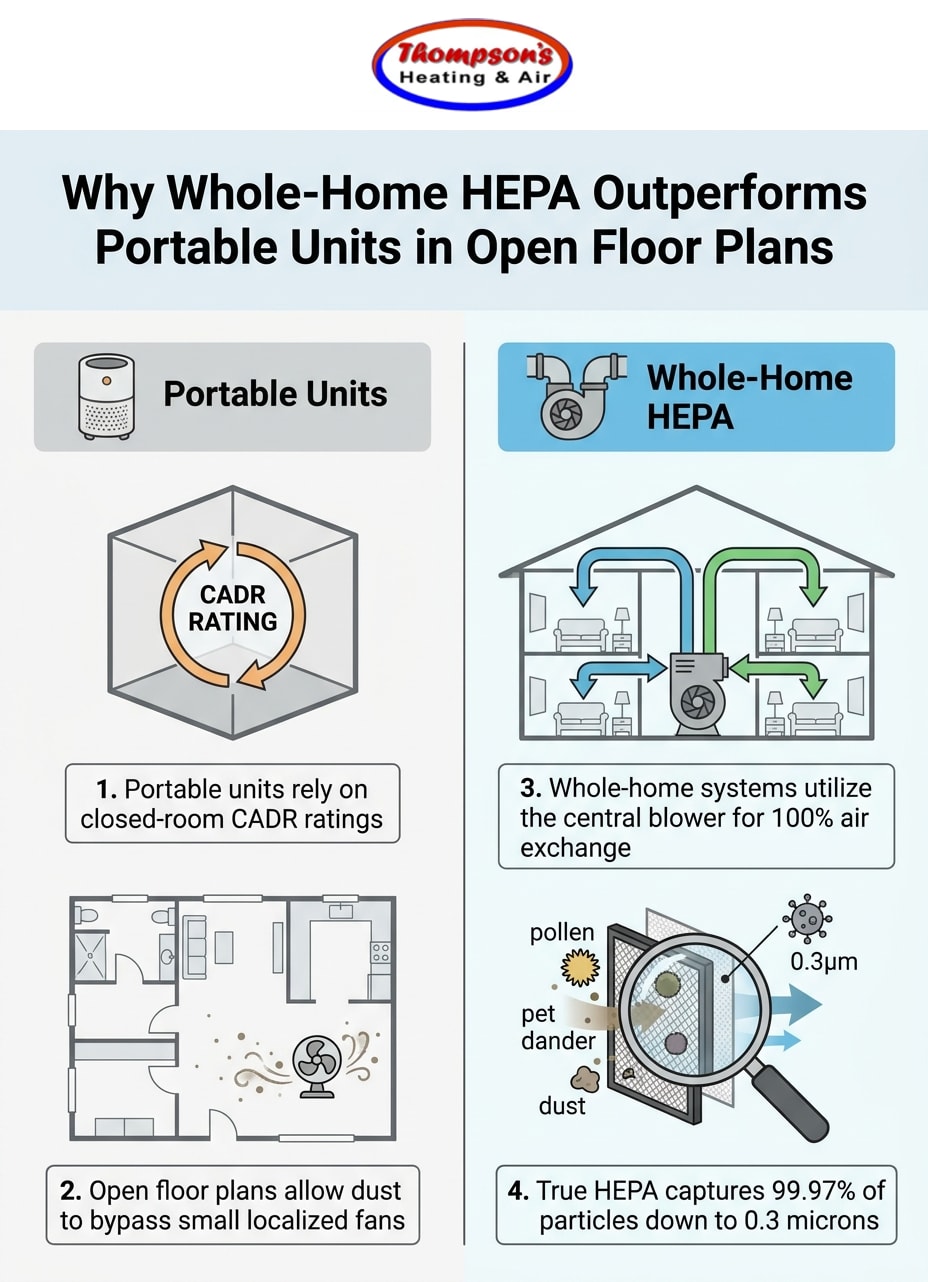
If you look at the box of any portable air purifier, you will see a Clean Air Delivery Rate (CADR) number. This metric tells you how quickly the unit can filter smoke, pollen, and dust. However, there is a critical catch to how this number is calculated.
• Sealed testing environments: Manufacturers test these units in small, closed-off rooms—typically around 100 to 120 square feet—with standard eight-foot ceilings and the door shut tight.
• Misleading square footage claims: A box might claim it covers "up to 500 square feet," but if that 500 square feet is part of a vaulted-ceiling living room that connects seamlessly to a kitchen and hallway, the unit's effective range drops dramatically.
• The lack of containment: Because open-concept floor plans do not have walls to trap the purified air, the clean air immediately dilutes into the dirty air of the adjacent spaces.
Air Mixing vs. Air Exchange
There is a massive difference between simply moving air around a room and actually exchanging it through a dense filtration medium. Portable units often create small, localized vortexes. The fan pulls in air from a three-foot radius, filters it, and blows it straight up. This creates a tiny bubble of clean air right next to the machine, while simultaneously pushing the heavier dust particles outward into unprotected zones.
To truly clean the air, you need comprehensive air exchange. This means taking the entire cubic volume of air in the house, pulling it out of the living spaces, forcing it through a filter, and returning it. Small standalone fans simply lack the static pressure and cubic-feet-per-minute (CFM) capacity to achieve this in a large house.
Why Portable Purifiers Struggle Against Valley Agricultural Dust
The limitations of portable purifiers become glaringly obvious when you factor in regional climate challenges. In our years of providing HVAC solutions throughout Woodland CA and the Sacramento Valley, our team at Thompson's Heating & Air has seen firsthand the unique and heavy particulate load local residents face. As the agricultural harvest wraps up in the fall, massive amounts of dirt, organic matter, and silica dust are kicked up into the atmosphere.
A true HEPA filter is designed to capture 99.97% of airborne particles down to 0.3 microns. This level of filtration is absolutely necessary for trapping fine agricultural dust and the microscopic soot associated with regional fires. The problem is not the filter media inside the portable unit—the problem is the delivery system.
The weight of the dust: Agricultural dust is often heavier and more abrasive than standard household dander. A small, oscillating fan motor inside a plastic tower cannot generate the suction required to pull these heavy particles from the opposite end of a vast living room. Instead, the dust simply settles onto your floors and countertops before it ever reaches the purifier.
This issue is compounded by seasonal weather patterns. Late fall temperature inversions act like a lid over the valley, trapping pollutants near the ground. When you add the challenge of keeping indoor air safe from wildfire smoke to the mix, relying on a few small room purifiers leaves too many blind spots in your home's defense.
How Whole-Home HEPA Filtration Leverages Your Existing HVAC
If portable units cannot handle the physics of open-concept floor plans, what is the technical solution? The answer lies in using the powerful engine your home already possesses: the central HVAC system. Integrating HEPA filtration directly into your ductwork ensures that every cubic foot of air is eventually scrubbed clean.
Here is how a whole-home system effectively manages indoor air quality:
1. Centralized suction: Instead of relying on a tiny fan in the corner of a room, the system uses your home's main return vents to pull air from every single room simultaneously.
2. Ductwork distribution: Once the air is pulled into the return ducts, it travels down to the central HVAC cabinet, ensuring that even air from the furthest corners of your open floor plan is collected.
3. Bypass filtration: A portion of this air is routed through a dedicated bypass loop containing a dense, medical-grade HEPA filter, scrubbing out 99.97% of contaminants.
4. Clean air delivery: The freshly purified air is then injected back into the main supply airstream and pushed powerfully through the supply vents back into your living spaces.
The Role of the Central Blower
Your central HVAC blower is a massive, high-powered fan designed specifically to push air through hundreds of feet of ductwork. By leveraging this blower, a whole-home filter achieves what portables cannot: total air exchange. Furthermore, modern variable-speed blowers can be set to run on a low, continuous "fan-only" mode. This provides ongoing, whisper-quiet filtration 24 hours a day, even when your system is not actively heating or cooling.
Bypass HEPA Systems Explained
You might be wondering how a system can push air through a filter that is dense enough to trap particles as small as 0.3 microns without suffocating the HVAC motor. The secret is the bypass installation method. Instead of placing the HEPA block directly across the main return duct—which would severely restrict airflow—a bypass system creates a side loop. It siphons off roughly 30% of the air during each cycle, cleans it to a medical standard, and returns it to the main flow. Over the course of a few hours, the entire volume of the house passes through this dense media multiple times, maintaining pristine air quality without stressing your equipment.
Protecting Your Home During the 'Closed Window' Season
The urgency for robust filtration peaks during a very specific window of the year. The transition into the November post-harvest / pre-winter heating season marks a drastic shift in how your home operates. During the mild days of early autumn, you might leave the windows open to enjoy the breeze, relying on natural ventilation to clear out stale indoor air.
But as November arrives, houses are sealed up tight to retain heat. This "sealed home" effect is great for energy efficiency, but it is disastrous for indoor air quality. Without fresh air ventilation, the concentration of indoor pollutants—including the agricultural dust that blew in weeks prior, pet dander, cooking odors, and cleaning chemicals—begins to spike rapidly.
Because the house is closed off, the air simply recirculates. If you are only using standard 1-inch fiberglass filters in your return grilles, that heavy dust is blowing right through the mesh and back into your breathing space. Positioning a whole-home HEPA system as the cornerstone of your comprehensive indoor air quality services is critical for preparing your home before the heaviest heating demands begin. It ensures that the air trapped inside your home remains safe and breathable all winter long.
The Importance of Professional Airflow Balancing
While the benefits of medical-grade filtration are clear, achieving them requires precise technical execution. One of the most common mistakes our technicians see homeowners make is attempting a DIY upgrade by purchasing the highest-rated pleated filter they can find at the hardware store and jamming it into their standard return grille.
The problem: True HEPA media is incredibly dense. It is essentially a thick, woven wall of glass fibers designed to catch microscopic soot.
The cause: When you place a highly restrictive filter into a system that was not designed for it, the static pressure inside the ductwork skyrockets. The blower motor has to work twice as hard to pull the same amount of air through the dense material.
The solution: Professional bypass installation and airflow balancing. If static pressure is ignored, the resulting airflow drop can lead to catastrophic system failures, including burned-out blower motors, frozen evaporator coils, or even cracked heat exchangers due to overheating.
"Think of your HVAC system's blower motor like a set of lungs. If you place a dense, restrictive filter over the intake—similar to breathing through a heavy wool blanket—the motor will eventually exhaust itself trying to pull in enough air."
Working with our specialized team at Thompson's Heating & Air ensures that your system is evaluated for proper static pressure before any heavy filtration media is installed. Because our technicians understand the specific demands of Woodland CA and Sacramento Valley agricultural zones, we know exactly how to calibrate bypass systems so you get maximum air purity without risking damage to your expensive heating and cooling equipment.
Comparing Long-Term Value and Maintenance
When weighing the decision between multiple portable units and one integrated system, it helps to look at the long-term logistics of owning and operating the equipment. For open-concept floor plans, the integrated approach is not just more effective; it is often much easier to manage.
• Airflow Coverage — Whole-Home HEPA System: Leverages central blower to reach every room uniformly. — Multiple Portable Units: Limited to the immediate radius around the standalone fan.
• Floor Space Required — Whole-Home HEPA System: Zero. Installed out of sight in the attic, garage, or utility closet. — Multiple Portable Units: Takes up valuable floor space in living rooms and bedrooms.
• Noise Levels — Whole-Home HEPA System: Whisper-quiet in the living space; equipment is remote. — Multiple Portable Units: Can be loud and disruptive when running on high speeds.
• Maintenance Routine — Whole-Home HEPA System: One central filter to replace, usually every 1 to 3 years. — Multiple Portable Units: Tracking and replacing multiple different filters every 3 to 6 months.
Filter Replacement Frequency
The lifespan of your filtration media matters. High-capacity whole-home HEPA filters are massive—often featuring deep pleats that provide dozens of square feet of surface area. Because of this massive surface area, they can hold a tremendous amount of dirt before they become restrictive, often lasting a year or more even in heavy agricultural dust conditions. Conversely, the small filters inside portable units clog rapidly when exposed to thick valley dust, requiring frequent and tedious replacements.
Energy Consumption
Running three or four separate portable air purifiers on high speed 24/7 draws a continuous, noticeable amount of electricity. A centralized system is highly efficient because it piggybacks on the variable-speed blower motor of your existing HVAC system. When the thermostat fan is set to "On" or "Circulate," the central motor runs at a low, energy-efficient speed, providing constant filtration without the high electrical draw of multiple independent motors.
Frequently Asked Questions About HEPA Filtration
Why isn't my portable air purifier working in my open living room?
Portable air purifiers are tested and rated for closed rooms, meaning they rely on walls to contain the clean air they produce. In an open living room, the clean air immediately mixes with unfiltered air from adjacent spaces like the kitchen or hallway. Additionally, the small fans in portable units lack the power to pull heavy dust particles from across a large, unpartitioned room.
Can I add a HEPA filter directly to my existing HVAC system?
You cannot simply slide a true HEPA filter into a standard 1-inch return grille because the dense material will severely choke your system's airflow. However, a professional can add a HEPA filter to your existing HVAC system by installing a bypass loop. This dedicated duct routing allows a portion of the air to be scrubbed to medical standards on every cycle without starving the main blower motor of air.
Do HEPA filters restrict HVAC airflow and damage the blower?
If improperly installed directly across the main air stream, a HEPA filter will absolutely restrict airflow and can cause a blower motor to burn out prematurely. This is why professional static pressure calculations are necessary. When installed correctly using a bypass system, the HEPA filter cleans the air effectively without causing any harmful restriction or damage to the HVAC equipment.
How many square feet does a standard portable HEPA filter actually cover?
While a box may claim a portable unit covers 400 to 500 square feet, this metric assumes a sealed room with a standard eight-foot ceiling. If you have vaulted ceilings or an open floor plan, the effective coverage area is drastically reduced. To achieve true whole-house coverage, you need a system integrated with your central ductwork.
What is a bypass HEPA system and how does it work?
A bypass HEPA system is an add-on filtration unit installed parallel to your main HVAC ductwork. It uses its own small fan or the pressure drop of the main system to siphon off about 30% of the return air, push it through a dense HEPA filter, and return it to the supply side. This method continuously cleans the home's air volume without interfering with the primary heating and cooling airflow.
Breathe Easier This Winter with a Whole-Home Solution
When you are battling the heavy particulate load of the November post-harvest / pre-winter heating season, portable units simply fall short in large, open spaces. They lack the mechanical power to pull dust across an open floor plan, and they require constant maintenance and floor space. A whole-home HEPA filtration system solves these problems by leveraging the powerful blower you already own to deliver medical-grade air purification to every corner of your house.
Preparing your home for the closed-window season doesn't have to mean settling for dusty surfaces and stale air. By upgrading your central system, you gain the peace of mind that comes with seamless, invisible, and highly effective dust management. If you are ready to stop fighting a losing battle with standalone fans, reach out to our team to schedule professional air purification installation in Woodland and protect your indoor environment all winter long.