
Preparing Your Heat Pump for Winter: Essential Checks Before the First Valley Freeze


The Hidden Threat of Sudden November Freezes
When it comes to preparing your heat pump for winter, November in the Sacramento Valley presents a unique weather shift: mild, pleasant afternoons that suddenly plummet into pre-winter overnight freezes. This rapid temperature swing is the biggest hurdle your equipment faces. Mild autumn days often mask underlying HVAC issues, lulling you into a false sense of security until the first sudden overnight temperature drop forces your system to work at maximum capacity.
Unlike a traditional furnace that simply ignites burners to create heat, a heat pump must seamlessly transition from extracting heat indoors (cooling) to extracting ambient heat from the outside air (heating). This mechanical reversal requires specific pre-winter preparation to execute efficiently. Without proactive checks, your system may struggle to pull enough heat from the freezing air, leaving your home chilly and your energy bills climbing.
Understanding what you can safely check as a homeowner versus what requires a professional is the key to winter reliability. Proactive preparation prevents you from relying on inefficient emergency heating methods when the cold hits. By ensuring your heat pump systems are fully optimized before the frost arrives, you protect the equipment from unnecessary wear and tear during the most demanding months of the year.
How Local Weather Patterns Impact Your System
Generic winter guides often focus on heavy snow and blizzards, but high-humidity cold presents a completely different challenge for outdoor HVAC units. In our years of servicing HVAC systems across Woodland CA and the Sacramento Valley, our technicians at Thompson's Heating & Air have found that the primary winter threat isn't feet of snow—it is heavy, damp air combined with near-freezing temperatures. Ambient moisture increases significantly during winter nights in the valley, accelerating frost buildup on outdoor coils at a surprising rate.
To understand how this local weather impacts your equipment, consider the step-by-step process your heat pump undergoes on a typical damp, cold night:
1. Moisture Accumulation: High humidity levels in the evening air saturate the outdoor unit's aluminum fins.
2. Temperature Drop: As the sun sets, ambient temperatures drop into the low 40s or high 30s.
3. Refrigerant Cooling: The refrigerant inside the outdoor coils drops below freezing to absorb ambient heat from the air.
4. Frost Formation: The ambient moisture instantly freezes upon contact with the super-cooled coils, creating a layer of frost even when the outside air is as high as 40 degrees Fahrenheit.
5. Efficiency Loss: This rapid frost accumulation acts as an insulator, blocking airflow and forcing the compressor to work harder to extract heat.
For Woodland homeowners, preparing for this specific sequence of events is crucial for uninterrupted comfort.
The Role of Tule Fog in Frost Buildup
The dense, damp tule fog native to our region introduces excessive moisture directly into the outdoor unit. Unlike dry, powdery snow that might simply blow past the condenser, tule fog clings to every surface. As the heat pump operates, the outdoor fan pulls this heavy, moisture-laden air across the freezing coils. The physical process of this moisture freezing creates a thick, solid layer of ice much faster than standard winter precipitation.
Our team frequently responds to early-morning "no heat" calls caused directly by this specific weather phenomenon, making local preparation unique. Your system doesn't just need to handle cold; it needs to handle wet, clinging cold that actively tries to suffocate the outdoor unit's airflow. If the system isn't prepared to shed this heavy moisture quickly, it will suffocate under a blanket of ice.
Safe Homeowner Preparation: The Pre-Winter Checklist
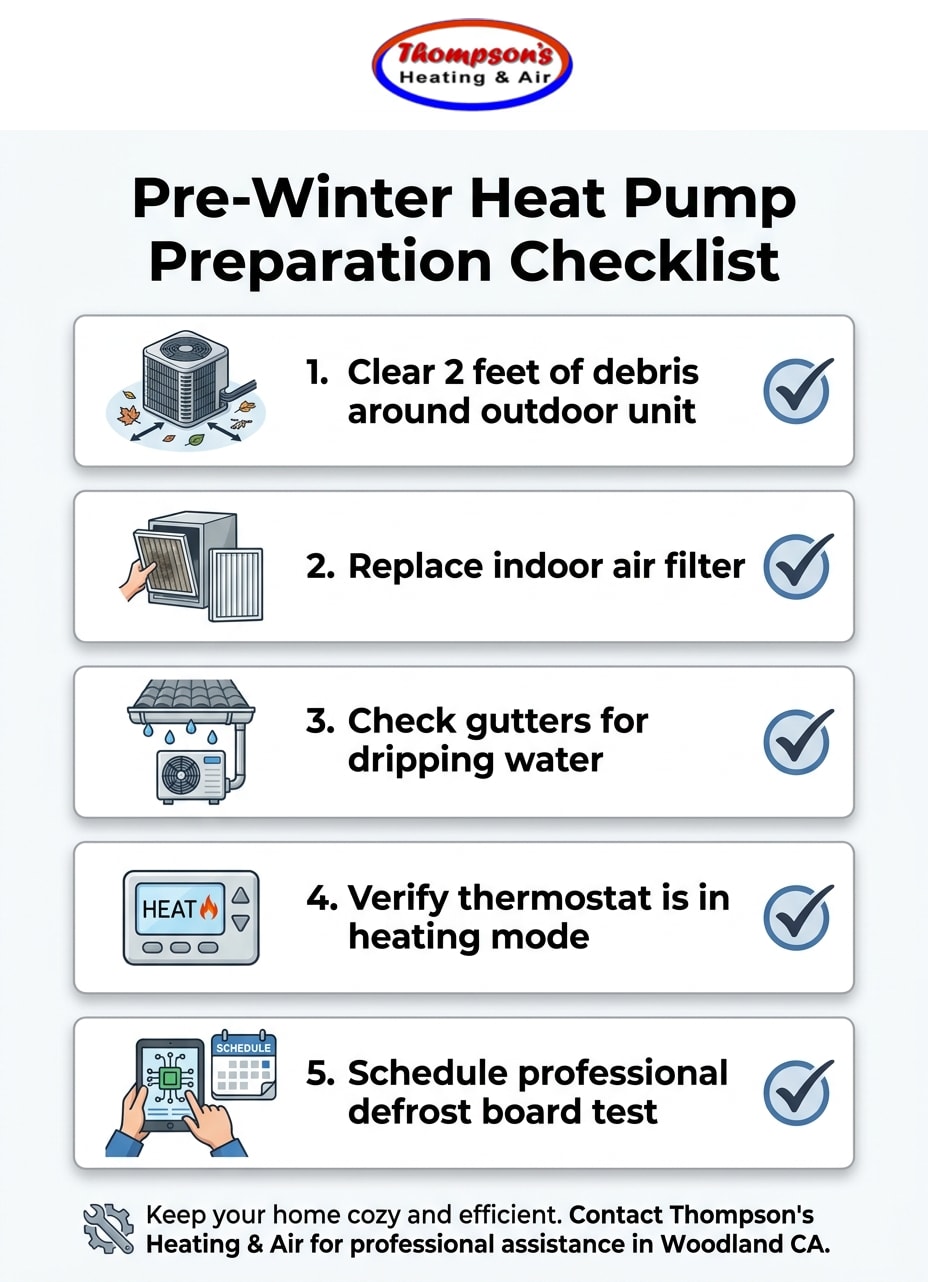
Before the November pre-winter overnight freezes arrive, there are several actionable steps you can take without crossing into dangerous or complex professional territory. Proper homeowner maintenance focuses heavily on airflow and environmental factors that surround the unit.
• Clear a 2-foot perimeter: Remove leaves, autumn debris, tall grass, and overgrown shrubs from around the outdoor unit. The system needs at least two feet of unobstructed clearance on all sides to pull in enough air.
• Inspect and replace indoor air filters: A clogged filter chokes the indoor blower motor, reducing the amount of warm air pushed into your living space and forcing the outdoor compressor to run longer cycles. Start the heating season with a fresh, high-quality filter.
• Check overhead gutters: Inspect the roofline and gutters directly above the heat pump. Ensure water won't drip directly onto the unit, as this dripping water will instantly freeze into a solid block of ice on the fan grille during cold nights.
• Verify thermostat settings: Ensure your thermostat is correctly switched to heating mode and programmed for your winter schedule. Test it on a mild evening to confirm the system responds promptly.
• Never cover the unit: Do not wrap or cover the heat pump entirely with tarps or custom covers. The system needs unrestricted airflow to extract ambient heat; covering it will completely disable its ability to heat your home.
Why Airflow is Your First Line of Defense
Restricted airflow is the fastest way to cripple a heat pump's efficiency. When debris buildup traps moisture against the unit, it worsens the frost issues caused by local fog. The compressor is forced to run longer cycles to compensate for the lack of air, which accelerates wear and tear on internal components. Clean filters and a clear outdoor perimeter prevent the indoor blower motor and outdoor fan from overworking, ensuring the system breathes easily.
• Outdoor Unit Clearance — Why it Matters for Winter Operation: Prevents recycled cold air from entering the system and stops debris from trapping moisture against the coils.
• Indoor Air Filter — Why it Matters for Winter Operation: Ensures maximum warm airflow into the home and prevents the blower motor from overheating.
• Overhead Gutters — Why it Matters for Winter Operation: Stops concentrated water from dripping onto the fan blades and freezing them in place overnight.
• Thermostat Schedule — Why it Matters for Winter Operation: Prevents the system from playing "catch up" during the coldest parts of the morning, saving energy.
The Defrost Cycle: Your Heat Pump's Winter Defense
For residents in Woodland CA and the Sacramento Valley, understanding the defrost cycle is vital. The specific combination of mild days and sudden freezing nights requires a highly responsive defrost control board to keep the system running.
The Problem: As we discussed earlier, ambient moisture freezes on the outdoor coils when the unit extracts heat from cold air. If left unchecked, this frost turns into a thick block of solid ice, suffocating the unit and preventing it from absorbing any heat whatsoever.
The Cause: High humidity, tule fog, and temperatures hovering between 30 and 40 degrees create the perfect storm for rapid ice accumulation. The system is functioning normally, but the environment is actively working against it.
The Solution: The defrost cycle. To melt this frost, the heat pump temporarily reverses its operation. It switches back into cooling mode for a few minutes, sending hot compressed refrigerant back to the outdoor coils instead of inside your home. During this brief period, the outdoor fan stops spinning so the heat can build up and melt the ice. You may even see a large cloud of steam rising from the unit—this is a normal and essential function during cold, damp weather.
Signs Your Defrost Cycle is Struggling
If the defrost cycle fails to trigger, the unit will become completely encased in ice, leading to total system failure. Watch for these warning signs:
• Uneven melting: Thick ice accumulation that doesn't clear fully after a cycle, leaving bands of frost on the coils.
• Constant running: The system runs continuously for hours without ever pausing to initiate a defrost cycle.
• Loud mechanical noises: Unusual grinding or buzzing noises coming from the outdoor compressor as it struggles against heavy ice buildup.
The High Cost of Ignoring Auxiliary Heat Issues
When November pre-winter overnight freezes hit and a heat pump cannot extract enough heat from the outside air—either due to extreme cold or a failing defrost cycle—it relies on a backup system. This backup is known as auxiliary (or emergency) heat. While it keeps your home warm, relying on it due to a malfunction is a costly mistake.
Auxiliary heat typically uses electric resistance strips located inside your indoor air handler. Think of these strips like the glowing coils inside a giant toaster. They are highly effective at generating heat, but electric resistance heating consumes significantly more energy than standard compressor operation. A heat pump's primary advantage is that it moves heat rather than creating it, which uses very little electricity. When forced to create heat via electric strips, your system loses that efficiency advantage entirely.
A malfunctioning heat pump—such as one with a broken defrost board or low refrigerant—will default to auxiliary heat to keep you comfortable. Because the home still feels warm, many homeowners don't realize the outdoor unit has failed until their winter utility bills spike dramatically. Recognizing when your system is stuck in auxiliary mode is critical for catching problems early. (For homes that struggle heavily with this, exploring standard heat pumps vs. dual-fuel systems can provide alternative backup heating options).
Monitoring Your Thermostat Indicators
Your thermostat is your first indicator that something is wrong. Look for the "Aux" or "Emergency Heat" indicator on the display. It is completely normal for the auxiliary heat to activate briefly while the outdoor unit is in a defrost cycle, as this prevents cold air from blowing through your vents while the system melts outdoor ice. However, continuous, hours-long use of auxiliary heat during normal winter temperatures is a massive red flag. Address constant auxiliary heat operation before the coldest months arrive to protect your energy budget.
What a Professional Diagnostics Visit Covers
While clearing debris and changing filters are great first steps, true winter reliability in Woodland CA and the Sacramento Valley requires professional oversight. There are specific, highly technical checks a licensed technician performs that homeowners simply cannot safely attempt. At Thompson's Heating & Air, our team's expertise in diagnosing defrost controls before the first freeze hits is designed specifically to prevent the frantic emergency calls we typically see when the weather turns.
During routine heating maintenance, a professional technician will execute a comprehensive diagnostic sequence:
1. Testing the Defrost Control Board: Technicians force the system into a defrost cycle to ensure the board and temperature sensors trigger at the exact correct moment. If these sensors are degraded, the system will either defrost too often (wasting energy) or not at all (causing freeze-ups).
2. Measuring Refrigerant Levels: Refrigerant charge is measured precisely. Low refrigerant severely impacts heating capacity and makes the defrost cycle highly inefficient, leading to rapid icing.
3. Inspecting Electrical Components: Connections, contactors, and capacitors are inspected for wear and tear sustained during the long summer cooling season. Weak capacitors are a leading cause of winter compressor failure.
4. Verifying the Reversing Valve: The reversing valve is the mechanical heart of a heat pump. Technicians test it to guarantee it shifts smoothly and completely between heating and cooling modes without sticking.
Why DIY Diagnostics Fall Short
Testing control boards requires specialized multimeters and deep electrical knowledge to read voltage drops safely. Handling refrigerant requires strict EPA certification and highly specific manifold gauges. Improper adjustments to the electrical or refrigerant systems can permanently damage the compressor, turning a simple tune-up into a catastrophic failure. Always leave internal diagnostics to certified professionals.
Frequently Asked Questions About Winterizing Heat Pumps
Should I cover my heat pump in the winter?
No, you should never cover your heat pump while it is operational. The system requires a massive, unrestricted flow of ambient air to extract heat for your home. Covering the unit will suffocate the system, cause severe internal damage, and completely prevent it from heating your house.
How do I prepare my outside heat pump for winter?
Start by clearing at least two feet of space around the entire unit, removing leaves, branches, and tall grass. Check your overhead gutters to ensure water won't drip onto the unit and freeze. Finally, schedule a professional inspection to verify the refrigerant levels and test the defrost control board before the freezing weather arrives in Woodland CA and the Sacramento Valley.
Why is my heat pump in defrost mode?
Defrost mode is a normal, vital function that melts frost off the outdoor coils during cold, damp weather. The system temporarily reverses into cooling mode to send warm refrigerant outside, stopping the outdoor fan to let heat build up and melt the ice. Once the ice is cleared, it automatically returns to heating your home.
At what temperature does a heat pump become inefficient?
Modern heat pumps are highly advanced and can extract heat even when temperatures drop below freezing. However, as temperatures dip into the 20s and below, the system has to work much harder, and efficiency gradually decreases. At this point, the system may rely on auxiliary electric heat strips to supplement the warmth.
Why is my heat pump blowing cold air in the winter?
If your heat pump is blowing cold air, it may currently be in a defrost cycle, which temporarily sends cooler air indoors (though auxiliary heat usually offsets this). If the cold air is continuous, you likely have a mechanical issue, such as a stuck reversing valve, low refrigerant, or a failing compressor that requires immediate professional diagnostics.
How does high humidity and fog affect my heat pump's performance?
High humidity and dense fog introduce excessive moisture to the outdoor coils. When the coils drop below freezing to absorb heat, this moisture instantly turns to frost. This forces the system to run its defrost cycle much more frequently to clear the ice, which can temporarily reduce overall heating efficiency.
Secure Your Comfort Before the Cold Settles In
Taking proactive steps now ensures your system won't leave you shivering in the cold during a sudden temperature drop. The November pre-winter overnight freezes are unforgiving to neglected HVAC systems, but combining safe homeowner checks with professional diagnostics provides total peace of mind. Don't wait for your system to get stuck in expensive auxiliary heat. Schedule comprehensive heat pump maintenance today to verify your defrost cycle and refrigerant levels are fully prepared for the season.