
Standard Heat Pumps vs. Dual-Fuel Systems for Yolo County's Mild Winters

Why Late Summer AC Troubles Force a Pre-Fall Heating Decision
Late August in the Sacramento Valley is notoriously unforgiving, and a struggling air conditioner is the last thing you want to deal with. But when your cooling system finally fails at the end of the season, it forces a much larger conversation about your home's year-round comfort. If you are facing a late summer or pre-fall system upgrade, evaluating Standard Heat Pumps vs. Dual-Fuel Systems for Yolo County's Mild Winters is the most critical step you can take to secure your home's comfort before the weather turns.
If you are ready to explore your options right away, scheduling a professional heat pump installation ensures your home is prepared for whatever the changing seasons bring.
Many homeowners wonder why a broken air conditioner means they need to think about heating. The reality of modern HVAC design is that your indoor and outdoor units operate as a matched pair. The indoor coil that distributes crisp, cool air in August is the exact same component that will distribute warm air in November. Replacing just the outdoor AC unit while leaving an aging furnace inside creates a severe mismatch in efficiency, often leading to premature breakdowns and voided warranties.
Because you are replacing the entire system anyway, this late-summer window presents a unique opportunity. You are no longer just buying an air conditioner; you are choosing your home's heating strategy for the next fifteen years. The core decision comes down to two distinct paths: transitioning to a fully electric heating and cooling system, or maintaining a hybrid setup that keeps a natural gas furnace as a reliable backup.
Making this choice requires looking beyond generic national advice. A system that works perfectly in sunny Southern California or snowy Minnesota might struggle here. You need a solution specifically tailored to the unique atmospheric conditions of the Sacramento Valley.
Understanding the Baseline: Heating Efficiency in the Sacramento Valley
To make an informed choice between these two technologies, you first need to understand how modern electric heating operates. Unlike older electric wall heaters or baseboards that generate heat by burning massive amounts of electricity, modern heat pumps use electricity simply to move heat from one place to another. Even when it feels chilly outside, there is still ambient thermal energy in the outdoor air. The system captures this energy, compresses it to raise the temperature, and pumps it into your living space.
This process is highly efficient, which is why you hear so much about heat pump benefits for Sacramento Valley homeowners. Because our region rarely sees extended periods of sub-zero temperatures, these systems do not have to work nearly as hard as they would in harsher northern climates. For homes in Woodland CA and Yolo County valley areas, this technology provides an incredibly effective baseline for winter comfort.
The All-in-One Comfort Advantage
The most significant operational advantage of this technology is its dual nature. The exact same equipment that fights off triple-digit heat waves in July simply reverses its operation to provide warmth in December.
• Seamless seasonal transitions: You do not have to worry about shutting down one system and firing up another. The thermostat automatically handles the switch from cooling to heating as fall weather sets in.
• Consistent temperature regulation: Instead of the massive blasts of hot air associated with older furnaces, electric systems provide a steady, continuous stream of gentle warmth that maintains an even temperature throughout the house.
• Simplified maintenance: With only one primary system handling your climate control, you streamline your annual tune-ups and filter changes.
While this all-in-one approach sounds perfect on paper, the reality of our local weather introduces a few specific challenges that every homeowner needs to anticipate.
The Challenge of Tule Fog and Chilly Valley Mornings
If you have lived in the valley for more than a year, you are deeply familiar with tule fog. This thick, ground-level radiation fog settles into the region during late fall and winter, creating conditions that heavily impact how your HVAC equipment performs. The challenge is not just the temperature—it is the heavy moisture suspended in the air.
When you encounter near-freezing valley morning temperatures, the high humidity fundamentally changes how cold the air feels. Damp cold pulls heat away from the body much faster than dry cold. A 38-degree morning in the valley often feels much more biting than a 25-degree morning in a dry mountain climate. This same thermodynamic principle applies to your outdoor heating equipment.
How Moisture Affects Defrost Cycles
As your outdoor unit pulls thermal energy from the chilly, damp morning air, the temperature of the outdoor coil drops below freezing. The heavy moisture from the tule fog immediately condenses on this freezing coil, rapidly turning into a layer of frost and ice. If left unchecked, this ice block would completely stop the system from absorbing heat.
To protect itself, the system initiates a mandatory "defrost cycle." Here is exactly what happens during this process:
1. The system temporarily reverses: The unit switches back into air conditioning mode for a few minutes, sending hot refrigerant out to the exterior coil to melt the accumulated ice.
2. The outdoor fan stops: The fan shuts off to allow the heat to build up quickly and melt the frost.
3. Indoor backup heat engages: Because the system is technically in cooling mode to melt the outdoor ice, it must activate a secondary heat source inside to prevent blowing cold air into your living room.
This cycle is entirely normal, but it represents the most significant comfort gap for homeowners. During a defrost cycle, you might notice a brief drop in warm air delivery or a temporary lukewarm draft. Understanding how each type of system handles this specific damp-cold scenario is the key to choosing the right upgrade.
Standard Heat Pumps: The 100% Electric Route
A standard heat pump operates entirely on electricity, meaning you can completely disconnect your heating system from natural gas. For many homeowners focused on long-term sustainability and reducing fossil fuel dependence, this is the ideal path forward.
Modern heat pump systems utilize advanced variable-speed inverter compressors. Instead of simply turning on at full blast and shutting off, these compressors ramp up and down in tiny increments, much like the accelerator pedal on a car. This allows them to extract heat efficiently even when outdoor temperatures drop into the 30s.
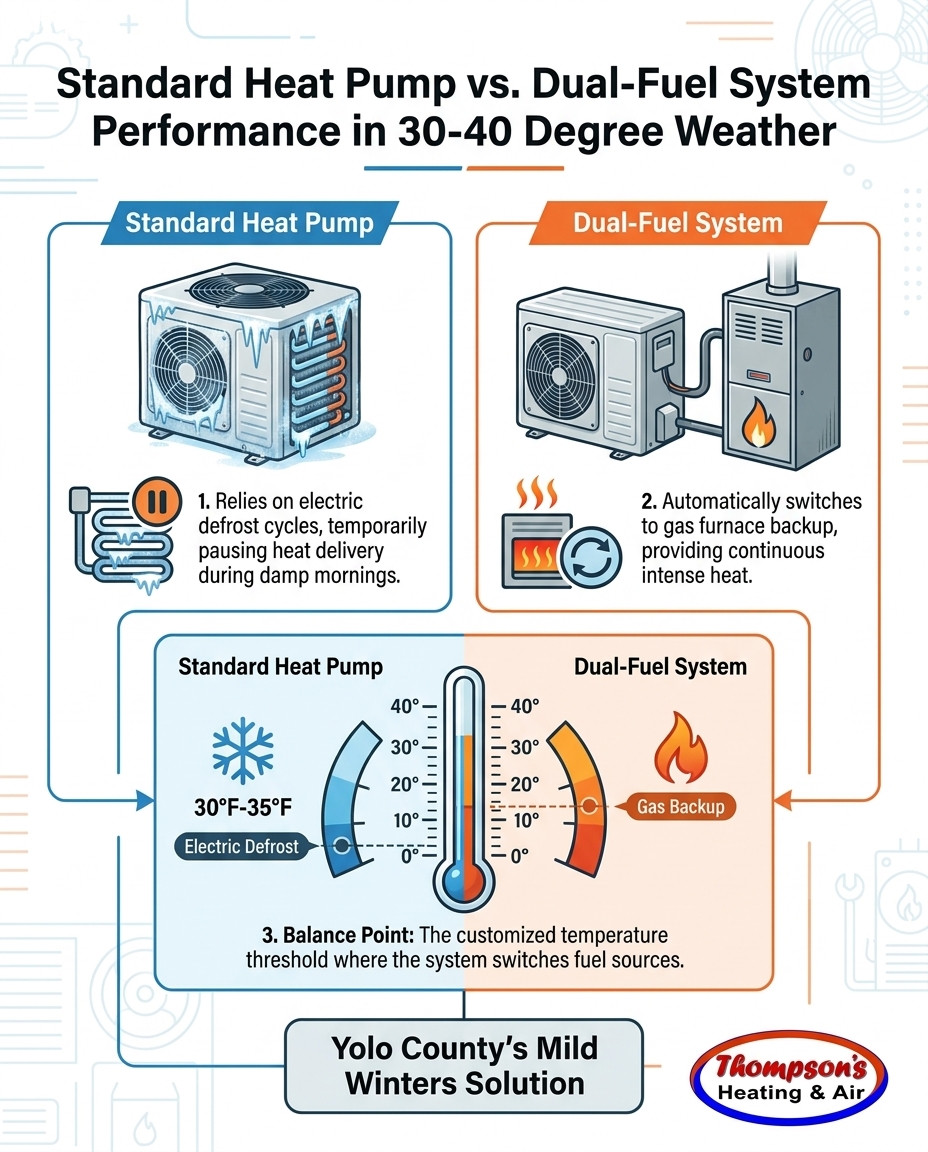
However, because a standard system lacks a gas furnace, it relies on electric resistance heat strips for backup during those damp, freezing mornings and mandatory defrost cycles. These heat strips function like the glowing coils inside a toaster. They are highly effective at generating warmth, but they consume a significant amount of electricity to do so.
Efficiency and Incentive Programs
Choosing a fully electric system often aligns with broader energy goals. By utilizing renewable electricity sources, you can significantly reduce your home's carbon footprint over the 15-year lifespan of the equipment.
Furthermore, local and federal energy programs heavily favor the transition to high-efficiency electric heating. Qualifying installations may be eligible for generic federal tax credits or utility rebates designed to encourage electrification. While these programs change frequently, leveraging them can help offset the initial investment of a premium, high-efficiency system. Always verify current program details with your utility provider or a qualified tax professional.
Dual-Fuel Systems: Integrated Gas Furnace Backup
A dual-fuel system—often called a hybrid system—combines the high-efficiency electric cooling and moderate heating of a heat pump with the intense, rapid heating power of a natural gas furnace. You get the best of both worlds, utilizing the most efficient fuel source based on the exact temperature outside.
During a mild 55-degree afternoon, the electric side of the system handles the workload effortlessly, using very little energy to keep your home comfortable. But as the sun goes down and the heavy valley fog rolls in, the system constantly monitors the outdoor temperature. Once the weather drops below a specific threshold—known as the balance point—the system automatically shuts down the outdoor electric unit and fires up the indoor gas furnace.
If you are planning a heating installation, this hybrid approach offers distinct advantages for our specific microclimate. Natural gas provides a much hotter, more intense heat out of the registers than electric resistance strips. When you wake up to a damp, 35-degree morning, the gas furnace quickly blasts away the chill, raising the indoor temperature rapidly without straining your electrical panel.
Seamless Switching for Uninterrupted Comfort
The true genius of a dual-fuel setup lies in the smart thermostat that controls it. You never have to manually choose between gas or electric.
• Precision balance points: The thermostat is programmed to know exactly when the electric system loses its efficiency advantage, automatically making the switch to gas.
• Eliminating defrost drafts: Because the system switches to the gas furnace during freezing temperatures, the outdoor unit rarely needs to run a defrost cycle. You avoid those temporary periods of lukewarm air entirely.
• Redundancy and reliability: If a severe winter storm causes a disruption in one energy market, you have a secondary heating method already built into your home.
Side-by-Side Comparison: Which System Fits Your Home?
To help you weigh the operational differences, this breakdown highlights how each system responds to the specific demands of a Sacramento Valley winter.
• Performance in 30-40° Damp Fog — Standard 100% Electric System: Requires periodic defrost cycles; relies on electric heat strips for backup warmth. — Dual-Fuel (Hybrid) System: Automatically switches to gas furnace; avoids defrost cycles entirely.
• Primary Energy Source — Standard 100% Electric System: 100% Electricity (ideal for homes with substantial solar production). — Dual-Fuel (Hybrid) System: Electricity for mild weather; Natural Gas for freezing temperatures.
• Indoor Air Temperature Delivery — Standard 100% Electric System: Steady, moderate warmth; may feel cooler during a defrost cycle. — Dual-Fuel (Hybrid) System: Intense, rapid heat during cold snaps when the gas furnace engages.
• Environmental Impact — Standard 100% Electric System: Zero direct on-site emissions; maximizes renewable energy usage. — Dual-Fuel (Hybrid) System: Reduces gas usage significantly, but still relies on fossil fuels for backup.
• Ideal Home Profile — Standard 100% Electric System: Homes looking to cap gas lines, utilize solar, and maximize electrification incentives. — Dual-Fuel (Hybrid) System: Homes that prioritize rapid morning heat and want to avoid cold drafts entirely.
Why Local Microclimate Sizing Matters More Than National Averages
One of the biggest mistakes homeowners make during a late-summer upgrade is relying on broad national climate zones to size their equipment. The Sacramento Valley is a unique microclimate. A system sized for the dry heat of Arizona will fail to manage our winter humidity, and a system sized for the deep freezes of the Midwest will be wildly oversized for our moderate falls.
We see the confusion this causes firsthand. Recently, a local homeowner comparing HVAC vendors for a new installation found that many companies struggled to explain the technical nuances of sizing these systems for our specific valley conditions. After our staff provided knowledgeable, technical answers regarding how different setups handle tule fog and balance points, the homeowner felt confident moving forward with a tailored solution. That local expertise is exactly what ensures long-term comfort.
Setting the correct balance point for a dual-fuel system requires deep technical expertise. If the switchover point is set too high, you waste money burning gas when the electric unit could easily handle the load. If it is set too low, you force the electric unit to struggle through heavy ice buildup, resulting in a cold, uncomfortable house.
Professional load calculations tailored specifically to valley homes account for your property's insulation, window placement, and sun exposure. Whether you need an entirely new setup or just reliable heat pump repair in Woodland, working with technicians who understand local weather patterns is non-negotiable.
Frequently Asked Questions About Heating Upgrades in Yolo County
At what temperature is a standard heat pump no longer effective?
Modern electric systems remain highly effective down to about 30 degrees Fahrenheit. Below this threshold, the system has to work significantly harder to extract thermal energy, often relying on auxiliary heat strips to make up the difference. While the system will still keep your home warm, the efficiency drops, which is why proper sizing for our local climate is so critical.
How does a dual fuel system work in mild winters?
During mild winter days, a dual-fuel setup operates almost exclusively on electricity, utilizing the highly efficient heat pump to maintain your indoor temperature. The gas furnace remains completely dormant until the outdoor temperature drops below the customized balance point. This allows you to maximize energy efficiency during the day while keeping powerful gas heat in reserve for freezing nights.
Do I need a dual fuel heat pump in California?
You do not strictly need one, but it is often highly recommended for homes in the valley that experience damp, near-freezing mornings. While Southern California homes do perfectly fine with 100% electric systems, our local tule fog and chilly mornings can cause standard units to run frequent defrost cycles. Having a gas backup eliminates the temporary cold drafts associated with those cycles.
What is the downside to a dual fuel heat pump?
The primary downside is the initial complexity and the requirement to maintain two distinct energy sources. You still have to pay a base connection fee to your natural gas provider, and the system requires maintenance for both the electric refrigerant components and the gas combustion components. Additionally, you will not be completely independent from fossil fuels.
Is a standard heat pump enough for Sacramento Valley winters?
Yes, a properly sized standard unit is more than capable of keeping a Sacramento Valley home warm throughout the winter. Because our temperatures rarely stay below freezing for extended periods, the system will operate efficiently for the vast majority of the season. You simply need to be prepared for the occasional defrost cycle on particularly cold, damp mornings.
How does valley fog affect my outdoor heating unit?
Heavy valley fog introduces excessive moisture into the cold air, which quickly condenses and freezes onto the outdoor coils of your unit. This ice buildup acts as an insulator, preventing the system from absorbing ambient heat. To resolve this, the unit must temporarily pause its heating function to run a defrost cycle, melting the ice before resuming normal operation.
Make a Confident Upgrade Choice Before Fall Arrives
Dealing with a failing air conditioner at the end of summer is frustrating, but it provides the perfect opportunity to rethink your home's entire climate control strategy. By upgrading your system before the fall weather sets in, you avoid the panic of a mid-winter breakdown and ensure your home is equipped to handle everything from mild autumn afternoons to freezing, damp January mornings.
The right choice between a fully electric setup and a hybrid gas system depends entirely on your specific comfort preferences, your home's existing infrastructure, and your long-term energy goals. You do not have to make this decision alone. Reach out for a personalized system evaluation, and our team will help you navigate the technical details so you can make a confident, lasting choice for your home's comfort.



.avif)
.avif)
.png)
