
Cracking the Code of Manual J Load Calculations


Why Understanding How HVAC Load Calculations Work Can Save You From a Costly Mistake
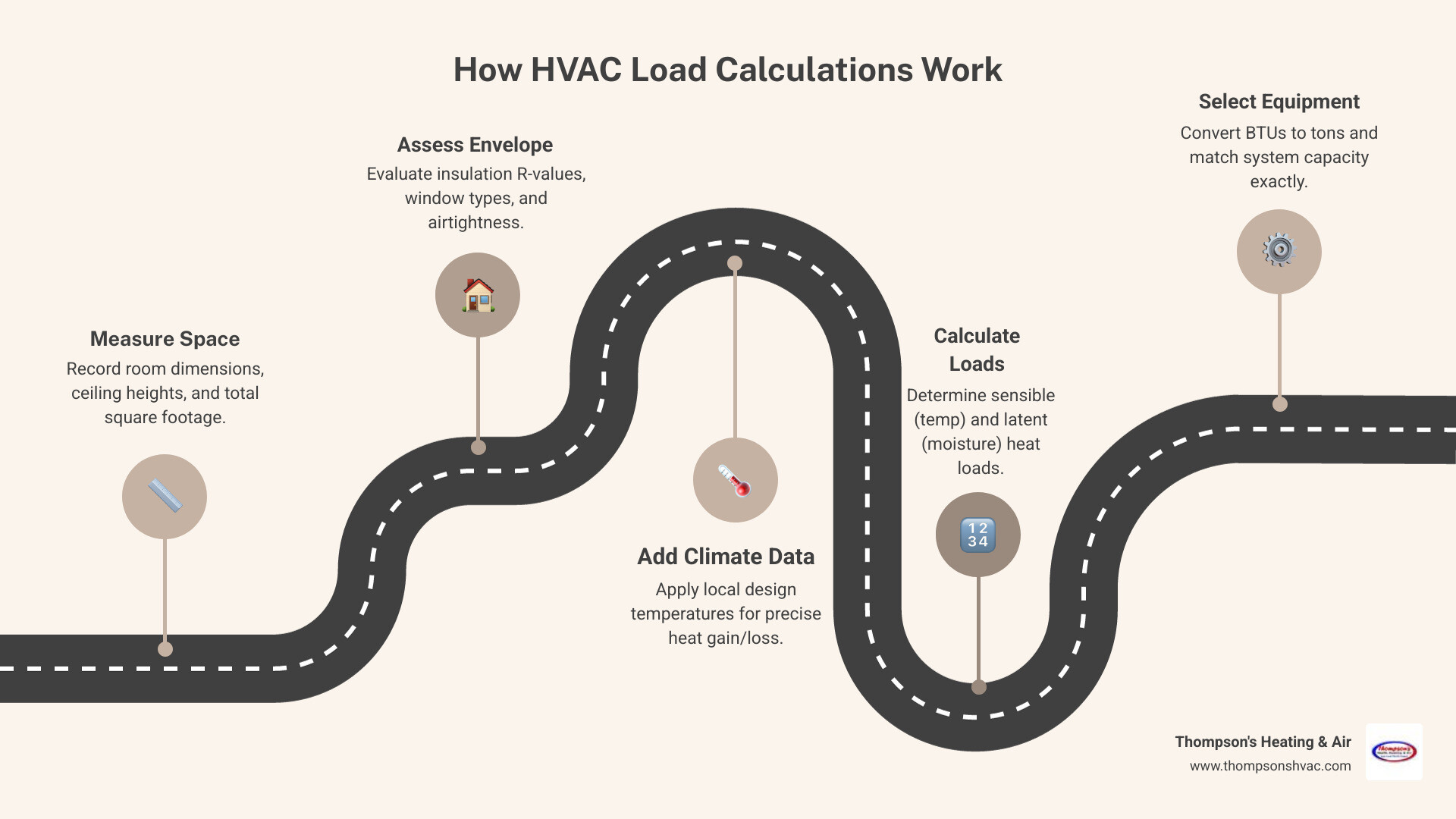
How HVAC load calculations work is one of the most important things to understand before replacing or installing a heating or cooling system in your Woodland, CA home. Here's a quick breakdown:
How HVAC Load Calculations Work — Quick Summary:
1. Measure the space — Room dimensions, ceiling heights, and total square footage are recorded.
2. Assess the building envelope — Insulation R-values, window types, and airtightness are evaluated.
3. Factor in climate data — Local design temperatures for Woodland, CA are applied.
4. Calculate heat gain and heat loss — Both sensible (temperature) and latent (moisture) loads are determined.
5. Account for internal gains — Occupants, appliances, and lighting all add heat to a space.
6. Run the Manual J calculation — All data is entered into ACCA-approved software for a precise result in BTUs per hour.
7. Convert to tonnage — The total BTU load is divided by 12,000 to determine required system capacity in tons.
8. Select equipment — A system is chosen that matches the calculated load as closely as possible.
Here's the problem most homeowners in Woodland and Yolo County never see coming: their HVAC system is the wrong size — and nobody told them. Research suggests that roughly 1 in 3 HVAC systems installed in homes across the country are oversized. That means the unit runs in short bursts, never properly removes humidity from the air, wears out faster, and still leaves rooms feeling uncomfortable. Undersized systems have the opposite problem — they run constantly, drive up energy bills, and struggle to keep up on the hottest or coldest days of the year.
The root cause of both problems is almost always the same: a load calculation that was skipped, guessed at, or done using an outdated square footage rule of thumb. Getting the sizing right requires a real, structured process — and that's exactly what this guide walks you through.
What is an HVAC Load Calculation and Why is it Essential?
At its simplest, an HVAC load calculation is a mathematical determination of exactly how much heating and cooling energy a building needs to stay comfortable. We often refer to this as the "Goldilocks" principle of HVAC sizing: we don't want a system that is too big or too small; we want one that is just right.
To understand the math, we first have to look at the units of measurement. In the HVAC world, we measure energy in BTUs (British Thermal Units). One BTU is the amount of heat required to raise the temperature of one pound of water by one degree Fahrenheit. When we talk about air conditioners or furnaces, we measure their "capacity" in BTUs per hour.
Understanding Tons of Refrigeration
You have likely heard HVAC professionals refer to a "3-ton" or "5-ton" unit. This doesn't refer to how much the equipment weighs on a scale. Instead, it is a historical term based on the cooling power of actual ice.
• 1 Ton of Refrigeration = 12,000 BTUs per hour.
• A 2,500 sq. ft. home might require approximately a 5-ton AC unit (60,000 BTUs), but this varies wildly based on the home's construction.
Why is this essential? Without an accurate HVAC Installation, Maintenance & Repair plan based on a load calculation, you are essentially guessing. Proper system sizing ensures that your equipment operates at peak energy efficiency, maintains consistent temperatures across every room, and stays within code compliance for modern energy standards in 2026.
How HVAC Load Calculations Work: The Manual J Standard
When professionals talk about doing things "by the book," the book they are referring to is Manual J. Developed by the Air Conditioning Contractors of America (ACCA), Manual J is the industry-recognized standard for residential load calculations.
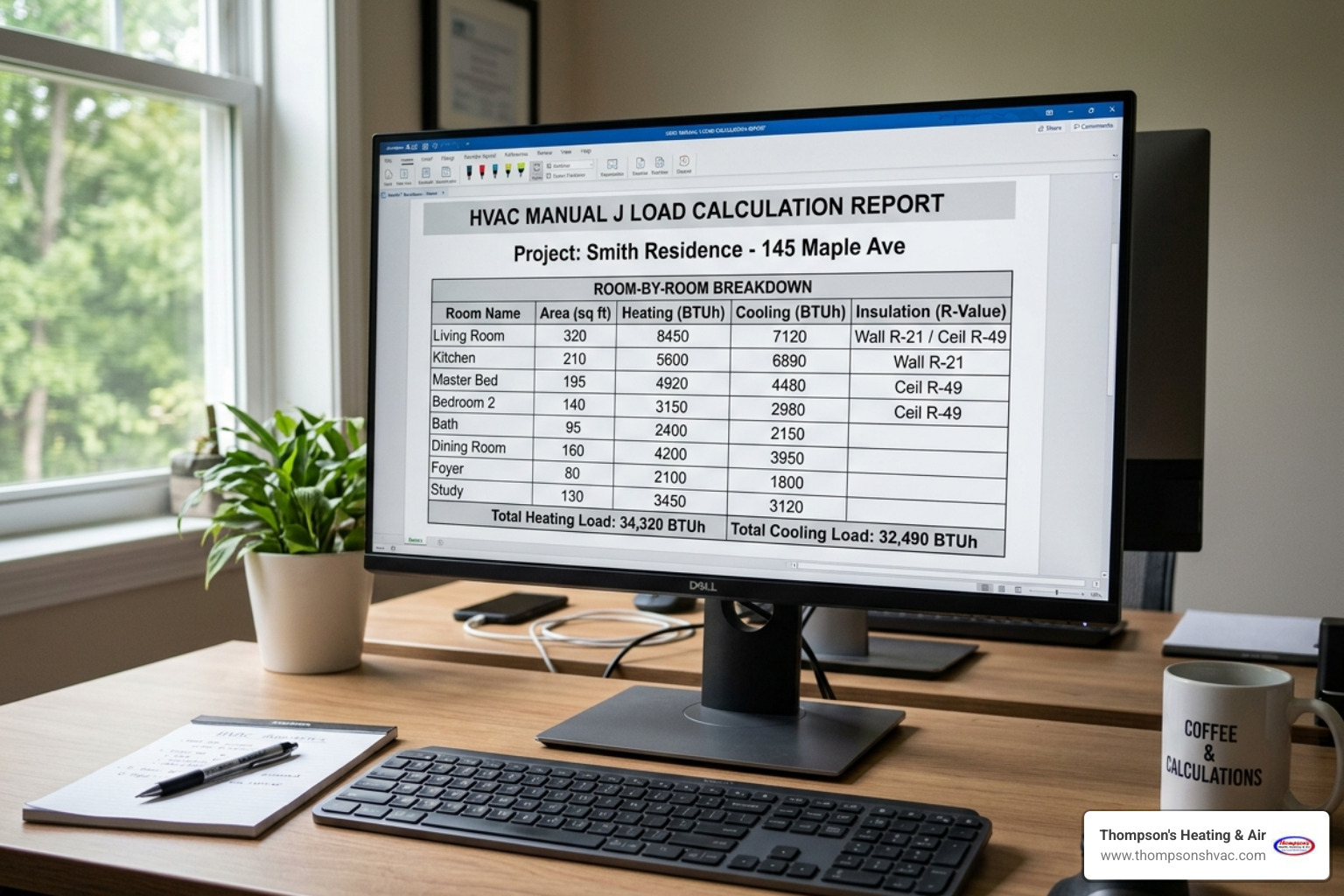
Unlike old-school methods that just looked at the total square footage of a house, Manual J requires a room-by-room analysis. We look at every individual space to determine two things:
1. Heat Loss: How much heat escapes the room during a chilly Winters or Davis night?
2. Heat Gain: How much heat enters the room during a blistering 105-degree afternoon in Woodland?
Rules of Thumb vs. Precision
For decades, many contractors used a "rule of thumb" suggesting one ton of capacity for every 500 to 600 square feet. While this is a fine way to get a "ballpark" estimate, it is a dangerous way to buy equipment. Two houses in West Sacramento could both be 2,000 square feet, but if one has modern dual-pane windows and R-38 attic insulation while the other has original single-pane glass and thin insulation, their HVAC needs will be completely different.
Using HVAC Maintenance and Repair data and Manual J software allows us to move past these limitations. We aren't just looking at the floor; we’re looking at the walls, the ceiling, and the sky.
Key Factors That Influence How HVAC Load Calculations Work
To get a precise Manual J result, we have to feed the software specific data points about your home’s "building envelope"—the physical barrier between the indoors and outdoors.
• Insulation R-values: We check the attic, walls, and floors. Higher R-values mean better resistance to heat flow.
• Window U-factors and SHGC: We look at how well your windows keep heat in (U-factor) and how much solar radiation they let in (Solar Heat Gain Coefficient).
• Home Orientation: A room with giant south-facing windows in Dixon will get significantly hotter in the afternoon than a north-facing room.
• Occupancy and Internal Gains: People generate heat (about 250–400 BTUs per hour depending on activity). Appliances, LED lighting (which produces less heat than old bulbs), and even your TV contribute to the "internal load."
Sensible vs. Latent Heat: Balancing Temperature and Humidity
One of the biggest misconceptions about air conditioning is that its only job is to lower the temperature. In reality, a high-quality system must manage two different types of heat loads.
1. Sensible Heat Load: This is the heat you can feel and measure with a standard thermometer. When we lower the "dry bulb" temperature in your home, we are tackling the sensible load.
2. Latent Heat Load: This is the heat held in moisture (humidity). In humid climates, or even during a muggy Northern California morning, your AC must work to wring the water out of the air.
If a contractor skips a proper Heating and Air Estimate, they might install a unit that is great at cooling the air (sensible) but terrible at removing moisture (latent). This leads to a home that feels "cold and clammy."
We use tools like psychrometric charts to understand the relationship between air temperature and moisture. A key metric we look for is the Sensible Heat Ratio (SHR). If your home has a high latent load—perhaps from lots of indoor plants, frequent cooking, or poor air sealing—we need to select equipment that can handle that specific moisture balance. This is critical for maintaining healthy indoor air quality and preventing mold growth.
Step-by-Step: How HVAC Load Calculations Work in Practice
So, what does the process actually look like when we visit your home in Yolo County? It isn't just a guy with a clipboard making a guess. It is a data-driven investigation.
Step 1: Data CollectionWe walk through the home, measuring every room and noting the direction each window faces. We verify insulation levels in the attic and crawlspace. In many cases, we may perform a blower door test. This involves mounting a powerful fan to an exterior door frame to depressurize the house, allowing us to measure exactly how much air is leaking through cracks and gaps.
Step 2: Applying Design TemperaturesWe don't size a system for the hottest day ever recorded in history, nor for a mild spring day. We use ASHRAE climate data, which provides "design conditions." For heating, we typically look at the 99% or 99.6% annual percentiles. This ensures your system can handle the vast majority of weather events in Woodland without being grossly oversized for the rest of the year.
Step 3: Software Entry and AnalysisAll those measurements—the R-values, the window specs, the square footage, and the local weather data—are entered into ACCA-approved software. This generates the total BTU requirement for the home.
Step 4: Manual S and Manual DOnce we have the Manual J "load," we move to Manual S, which is the process of selecting the specific equipment that matches that load. Finally, we use Manual D to ensure your ductwork is sized correctly to deliver the exact amount of air (measured in Cubic Feet per Minute, or CFM) that the new system produces. A typical system produces about 400 CFM per ton of air conditioning.
The Dangers of Oversized and Undersized Systems
Many homeowners think "bigger is better." They assume that if a 3-ton unit is good, a 4-ton unit will be even faster at cooling the house. In the HVAC world, this is a recipe for disaster.
The Problem with Oversizing
When a system is too large for the space, it reaches the thermostat's target temperature too quickly. This is called short cycling. Because the unit only runs for a few minutes at a time, it never gets the chance to remove humidity. The cooling coils need time to get cold enough to condense water out of the air.
• Result: High humidity, uneven temperatures, and increased wear and tear on the compressor, leading to a shorter lifespan for the equipment.
The Problem with Undersizing
An undersized system will run 24/7 during a heatwave and still fail to keep the house at 72 degrees. This leads to massive energy bills and a system that burns out prematurely because it never gets a break.
• Cycle Length — Oversized System: Short, frequent bursts — Undersized System: Constant, never-ending
• Humidity Control — Oversized System: Poor (Clammy feeling) — Undersized System: Moderate (but air stays warm)
• Energy Bills — Oversized System: High (due to startup surges) — Undersized System: Very High (due to constant run time)
• System Lifespan — Oversized System: Shortened (compressor wear) — Undersized System: Shortened (overworked motor)
• Comfort — Oversized System: Hot/Cold spots — Undersized System: Consistently too warm/cold
Frequently Asked Questions about HVAC Sizing
Is the square footage rule of thumb accurate for Woodland homes?
In short: No. While the rule of 500–600 square feet per ton is a common starting point, it is far too imprecise for modern standards. A home built in the 1970s in the Zamora or Arbuckle area will have vastly different thermal properties than a new build in Natomas, even if they are the exact same size. Relying on this rule often leads to the 1-in-3 statistic of oversized systems.
When should I request a Manual J report from my contractor?
You should request a Manual J report whenever you are planning a system replacement or a major renovation. If a contractor provides a quote without taking measurements or asking about your insulation, they are guessing. A professional HVAC Installation, Maintenance & Repair specialist should always be able to show you the math behind their recommendation.
How do you convert BTUs to tons of refrigeration?
The math is simple: Divide the total BTUs by 12,000.
• Example: If your Manual J calculation says your home needs 36,000 BTUs of cooling, you divide 36,000 by 12,000 to get 3 tons.
• If the math comes out to something like 2.6 tons, your contractor will use Manual S to find the closest equipment match, often opting for a 2.5-ton unit if the home is well-sealed, or a 3-ton unit with variable-speed technology to handle the range.
Conclusion
Understanding how hvac load calculations work is the difference between a home that is "sort of cool" and a home that is perfectly comfortable and energy-efficient. At Thompson's Heating & Air, we don't believe in guesswork. Since 1992, we have served the Yolo County community—from Woodland and Davis to West Sacramento and beyond—with a commitment to technical precision.
Our family-owned business treats every installation like it's for our own home. That means we take the time to measure, calculate, and verify before we ever turn a wrench. Whether you need a simple repair or a complete HVAC Installation, Maintenance & Repair solution, our NATE-certified technicians are here to ensure your system is sized "just right" for the Northern California climate.
Don't settle for a "rule of thumb" when your comfort and bank account are on the line. Contact us today to schedule a professional load calculation and experience the Thompson's difference.



.avif)
.avif)
.png)
