
Beating the Heat with These Valley Home Maintenance Tips

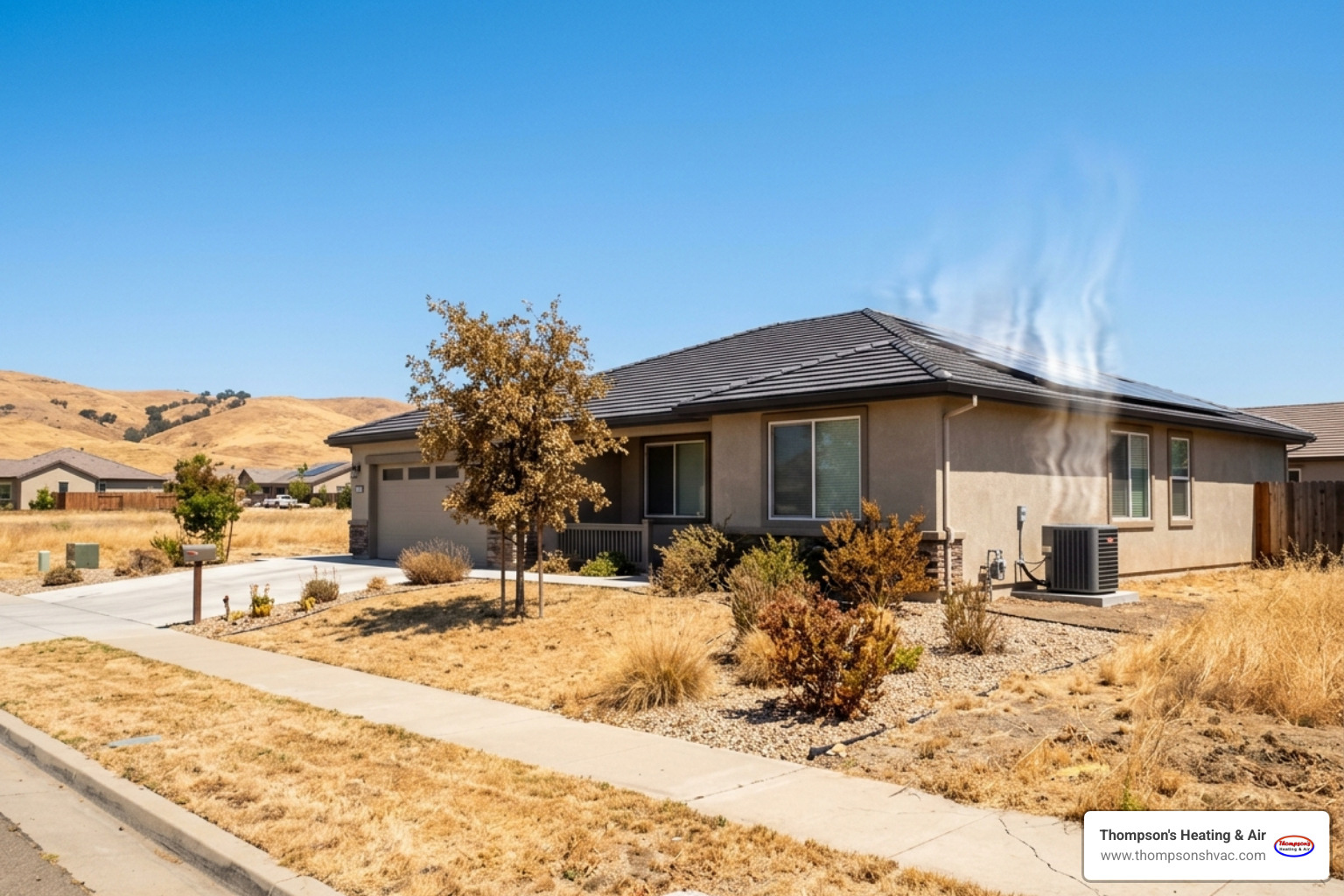
Why Sacramento Valley Heat Is Hard on Your Home's Mechanical Systems
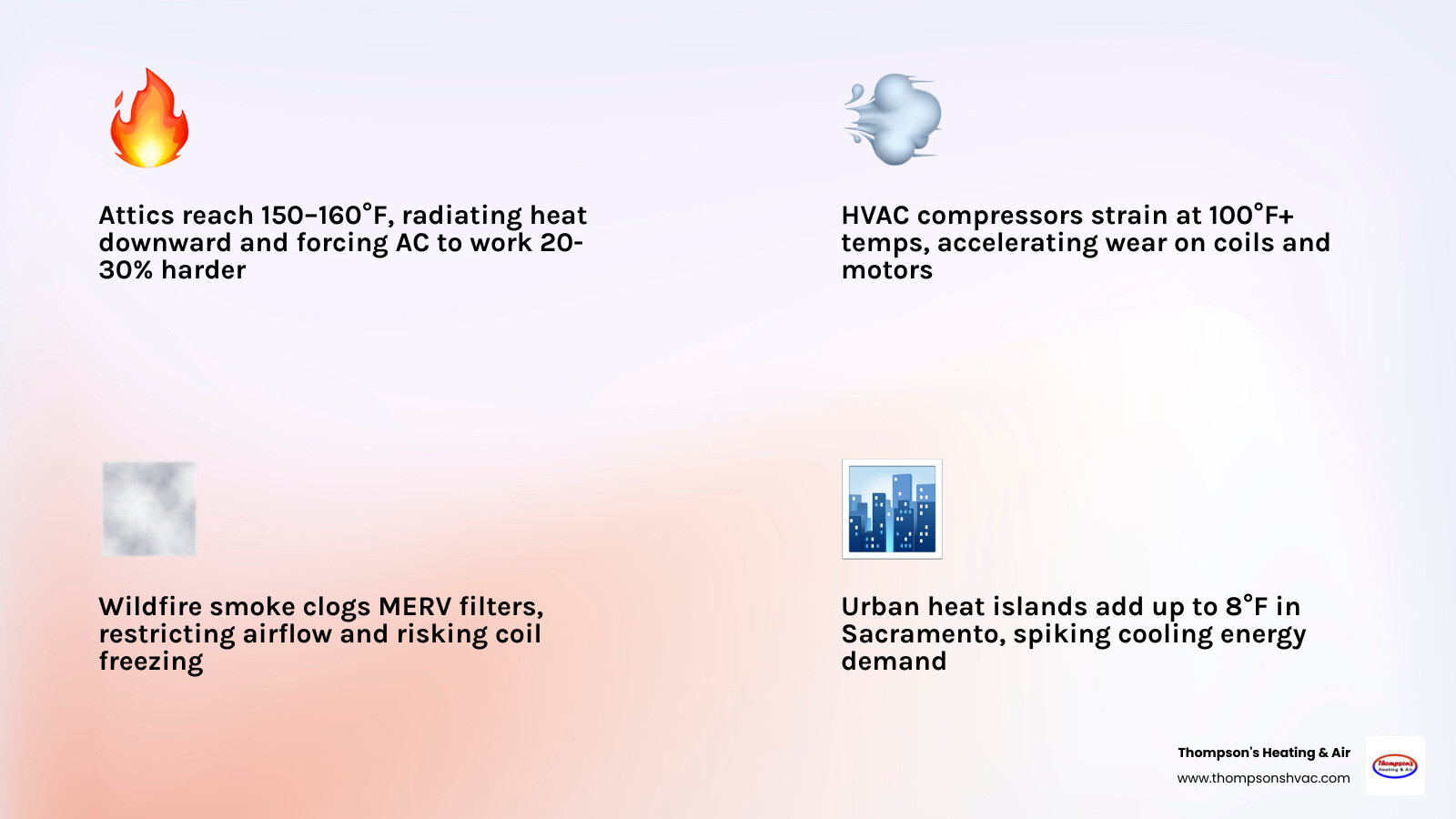
How Sacramento Valley heat affects your HVAC and fireplace is something every homeowner in the region needs to understand before summer arrives. Here's a quick breakdown:
At a glance — what extreme heat does to your home systems:
• HVAC cooling systems run continuously in triple-digit heat, operating near their design limits and wearing out faster
• Attics can reach 150–160°F on hot days, radiating heat downward and forcing your AC to work harder
• Compressors, coils, and motors experience accelerated wear during prolonged heat waves
• Gas fireplaces face dry seal deterioration, pilot light stress, and chimney drafting problems in hot, dry conditions
• Wildfire smoke clogs filters and restricts airflow, reducing efficiency exactly when you need it most
• Urban heat island effect adds up to 8°F to downtown Sacramento temperatures, increasing cooling demand even further
If you've lived through a Sacramento Valley summer, you already know the feeling. Temperatures climb past 100°F for days at a stretch. Your air conditioner runs without stopping. Certain rooms never quite cool down. And somewhere in the back of your mind, you wonder whether your system is going to make it through the season.
Sacramento's Mediterranean climate — with its blazing summers, periodic wildfire smoke, Delta breeze humidity spikes, and rapid fall transitions — creates a uniquely demanding environment for home comfort systems. In April 2026, with climate trends pointing toward more frequent and intense heat events, understanding how these conditions stress your HVAC equipment and fireplace isn't just useful — it's essential for protecting your home and your budget.
This guide breaks down exactly what's happening to your systems when the Valley heats up, and what you can do about it.
How Sacramento Valley Heat Affects Your HVAC and Fireplace Systems
When the thermometer in Woodland or Davis hits 105°F, your home becomes a thermal battlefield. Most people think of their air conditioner as a machine that "creates cold," but it’s actually a heat mover. Its job is to grab the heat inside your house and dump it outside. However, when the outside air is already scorching, that "dumping" process becomes much harder.
The primary way how sacramento valley heat affects your hvac and fireplace involves pure mechanical strain. As temperatures soar, the compressor — the heart of your AC — has to work at much higher pressures to move refrigerant. This generates internal heat within the unit itself, which can lead to oil breakdown and motor failure if the system isn't well-maintained.
Furthermore, we have to talk about your attic. On a typical 100°F day in the Valley, your attic can easily reach 150°F to 160°F. This massive reservoir of heat sits right above your living space, separated only by a layer of drywall and some insulation. This thermal radiation constantly pushes heat back into your home, forcing your HVAC system to fight every single BTU. To keep your home healthy during these times, ensuring your Indoor air quality solutions are up to par is a great first step in maintaining a comfortable environment.
Understanding the 20-Degree Rule and HVAC Limits
It is a common misconception that if you set your thermostat to 68°F on a 110°F day, your house will eventually get there. In reality, most residential HVAC systems are designed to maintain a 20-degree differential between the outdoor air and the indoor temperature.
If it’s 100°F outside, a healthy, well-sized system is doing its job perfectly if it keeps your living room at 80°F. When you see your AC running continuously during a heat wave, it’s often not "broken"—it’s simply reached its design limit. Setting the thermostat lower won't make the air coming out of the vents any colder; it just tells the system to keep running indefinitely, which leads to massive energy bills and premature component failure. We generally recommend a setting of 78°F when you are home to balance comfort with system longevity.
How Sacramento Valley Heat Affects Your HVAC and Fireplace Safety
You might not think about your fireplace when it's 105°F outside, but the heat is definitely thinking about it. For homeowners with gas fireplaces, extreme heat can dry out the rubber seals and gaskets in the gas valves. If these seals crack, you could face minor gas leaks or a system that won't ignite when winter finally arrives.
Additionally, the "stack effect" or chimney drafting can reverse during intense heat. Hot air outside is less dense than the cooler air inside your home. This can cause air to push down the chimney, bringing soot smells or even hot, dusty air into your living room. If you keep a standing pilot light on, that small flame adds constant heat to the fireplace glass and the surrounding wall, which, during a heat wave, is the last thing your AC needs to deal with.
Local Climate Factors: Urban Heat Islands and the Delta Breeze
In the Sacramento Valley, we have two unique weather phenomena that drastically change how our HVAC systems perform. First is the Urban Heat Island Effect. If you live in a more densely populated area like downtown Sacramento or parts of West Sacramento, the asphalt and concrete soak up sun all day and radiate it back out at night. This can keep local temperatures up to 8°F higher than in more rural spots like Esparto or Capay.
Then there’s our famous Delta Breeze. While we all love that cool air coming off the Bay, it brings a hidden challenge: humidity spikes. When the humidity rises, your HVAC system has to work twice as hard. Not only must it lower the temperature, but it also has to "wring" the moisture out of the air. This moisture collects on the evaporator coils, and if your airflow is restricted by a dirty filter, that moisture can actually freeze, turning your AC into a block of ice in the middle of a July afternoon.
Wildfire Smoke and Air Quality Challenges
April might seem early to talk about fire season, but preparation is key. In recent years, wildfire smoke has become a standard part of the Valley summer. Smoke isn't just bad for your lungs; it’s a silent killer for HVAC efficiency. Fine ash and particulates quickly clog standard air filters.
When a filter is clogged, the blower motor has to work harder to pull air through, which can lead to overheating. We often suggest upgrading to MERV 13 filters during smoke events, but you must ensure your system's fan is powerful enough to handle the increased resistance. For those concerned about the long-term effects of smoke on their home, exploring Advanced air purification services can provide a much-needed layer of defense.
How Sacramento Valley Heat Affects Your HVAC and Fireplace Efficiency
Efficiency isn't just about your monthly bill; it's about the "health" of your equipment. In our dry, hot climate, systems with high SEER2 ratings are becoming the gold standard. Modern units with variable-speed compressors are particularly effective because they don't just blast "on" or "off." They can throttle down to a lower speed, maintaining a steady temperature and better managing the humidity shifts brought by the Delta Breeze.
Maximizing Efficiency During Triple-Digit Heat Waves
To survive a week of 100°F+ days without a system breakdown, you need a multi-pronged approach. Your HVAC system is only one part of the equation; the "envelope" of your home—the walls, windows, and attic—is the other.
• Attic Insulation — Standard Impact: 3-5 inches (R-19) — High-Efficiency Impact: 10-14 inches (R-49)
• Windows — Standard Impact: Single pane (High heat gain) — High-Efficiency Impact: Double pane with Low-E coating
• Thermostat — Standard Impact: Manual (Constant adjustment) — High-Efficiency Impact: Smart/Programmable (Pre-cooling)
• HVAC Type — Standard Impact: Standard AC (Single stage) — High-Efficiency Impact: Heat Pump (Variable speed)
Upgrading your attic insulation is perhaps the most underappreciated home improvement in Yolo County. Moving from standard fiberglass batts to R-49 blown-in insulation can reduce the heat radiating into your home by a significant margin, directly lowering the load on your AC.
How Sacramento Valley Heat Affects Your HVAC and Fireplace Maintenance Schedule
Timing is everything. If you wait until the first 100°F day in June to call for a tune-up, you’ll likely find yourself on a two-week waiting list. We recommend scheduling your maintenance in early April.
A professional tune-up should include:
1. Coil Cleaning: Removing the "blanket" of dust and cottonwood seeds from your outdoor unit.
2. Refrigerant Check: Ensuring your system has the exact amount of "juice" needed to move heat.
3. Electrical Inspection: Tightening connections that expand and contract during heat cycles.
4. Duct Sealing: Making sure the cool air you pay for actually reaches your rooms instead of leaking into the 150°F attic.
Signs of System Failure Under Heat Stress
Your HVAC system will usually try to tell you it's struggling before it gives up completely. Watch for these warning signs:
• Tripped Breakers: If your AC trips the circuit breaker, it’s likely drawing too much power because the motor or compressor is overheating.
• Buzzing or Grinding: These are the sounds of mechanical components reaching their breaking point.
• Ice on the Lines: If you see ice on the copper pipes outside or the unit inside, stop! Turn the system off and call us immediately. This is usually caused by restricted airflow or low refrigerant.
• The "Never-Ending" Cycle: If the temperature inside is rising even though the AC has been running for five hours straight, the system is losing the battle.
Transitioning from Summer Heat to Tule Fog and Winter Humidity
The end of summer brings its own set of challenges. As we move into October and November, the Sacramento Valley experiences a rapid shift. We go from "bone-dry" heat to the damp, heavy Tule fog.
This transition is hard on HVAC systems because the moisture from the fog can interact with the dust and debris left over from the summer. If you haven't cleaned your evaporator coils after a long, dusty summer, that dust turns into a "mud" that can harbor mold or restrict airflow during the heating season. We often recommend running your system in "fan-only" mode during the first few foggy mornings to help circulate air and prevent moisture buildup within the ductwork.
Frequently Asked Questions about Valley Heat and Home Systems
Why does my AC run constantly when it's over 100°F in Woodland?
As mentioned earlier, this is often normal. Most systems are designed to bridge a 20-degree gap. When it's 105°F outside, your AC has to run non-stop just to keep the house at 78°F or 80°F. If it's blowing cool air (roughly 15-20 degrees colder than the room air) but the house isn't getting "cold," the system is simply at its capacity.
Is it safe to leave my fireplace pilot light on during a Sacramento heat wave?
While it is generally safe, it's not efficient. A standing pilot light generates a small but constant amount of heat. In the middle of a triple-digit heat wave, you’re essentially paying your AC to remove the heat generated by your fireplace. Turning it off for the summer also protects the glass from "fogging" and saves a bit on your gas bill.
Are heat pumps effective for Sacramento’s extreme summers compared to traditional AC?
Absolutely. In fact, modern heat pumps are often more effective because they use variable-speed technology. They are excellent at dehumidifying the air during those "Delta Breeze" spikes and provide incredibly efficient heating during our mild Winters. In a Mediterranean climate like ours, a heat pump is often the most logical all-in-one solution.
Conclusion
Understanding how sacramento valley heat affects your hvac and fireplace is the first step toward a comfortable, stress-free summer. From the 150°F temperatures in your attic to the invisible particulates of wildfire smoke, our local environment puts your home's mechanical systems through a rigorous "stress test" every single year.
At Thompson's Heating & Air, we’ve been helping our neighbors in Woodland, Davis, and throughout Yolo County navigate these extremes since 1992. As a family-owned business, we know that a broken AC in July isn't just an inconvenience—it's an emergency. Whether you need a spring tune-up to beat the rush, a more efficient heat pump installation, or advanced Indoor air quality products to protect your family from smoke, we’re here with 24/7 technician access and a commitment to 5-star service.
Don't wait for the first triple-digit forecast to wonder if your system is ready. Take action now to ensure your home remains a cool sanctuary all summer long.



.avif)
.avif)
.png)
