How Short Cycling Damages a Furnace During Early Cold Snaps

The Silent Threat to Your Heating Equipment This Fall
November early cold snaps are officially here, and after months of sitting idle, your equipment is finally waking up. But if you notice your system turning on, running for just a few minutes, and abruptly shutting down, you are witnessing a serious problem. Understanding how short cycling damages a furnace is critical because this rapid on-and-off behavior is far more than a minor annoyance. It is actively degrading your system's most vital internal components.
To fully grasp what is happening, you have to look at the unique weather patterns we experience. Here in Woodland, CA, distinct late fall nighttime temperature drops into the 40s abruptly shift dormant heating systems into high demand. At Thompson's Heating & Air, our team has spent years responding to early-season no-heat calls, and we constantly see furnaces go from zero activity to suddenly trying to keep pace with the chill. When a system short cycles during this vulnerable transition period, it creates a dangerous false sense of security.
The Illusion of Comfort
The biggest reason homeowners ignore rapid cycling is that the house still feels warm. If your thermostat is set to 70 degrees and the room temperature remains comfortable, it is easy to assume everything is fine. However, behind the metal cabinet of your furnace, the internal mechanisms are fighting a losing battle.
Every time your furnace starts up, it uses a massive amount of energy and puts heavy physical strain on its moving parts. When it shuts down prematurely, only to start up again a few minutes later, it never reaches a steady, efficient operating state. If you wait until peak winter demand to address this hidden wear, you risk facing a complete mechanical breakdown on the coldest night of the year.
What Exactly Is Furnace Short Cycling?
To understand the damage, we first need to define what normal operation looks like. A healthy furnace generally runs in cycles lasting 15 to 20 minutes. This gives the system enough time to safely ignite, warm the heat exchanger, distribute the heated air evenly throughout your Woodland CA home, and then gracefully power down once the thermostat is satisfied.
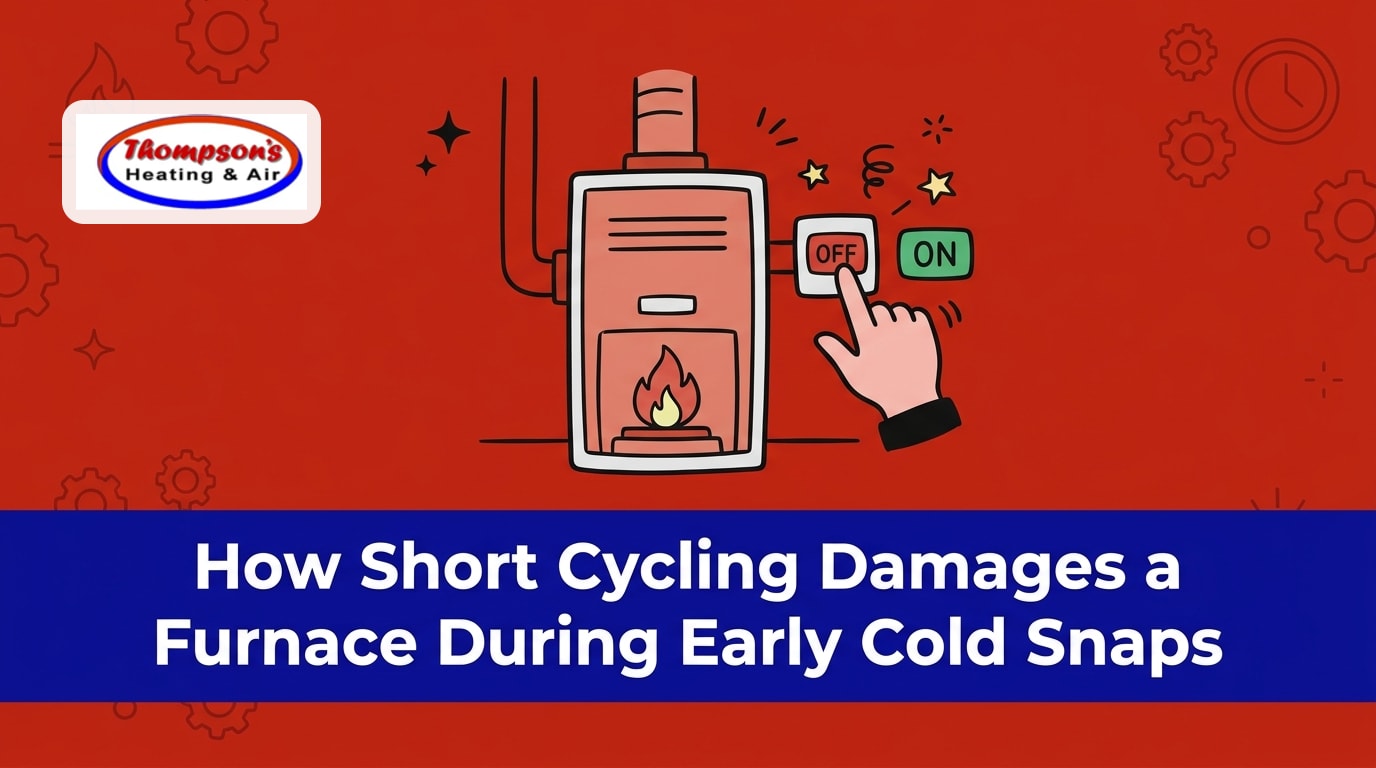
Short cycling occurs when the furnace shuts down prematurely—often after just three to five minutes—before the heating cycle is genuinely complete. The thermostat then senses the temperature dropping again, and forces the furnace to restart almost immediately. This creates a relentless, exhausting loop.
The Hidden Mechanical Toll
The startup phase of any heating cycle consumes the most energy and causes the highest level of mechanical wear. Think of it like driving a car in heavy stop-and-go traffic versus cruising on a highway. The constant stopping and starting grinds down the brakes and transmission. Your furnace experiences the exact same type of mechanical exhaustion.
Often, this behavior is triggered by airflow restrictions. In our experience working on homes throughout Woodland CA, we frequently find that using highly restrictive filters can cause short-cycling because the furnace cannot pull enough air over the heat exchanger, causing the internal safety limits to trip and shut the system down.
• Normal Heating Cycle — Average Duration: 15 to 20 minutes — Mechanical Wear Level: Low (Steady State) — Energy Consumption: Efficient
• Short Cycling — Average Duration: 3 to 5 minutes — Mechanical Wear Level: Severe (Constant Startup) — Energy Consumption: Highly Inefficient
Thermal Stress: How Short Cycling Damages a Furnace Heat Exchanger
The heat exchanger is the heart of your furnace, responsible for safely transferring the heat from combustible gases into the air that circulates through your vents. Because it handles live flames and toxic combustion gases, its structural integrity is non-negotiable. This is where the damage from rapid cycling becomes incredibly dangerous during November early cold snaps.
Metals naturally expand when they get hot and contract when they cool down. During a normal, healthy heating cycle, the metal of the heat exchanger heats up gradually, stays warm for 15 to 20 minutes, and then cools down slowly. This controlled thermal expansion and contraction is exactly what the metal was engineered to handle.
When a furnace short cycles, this process is violently interrupted. The metal begins to heat up and expand, but before it reaches a stable temperature, the system shuts off, forcing it to rapidly contract. Minutes later, the flame kicks back on, shocking the metal with heat once again. This continuous, rapid shifting prevents the metal from properly heating and cooling, leading to severe thermal stress.
Over a remarkably short period, this thermal fatigue causes the metal to become brittle. Eventually, it will develop microscopic cracks. A cracked heat exchanger is a critical safety failure that allows carbon monoxide to leak into your breathing air, almost always requiring immediate furnace repair or a total system replacement.
Components Damaged by Furnace Short Cycling:
• Heat Exchanger: Suffers extreme thermal stress, leading to metal fatigue and premature, dangerous stress cracks.
• Blower Motor: Overheats from the continuous, massive surges of startup electricity required to overcome inertia.
• Igniter: Burns out rapidly because it is forced to spark or glow dozens of extra times per day.
• Flame Sensor: Experiences excessive wear and carbon buildup, leading to false readings that worsen the cycling loop.

Blower Motor and Electrical Component Exhaustion
The mechanical damage of short cycling extends far beyond the heat exchanger. Your furnace relies on a heavy-duty blower motor to push conditioned air through your ductwork and into the rooms of your Woodland CA home. Getting that heavy motor wheel to start spinning from a dead stop requires a massive surge of electricity—often called "inrush current."
According to fundamentals established by the Department of Energy (DOE) and ASHRAE regarding HVAC mechanical stress, this startup phase is the most taxing moment in a motor's operational life. Once the motor is spinning at full speed, its electrical draw drops significantly, and the internal fan helps cool the motor's windings.
When your furnace short cycles, the blower motor is subjected to that massive surge of startup electricity over and over again, but it never runs long enough to properly cool itself down. The heat inside the motor windings continues to build with every rapid restart until the motor literally cooks itself to death.
The Cumulative Toll on Capacitors and Relays
The blower motor isn't the only electrical component suffering. The capacitors, which store energy to help jump-start the motors, are drained and recharged at an unsustainable rate. The internal relays and contactors on your circuit board—the physical switches that click open and closed to send power to different parts of the furnace—are forced to engage and disengage dozens of extra times a day.
Every time a relay clicks, a tiny electrical arc occurs. Under normal conditions, a relay can handle tens of thousands of these arcs over its lifespan. Under short-cycling conditions, that lifespan is rapidly accelerated, leading to burnt contacts, failed circuit boards, and a completely unresponsive heating system just when you need it most.
Igniter Degradation and Flame Sensor Strain
Modern furnaces do not use a standing pilot light. Instead, they rely on electronic ignition systems—either a hot surface igniter that glows white-hot, or a direct spark igniter that creates a continuous electrical arc to light the gas. These components are engineering marvels, but they are rated for a specific, expected number of cycles per season.
When November early cold snaps trigger your system to short cycle, you are forcing the igniter to fire up exponentially more times than it was designed to handle. A hot surface igniter is particularly vulnerable to this. The repeated heating and cooling of its fragile silicon carbide element causes it to become brittle and eventually snap, leaving you without any heat at all.
The Flame Sensor Feedback Loop
Right next to the igniter sits the flame sensor. Its only job is to detect whether a fire has successfully started. If it doesn't sense a flame within a few seconds of the gas valve opening, it shuts the whole system down to prevent raw gas from flooding your home.
When a furnace short cycles, the flame sensor is subjected to constant blasts of raw flame followed by sudden cooling. This rapid cycling can cause microscopic layers of soot and oxidation to build up on the sensor rod much faster than normal. Here is where the problem compounds: a dirty or failing flame sensor cannot accurately read the fire. It will shut the furnace down prematurely, effectively creating a feedback loop that causes even more short cycling. What starts as a minor airflow or thermostat issue quickly snowballs into a cascading failure of your ignition components.
Why Proper Diagnostics Matter More Than Immediate Replacement
When homeowners realize the sheer amount of wear and tear their system is enduring, panic often sets in. It is easy to assume that a furnace trapped in a short-cycling loop is already a total loss and needs to be ripped out immediately. However, jumping straight to a premature furnace replacement is often an expensive overreaction.
Many of the root causes of short cycling are entirely correctable if they are caught early enough. A poorly placed thermostat sensing a draft, a blocked return air vent, a dirty flame sensor, or a clogged condensate drain can all force a perfectly good furnace into a rapid-cycling state.
Minor Issues Masquerading as Major Failures
This is where the integrity of your HVAC provider becomes crucial. Unfortunately, some companies use short cycling as an easy excuse to push a costly replacement on an anxious homeowner. They will point to the rapid shutting off and claim the system is "dead."
At Thompson's Heating & Air, we approach this differently. We believe what you truly need is thorough, honest diagnostics aimed at saving and extending the life of your current equipment. Our highly trained Woodland CA technicians will always take the time to trace the short cycling back to its exact root cause. By identifying and repairing a minor airflow restriction or recalibrating a sensitive limit switch today, you can stop the mechanical degradation in its tracks and safely get many more years of reliable service out of your existing furnace.
Preventing Mid-Winter Breakdowns with Proactive Care
The absolute worst time to find out your furnace has suffered cumulative mechanical damage is during a freezing holiday weekend. The hidden wear caused by November early cold snaps will inevitably reveal itself when the system is forced to run continuously during the peak of winter. Addressing the rapid cycling now is the only way to prevent those emergency midnight failures.
If you suspect your system is short cycling, we highly recommend establishing a baseline of system health through professional intervention. Do not attempt to DIY internal mechanical repairs. Opening the combustion chamber, altering gas valves, or bypassing safety limit switches poses a severe risk of fire, carbon monoxide poisoning, and will instantly void your manufacturer's warranty.
What a Professional Diagnostic Evaluates:
• Heat Exchanger Integrity: Using specialized cameras to inspect the metal for microscopic stress cracks caused by thermal fatigue.
• Motor Amp Draw: Testing the electrical current pulling through the blower motor to ensure it isn't overheating or struggling against high static pressure.
• Safety Limit Calibration: Verifying that all internal temperature sensors are reading accurately and not tripping prematurely.
• Ignition Sequence: Measuring the microamps of the flame sensor and testing the resistance of the hot surface igniter.
Investing in routine heating maintenance and professional diagnostics ensures these internal components are operating within their safe design limits, protecting your home from sudden, catastrophic equipment failure.
Protect Your Home's Comfort Before the Deep Freeze
The short answer is that ignoring a short-cycling furnace guarantees premature mechanical failure. While the house may feel warm enough today, the thermal stress on your heat exchanger and the electrical exhaustion of your blower motor are quietly compounding with every rapid restart.
Early intervention is always the most cost-effective strategy. By catching the issue early here in Woodland CA, you can have the root cause corrected, stop the excessive wear and tear, and restore your system to a safe, steady operating state. If your furnace is turning on and off rapidly, having a professional evaluate the system now is the best way to secure your peace of mind before the deep winter freeze arrives.
Frequently Asked Questions
Can short cycling ruin a furnace?
Yes, short cycling can absolutely ruin a furnace if left unaddressed. The constant stopping and starting causes severe thermal stress on the heat exchanger and overheats the blower motor. Over time, this rapid cycling forces critical internal components to fail years before their expected lifespan.
What happens if you let a furnace short cycle?
If you let a furnace short cycle, you are accelerating the wear and tear on every moving part and electrical relay inside the cabinet. You will experience higher utility bills due to the constant energy surges required for startup, and eventually, the system will suffer a hard breakdown, often requiring expensive repairs or a full replacement.
Is it bad if my furnace turns on and off frequently?
It is very bad for a furnace to turn on and off frequently in short bursts. While it is normal for a furnace to cycle a few times an hour, shutting down after only three to five minutes prevents the system from ever reaching an efficient operating state. This behavior points to an underlying issue like restricted airflow, a failing sensor, or an overheating safety trip.
Why does my furnace only run for 5 minutes then shut off?
A furnace that only runs for five minutes is usually tripping an internal safety limit switch. This often happens because a dirty air filter is blocking airflow, causing the heat exchanger to overheat and shut the system down to prevent a fire. It can also be caused by a dirty flame sensor failing to read the fire correctly.
How can I tell if short cycling has already damaged my heat exchanger?
You cannot safely inspect a heat exchanger for microscopic stress cracks on your own. A professional technician must use specialized diagnostic tools, such as a combustion analyzer and an inspection camera, to verify the structural integrity of the metal. If you suspect damage, turn the system off and call for a professional evaluation immediately to prevent carbon monoxide exposure.