
Why Your Heating System Short-Cycles When Using Restrictive High-MERV Filters

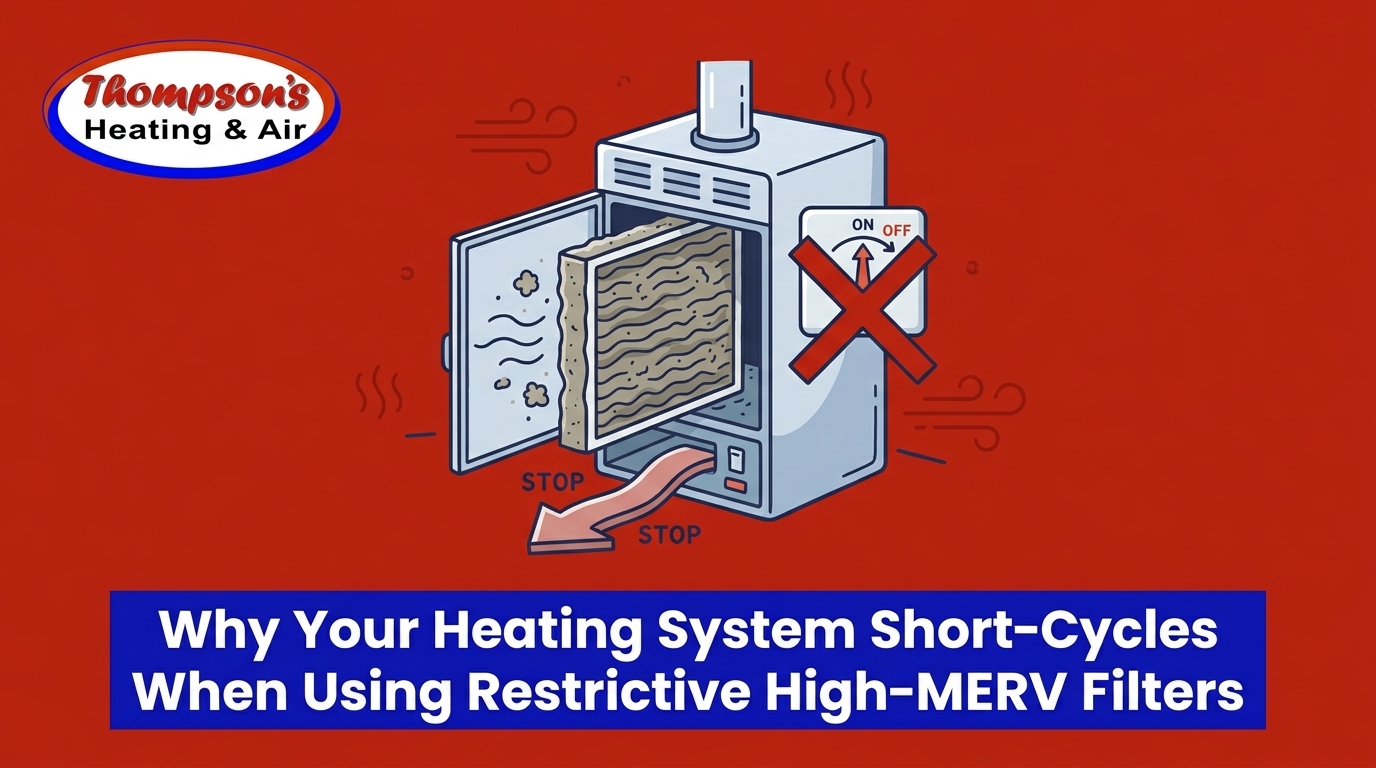
The Hidden Cost of Upgrading Your Indoor Air Quality This Fall
Here at Thompson's Heating & Air, we know that the September early fall prep and harvest season is just around the corner. Before the first freeze hits, you might find yourself wondering exactly why your heating system short-cycles when using restrictive high-MERV filters. As the weather cools down and we transition away from summer air conditioning, the urge to block out seasonal dust and environmental pollutants is completely understandable. You want your home to be a clean, comfortable sanctuary for your family. However, those ultra-dense filters designed to catch every tiny microscopic particle often act as an unintended barrier to your standard furnace blower. This creates a frustrating dilemma for many homeowners: how do you effectively balance the need for clean indoor air with the strict mechanical requirements for safe, continuous furnace operation?
If you are struggling to keep your system running smoothly without sacrificing your indoor air quality, our heating services can help you find the right balance for your specific equipment. In our years of servicing homes across Woodland and the broader Sacramento Valley, our technicians deal with a unique combination of environmental factors that make this issue incredibly common. The late-season agricultural dust from the local harvest and lingering wildfire smoke prompt many homeowners to upgrade their indoor air quality defenses right as the heating season begins. You head to the hardware store, grab the highest-rated filter on the shelf, and slide it into your return vent, assuming it is a smart move for your family's respiratory health.
But within a few days, your furnace starts acting up. It kicks on, runs for a few minutes, and abruptly shuts down before the house actually warms up to your target temperature. The air coming from the vents might feel lukewarm, and the system seems to be constantly turning on and off. This is a classic short-cycle, and it is a direct result of choking your system's airflow. Our service team responds to this exact pattern every single fall. The heavy-duty filter you bought to protect your lungs is actively suffocating your HVAC equipment, leading to immediate performance issues and potential long-term damage if left unaddressed.
The Anatomy of a Filter-Induced Short Cycle
When your furnace shuts down prematurely, it is not just being stubborn or malfunctioning randomly. At Thompson's Heating & Air, our technical experts want you to understand that this sudden shutdown is actually a critical safety mechanism doing exactly what it was designed to do, rather than a mere nuisance. Your heating system is programmed to protect itself from catastrophic failure, and the sequence of events leading to a filter-induced short cycle follows a very specific mechanical path.
1. Step 1: Return airflow is severely restricted. The dense filter you installed acts like a physical plug in your return duct. Your blower motor activates and tries to pull air through the thick, tightly woven pleated material, but it simply cannot draw in enough volume to satisfy the system's operational needs.
2. Step 2: The heat exchanger rapidly overheats. Your furnace generates a massive amount of thermal energy. Without a constant, high-volume flow of cold indoor air moving over the metal heat exchanger to absorb and distribute that heat into your home, the internal temperature of the furnace cabinet spikes dangerously fast.
3. Step 3: The safety controls activate. As the internal temperature climbs beyond safe operating limits, the high-limit switch temperature trip occurs. This specialized thermal sensor is mounted directly on the heat exchanger. It detects the excessive heat and immediately cuts electrical power to the gas valve and burners to prevent the metal from cracking or causing a severe fire hazard.
4. Step 4: The system shuts off prematurely. The gas burners go dark, stopping the heating cycle well before your thermostat's set temperature is reached. However, you will likely hear the blower fan continue to run for several minutes as it desperately tries to push whatever air it can gather over the overheated system to cool it down.
If this sequence is happening repeatedly in your home, professional heating repair is the most reliable way to verify whether the safety switch has been permanently damaged by the constant overheating and tripping.

Why Dense Filters Act Like a 'Brick Wall' to Your Blower
To truly understand why your system struggles with premium filters, we need to talk about the basic physics of HVAC airflow. Every heating and cooling system operates under the strict constraints of static pressure. In simple terms, static pressure is the physical resistance to airflow within your ductwork. Think of it like blood pressure for your heating system. Your specific blower motor is calibrated at the factory to push and pull air against a very specific maximum static pressure limit.
When you insert MERV 11 to 13 pleated filters into a standard residential heating system, you are drastically altering that delicate pressure dynamic. These heavily woven materials are incredibly effective at trapping microscopic dust, pollen, and smoke particles, but they require a tremendous amount of mechanical force to pull air through. For a standard Permanent Split Capacitor (PSC) blower motor, encountering one of these ultra-dense filters is literally like hitting a brick wall. The motor pushes past its design limits, straining to circulate air, and ultimately starves the furnace of the volume it needs to function safely.
The MERV Rating Misconception
There is a widespread misconception among homeowners that a higher Minimum Efficiency Reporting Value (MERV) rating is inherently better for your home. While it is undeniably true that higher ratings catch much smaller particles, they also exponentially increase airflow resistance. From what we've encountered in countless Woodland utility closets, most standard older furnaces are only designed to handle up to a MERV 8 or MERV 10 filter without requiring significant ductwork modifications.
Pushing beyond that specific threshold without upgrading your blower motor to a variable-speed model or expanding your return duct size forces the system to work much harder. The motor consumes significantly more electrical energy attempting to pull air through the restriction, runs hotter, and eventually triggers the thermal safety shutdowns we discussed earlier. You are essentially suffocating the machine in an attempt to clean the air.
Identifying High-Limit Switch and Overheating Symptoms
How do you know if your furnace is actually overheating due to a filter issue, or if something else entirely is broken? Differentiating between a filter-induced short cycle and a failing internal component can save you a significant amount of frustration and unnecessary worry. If your system is experiencing a high-limit switch temperature trip, it will exhibit a very specific, recognizable set of behaviors.
Here is a detailed checklist of the most common symptoms our technicians advise you to watch out for as you monitor your heating system:
• Extremely brief run times: The furnace fires up normally, the flames look steady, but the burners only stay lit for 3 to 5 minutes before cutting out abruptly, long before the room feels warm.
• Extended fan operation: The blower fan continues to run loudly long after the warm air stops flowing from your vents. This happens because the system is locked in a cooling phase, desperately trying to lower the temperature of the overheated heat exchanger.
• Unusually hot exterior casing: If you carefully place your hand on the outer metal casing of the furnace unit itself, it feels uncomfortably hot to the touch, indicating that internal heat is trapped and not being distributed through the ductwork.
• Continuous operational looping: The system resets itself after cooling down, fires up again, and repeats the rapid short cycle continuously, never actually reaching the temperature you set on the thermostat.
• Weak or restricted airflow at the vents: Even when the blower fan is running at full speed, the air coming out of your floor or ceiling registers feels incredibly weak or barely noticeable compared to previous heating seasons.
If you notice these specific signs, the very first thing our team suggests you do is check your air filter. Pull it out and inspect it. If it is a dense, high-MERV model, or if it is visibly caked in dust, replace it immediately. If the problem persists after swapping it out for a standard, breathable version, scheduling routine heating maintenance is the next logical step to ensure no permanent thermal damage has occurred to your sensors.
Balancing Indoor Air Quality with Furnace Health
The Problem: You need clean air for your family's health, but your furnace absolutely needs to breathe to function. In our experience, managing Woodland's heavy harvest dust and seasonal wildfire smoke is critical for your respiratory comfort, but it should never come at the cost of destroying your primary heating source during the very first cold snap of the year.
The Cause: As we have established, standard residential heating systems simply lack the necessary blower power to force sufficient air through dense MERV 11 to 13 pleated filters. The exact same tight weave that successfully blocks agricultural particulate matter from entering your living room also blocks the vital return air your furnace needs to regulate its internal operating temperature.
The Solution: Our team's most immediate and effective fix is downgrading to a furnace-safe MERV rating—typically around MERV 8—for the duration of the winter months. A high-quality MERV 8 filter provides excellent, reliable protection against standard household dust, pet dander, and larger debris without starving your blower motor of air. To maintain good air quality with a lower MERV rating, simply increase your filter change frequency. Swapping a standard filter every 30 days is far healthier for your HVAC system than leaving a highly restrictive filter in place for three months.
Alternative Solutions for Superior Filtration
If a MERV 8 filter simply does not meet your family's allergy or respiratory needs, you do not have to settle for poor indoor air quality. Our indoor air quality specialists frequently recommend alternative mechanical ways to achieve exceptional air filtration without adding dangerous static pressure to your existing ductwork.
• Media Filter Cabinets: These systems are installed directly into your ductwork by a professional and use much thicker, 4-inch or 5-inch pleated filters. Because they have a massive surface area, they can offer high MERV ratings with a significantly lower pressure drop than a standard 1-inch filter, protecting both your lungs and your blower motor.
• Standalone HEPA Purifiers: If seasonal smoke or harvest dust is a major issue in specific areas like bedrooms or home offices, running standalone HEPA air purifiers cleans the air locally without involving your furnace's blower motor at all.
• Electronic Air Cleaners: These advanced systems integrate into your HVAC setup and use electrical charges to capture microscopic particles, providing high-efficiency cleaning with almost zero airflow restriction.
The Long-Term Damage of Repeated Short-Cycling
Our repair crews can tell you firsthand that ignoring a short-cycling furnace is one of the most expensive mechanical mistakes a homeowner can make. When you leave a highly restrictive filter in place despite the warning signs, you are forcing your heating system to operate in a constant state of thermal emergency. The high-limit switch temperature trip is designed to save your furnace from immediate destruction, but it is absolutely not meant to be used as a regular operational control.
The continuous, rapid expansion and contraction of the metal heat exchanger under these extreme temperature swings drastically increases the risk of metal fatigue and stress cracks. A cracked heat exchanger is not just an expensive repair; it is a severe, life-threatening safety hazard that can allow deadly carbon monoxide combustion gases to leak directly into your living spaces. Furthermore, the constant starting and stopping places immense electrical and mechanical strain on your blower motor, often leading to premature capacitor failure or total motor burnout.
To help you understand the cascading effects of poor airflow, here is a detailed breakdown of how the mechanical damage progresses over time:
• Immediate (Days) — Impact on Your Heating System: Frequent high-limit switch trips, poor overall heating performance, weak airflow at the registers. — Impact on Your Wallet: Spikes in daily energy bills due to the system constantly drawing startup amperage.
• Short-Term (Weeks) — Impact on Your Heating System: Overheating internal electrical components, severe blower motor capacitor strain, stuck safety sensors. — Impact on Your Wallet: Increased wear and tear, potential need for minor electrical repairs and part replacements.
• Long-Term (Months) — Impact on Your Heating System: Blower motor burnout, cracked metal heat exchanger, totally compromised safety switches. — Impact on Your Wallet: Catastrophic system failure requiring total furnace replacement and potential safety hazards.
Protecting your major home investment starts with choosing the right everyday components. Finding the best air filter for your home means prioritizing adequate airflow just as much as you prioritize airborne particle capture.
Frequently Asked Questions About Furnace Airflow and Filters
Can a high MERV filter cause short cycling?
Yes, a high MERV filter is one of the most common and easily preventable causes of furnace short cycling. These ultra-dense filters severely restrict the amount of air returning to the furnace, causing the internal heating components to rapidly overheat and trigger a mandatory safety shutdown. If your system turns on and off rapidly after installing a premium filter, airflow restriction is the most likely culprit.
What happens if my furnace filter is too restrictive?
If your filter is too restrictive, your blower motor is forced to work much harder to pull air, and your heat exchanger overheats due to a lack of cooling airflow. This chain reaction leads to significantly increased energy consumption, poor heating performance throughout the house, and eventual mechanical damage to vital system components like the motor and limit switch.
Why does my furnace overheat with a new filter?
Your furnace overheats with a new filter if the filter's synthetic weave is simply too tight for your specific blower motor to pull air through efficiently. Without enough cold indoor air moving across the metal heat exchanger to absorb the thermal energy, the temperature inside the unit climbs uncontrollably until the safety switch trips.
Is MERV 13 too restrictive for older furnaces?
In almost all residential cases, MERV 13 is far too restrictive for older, standard residential furnaces. These older systems were typically engineered and designed for standard MERV 8 filters, and using MERV 11 to 13 pleated filters acts like a solid wall, starving the blower of necessary airflow and forcing the system to overwork.
Why does my furnace shut off after 5 minutes?
A furnace abruptly shutting off after only 5 minutes usually indicates that it has tripped its high-limit safety switch due to severe internal overheating. The most frequent and easily fixable culprit for this rapid overheating is a clogged, dirty, or overly dense air filter blocking the main return duct.
How do I know if my high-limit switch is damaged from short cycling?
If you replace your highly restrictive filter with a standard, breathable one and the furnace still short-cycles, the limit switch may be permanently stuck open or thermally damaged from repeated use. A professional HVAC technician will need to test the switch with a multimeter to confirm if it requires a full replacement.
Does Woodland's harvest season require special furnace filters?
While the heavy agricultural dust during the local harvest season makes indoor air filtration incredibly important, our local experts strongly advise against compromising your furnace's airflow to achieve it. Instead of choking your system with a dense 1-inch filter, consider upgrading to a professionally installed 4-inch media cabinet or using standalone room purifiers to handle the seasonal dust safely.
Restore Safe Airflow Before Winter Hits
As we move through the September early fall prep and harvest season, getting your home ready for colder weather should bring peace of mind, not frustrating mechanical headaches. A simple, inexpensive filter swap might be all it takes to completely fix a short-cycling furnace and restore comfort to your living spaces. However, if your system has been struggling with poor airflow for a while, the limit switch or heat exchanger may already be mechanically compromised.
Don't wait for a complete system breakdown on the coldest night of the year. If you have removed your dense filter and your heating system is still turning on and off rapidly, it is time to have a professional evaluate your static pressure and overall system health. The team at Thompson's Heating & Air is here to help you achieve the perfect balance of clean indoor air and reliable, safe heating performance. Reach out today to schedule a thorough inspection and ensure your system is breathing easily before deep winter sets in.



.avif)
.avif)
.png)
