
What Happens If You Skip HVAC Maintenance: Key Risks

Why Skipping HVAC Maintenance Is a Risk You Can't Afford
What happens if you skip HVAC maintenance is something most homeowners in Woodland, CA only think about after something breaks — usually on the hottest afternoon in August or the coldest night in January. And by then, a small, preventable issue has often turned into a costly repair or full system failure.
Here is a quick summary of what you can expect when routine HVAC service gets skipped:
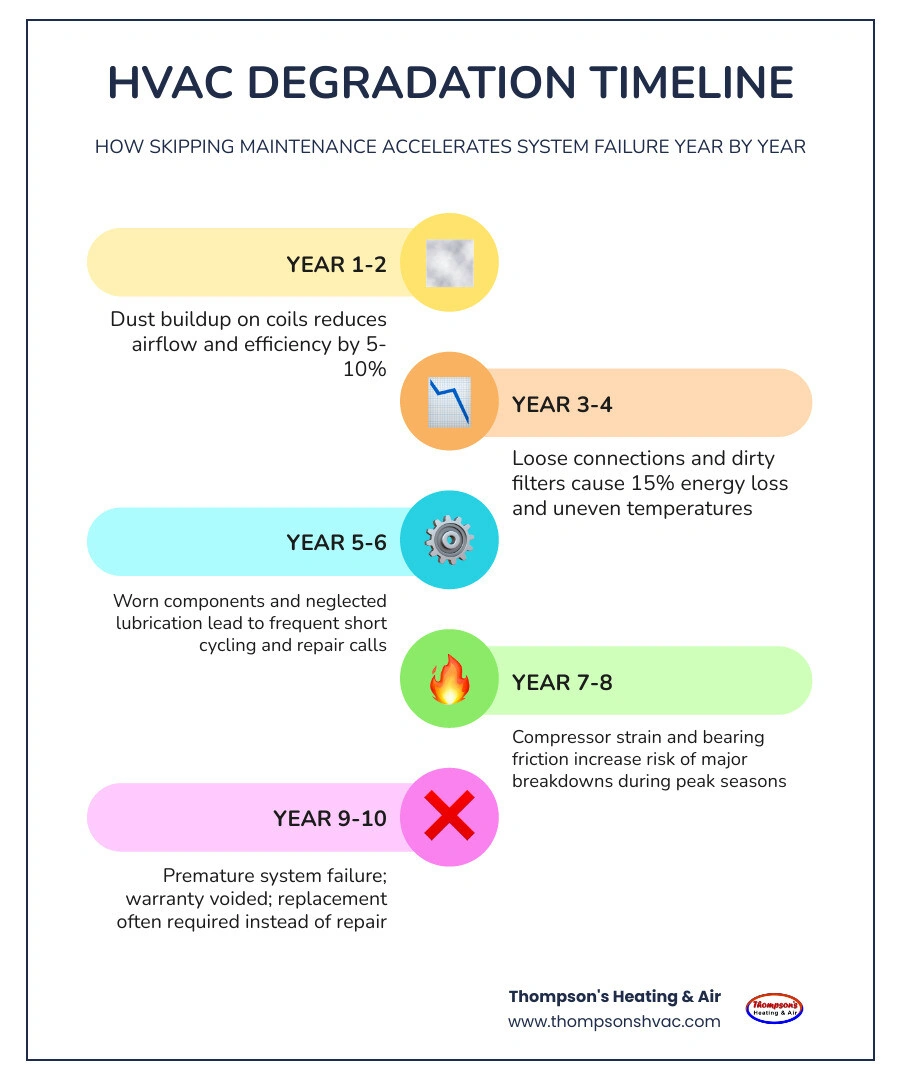
• Higher energy bills — A neglected system loses up to 5% efficiency every year, which can mean 20% more energy use after just four years
• More frequent breakdowns — Dust buildup, loose connections, and worn components go unnoticed and compound over time
• Shorter system lifespan — A well-maintained system can last 15–20 years; a neglected one may fail in 8–10 years
• Voided warranty — Many manufacturers require documented annual maintenance to honor warranty claims
• Safety risks — A cracked heat exchanger in a gas furnace can leak carbon monoxide into your home
• Poor indoor air quality — Without proper filtration and cleaning, indoor pollutant levels can be 2 to 5 times higher than outdoor levels, according to industry data
Most of these problems don't show up overnight. They build slowly behind the scenes, invisible until your system fails at the worst possible moment. That's what makes skipped maintenance so deceptive — the system still runs, so it's easy to assume everything is fine.
The sections below walk through each of these risks in detail, so you know exactly what's at stake and what to do about it.
Learn more about what happens if you skip hvac maintenance:
• annual hvac maintenance is it worth it
• how often should you service your hvac
What Happens If You Skip HVAC Maintenance?
When we talk about what happens if you skip HVAC maintenance, we aren't just talking about a sudden "on or off" failure. Instead, it is a gradual decline in performance that often goes unnoticed for months or even years. Your system is a complex machine with hundreds of moving parts, electrical connections, and sensitive sensors. Without regular attention, these components begin to drift out of calibration or wear down prematurely.
The biggest shift that occurs is moving from preventive service to reactive service. In a preventive model, we catch a loose belt or a dusty sensor before it causes a problem. In a reactive model, you are calling us for signs your AC needs repair because the house is 85 degrees and the unit won't turn on. By the time symptoms are visible to you, the damage is often already done.
Why what happens if you skip hvac maintenance starts with small issues
It starts with a thin layer of dust. While it seems harmless, dust is the enemy of efficiency. It accumulates on the evaporator coils, insulating them and making it harder for the system to remove heat from your home. This forces the compressor to work harder and run longer.
Beyond dust, small issues like loose electrical connections or slightly misaligned components create friction and heat. Over time, these minor stressors lead to how to maintain your heating and cooling system becoming a much larger project than a simple seasonal check-up.
The shift from preventive to reactive repairs
When maintenance is skipped, your system is essentially "flying blind." You lose the opportunity to identify parts that are near the end of their life cycle. This leads to emergency breakdowns, which almost always happen during periods of peak demand. In Woodland, that means your AC is most likely to quit when it's 100 degrees outside because that is when the strain on neglected components is at its highest. Knowing emergency HVAC repair what to expect is helpful, but preventing the emergency altogether is always the better path.
Decreased Efficiency and Rising Energy Bills
One of the most immediate consequences of skipping service is the impact on your wallet through utility costs. According to the U.S. Department of Energy, routine maintenance can improve HVAC efficiency by up to 15%. Conversely, a system that isn't cleaned and calibrated will experience restricted airflow and longer run cycles.
• Maintained — Annual Efficiency Loss: 0% — 4-Year Energy Impact: Peak Performance
• Neglected — Annual Efficiency Loss: 1–5% — 4-Year Energy Impact: 20% Higher Bills
• Severely Neglected — Annual Efficiency Loss: 5%+ — 4-Year Energy Impact: Potential Motor Failure
When your system has to run for 45 minutes to achieve what it used to do in 30 minutes, you are paying for that extra electricity every single month. Our annual HVAC maintenance complete guide explains how professional cleaning restores that lost efficiency.
How what happens if you skip hvac maintenance impacts your monthly budget
It isn't just about the hardware; it’s about the accuracy of your home's climate control. Thermostats can lose calibration, causing the system to overshoot or undershoot your target temperature. This leads to "short cycling," where the unit turns on and off too frequently, which is incredibly energy-intensive. Many homeowners find that is an HVAC maintenance plan worth it simply because the energy savings alone often cover the cost of the plan.
Shortened System Lifespan and Warranty Risks
An HVAC system is one of the largest investments you’ll make in your home. A well-maintained unit in Yolo County can easily last 15 to 20 years. However, when you skip maintenance, you are effectively cutting that lifespan in half. Neglected systems often fail in as little as 8 to 10 years. This happens because the "heart" of the system—the compressor—is forced to operate under constant stress, leading to a premature "heart attack" that requires a full replacement. If you're at this crossroads, checking our HVAC repair vs replace guide 2026 can help you weigh your options.
Voiding your manufacturer warranty
This is a risk many homeowners don't realize until it's too late. Major manufacturers like Trane, Carrier, and Lennox often require proof of annual professional maintenance to honor their 10-year parts warranties. If your compressor fails in year seven, but you have no records of professional service, the manufacturer may deny your claim, leaving you to pay for the part out of pocket. Keeping a paper trail of service is essential, and it’s a key factor when deciding should I repair or replace my HVAC system.
Accelerated mechanical wear and tear
Without proper lubrication, moving parts like bearings and fans experience high levels of friction. This friction creates heat, which further degrades the metal and leads to fraying belts or burnt-out motors. Furthermore, how improperly sized systems shorten equipment life is a known issue, but even a perfectly sized system will act like an undersized one if it is choked by dirt and lack of care.
Safety Hazards and Poor Indoor Air Quality
While comfort and money are important, safety is the most critical reason not to skip maintenance. For homes with gas furnaces, the heat exchanger is the component that keeps combustion gases (like carbon monoxide) separate from the air you breathe. Over time, a neglected furnace can develop cracks in this exchanger due to overheating or rust. Carbon monoxide is colorless and odorless, making it a silent threat. If you suspect a safety issue, you need to know when an HVAC failure is a true emergency.
Respiratory health and airborne pollutants
Indoor air quality (IAQ) is directly tied to your HVAC system's cleanliness. Without regular maintenance:
• Dust and allergens circulate through your home 5–7 times per day.
• Mold spores can grow in the damp environment of a dirty evaporator coil or condensate pan.
• Humidity levels may not be properly controlled, leading to dust mite growth or wood damage.
The EPA has noted that indoor pollutant levels can be 2 to 5 times higher than outdoor levels. For families in Woodland with asthma or allergies, skipping maintenance isn't just a budget risk—it's a health risk.
Avoiding Emergency Breakdowns in Woodland, CA
In the Yolo County area, we experience some of the most intense heat in Northern California. Our systems work incredibly hard from May through September. A professional tune-up in the spring ensures that your refrigerant levels are correct, your coils are clean, and your electrical components are tight. This "pre-season" check is the best way to prevent HVAC emergencies with maintenance and ensure your family stays cool when the valley heat arrives.
Frequently Asked Questions about HVAC Neglect
Can skipping maintenance void my HVAC warranty?
Yes. Most manufacturer warranties explicitly state that the equipment must be maintained by a licensed professional to remain valid. If a major component fails and you cannot provide service records, you may be responsible for the full cost of the repair.
How often should my heating and cooling system be serviced?
We recommend a professional tune-up twice a year: once in the spring for your air conditioner and once in the fall for your heating system. This ensures each system is ready for its respective peak season.
Is maintenance necessary for a brand-new HVAC system?
Absolutely. In fact, maintaining a new system is the best way to ensure it reaches its 20-year potential. Early maintenance catches factory defects and ensures the installation is settled properly, protecting your significant investment from day one.
Conclusion
At Thompson's Heating & Air, we’ve been serving the Woodland community since 1992. As a family-owned business, we’ve seen what happens if you skip HVAC maintenance, and we want to help our neighbors avoid those preventable headaches. Whether you are in Davis, Dixon, or right here in Woodland, our team is dedicated to providing the 5-star service and local expertise you need to keep your home comfortable year-round.
Don't wait for your system to send you a distress signal. Schedule your professional tune-up today and breathe easier knowing your home is in good hands.



.avif)
.avif)
.png)
