
How Upgrading to a Media Cabinet Improves IAQ During Valley Harvest Season

Battling the Late-Summer Dust and Smoke Invasion in Your Home
Your air conditioner is running nonstop to fight the heat, but a fine layer of grit keeps settling on your countertops, leaving you to wonder exactly how upgrading to a media cabinet improves IAQ during Valley harvest season. You dust the furniture in the morning, and by evening, a new film has already appeared. This is a frustrating reality for homeowners in Woodland CA and surrounding Central Valley agricultural zones. As late summer approaches, standard air filters simply cannot keep up with the heavy particulate loads entering your home.
If you are serious about breathing cleaner air, it is time to explore professional indoor air quality upgrades, including high-capacity air filtration systems.
We face a unique dual threat during this time of year. First, the heavy agricultural particulates from constant tractor activity and harvesting drift directly into residential neighborhoods. Second, regional wildfire smoke carries microscopic ash that easily infiltrates even well-sealed houses. Because of the unique geography of the Sacramento Valley, which acts like a massive bowl, thermal inversions naturally trap this particulate matter close to the ground during the late summer months. The contaminated air sits stagnant, waiting to be pulled into your HVAC system.
The critical decision point: You can continue struggling with inadequate standard filters that require constant replacement and still let dust through, or you can make a permanent upgrade to a proper air filtration strategy. True indoor air quality requires mechanical solutions built specifically for these extreme local conditions, not just off-the-shelf temporary fixes.
The Unique Air Quality Challenges of August in the Central Valley
To understand why your home's air quality plummets late in the year, we have to look at the environmental factors converging outside your windows. The combination of intense August heat, relentless harvest activity, and elevated wildfire risk is a specifically local phenomenon that puts immense strain on your home's defenses.
During the peak of the August late-summer harvest and wildfire season, immense amounts of agricultural dust are kicked up into the atmosphere. Tractors tilling dry soil, trucks moving crops, and general agricultural operations create a massive volume of coarse dust known as PM10. But that is only half the battle. At the exact same time, regional wildfires generate microscopic PM2.5 particles. These ultra-fine particles of ash and soot are so small they remain suspended in the air for days, traveling hundreds of miles and easily penetrating the tiny gaps around your doors and windows.
• Agricultural Dust (PM10): Coarse particles from dry soil and plant matter that coat your furniture and irritate your throat.
• Wildfire Ash (PM2.5): Microscopic combustion particles that bypass natural nasal defenses and settle deep in your lungs.
• Seasonal Pollens: Late-blooming weeds and plants adding biological allergens to the mix.
These particulate sources combine to create a perfect storm for allergy and asthma sufferers. To make matters worse, this heavy contamination occurs exactly when air conditioners are running non-stop to combat the brutal summer heat. Your HVAC system effectively acts as a giant vacuum cleaner, continuously pulling this heavily polluted outdoor air into your living spaces and circulating it through your ductwork.
Why Standard 1-Inch Filters Are Not Designed for Human Lungs
When faced with heavy dust and smoke, the natural instinct is to run to the hardware store and buy the most expensive, highest-rated standard filter available. However, this reveals a fundamental misunderstanding of what standard HVAC filters are actually meant to do.
Basic 1-inch fiberglass or pleated filters are primarily engineered to keep large debris—like pet hair, dead skin cells, and large dust bunnies—out of the HVAC equipment. Their job is to protect the blower motor and the evaporator coil from catastrophic buildup, not to purify the air you breathe. When microscopic PM2.5 wildfire ash and fine agricultural dust enter the system, they pass right through the loose weave of low-MERV 1-inch filters and blow directly into your living room.
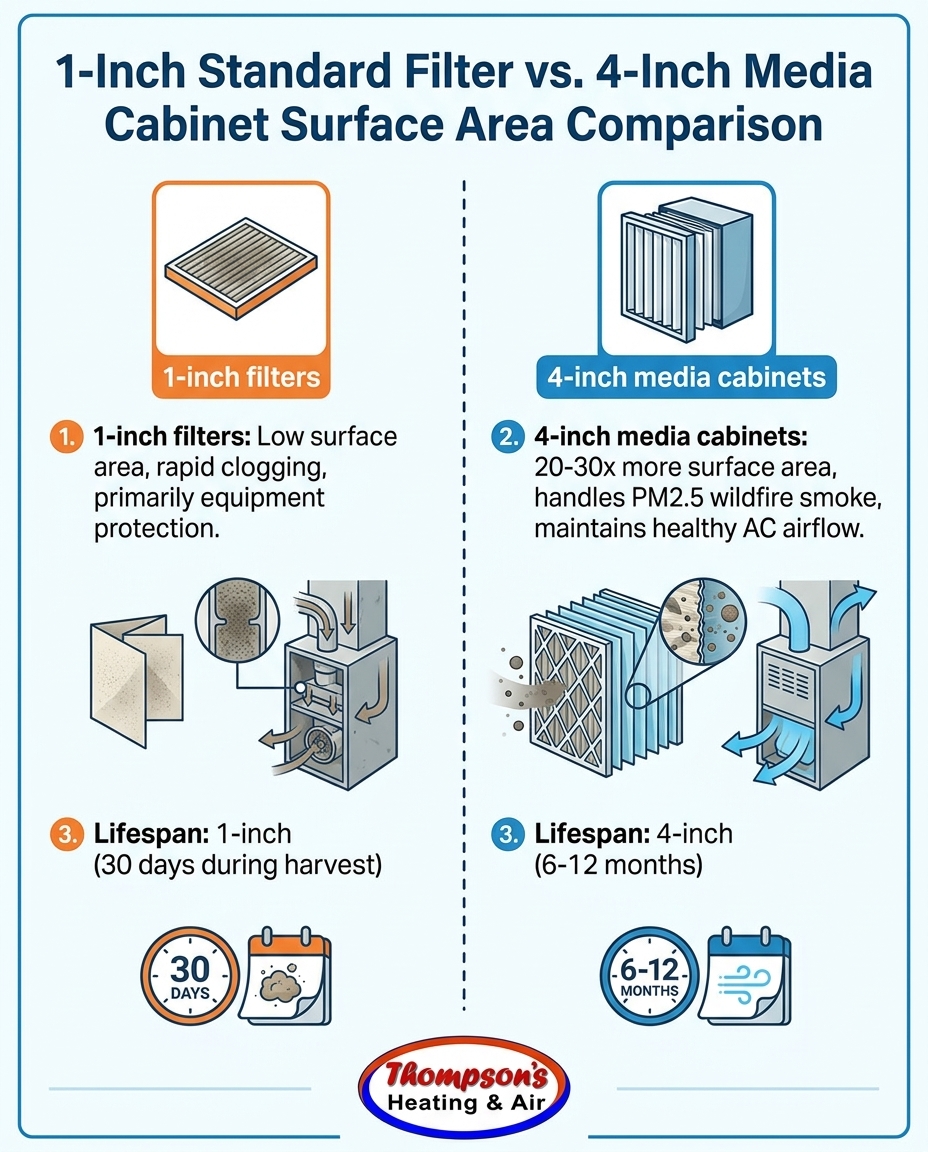
• Primary Purpose — Standard 1-Inch Filter: Protecting HVAC equipment — 4-Inch Media Cabinet: Protecting human health and equipment
• Particle Capture — Standard 1-Inch Filter: Large debris, pet hair, coarse dust — 4-Inch Media Cabinet: Microscopic PM2.5, smoke, fine ag dust
• Surface Area — Standard 1-Inch Filter: Very low (rapid clogging) — 4-Inch Media Cabinet: Massive (20-30x more filter material)
• Lifespan in Summer — Standard 1-Inch Filter: 14 to 30 days — 4-Inch Media Cabinet: 6 to 12 months
The high-MERV trap: Addressing the temptation to buy the highest MERV 1-inch filter available is critical. If you force a dense, high-MERV 1-inch filter into a standard slot, the tight weave successfully stops the dust, but it also stops the air. This leads to immediate mechanical problems, which we will explore in the next section. True respiratory protection requires a completely different approach to filtration, which is why choosing the best air filter for your home often means abandoning the 1-inch format entirely in favor of a 4-inch media cabinet vs standard 1-inch filter setup.
Understanding Airflow: The Danger of Clogging During Heat Waves
Relying on standard filters during heavy particulate events introduces a severe mechanical risk to your cooling system. Your air conditioner requires a precise, continuous volume of air moving over the indoor evaporator coil to function. When you restrict that airflow, the entire cooling process breaks down.
When a 1-inch filter is bombarded with heavy harvest dust and falling ash during the August late-summer harvest and wildfire season, it clogs incredibly fast. A filter that might last three months in the winter can become completely choked in just two weeks during a heavy smoke event. Once that filter clogs, it acts like a solid wall. The blower motor has to work much harder, straining to pull air through the packed dirt.
The cascading failure: This restricted airflow leads directly to reduced cooling capacity. Without enough warm air passing over the evaporator coil, the refrigerant inside gets too cold, causing atmospheric moisture to freeze on the coils. Before you know it, your AC is encased in a block of ice and shuts down completely. These sudden system breakdowns inevitably happen during extreme heat events when the system is under the most stress.
One local homeowner reached out to us as a severe heat wave approached because their air conditioning was suddenly working poorly and struggling to keep the house cool. We came out the next day, showed up on time, and found the exact problem: a restrictive, heavily soiled standard filter had completely choked the airflow, causing the system to freeze up just as temperatures spiked. Once the airflow was corrected, the system was back to cooling the home properly.
The Science of Surface Area: How Media Cabinets Excel
The solution to capturing microscopic particles without suffocating your air conditioner comes down to simple physics. A media cabinet is a specialized, widened housing installed directly into your HVAC ductwork, designed to hold a thick, 4-inch pleated filter rather than a flimsy 1-inch slide-in.
The secret is the accordion-like pleating of the filter material. Because the filter is four inches deep and tightly folded, a 4-inch media cabinet has up to 20 to 30 times more surface area than a standard 1-inch filter. As local HVAC professionals, we don't just guess at solutions; we demonstrate deep local expertise by explaining exactly how surface area physics solve the specific problem of local agricultural dust clogging systems.
Imagine trying to drink a thick milkshake through a tiny cocktail straw—that is your AC trying to pull air through a dirty 1-inch filter. Now imagine drinking that same milkshake through a wide boba straw. The massive surface area of a 4-inch media cabinet allows the filter to trap massive amounts of microscopic PM2.5 ash and heavy agricultural dust while still leaving plenty of open pores for the air to flow freely. This extended capacity means media filters can handle heavy particulate loads for months rather than weeks, dramatically extending their lifespan.
Capturing Fine Particulates Without Sacrificing Efficiency
Because the air is spread out over such a vast amount of filter material, media cabinets allow for much higher MERV ratings—providing vastly better filtration—while maintaining optimal static pressure within the ductwork. The air velocity slows down as it passes through the thick media, giving the fibers more time to snag microscopic pollutants. This perfect balance protects both the homeowner's lungs from irritating allergens and the HVAC system's longevity from airflow-related breakdowns.
Transforming Your Home's Air Defenses for Allergy Relief
Moving from a 1-inch standard filter to a 4-inch media cabinet is not just a technical upgrade; it delivers tangible health, comfort, and lifestyle benefits for your entire household. For families living in Woodland CA and surrounding Central Valley agricultural zones, the difference is noticeable almost immediately.
The most obvious change is the drastic reduction in indoor dust accumulation. When the heavy agricultural dirt is caught at the air handler rather than blown through the vents, you spend significantly less time cleaning and wiping down surfaces during harvest season. You will notice fewer particles floating in the sunlight streaming through your windows.
More importantly, this upgrade provides profound relief for allergy and asthma sufferers. When fine agricultural particulates, pollens, and wildfire smoke are effectively trapped in a deep-pleated media filter, the indoor air becomes a safe haven. You can finally sleep through the night without waking up to a scratchy throat or congested sinuses. This upgrade offers the peace of mind that comes from knowing your indoor environment is protected, regardless of how bad the air quality gets outside. By investing in Woodland indoor air quality services, you are positioning the media cabinet as an essential investment in your family's comprehensive home health.
Why Retrofitting a Media Cabinet Requires Professional Expertise
It is crucial to understand that upgrading to a 4-inch media cabinet vs standard 1-inch filter is a permanent system modification, not a simple DIY filter swap. You cannot simply shove a 4-inch filter into a 1-inch slot.
Installing a media cabinet requires professionally modifying the existing ductwork and fabricating custom sheet metal to accommodate the wider housing. The new cabinet must be integrated seamlessly into the return air plenum. Furthermore, professional static pressure testing is essential to ensure the new cabinet is sized correctly for your specific blower motor's capacity. If the cabinet is undersized, it will choke the system just like a dirty filter would.
We strongly warn against improper DIY installations. If the sheet metal is not fabricated and sealed correctly with mastic, it leads to massive air leaks. Air always takes the path of least resistance; if there is a gap between the ductwork and the new filter housing, the system will suck dirty, unfiltered air from your garage or attic right past the filter, entirely defeating the purpose of the upgrade. A proper, professional installation guarantees your air filtration systems operate at peak efficiency, keeping your air clean and your equipment safe during the hottest months of the year.
Take Control: How Upgrading to a Media Cabinet Improves IAQ During Valley Harvest Season
Standard 1-inch filters simply cannot handle the dual threat of harvest dust and wildfire smoke that blankets Woodland CA and surrounding Central Valley agricultural zones every late summer. They clog too quickly, restrict your cooling airflow, and let microscopic allergens blow right into your living spaces.
Upgrading to a proper 4-inch media cabinet is the definitive solution for breathable, clean indoor air. By utilizing massive surface area, these cabinets capture the dangerous PM2.5 ash and coarse agricultural dirt without suffocating your air conditioner. It is time to stop fighting a losing battle with cheap standard filters that require changing every two weeks. We encourage you to consult with local IAQ experts to evaluate your ductwork and see if your system is a candidate for a media cabinet retrofit. Taking action now ensures your home remains a comfortable, clean refuge no matter what the harvest season blows your way.
Frequently Asked Questions
Why does my house get so dusty during harvest season?
During the late summer harvest, constant agricultural activity kicks up massive amounts of coarse dirt and plant matter into the air. If you rely on standard 1-inch filters, this fine dust easily bypasses the loose filter media and gets blown directly through your ductwork into your living spaces. Upgrading your filtration captures this dust before it reaches your rooms.
Do 4-inch HVAC filters restrict airflow?
No, when properly sized, 4-inch media filters actually improve airflow compared to dirty 1-inch filters. Because they have 20 to 30 times more surface area, the air easily passes through the deep pleats even when the filter is loaded with dust. However, the cabinet must be professionally installed to match your blower motor's static pressure requirements.
What is the best HVAC filter for wildfire smoke?
The best defense against wildfire smoke is a 4-inch pleated media filter with a high MERV rating (typically MERV 11 to 16). Wildfire smoke contains microscopic PM2.5 particles that pass right through standard fiberglass filters. A thick media cabinet provides the necessary density to trap these fine ash particles without choking your air conditioner.
Are media filters worth the initial investment?
Yes, media filters are highly cost-effective over time. While the initial sheet metal modification requires an upfront investment, the 4-inch replacement filters last 6 to 12 months, saving you from buying cheap filters every few weeks. More importantly, they prevent expensive AC breakdowns caused by clogged airflow and protect your family's respiratory health.
How often should I change a media filter during heavy wildfire season?
Under normal conditions, a 4-inch media filter lasts up to a year, but during heavy wildfire or harvest seasons, you should check it every 4 to 6 months. The massive surface area allows it to hold a tremendous amount of ash and dust before it becomes restrictive. Your HVAC technician can help you establish the perfect replacement schedule for your specific neighborhood.
Can a media cabinet be added to an older HVAC system?
In most cases, yes, a media cabinet can be retrofitted to an older HVAC system. An HVAC professional will need to evaluate your existing return ductwork to ensure there is enough physical clearance to install the wider housing. They will also perform a static pressure test to confirm your older blower motor can handle the upgraded filtration.



.avif)
.avif)
.png)
