What We Find Inside a Furnace After Five Years of Hard Water Humidifier Use


The Hidden Mechanical Cost of Winter Comfort
When dry winter air leaves you with a scratchy throat and constant static shocks, adding a humidifier to a furnace is often the first solution that comes to mind. It seems like a straightforward upgrade to improve your indoor comfort ahead of the holiday season. However, there is a hidden mechanical cost that most people do not realize until it is too late.
When you introduce moisture into home heating systems, you are fundamentally changing the operating environment of your mechanical equipment. While a humidifier solves the problem of dry air, untreated hard water introduces a completely different threat: severe mineral scale buildup and long-term corrosion on your furnace's internal components.
The core decision point:
• Standard installations: Adding a basic humidifier without water treatment often leads to high maintenance overhead and potential equipment damage.
• Advanced protection: Investing in appropriate water treatment or specialized humidification equipment preserves your furnace while delivering the comfort you need.
As we approach November pre-winter heating prep, the focus must shift from simple indoor comfort to vital equipment preservation. Making the right choice now prevents catastrophic mechanical failures down the line.
How an Evaporative Bypass Humidifier Interacts with Your Furnace
To understand why hard water causes so much damage, you first need to understand the mechanics of the equipment. The most common type of whole-home humidification is the evaporative bypass humidifier. This system relies entirely on your furnace's blower motor to distribute moisture throughout the ductwork.
While this setup is highly effective for improving indoor air quality, it introduces a constant source of water directly into the sensitive mechanical environment of your HVAC system. Understanding how humidifiers integrate with your HVAC system is the first step in protecting your investment.
The Bypass Duct Connection
A bypass humidifier is typically mounted on either the supply plenum (where warm air exits the furnace) or the return duct (where cool air enters). A physical bypass duct connects the two sides. Because the supply side operates under higher pressure than the return side, air is naturally forced through the bypass duct.
As the warm air travels through this bypass, it passes through the humidifier unit. This pressure differential is what drives the entire evaporative process, but it also means that any issues within the humidifier immediately affect the airflow dynamics of the furnace itself. Proper professional installation is critical to ensure this bypass does not rob the house of necessary heating airflow.
The Water Panel Evaporation Process
Inside the humidifier sits a water panel, often called an evaporator pad. A small water valve opens when the system calls for humidity, allowing a steady trickle of water to flow evenly over this porous pad.
Here is the thing: As the warm bypass air blows across the wet panel, pure water evaporates into the air stream. However, the water supplied to your home is rarely pure. When the H2O molecules turn into vapor, they leave absolutely all dissolved minerals behind on the pad. Over time, this evaporation process acts as a highly efficient mineral concentration machine.
The Compounding Threat of Hard Water in the Sacramento Valley
The mechanical realities of an evaporative bypass humidifier collide aggressively with local environmental factors. In the Sacramento Valley, our dry winters make humidification almost a necessity for indoor comfort. Unfortunately, this necessity is compounded by notoriously hard water.
The Problem: Hard water is defined by high concentrations of dissolved minerals, primarily calcium and magnesium. Our team at Thompson's Heating & Air typically sees water hardness levels in areas like Woodland CA frequently exceed 120 to 180 milligrams per liter. When you run this mineral-heavy water through a furnace humidifier, you are continuously baking those minerals onto your equipment.
The Cause: Because the evaporative process only takes the pure water vapor, the calcium and magnesium are left behind. They do not just sit there as a loose powder; the constant cycle of wetting and drying causes these minerals to crystallize into rock-hard scale.
The Solution: You cannot change the municipal water supply, but you can control how it interacts with your HVAC system. When exploring indoor air quality solutions in Woodland, you must pair any humidification strategy with a robust water quality strategy to prevent this rapid, destructive accumulation.
The 5-Year Mechanical Impact on Furnace Components
When our service technicians open up a local furnace that has been running an evaporative bypass humidifier with untreated hard water for several years, the visual reality is often shocking. Adopting a transparent, unfiltered look at what we actually find inside these systems proves why preventative maintenance is not just a suggestion—it is vital for equipment survival.
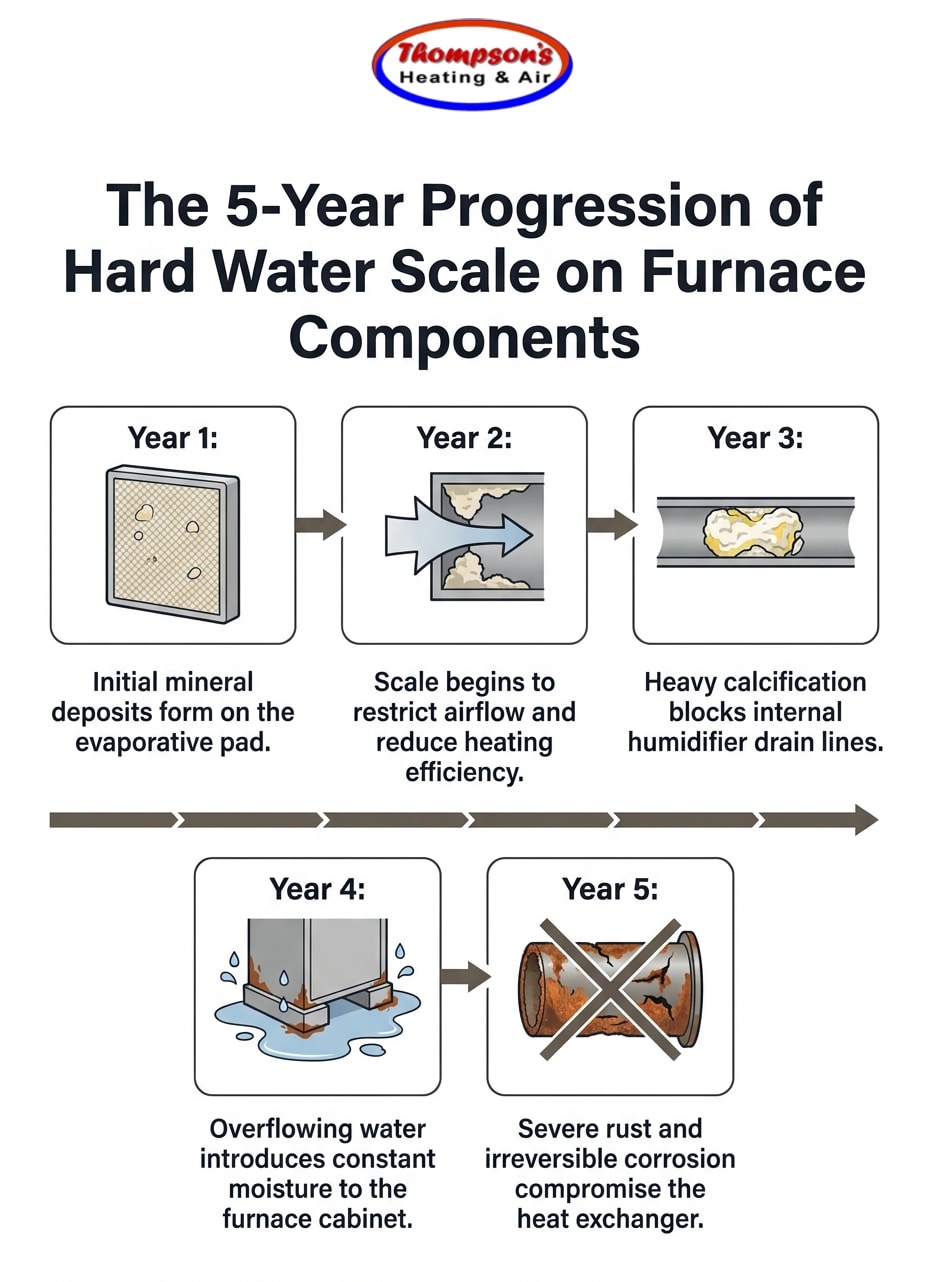
A pattern we see often during our Woodland service calls is that over a five-year period, the progression of hard water damage moves from a minor nuisance to a major mechanical failure.
Heat Exchanger Corrosion
The heat exchanger is the heart of your furnace, responsible for safely transferring heat to the air while keeping dangerous combustion gases sealed away. Constant moisture and mineral deposits are the natural enemies of the thin metal used in heat exchangers.
When a heavily scaled humidifier operates, it often splatters tiny droplets of mineral-rich water into the ductwork, or worse, leaks directly onto the furnace cabinet. As this water hits the hot metal of the heat exchanger, it flashes into steam, leaving concentrated mineral deposits directly on the metal. Over years of operation, this constant localized moisture and mineral etching degrades the metal, leading to surface rust that eventually deepens into irreversible, dangerous corrosion.
Drainage Blockages and Leaks
Bypass humidifiers are designed to flush excess water down a drain tube to prevent stagnation. However, as the water panel calcifies, large chunks of rock-hard scale frequently break off and fall into the humidifier's internal drain pan.
• The blockage: These mineral chunks travel into the narrow drain tube, quickly creating a solid blockage.
• The overflow: With nowhere else to go, the incoming water fills the humidifier housing and overflows.
• The damage: This escaping water runs down the exterior of the furnace cabinet, seeps into the electrical control board compartment, and pools around the base of the unit, causing extensive internal rusting.
Restricted Airflow and Overheating Risks
Beyond the direct threat of water leaks and corrosion, severe mineral scale creates a dangerous secondary impact on your furnace's operational efficiency. An evaporative bypass humidifier relies on air passing smoothly through the water panel.
The Problem: A heavily scaled water panel acts as a solid physical barrier. The porous mesh becomes entirely filled with crystallized calcium, effectively building a brick wall inside your bypass duct.
The Cause: Because the furnace blower motor is designed to push a specific volume of air, this sudden restriction forces the motor to work significantly harder. This increased static pressure strains the blower, leading to higher energy consumption and premature motor wear. More importantly, reduced air circulation means the heat generated by the furnace cannot escape the cabinet quickly enough.
The Solution: When the internal temperature of the furnace rises excessively due to blocked airflow, the system's high-limit safety switch will trip, shutting off the burners to prevent a fire. This phenomenon is known as short-cycling. The furnace turns on, rapidly overheats, shuts down, and repeats the process. Keeping the humidifier panel clear of scale is essential to maintaining proper airflow and preventing your furnace from destroying itself through short-cycling.
Preventing Corrosion Through Proper Water Treatment and Equipment Choices
If you live in a hard water area, installing a standalone humidifier without a water quality strategy is a short-term approach that guarantees future maintenance headaches. Preventing corrosion requires integrating proper water treatment or selecting equipment designed to handle the local water chemistry.
Homeowners generally have two paths to mitigate hard water damage: treating the water before it reaches the humidifier, or upgrading the humidifier technology.
• Standard Bypass Humidifier — Hard Water Reaction: Minerals bake directly onto the evaporative pad, blocking airflow and clogging drains. — Maintenance Reality in Hard Water Areas: Requires pad replacement 2-3 times per season. Inline water filtration or whole-home softening is highly recommended to prevent furnace damage.
• Steam Humidifier — Hard Water Reaction: Boils water in a separate canister, keeping scale away from the furnace ductwork. — Maintenance Reality in Hard Water Areas: Canister must be replaced annually. Much safer for the furnace, as scale is contained within the replaceable steam cylinder, not the HVAC equipment.
Integrating whole-home water softening removes the calcium and magnesium before it ever reaches your HVAC system, allowing standard bypass units to operate cleanly. Alternatively, specialized inline filtration can reduce the scale buildup. Professional consultation is critical to match the right equipment to your home's specific water chemistry.
Pre-Winter Equipment Preservation and Maintenance
As part of your November pre-winter heating prep, inspecting and servicing your humidifier is just as critical as checking the furnace itself. Waiting until the middle of a freezing January night to discover your humidifier has flooded your furnace control board is a stressful and avoidable situation.
Water Panel Replacement Frequency
The most important maintenance task for an evaporative bypass humidifier is replacing the water panel.
1. Check the pad early: Inspect the pad before turning the humidifier on for the season. If it is stiff, crusty, or coated in white/yellow scale, it must be replaced.
2. Do not attempt to clean it: Attempting to clean or descale a disposable water panel is entirely ineffective. The specialized coating that helps water spread evenly will be destroyed by descaling chemicals or scrubbing.
3. Increase frequency for hard water: In areas with high mineral content, you may need to replace the panel two or even three times during a single heating season to ensure safe airflow.
Professional System Inspections
Humidifier maintenance is not a simple DIY task because the unit integrates directly with your home's electrical, plumbing, and HVAC ductwork. During routine furnace maintenance, a professional technician will clear the humidifier drain lines, check the solenoid valve for proper operation, and verify that the humidistat is communicating correctly.
Most importantly, a technician will verify the integrity of the heat exchanger, looking for any early signs of rust or scaling caused by previous water exposure, ensuring your system operates safely all winter long.
Frequently Asked Questions About Adding a Humidifier to a Furnace
Can you add a humidifier to an existing furnace?
Yes, a humidifier can be retrofitted to almost any existing forced-air furnace. The most common method involves mounting a bypass unit directly onto the ductwork and tapping into a nearby cold water line. A professional will also need to wire the humidifier's control board to the furnace so they operate in tandem.
Is it worth putting a humidifier on a furnace?
For homes that suffer from extreme dry air in the winter, a whole-home humidifier is highly beneficial. It eliminates static shocks, protects hardwood floors from cracking, and makes the indoor air feel warmer at lower thermostat settings. However, it is only worth the investment if you are committed to the necessary seasonal maintenance.
Does a furnace humidifier cause mold?
A properly installed and maintained furnace humidifier will not cause mold. Mold issues only arise if the humidistat is set too high (causing condensation on cold windows and walls) or if a blocked drain line causes water to pool inside the ductwork. Keeping indoor humidity between 30% and 50% prevents mold growth.
How does hard water affect a whole-home humidifier?
Hard water dramatically accelerates the buildup of mineral scale inside the humidifier. As pure water evaporates, heavy concentrations of calcium and magnesium are left behind, which can clog the water panel, block drain lines, and eventually cause corrosive leaks onto the furnace itself.
What is the difference between a bypass humidifier and a steam humidifier in a hard water area?
A bypass humidifier leaves scale directly in the airstream, while a steam humidifier contains the scale in a separate canister. Steam units boil the water independently and inject pure steam into the ductwork, making them much safer for the furnace in hard water areas, though they require replacing the steam canister annually.
How often should a humidifier water panel be replaced?
At a minimum, the water panel should be replaced once a year before the heating season begins. However, in regions with hard water, the panel often calcifies much faster and may require replacement two or three times throughout the winter to maintain proper furnace airflow.
Make the Right Choice for Your Heating System
Adding a humidifier to a furnace is a fantastic way to improve your family's winter comfort, but it must be balanced with strict equipment protection. Understanding the long-term, compounding impact of hard water allows you to make informed, preventative choices rather than reacting to a mid-winter breakdown.
Whether you choose to integrate whole-home water treatment, upgrade to a steam system, or commit to rigorous seasonal maintenance for your evaporative bypass humidifier, the key is preparation. Do not let untreated hard water destroy your heating equipment. Consult with a local professional to evaluate your HVAC system and water quality before the heavy winter weather hits.