
How to Integrate a Humidifier With Your HVAC System


Why Understanding How Humidifiers Work With Your HVAC System Can Transform Your Home Comfort
Understanding how humidifiers work with your HVAC system is the first step toward solving one of the most common winter comfort problems — dry indoor air. When your heating system runs, it pulls in cold outdoor air and warms it up. The problem is that cold air holds very little moisture to begin with, and the heating process makes it even drier. Without added humidity, indoor relative humidity can drop well below 20%, causing dry skin, scratchy throats, static shocks, and even damage to wood floors and furniture.
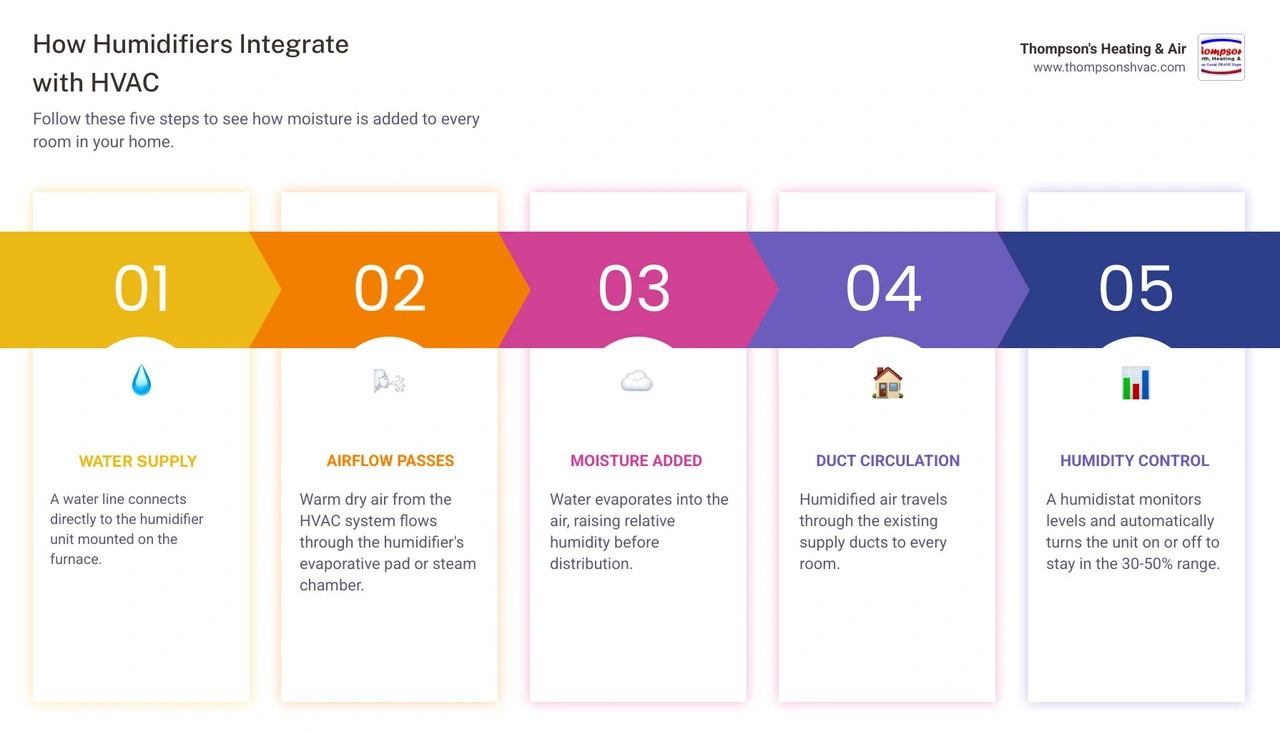
Here is a quick overview of how HVAC-integrated humidifiers work:
1. Water supply connects to the humidifier unit, which is mounted directly on your furnace or air handler.
2. Air from your HVAC system passes through or over a moisture source inside the humidifier (a water panel, evaporative pad, or steam generator).
3. Water evaporates into the air, adding moisture before the air travels through your ductwork.
4. The humidified air circulates throughout every room in your home via the existing duct system.
5. A humidistat monitors indoor humidity levels and signals the humidifier to run or stop, keeping moisture within the recommended 30% to 50% range.
For homeowners in Woodland, CA and across Yolo County, dry winters and forced-air heating make this a combination worth paying attention to.
What is a Whole-House Humidifier vs. Portable Units?
When your home starts feeling as dry as a desert, your first instinct might be to run to the store and buy a few portable, tabletop humidifiers. While portable units have their place, they operate very differently from a whole-house system.
Portable humidifiers are designed to treat a single room, such as a bedroom or a small office. They require you to carry heavy water tanks back and forth to the sink, refill them daily, and clean them constantly to prevent mold and bacterial growth. Because they rely on a small built-in fan, their coverage is highly limited. If you leave the bedroom, you leave the humidified air behind.
A whole-house humidifier, on the other hand, is installed directly into your central heating and cooling system. Instead of treating one room, it delivers balanced moisture to every square inch of your home. Because it connects directly to your home’s plumbing, you never have to refill a water tank. It operates quietly in the background, only requiring basic annual maintenance.
For homeowners living in Northern California, understanding Whole House Humidifier Benefits for Dry Climates can make a world of difference in maintaining a healthy, comfortable, and low-maintenance indoor environment.
How Humidifiers Work with Your HVAC System to Balance Moisture
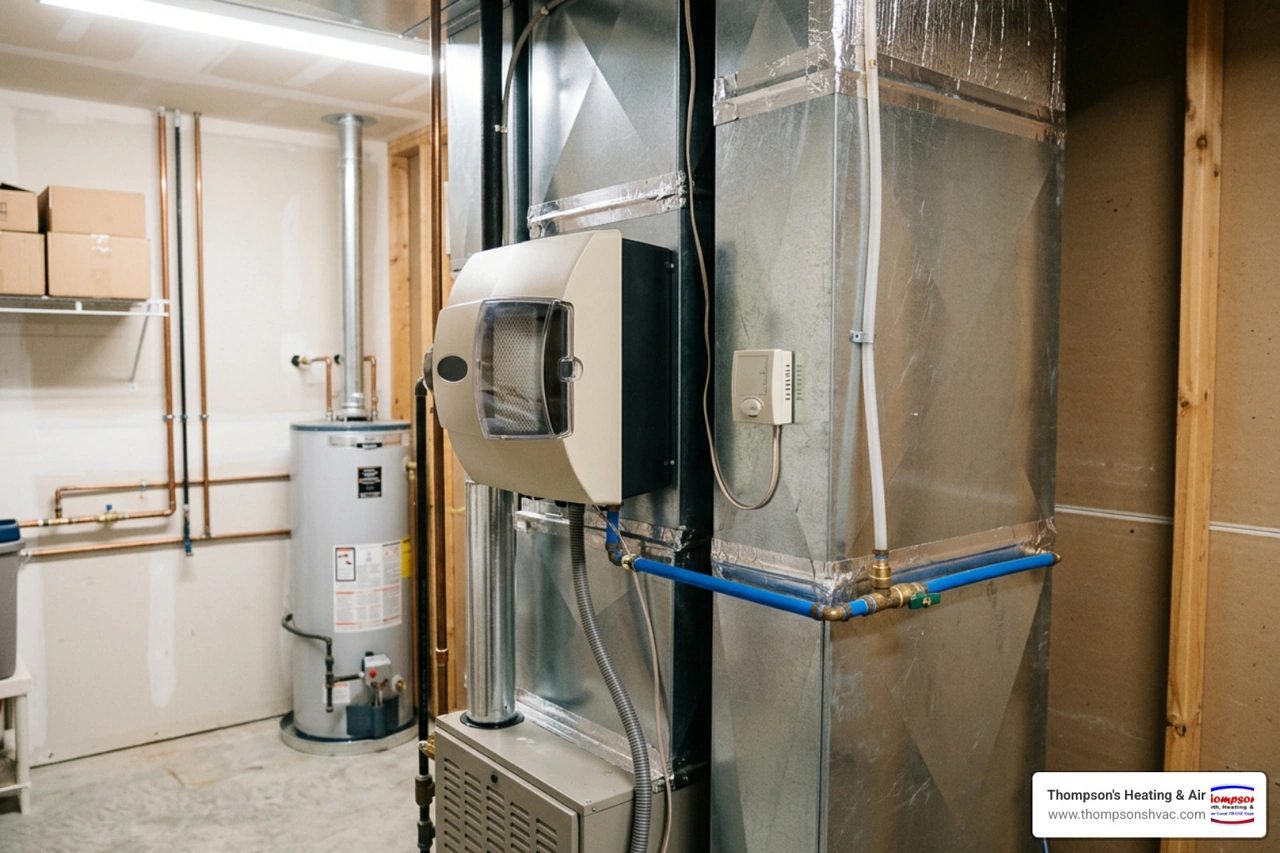
To understand how humidifiers work with your HVAC system, it helps to picture the path air takes through your home. Your central heating system relies on a network of ductwork to circulate air. This network has two main sides: the return plenum (which pulls air out of your rooms and sends it to the furnace to be heated) and the supply plenum (which distributes the freshly heated air back to your living spaces).
A whole-house humidifier is typically mounted on either the supply or return plenum. We also run a dedicated water line directly to the humidifier. When your indoor air becomes too dry, the system opens a water solenoid valve to wet an internal evaporative pad (often called a water panel) or activates a steam generator.
As dry air flows through your ductwork, it passes through this moisture-rich environment. The air absorbs water vapor and carries it through the supply ducts, distributing comfortable, balanced air to every register in your home. This seamless integration is one of the most effective upgrades you can make to your home's Indoor Air Quality.
The Role of the Humidistat in Automatic Control
Just as a thermostat controls your heating and cooling, a humidistat controls your home’s humidity levels. The humidistat constantly measures the relative humidity (RH) of your indoor air. When the RH drops below your set point, the humidistat sends a 24-volt signal to the humidifier’s water valve or steam canister to start adding moisture.
Modern automatic humidistats go a step further by using an outdoor temperature sensor. This is incredibly important during cold weather. If the outdoor temperature drops sharply, high indoor humidity can cause water to condense on your windows, potentially leading to wood rot or mold. An automatic humidistat detects this temperature drop and automatically lowers the indoor humidity target just enough to prevent window condensation while keeping your home comfortable.
The Three Main Types of Whole-House Humidifiers
Not all central humidifiers add moisture to your ductwork in the same way. There are three primary technologies used in residential HVAC systems today: bypass, fan-powered, and steam.
To help you visualize the differences, here is a quick comparison:
• Operation Mechanism — Bypass Humidifiers: Relies on HVAC blower & pressure differential — Fan-Powered Humidifiers: Built-in fan pulls air through pad — Steam Humidifiers: Electric electrodes boil water into steam
• Water Efficiency — Bypass Humidifiers: Moderate — Fan-Powered Humidifiers: Moderate — Steam Humidifiers: High (100% steam conversion)
• Output Capacity — Bypass Humidifiers: Lower (approx. 12-17 Gallons/Day) — Fan-Powered Humidifiers: Medium (approx. 18-22 Gallons/Day) — Steam Humidifiers: High (up to 34+ Gallons/Day)
• Runs Independently? — Bypass Humidifiers: No (requires furnace to run) — Fan-Powered Humidifiers: Yes (with blower activation) — Steam Humidifiers: Yes (fully independent)
• Best For — Bypass Humidifiers: Budget-conscious, small-to-medium homes — Fan-Powered Humidifiers: Medium-to-large homes, tight spaces — Steam Humidifiers: Large homes, homes with boilers or zoned systems
Bypass Humidifiers and Pressure Differentials
Bypass humidifiers are highly popular because they are simple, reliable, and have very few moving parts. They do not have their own built-in fan. Instead, they rely on a 6-inch bypass duct that connects the supply and return plenums.
This connection creates a pressure differential. Because air naturally moves from high-pressure areas (supply) to low-pressure areas (return), a portion of the heated air is bypassed through the humidifier. The air passes through a water-soaked evaporative pad, picks up moisture, and is pulled back into the return duct to be distributed throughout the house.
Because they rely entirely on the airflow created by the furnace blower, bypass humidifiers only operate when your heating system is actively running.
Fan-Powered Humidifiers for Independent Operation
Fan-powered humidifiers look similar to bypass models, but they include a built-in electric fan. This fan actively pulls dry air from your ductwork, pushes it through the water panel, and sends the humidified air back into the airstream.
Because they have their own fan, they do not require a bypass duct, making them an excellent choice for tight mechanical closets where space is limited. Furthermore, fan-powered units can be wired for "blower activation." This means that if your home needs moisture but doesn't need heat, the humidifier can turn on its own fan and signal your HVAC blower to circulate humidified air independently of the furnace heating cycle.
Steam Humidifiers: The Gold Standard of Moisture Control
If you want the absolute best in humidity control, steam humidifiers are the undisputed gold standard. Instead of relying on evaporation, steam humidifiers use electrode technology to boil water and create pure, sterile steam. This steam is then injected directly into your supply ductwork via a dispersion tube.
Steam humidifiers offer several major advantages:
• High Capacity: They can deliver up to twice the moisture output of evaporative models, making them perfect for large homes.
• Sterile Moisture: Because the water is boiled, the moisture introduced into your home is completely sterile and mineral-free.
• True Independence: They operate completely independently of whether your furnace is heating, making them ideal for homes utilizing heat pumps or zoned systems.
Key Benefits of Integrating a Humidifier with Your Heating and Cooling
Adding a whole-house humidifier to your central HVAC system offers a wealth of lifestyle and health benefits. When you keep your home's relative humidity balanced, you will notice immediate improvements in several areas:
• Health and Respiratory Relief: Dry air draws moisture from your eyes, nose, throat, and skin. Maintaining balanced humidity keeps your nasal passages lubricated, which helps your body naturally filter out viruses and bacteria.
• Home Preservation: Wood is a hygroscopic material, meaning it absorbs and releases moisture. When the air gets too dry, hardwood floors, wooden furniture, trim, and musical instruments can shrink, warp, gap, or crack.
• Static Electricity Reduction: Low humidity is the primary cause of those annoying static shocks when you touch a doorknob or pet your dog. Balanced humidity keeps static electricity at bay.
If you are looking for comprehensive ways to make your home healthier, learning How to Improve Indoor Air Quality at Home is a great place to start.
How Humidifiers Work with Your HVAC System to Lower Energy Bills
One of the most surprising ways how humidifiers work with your HVAC system is by helping you save money on your monthly utility bills. It all comes down to how your body perceives temperature.
When indoor air is dry, moisture evaporates rapidly from your skin, which has a cooling effect on your body. This is why 70 degrees in a dry room can feel chilly, prompting you to walk over to the thermostat and turn up the heat.
However, humid air holds heat much better and slows down skin evaporation. By adding just the right amount of moisture to the air, your home will naturally feel warmer at a lower actual temperature. This allows you to set your thermostat 2 to 3 degrees lower during the winter without sacrificing a bit of comfort, leading to lower energy bills.
Maintenance and Risk Management for Integrated Systems
To keep your whole-house humidifier running safely and efficiently, regular upkeep is essential. Neglecting your system can lead to mineral buildup, reduced airflow, or water leaks.
The most important maintenance task is replacing the evaporative water panel (or steam canister) at least once per heating season. Over time, as water evaporates off the pad, it leaves behind calcium, lime, and other minerals. If left unchecked, this mineral crust will block airflow and prevent the system from humidifying your home.
Fortunately, keeping your system in top shape is simple when you know How to Maintain Your Heating and Cooling System. During a standard service visit, we also inspect the drain lines to ensure they are free of clogs and calibrate the humidistat to keep your indoor environment perfectly balanced.
If you are wondering what else goes into keeping your heating and cooling running smoothly, you can read about What Does an HVAC Maintenance Visit Include and discover How a Maintenance Plan Extends Equipment Life for long-term peace of mind. Regular care is especially helpful if you want to enjoy the Benefits of Regular HVAC Maintenance in Hot Dry Valley climates where equipment runs hard.
How Humidifiers Work with Your HVAC System During Seasonal Transitions
As winter fades into the warm spring and hot summer months of Northern California, your humidity needs will change. During the summer, you want to remove humidity from your home rather than add it. Managing this transition correctly is vital for protecting your HVAC system.
When you shut down your heating system for the year, you should follow these steps to turn off your humidifier:
1. Turn off the humidistat: Switch the control dial to the "Off" or "Summer" setting.
2. Close the bypass damper: If you have a bypass humidifier, turn the manual damper handle to the "SUMMER" position to prevent cooled AC air from bypassing through the unit.
3. Shut off the water supply: Turn the manual water valve clockwise to close the water line to the unit.
For a complete look at how to handle seasonal transitions for all your comfort systems, check out our Annual HVAC Maintenance Complete Guide.
Frequently Asked Questions about HVAC Humidifiers
What is the ideal indoor humidity range?
According to EPA guidelines, the ideal indoor relative humidity is between 30% and 50%. Keeping your home within this range prevents the air from feeling too dry while ensuring you do not create a high-moisture environment where mold and dust mites thrive.
Can a whole-house humidifier cause mold in my ductwork?
When professionally installed and maintained, a whole-house humidifier will not cause mold in your ductwork. Modern systems are designed to introduce water vapor (which is a gas) rather than liquid water droplets. Additionally, they are equipped with drain lines to safely carry away any excess water.
How do I know if my home needs a whole-house humidifier?
You likely need a humidifier if you experience frequent static shocks, wake up with a dry or scratchy throat, have itchy skin, or notice gaps forming between your hardwood floorboards during the winter heating season.
Conclusion
Integrating a whole-house humidifier with your central heating and cooling system is one of the most effective ways to upgrade your home’s comfort, protect your health, and safeguard your wooden furnishings. By automatically delivering balanced moisture through your existing ductwork, these systems eliminate the hassle of portable units while keeping your home cozy and energy-efficient all winter long.
At Thompson's Heating & Air, we have been helping families across Woodland, Davis, Winters, and surrounding Yolo County communities stay comfortable in their homes since 1992. Our experienced, friendly team is always ready to help you find the perfect solutions for your home.
If you are ready to say goodbye to dry winter air, explore our high-quality Indoor Air Quality Products or contact us today to schedule your professional installation!



.avif)
.avif)
.png)
