
Stop Living in a Bubble and Start Improving Your Home Air Quality

Why Indoor Air Quality at Home Matters More Than You Think
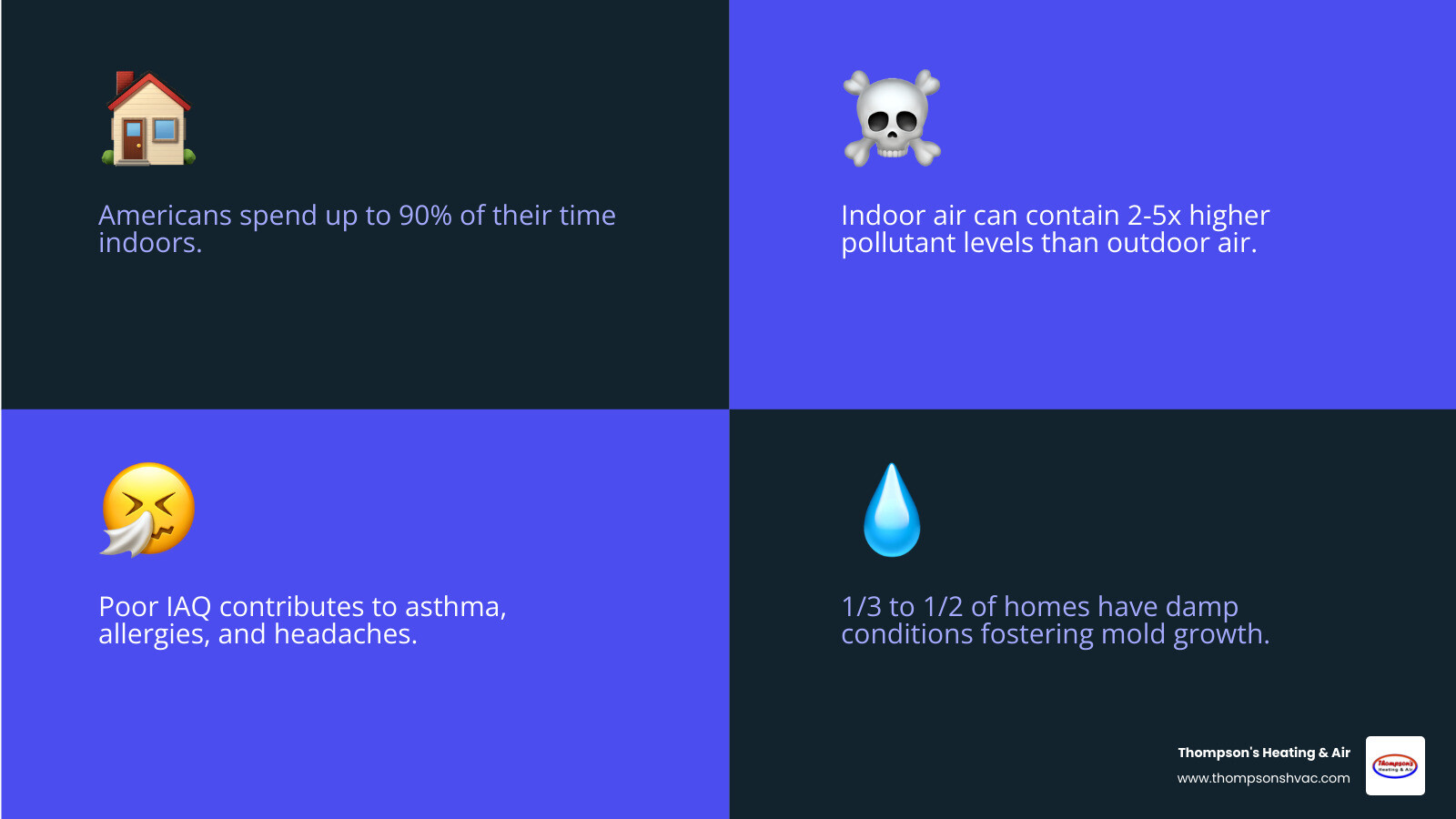
How to improve indoor air quality at home starts with understanding what you're actually breathing — and the answer might surprise you. According to the EPA, Americans spend up to 90% of their time indoors, yet indoor air can contain pollutants at levels two to five times higher than outside air.
Here are the core ways to improve your home's indoor air quality:
1. Control pollution sources - Remove or reduce VOCs, smoke, and chemical off-gassing
2. Improve ventilation - Open windows when safe, use exhaust fans in kitchens and bathrooms
3. Use air filtration - Install HEPA-rated or MERV 13 filters in your HVAC system
4. Manage humidity - Keep indoor humidity between 30-50% to prevent mold and dust mites
5. Test for hidden hazards - Radon is the second leading cause of lung cancer in the U.S.
6. Clean consistently - Vacuum weekly, wash bedding in hot water, and dust with microfiber cloths
These steps can make a real difference for your family's health, especially if anyone in your home deals with asthma, allergies, or frequent headaches.
Most people don't think about the air inside their home until something goes wrong — a musty smell, a sneezing fit that won't quit, or a family member who keeps waking up congested. But poor indoor air quality builds up quietly. It comes from everyday sources: cleaning sprays, cooking fumes, pet dander, old ductwork, and even the furniture you sit on. One third to one half of all homes have damp conditions that can encourage mold and bacteria growth, often without any visible signs.
For homeowners in Woodland, CA, where hot, dry summers push people indoors for months at a time, the quality of your indoor air is directly tied to how your HVAC system is performing. A well-maintained system doesn't just keep you comfortable — it plays a key role in filtering, circulating, and controlling the air your family breathes every day.
Identifying and Eliminating Common Indoor Pollutants
When we talk about how to improve indoor air quality at home, the first rule of thumb is "source control." This is a fancy way of saying: if something is making the air dirty, get rid of it! It is often the most cost-effective strategy because it prevents the problem before you have to spend energy (and money) filtering it out.
Common pollutants in our Northern California homes include Volatile Organic Compounds (VOCs), which are gases emitted from certain solids or liquids. You’ll find these in everything from new carpets and composite wood furniture to household cleaners and even those "mountain breeze" scented candles. In fact, VOC levels can be two to five times higher indoors than out.
To tackle these, we recommend looking for "low-VOC" or "no-VOC" labels when remodeling. If you’ve just bought new furniture, let it "off-gas" in a garage or a well-ventilated room for a few days before bringing it into the main living space.
The Danger of Smoke and Chemicals
Secondhand smoke is a major indoor pollutant, but have you heard of "thirdhand smoke"? This is the residue that clings to your walls, carpets, and furniture long after a cigarette is extinguished. For homes in areas like Davis or Dixon where older homes might have a history of indoor smoking, we suggest steam cleaning upholstery and carpets to break down these lingering toxins.
Beyond smoke, common household items contribute to a "pollutant soup." Dust is more than just dirt; it's a mix of skin cells, pet dander, pollen, and even microscopic plastic fibers. By identifying these sources, you can take the first step toward a healthier home.
If you are concerned about what might be hiding in your air, our Indoor Air Quality services can help identify specific triggers in your environment.
Common Indoor Air Pollutants to Watch For:
• Radon: An invisible, radioactive gas that enters through foundation cracks.
• Formaldehyde: Found in many glues and pressed-wood products.
• Nitrogen Dioxide (NO2): Often produced by unvented gas stoves or space heaters.
• Biological Contaminants: Mold, mildew, bacteria, and dust mites.
• Particulate Matter (PM2.5): Fine particles from cooking, candles, or outdoor smoke.

How to improve indoor air quality at home through better ventilation
If source control is the first step, ventilation is the second. Many of us in Yolo County keep our homes tightly sealed to keep the heat out during our scorching July afternoons. While this is great for your energy bill, it can lead to "stale" air. Without fresh air exchange, pollutants simply circulate over and over.
Natural ventilation is the easiest method. Opening windows for just 10 to 15 minutes a day can significantly dilute indoor pollutant concentrations. However, we have to be smart about it. If it’s allergy season in Winters or if there’s a nearby agricultural burn, keep those windows shut. Check your local air quality index (AQI) before letting the outside air in.
Mechanical Ventilation and Your HVAC
Most residential heating and cooling systems do not mechanically bring fresh air into the house. They simply recirculate the air already inside. This is why using your exhaust fans is so critical.
• Kitchen Fans: Always run your range hood when cooking, especially if you have a gas stove. It helps pull out NO2 and moisture.
• Bathroom Fans: Run these during and for 20 minutes after a shower to prevent the damp conditions that lead to mold.
For a more comprehensive solution, we often look at how your system is integrated. Whether you need Air Conditioning Service in Sacramento CA or Heating Service in Sacramento CA, ensuring your system has the right "breathability" is key. Advanced home designs now include Heat Recovery Ventilators (HRVs) that swap out stale indoor air for fresh outdoor air while pre-heating or cooling it so you don't lose energy.
Utilizing Advanced Air Filtration and Purification Systems
When you can't eliminate the source and ventilation isn't enough, it's time to bring in the heavy hitters: filtration and purification. This is where we see the biggest technology leaps in 2026.
Standard 1-inch fiberglass filters are designed to protect your HVAC equipment from large dust bunnies, but they do very little for your lungs. To truly see how to improve indoor air quality at home, you should look at the MERV (Minimum Efficiency Reporting Value) rating of your filters.
For most homes in Woodland and West Sacramento, we recommend a filter with a MERV 11 to MERV 13 rating. These are dense enough to capture fine particles like bacteria, tobacco smoke, and even some viruses, without putting too much strain on your blower motor. If you’re unsure which filter your system can handle, our experts in Air Filtration can guide you to the perfect balance of protection and performance.
If someone in your family suffers from severe allergies or respiratory issues, a whole-home system like the Air Purification Installation Woodland CA is a game-changer. These systems are installed directly into your ductwork and work 24/7 to scrub the air as it passes through.
Why HEPA filters are essential for how to improve indoor air quality at home
You’ve likely heard the term "HEPA" (High-Efficiency Particulate Air). To be truly HEPA-rated, a filter must be able to remove at least 99.97% of particles that are 0.3 microns in size. To put that in perspective, a human hair is about 70 microns wide. HEPA filters are the gold standard for capturing the smallest, most irritating triggers.
While HEPA filters are common in portable air purifiers, they can sometimes be too restrictive for standard home HVAC fans. This is why we often recommend dedicated Air Purification units that work alongside your existing system. They ensure that even the tiniest droplets and dust mites are trapped and removed from your living space.
Professional maintenance as a way how to improve indoor air quality at home
We can't talk about air quality without talking about maintenance. A dirty HVAC system is essentially a dust-delivery machine. Over time, dust and moisture can accumulate on your evaporator coils, leading to "dirty sock syndrome"—that musty smell that greets you when the AC kicks on.
Regular professional checks for Indoor Air Quality Woodland CA ensure that:
1. Ducts are sealed: Leaky ducts can pull in dusty air from your attic or crawlspace.
2. Drain lines are clear: Standing water in your system is a breeding ground for mold.
3. Filters are fresh: We recommend checking filters every 30 days and replacing them at least every 90 days (or more often if you have pets!).
Controlling Humidity and Preventing Mold Growth
In our part of California, we often deal with dry air, but indoor humidity can spike in kitchens, bathrooms, and laundry rooms. Keeping your indoor relative humidity between 30% and 50% is the "sweet spot" for health.
If humidity drops below 30%, your skin and nasal passages dry out, making you more susceptible to colds. If it rises above 50%, you’re inviting dust mites and mold to move in. Since one third to one half of structures have damp conditions, monitoring this is vital. A simple tool called a hygrometer can help you keep track of these levels.
For those in areas like West Sacramento or Natomas where humidity can linger near the river, Indoor Air Quality Services in Sacramento CA often involve installing whole-home dehumidifiers. These units work with your HVAC system to pull moisture out of the air before it ever reaches your living room.
• Below 30% — Potential Health & Home Impacts: Dry skin, itchy eyes, increased respiratory infections, wood furniture cracking.
• 30% - 50% — Potential Health & Home Impacts: The Ideal Range. Minimal mold growth and maximum comfort for humans.
• Above 50% — Potential Health & Home Impacts: Dust mite populations explode; mold begins to grow on surfaces and inside walls.
• Above 60% — Potential Health & Home Impacts: Significant risk of structural damage and severe allergen buildup.
Testing for Radon and Invisible Hazards
Some of the most dangerous pollutants are the ones you can't see, smell, or taste. Radon is a naturally occurring radioactive gas that comes from the breakdown of uranium in soil. It can seep into your home through cracks in the foundation or gaps around pipes. Exposure to radon is the second leading cause of lung cancer in the United States, right after smoking.
Because radon levels vary from house to house—even on the same street in Woodland—testing is the only way to know if you're at risk. You can find DIY radon testing kits at most hardware stores. If your levels are high, don't panic; radon mitigation systems are very effective at venting the gas safely outside.
Similarly, Carbon Monoxide (CO) is a silent killer. We always insist that our neighbors in Yolo County have working CO detectors on every level of their home, especially near bedrooms. If you use gas appliances or have an attached garage, these detectors are non-negotiable. For a deep dive into your home's safety, consider Air Quality Testing Woodland CA to get a professional baseline of your home's health.
Frequently Asked Questions about Home Air Quality
Are houseplants effective for improving IAQ?
This is one of the most common questions we get! While a famous NASA study from the 1980s suggested plants could clean the air, the reality in a modern home is a bit different. You would need a literal jungle—hundreds of plants—to match the air-cleaning power of one good HVAC filter or a single open window. Plus, over-watering plants can lead to damp soil, which promotes the growth of mold and microorganisms. We love plants for the vibes, but rely on your HVAC for the air!
How often should I change my HVAC filters?
It depends on your environment. If you live in a dusty area like Arbuckle or have three shedding dogs in Knights Landing, you might need to change them every month. For most people using high-quality MERV 11-13 filters, every 3 months is the standard. If you notice reduced airflow or your energy bills are creeping up, check the filter first—it’s the most common culprit.
What are the signs of poor indoor air quality?
If you find yourself sneezing only when you’re at home, or if you notice a "heavy" or musty smell that doesn't go away, your IAQ likely needs help. Other signs include frequent headaches, dry throat, itchy eyes, and visible dust accumulation on surfaces just a day after cleaning. If asthma triggers seem more frequent during the winter when the house is closed up, that’s a major red flag.
Conclusion
Improving the air you breathe isn't just about comfort; it's about long-term health and peace of mind. From simple steps like taking your shoes off at the door to advanced solutions like whole-home air scrubbers, every action counts.
At Thompson's Heating & Air, we've been helping our neighbors in Woodland, Davis, and across Yolo County breathe easier since 1992. We understand our local climate and the unique challenges it brings to indoor comfort. Whether you're looking for a simple filter upgrade or a complete air quality overhaul, we're here to provide reliable, 5-star service.
Ready to take control of your home's environment? Explore our range of Indoor Air Quality Products and start breathing cleaner air today. After all, you shouldn't have to live in a bubble to feel safe in your own home.



.avif)
.avif)
.png)
