
Standing Pilot Light vs Electronic Ignition: Understanding Furnace Safety Before the First Frost

Is Your Heating System Ready for the First Frost?
As we prepare homes for the November 2026 winter season, the team at Thompson's Heating & Air often fields questions about upgrading aging equipment. When comparing a standing pilot light vs electronic ignition for your home's heating, the most pressing question is whether your furnace will turn on reliably when the first cold snap hits. Older furnaces—particularly those manufactured before the early 1990s—equipped with constant-burning pilot lights are notoriously prone to blowing out or wasting energy just when you need them most. As rapid temperature drops sweep through the Sacramento Valley during late fall, nursing an outdated heating system with an AFUE rating below 65% becomes a frustrating and uncomfortable gamble. You are left facing a clear decision: continue dealing with an unreliable, aging furnace, or upgrade to a modern electronic ignition system that guarantees warmth on demand.
If you need comprehensive heating services or are considering a furnace installation before the deep freeze arrives, understanding your ignition options is the safest place to start.
What Is a Standing Pilot Light?
A standing pilot light is a small, continuous gas flame that burns inside older furnaces 24 hours a day, seven days a week. For decades, particularly in homes built throughout the 1970s and 1980s, this was the industry standard for residential heating. Its sole purpose is to serve as a reliable ignition source so that when your thermostat detects a drop in room temperature, the main burner can ignite immediately.
While the concept is straightforward, the mechanics rely on a delicate balance of parts that our technicians frequently see impacted by their environment. Here is how a traditional standing pilot system operates:
1. The continuous flame: A small gas valve remains permanently open, feeding a tiny amount of gas to maintain a constant blue flame inside the combustion chamber.
2. The thermocouple sensor: This small copper rod sits directly in the path of the pilot flame. As long as the flame is burning, the heat generates a small electrical voltage—typically around 30 millivolts—that tells the main gas valve it is safe to remain open.
3. The safety shutoff: If a sudden draft or a buildup of dirt extinguishes the pilot flame, the thermocouple cools down. The voltage drops, and a safety mechanism snaps the gas valve shut to prevent raw gas from flooding your home in Woodland CA or the wider Sacramento Valley.
The primary flaw in this older technology is its vulnerability. Because the flame is always burning, it requires a constant, unending supply of natural gas. Furthermore, environmental factors like dusty basements, minor drafts, or simply a worn-out thermocouple can easily extinguish the flame. When that happens, your heating system shuts down entirely, leaving your home freezing until a professional can assess and resolve the issue.
How Modern Electronic Ignition Systems Work
As heating technology advanced into the 2000s and beyond, manufacturers realized that keeping a flame burning constantly was both inefficient and unnecessary. Modern furnaces now utilize electronic ignition systems, which eliminate the continuous pilot light entirely. Instead of burning gas all day and night, these advanced systems remain completely dormant until your thermostat calls for heat.
At Thompson's Heating & Air, we install two primary types of electronic ignition systems used in modern heating equipment:
• Intermittent Pilot Systems: This setup uses an electronic spark to ignite a temporary pilot flame only when the furnace needs to run. Once the main burner lights and the heating cycle is complete, the pilot flame extinguishes completely.
• Hot Surface Igniters (HSI): This is the most common technology in high-efficiency furnaces (typically those boasting 90% to 98% AFUE ratings) today. It functions similarly to the filament in a lightbulb or a toaster. When the thermostat signals for heat, electrical current passes through a durable element (usually made of silicon carbide), causing it to glow red-hot at temperatures reaching up to 2,500 degrees Fahrenheit. The gas valve opens, the gas meets the glowing element, and the main burner ignites.
By eliminating the continuous flame, electronic ignitions drastically improve both energy efficiency and system reliability. You no longer have to worry about a stray breeze blowing out your pilot light during late fall and pre-winter cold snaps. Furthermore, these modern igniters are deeply integrated into the furnace's automated safety sequences. For example, if the system detects improper airflow, it will halt the ignition sequence entirely. This interconnected safety net highlights the risks of ignoring a weak furnace inducer motor, as modern ignitions rely on every component functioning perfectly before allowing gas into the combustion chamber.
Standing Pilot Light vs Electronic Ignition: A Side-by-Side Comparison
Understanding the fundamental differences between these two technologies makes it clear why the HVAC industry has shifted entirely away from standing pilots in modern manufacturing. In our years of serving Woodland CA and elsewhere in the Sacramento Valley, evaluating these systems side-by-side reveals stark contrasts in performance, especially when comparing a legacy 60% AFUE unit to a modern 95% AFUE system.
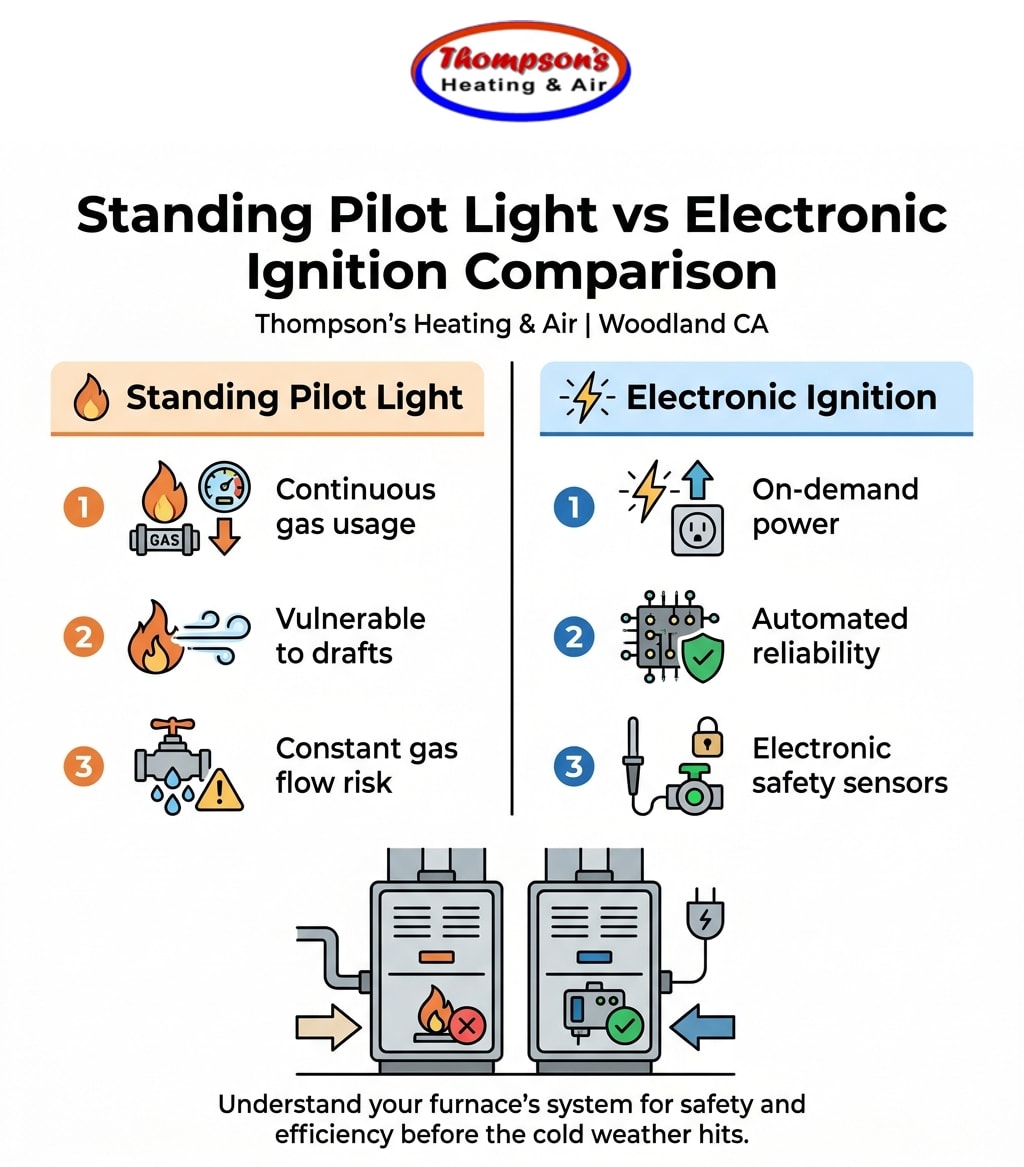
• Energy Usage — Standing Pilot Light (Older Furnaces): Consumes gas continuously, 24/7, even when the furnace is not actively heating the home. — Electronic Ignition (Modern Furnaces): Uses a brief surge of electricity only on-demand when the thermostat calls for heat.
• Reliability — Standing Pilot Light (Older Furnaces): Highly susceptible to drafts, dust buildup, and thermocouple wear, leading to frequent blowouts. — Electronic Ignition (Modern Furnaces): Highly dependable, utilizing automated electrical sequences that are unaffected by minor drafts.
• Safety Mechanisms — Standing Pilot Light (Older Furnaces): Relies on a mechanical thermocouple that can fail or become sluggish over time. — Electronic Ignition (Modern Furnaces): Utilizes instant-response electronic flame sensors and integrated fail-safes.
• Maintenance Needs — Standing Pilot Light (Older Furnaces): Requires frequent cleaning of the pilot orifice and regular thermocouple replacements. — Electronic Ignition (Modern Furnaces): Generally requires less hands-on intervention, though annual professional inspections are still necessary.
The Hidden Safety Risks of Outdated Pilot Lights
While energy waste is a significant drawback, the most compelling reason to move away from standing pilot lights involves household safety. Older furnaces rely on mechanical parts that degrade over time, creating hidden hazards that our service team often finds homeowners overlook until a failure occurs.
The Problem: Thermocouple Degradation
The thermocouple is the only line of defense preventing raw gas from flowing into your home if the pilot light goes out. Over years of exposure to a constant flame, this small copper component develops carbon buildup and structural wear. During our late fall maintenance checks, we frequently encounter failing thermocouples that have become "lazy," meaning they take dangerously long to shut off the gas valve after the flame extinguishes. In worst-case scenarios, it can lead to delayed ignition—where gas pools in the combustion chamber before finally catching a spark, resulting in a dangerous small explosion or "roll-out" of flames.
The Cause: Incomplete Combustion and Carbon Monoxide
Older, poorly maintained units with standing pilots are also at a higher risk of incomplete combustion. If the pilot orifice becomes clogged with dust or debris, the flame burns yellow instead of a crisp blue. A yellow flame indicates that the gas is not burning cleanly, which produces elevated levels of carbon monoxide. If the furnace's heat exchanger also has microscopic cracks from age, this deadly, odorless gas can circulate directly into your living spaces, potentially triggering carbon monoxide detectors if levels exceed safe parts-per-million (PPM) thresholds.
The Solution: Proactive Safety Upgrades
At Thompson's Heating & Air, our commitment to safety and modern efficiency means our local technicians consistently recommend moving away from outdated standing pilots to protect families. Upgrading to a modern electronic ignition system is not just a luxury; it is a proactive safety measure. We strongly warn against DIY relighting or repairs on older systems. Gas appliances require licensed professionals, and attempting to manually relight a stubborn pilot during late fall and pre-winter weather can easily lead to dangerous gas buildup or flash fires.
Energy Waste and Efficiency Considerations
Beyond safety, the financial and environmental impact of operating an older furnace is substantial. According to Department of Energy (DOE) guidelines regarding furnace efficiency, older systems with continuous pilot lights are inherently wasteful. The energy footprint of a standing pilot is much larger than most homeowners realize.
A standing pilot light can consume up to 5 to 8 therms of natural gas each month just by remaining lit. Even during the warmer months when the furnace is completely inactive, that small flame continues to draw gas from your utility line unless you manually shut off the gas supply to the furnace. Over the course of a single year, this continuous burning adds up to significant, unnecessary utility usage. You are effectively paying to heat a tiny portion of the air inside your metal furnace cabinet 24 hours a day.
Furthermore, older systems require meticulous routine upkeep just to maintain their baseline efficiency. If the pilot flame is misaligned or the gas pressure is slightly off, the system wastes even more fuel. While scheduling thorough heating maintenance is vital for every system in Woodland CA and the Sacramento Valley, modernizing the ignition system entirely is a far more effective step in reducing your overall household energy footprint. In many cases, federal tax credits or local utility incentive programs may apply to qualifying high-efficiency electronic ignition furnace installations, making the upgrade even more accessible. We advise readers to verify current programs with their utility provider or a tax professional. Electronic ignitions eliminate this constant gas draw, ensuring that you only use energy when your home actually requires warmth.
Frequently Asked Questions About Furnace Ignitions
Is electronic ignition better than a pilot light?
Yes, our technicians at Thompson's Heating & Air find that electronic ignitions are significantly better in terms of safety, reliability, and energy efficiency. They eliminate the continuous waste of gas and the risk of the flame blowing out unexpectedly. Modern systems use advanced sensors that communicate directly with the furnace's control board, ensuring that the heating cycle only begins when all safety parameters are met.
Can I replace a standing pilot with electronic ignition?
While conversion kits exist, it is generally not recommended or safe to retrofit an old standing pilot furnace with an electronic ignition. Modifying older gas appliances alters their engineered safety certifications and can introduce severe hazards. Upgrading the entire furnace is the safest, most reliable way to gain the benefits of electronic ignition, especially as late fall and pre-winter weather approaches.
How much gas does a standing pilot light use?
A standing pilot light can consume a noticeable amount of gas each month—often estimated at 5 to 8 therms—contributing to constant energy waste. Because the flame burns continuously, it draws a steady flow of fuel regardless of whether the furnace is actively heating your home. Over a year, this continuous burning adds up to unnecessary utility usage and a larger environmental footprint.
Are standing pilot lights safe for continuous winter use?
They are generally safe if properly maintained by a licensed professional, but they carry higher inherent risks than modern systems. Thermocouple failures, clogged orifices, or strong drafts can lead to delayed ignition, gas leaks, or a sudden loss of heat. During critical cold snaps, relying on outdated mechanical safety switches is a gamble compared to modern electronic sensors.
Why does my furnace pilot light keep going out?
Common causes we see in the field include a dirty pilot orifice, a failing thermocouple, or strong drafts near the furnace cabinet. When the thermocouple wears out and loses its 30-millivolt output, it fails to sense the flame and automatically shuts off the gas supply as a safety precaution. Frequent blowouts indicate the system is struggling and requires a professional evaluation immediately.
What should I do if my pilot light won't stay lit?
Do not repeatedly attempt to manually relight it, as this can cause dangerous gas buildup in the combustion chamber. Turn off the furnace at the thermostat and contact a licensed HVAC professional for immediate service. Gas appliances require specialized tools and training to diagnose safely, and DIY repairs pose a severe fire and safety hazard.
Explore Your Options for a Safer, More Reliable Winter
Navigating the differences between a standing pilot light vs electronic ignition ultimately comes down to prioritizing your home's safety and comfort. Electronic ignition systems offer distinct peace of mind through enhanced safety protocols, reliable on-demand operation, and improved energy efficiency. By eliminating the constant gas waste and the mechanical vulnerabilities of older pilot lights, modern furnaces ensure that your home stays warm without the worry of unexpected breakdowns.
Sacramento Valley winter nights require a heating system that turns on without fail the moment temperatures drop. As we gear up for the November 2026 holiday season, now is the perfect time to evaluate your aging equipment. If you are tired of nursing an unreliable pilot light in Woodland CA or the surrounding areas, exploring your options for a professional furnace installation with Thompson's Heating & Air will provide the dependable, worry-free warmth your family deserves.