
Why Indoor Dust Increases During Fall Harvest: Understanding the October Surge

Noticing More Dirt Indoors? The Reality of the Autumn Particulate Surge
Have you recently wiped down your living room tables, only to find a fine layer of dirt settling back on them just days later? If you are wondering why indoor dust increases during fall harvest, you are not alone. Here at Thompson's Heating & Air, we field calls every October from homeowners across Woodland and the Sacramento Valley who notice a sudden, rapid accumulation of fine dirt on their furniture despite maintaining a rigorous cleaning schedule. This isn't a sign that your housekeeping is slipping; it is a direct result of environmental changes happening right outside your front door.
To protect your home and your HVAC equipment, professional guidance is essential. Discover how we can help by exploring our indoor air quality solutions.
During the October harvest, a massive surge of fine agricultural dust and organic particulate matter is kicked up into the atmosphere. Heavy machinery works around the clock, pulverizing dry soil and plant material. This sudden influx of airborne debris creates a unique challenge for residential heating and cooling systems. Standard 1-inch filters that easily survived the relatively clean air of the summer cooling season are suddenly overwhelmed by this dense, abrasive matter.
When this seasonal shift occurs, homeowners face an important decision point: continue replacing basic filters every few weeks, risk running the system with restricted airflow, or upgrade to higher MERV filters and dedicated IAQ solutions that can actually handle the load. Understanding the nature of this seasonal particulate surge is the first step in taking control of the air circulating through your living spaces.
What Makes Agricultural Dust Different from Standard Household Lint?
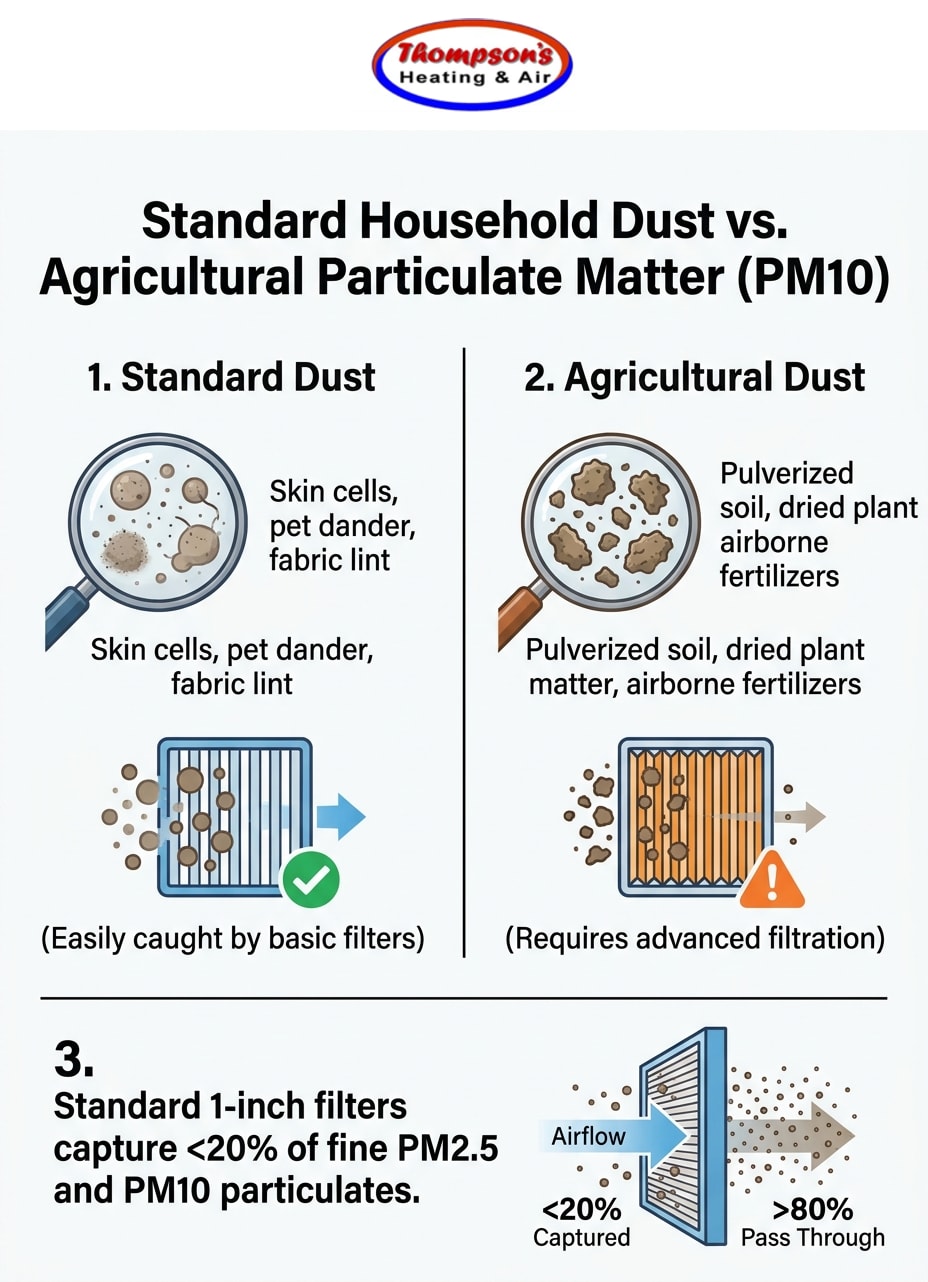
To understand why your standard HVAC filter is suddenly struggling, you need to understand the fundamental differences between the dust you see in July and the dust you see during the October harvest. Standard household dust is relatively light and benign. It consists mostly of human skin cells, fabric lint, carpet fibers, and pet dander. While annoying, it is exactly what basic filters were designed to catch.
In our experience servicing local ductwork, we've seen how agricultural dust is an entirely different substance. It is composed of pulverized dry soil, crushed and dried plant matter, and trace amounts of airborne fertilizers. When tractors and harvesters move through the fields, they launch these materials into the air. If you want to stop this heavier material from circulating through your ductwork, upgrading to advanced air filtration systems is often the most effective route.
The scientific measurement of these airborne particles is categorized by size. Particulate Matter (PM) is measured in microns. PM10 refers to inhalable particles with diameters that are generally 10 micrometers and smaller, while PM2.5 refers to fine inhalable particles that are 2.5 micrometers and smaller. Heavy farming machinery significantly elevates these concentrations in the air.
Because organic agricultural matter is heavier, denser, and more abrasive than fabric lint, it behaves differently when it enters your HVAC system. It packs tightly into filter fibers, creating a solid wall of dirt that restricts airflow much faster than normal dust. For residents in Woodland and the Sacramento Valley, this means the air inside the home is carrying a much heavier, more damaging load than at any other time of the year.
• Primary Composition — Standard Household Dust: Skin cells, pet dander, fabric lint, hair — Agricultural Harvest Dust: Pulverized soil, dried organic plant matter, silicates
• Particle Size & Weight — Standard Household Dust: Larger, lighter, easily floats — Agricultural Harvest Dust: Dense, heavy, highly concentrated PM10 and PM2.5
• Impact on HVAC Filters — Standard Household Dust: Accumulates slowly over 30-90 days — Agricultural Harvest Dust: Can completely blind a standard filter in weeks
• Abrasiveness — Standard Household Dust: Low (soft organic materials) — Agricultural Harvest Dust: High (contains microscopic rocks and hard soil)
How Dry Autumn Winds Force Particulates Inside Your Home
The Problem: You keep your doors closed and your windows locked, yet the fine silt still manages to coat your kitchen counters. The physical breach of your home envelope happens because of a combination of environmental mechanics and home pressure dynamics. During the October harvest, the sheer volume of dust in the outdoor air is staggering, but it needs a transport mechanism to get inside.
The Cause: The Sacramento Valley's dry autumn winds actively transport dense agricultural particulates into residential areas. These sustained breezes pick up the PM10 and PM2.5 kicked up by harvesters and carry them for miles. But wind alone doesn't push the dust indoors. The real culprit is negative air pressure. When exhaust fans run, or when your HVAC system has leaky return ducts in the attic or crawlspace, your home physically pulls air from the outside to equalize the pressure. This means dusty outdoor air is sucked through tiny cracks around doors, window frames, and baseboards.
Furthermore, many homeowners take advantage of mild fall days by opening their windows. While the breeze feels refreshing, it introduces a massive particulate load directly into the living space. Once inside, this dust settles onto surfaces and gets pulled into the HVAC return vents the next time the thermostat calls for heating or cooling.
The Solution: Addressing this requires a multi-layered approach. Sealing drafts and managing indoor air pressure is critical. If you are struggling with this seasonal influx, exploring professional Woodland indoor air quality services can help you identify exactly where the breaches are occurring and how to filter the air effectively. This environmental shift happens rapidly, long before the winter rains arrive to wash the air clean, making proactive defense essential.
The Hidden Toll on Your Heating and Cooling Equipment
While dusting your coffee table more frequently is an annoyance, the real threat of the October harvest lies hidden behind your walls. The sudden intake of heavy organic dust has a severe mechanical impact on your heating and cooling equipment. Our technicians at Thompson's Heating & Air see firsthand what harvest dust does to local heating systems, providing a boots-on-the-ground perspective that highlights just how damaging this season can be.
A pattern we see often in Woodland homes is that when dense agricultural soil and plant matter enter your return ducts, they slam into your air filter. Because this dust is so heavy and concentrated, it can clog a standard filter in a matter of weeks, not months. Once that filter is blinded by dirt, the system's airflow is severely restricted. This sets off a chain reaction of mechanical stress.
• Increased Blower Strain: The blower motor has to work twice as hard to pull the required volume of air through a wall of dirt. This causes the motor to run hotter, consume significantly more electricity, and wear out its bearings prematurely.
• Reduced Heating Efficiency: If airflow is restricted, the heat exchanger cannot transfer warmth effectively into your living spaces. Your furnace will run longer cycles, struggling to satisfy the thermostat while wasting energy.
• Overheating and Short Cycling: In severe cases, restricted airflow causes the furnace's internal temperature to spike. The high-limit safety switch will trip, shutting the system down to prevent a fire. This results in "short cycling," where the system turns on and off rapidly without ever heating the home.
• Coated Internal Components: Dust that bypasses the filter will settle directly on the blower wheel blades and the heat exchanger, acting as an insulating blanket that further destroys system efficiency.
Dirty components cause premature wear and tear right as the system needs to gear up for winter heating. This is why scheduling comprehensive fall heating maintenance is so critical for residents in Woodland and the Sacramento Valley. A professional tune-up ensures that agricultural debris is cleared out before it causes a mid-winter breakdown.
Why Standard 1-Inch Filters Fail Against Fine Particulates
Most homes are equipped with standard 1-inch filter slots. Homeowners often head to the hardware store, buy a multi-pack of basic fiberglass filters, and assume their air is being cleaned. However, during the October harvest, these filters are completely outmatched by the environment.
Standard 1-inch fiberglass filters (typically rated MERV 1 to 4) are designed for one purpose: to protect the HVAC equipment from large debris like pet hair, carpet fibers, and large dust bunnies. They are not designed to clean the air you breathe. According to EPA guidelines, these basic filters capture less than 20% of fine particulate matter, including the PM2.5 and PM10 particles that make up the bulk of agricultural dust.
When harvest dust hits a MERV 1-4 filter, the microscopic soil and plant particulates simply slip right through the loose fiberglass weave. They travel through your ductwork, blow out of your supply registers, and settle onto your furniture. When you walk across the room, you kick them back into the air, and the cycle repeats.
The danger of the quick fix: We often see homeowners make a dangerous mistake: realizing their basic filter isn't working, they buy the highest MERV-rated 1-inch filter they can find (like a MERV 13). Shoving a dense, restrictive filter into a standard 1-inch slot is like trying to breathe through a thick wool blanket. It drastically increases static pressure, suffocates the blower motor, and can cause catastrophic system failure. Higher MERV ratings are absolutely required to capture agricultural dust, but they must be implemented correctly.
Preparing Your Home with Advanced IAQ Upgrades
If basic filters fail and dense 1-inch filters damage your equipment, how do you protect your home during the harvest season? The answer lies in upgrading your system's filtration capacity. For residents in Woodland and the Sacramento Valley, our team recommends investing in dedicated indoor air quality solutions as the most effective way to manage the heavy particulate load without destroying your HVAC system.
Installing a High-Capacity Media Cabinet
The most effective mechanical solution is upgrading to a media cabinet to handle harvest season dust. A media cabinet replaces your standard 1-inch filter slot with a housing designed to hold a 4-inch or 5-inch thick pleated filter. Because these filters have deep pleats, their total surface area is massive compared to a flat 1-inch filter. This vast surface area allows them to achieve high MERV ratings (MERV 11 to 16) to capture fine farm dust, while still allowing air to flow freely through the system.
Integrating Whole-Home Air Scrubbers
While media cabinets excel at trapping physical particles, whole-home air scrubbers and purifiers provide an active layer of defense. These systems are installed directly into your ductwork. Using technologies like ultraviolet (UV) light and ionization, they actively neutralize organic matter, allergens, and airborne pollutants. When combined with a high-efficiency media filter, air scrubbers ensure that the air circulating through your home is pristine, regardless of what the tractors are kicking up outside.
The Importance of Professional Sizing
It is vital to understand that any significant filtration upgrade should be sized and installed by a licensed professional. Modifying your ductwork to accommodate a media cabinet requires careful calculations to protect the system's static pressure. Improper installation can lead to the exact airflow restrictions you are trying to avoid. By taking action before the harvest season peaks, you can ensure your home remains a clean, comfortable refuge.
Frequently Asked Questions About Fall Harvest Dust and Indoor Air Quality
Why is my house so dusty in the fall?
Your house becomes dusty in the fall because the combination of dry weather, falling leaves, and agricultural harvesting creates a massive spike in outdoor particulate matter. This dense dust easily infiltrates homes through negative air pressure, drafty windows, and open doors during the October harvest season.
Does harvesting crops cause indoor dust?
Yes, harvesting crops is a primary cause of seasonal indoor dust in agricultural regions. Heavy machinery pulverizes dry soil and plant matter, sending PM10 particulates into the air, which are then carried by autumn winds directly into nearby residential neighborhoods.
How does harvest dust affect HVAC systems?
Dense organic harvest dust quickly clogs standard air filters and severely restricts vital airflow. This restriction strains the blower motor, causes the system to overheat, and can coat internal components, significantly reducing overall heating efficiency just before winter.
What is the best HVAC filter for agricultural dust?
Filters with a MERV rating of 11 to 13 are highly effective at capturing fine agricultural dust. However, upgrading to a thicker 4-inch or 5-inch media cabinet is often necessary to use these high-MERV filters without restricting proper airflow to your equipment.
Can fine farm dust trigger indoor allergies?
Absolutely, fine farm dust is a major trigger for indoor allergies. Agricultural dust contains concentrated organic matter, pollen, fertilizers, and soil particulates that can severely irritate the respiratory system and trigger seasonal allergy flare-ups even when you stay indoors.
Take Control of Your Air Quality Before Winter Arrives
While you cannot stop the heavy machinery from rolling through the fields during the October harvest, you absolutely have the power to control what circulates inside your home. Understanding that standard filters are outmatched by this dense agricultural dust is the first step in protecting both your family's comfort and your heating equipment's longevity.
By recognizing the threat that fine particulates pose to your blower motor and heat exchanger, you can make informed decisions about your indoor air quality. For homeowners in Woodland and the Sacramento Valley, proactive maintenance and professional filtration upgrades are the most effective defense. Explore your options for media cabinets and air scrubbers today, and ensure your home is ready for a clean, efficient winter season.