
Why Your Thermostat Screen Goes Blank During Peak Cooling Hours

Facing a Blank Thermostat on a 100-Degree Summer Afternoon
August late-summer peak cooling is in full swing, and understanding exactly why your thermostat screen goes blank during peak cooling hours is critical when indoor temperatures start climbing. The seasonal heat in the Sacramento Valley pushes air conditioning systems to their absolute limits. When consecutive 100-plus degree days hit, your cooling equipment operates at a near 100 percent duty cycle. It runs constantly just to keep your living space habitable. If you walk past your hallway wall and notice the digital display on your thermostat is completely dead, panic usually sets in immediately.
Our team at Thompson's Heating & Air fields dozens of frantic calls about this exact issue every August. For professional assistance with these exact symptoms, you can rely on our comprehensive Air Conditioning Services.
A sudden power loss at the thermostat forces a stressful decision point. You have to figure out if you are dealing with a minor power glitch, a flipped breaker, or a total system lockout that requires professional intervention. Most homeowners immediately assume the thermostat itself has permanently broken. They worry they will need to rush out, buy a new smart thermostat, and figure out how to wire it while the house heats up.
Here is the reassuring truth: a blank screen rarely means the thermostat is broken. In the vast majority of cases, the thermostat is functioning exactly as it should. The blank screen is actually a symptom of a larger safety mechanism doing its job. Before you start pulling the device off the wall, it helps to understand the difference between a broken component and a system that has intentionally shut itself down to protect your property.
• Completely blank digital display — Common Homeowner Assumption: The thermostat is broken and needs replacement. — Actual System Reality: Power has been intentionally cut by a safety switch.
• System unresponsive to app commands — Common Homeowner Assumption: The Wi-Fi module or smart thermostat failed. — Actual System Reality: The indoor unit has locked out to prevent damage.
• AC stops during the hottest part of the day — Common Homeowner Assumption: The compressor overheated and died. — Actual System Reality: Heavy condensation triggered the drain pan float switch.
• Screen is blank but batteries are fresh — Common Homeowner Assumption: Internal wiring in the wall went bad. — Actual System Reality: A low-voltage fuse on the furnace control board blew.
When the afternoon heat is at its worst, your system is working its hardest. That heavy workload is exactly what triggers these protective shutdowns. Instead of panicking over a broken screen, you can approach the situation knowing that your equipment is likely protecting itself—and your home—from a much larger disaster.
The Hidden Hero: How Your AC's Safety Switches Prevent Disaster
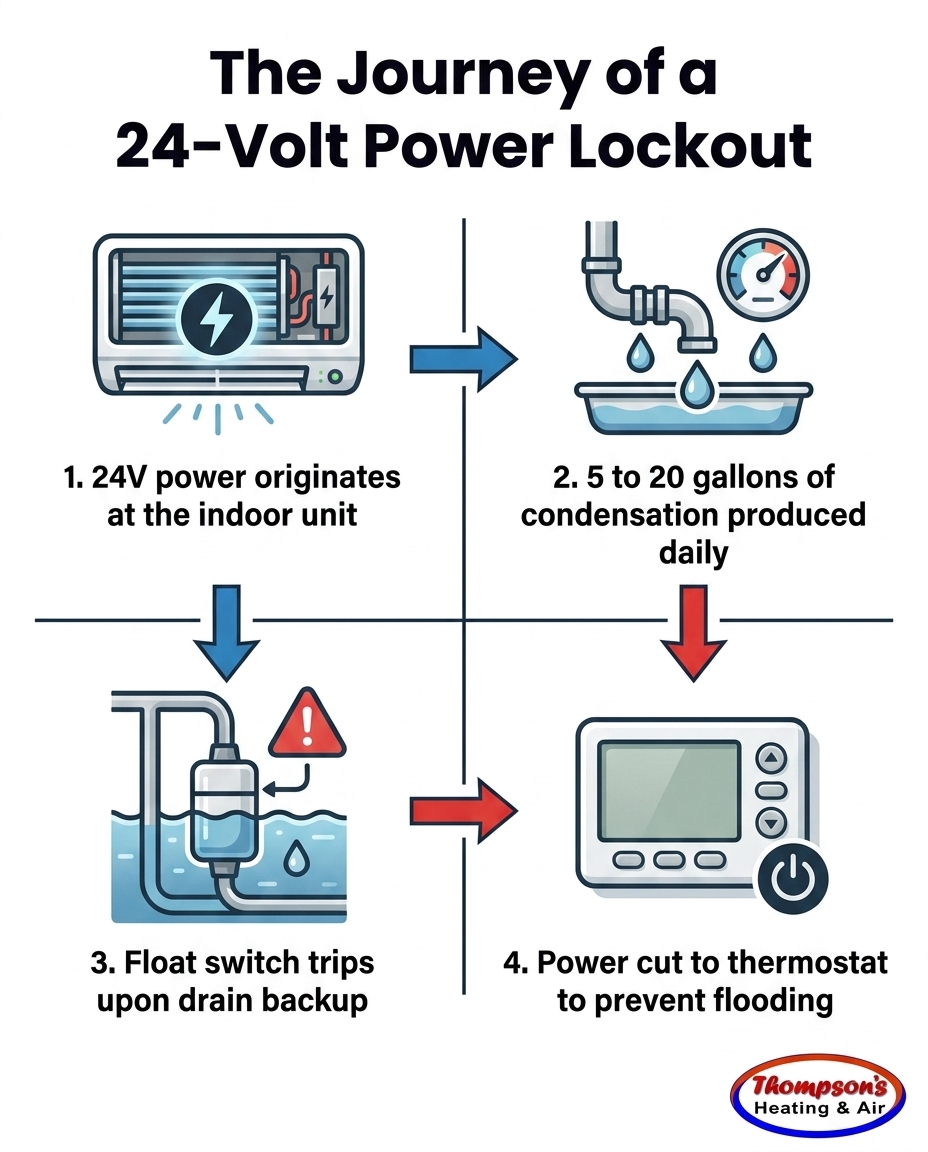
To make sense of a dead thermostat, you have to understand how the device gets its power. Your thermostat does not pull electricity directly from the wall like a television or a lamp. Instead, it relies on a continuous 24-volt electrical loop that originates from your indoor air handler or furnace. This low-voltage connection is the lifeline of your entire climate control system.
When built-in safety mechanisms inside your indoor unit detect a critical issue, their first action is to intentionally cut this 24-volt power loop. By severing the connection, the system immediately shuts down the outdoor compressor and the indoor blower motor. Because the thermostat relies on that exact same loop for its operating power, the screen goes completely blank the moment the safety switch trips.
This intentional power loss is a brilliant design feature. It stops the equipment from running when operating conditions become dangerous. If your system is locked out and you need immediate AC repair, this safety feature has likely just saved you from severe water damage or a potential electrical fire.
Understanding the 24-Volt Connection
The relationship between your indoor unit and your wall thermostat is a continuous conversation. The indoor equipment houses a small transformer that steps down your home's standard electrical current to a safe 24 volts. This power travels up the wires hidden in your walls, powers up the digital display, and allows the thermostat to send signals back down to turn on the cooling or heating.
1. Power Generation: The indoor transformer converts high voltage to 24-volt low voltage.
2. Continuous Loop: This low voltage travels through the safety switches first, then up to the thermostat.
3. Signal Return: The thermostat uses this power to function and sends commands back to the control board.
4. Safety Interruption: If a safety switch trips, it breaks the loop before the power ever reaches the thermostat.
Many homeowners in Woodland CA assume that changing the batteries in their thermostat will fix a blank screen. However, for most modern smart thermostats and digital models, batteries only provide backup power to save your memory settings during a neighborhood blackout. They do not provide the primary operating power required to run the screen and communicate with the air conditioner. If the 24-volt loop is broken by a safety switch, fresh batteries will not bring the system back online.
The Number One Culprit: A Tripped Condensate Float Switch
During the intense heat of late summer, your air conditioner does much more than just lower the temperature. It also acts as a massive dehumidifier. As warm indoor air blows across the freezing cold evaporator coils inside your unit, moisture is pulled out of the air. This moisture drips down into a drain pan and flows outside through a white PVC pipe.
Central air conditioners can produce 5 to 20 gallons of condensation per day during heavy, continuous operation. In our years of servicing HVAC systems across Woodland, we see firsthand how extreme summer heat causes your system to run constantly, maximizing this condensation output. By the time August late-summer peak cooling arrives and families are transitioning back to school, the drain line has been working overtime for months.
Over the course of the season, dust, dirt, and biological growth like algae accumulate inside that dark, damp drain line. Eventually, this buildup creates a stubborn clog. When the water can no longer flow outside, it begins to back up into the indoor drain pan. This is where your system's most active safety feature comes into play.
If you are trying to troubleshoot an AC that is not cooling properly, understanding the float switch is critical. Here is exactly how this mechanism causes your screen to go blank:
1. Water Accumulation: The clogged PVC pipe forces gallons of condensation to pool in the primary drain pan beneath your indoor coils.
2. Float Activation: As the water level rises dangerously close to the edge of the pan, it lifts a small plastic float device wired into the pan's edge.
3. Circuit Break: Once the float reaches a certain height, it triggers a switch that physically breaks the 24-volt electrical circuit.
4. System Shutdown: The broken circuit instantly cuts power to the thermostat, shutting off the compressor and stopping the creation of new condensation.
If this switch did not exist, your air conditioner would continue running, producing up to 20 gallons of water that would overflow the pan, soak through your ceiling, and destroy your drywall and flooring. The blank screen is simply the side effect of the float switch saving your home from a massive plumbing disaster.
Blown Low-Voltage Fuses on the AC Control Board
While a tripped float switch is the most common reason for a blank screen during peak cooling hours, electrical stress is a close second. Your indoor air handler or furnace contains a main control board that acts as the brain of the system. To protect this sensitive, expensive computer board from electrical surges, manufacturers install a small, automotive-style blade fuse.
This low-voltage fuse (usually a 3-amp or 5-amp piece of plastic with a metal wire inside) sits directly in the path of the 24-volt power loop. If there is an electrical short anywhere in the system, this fuse sacrifices itself. It pops instantly, severing the 24-volt connection and killing the power to your thermostat screen.
Electrical shorts become highly prevalent during heat waves. The outdoor condenser unit vibrates heavily during continuous use, which can slowly rub the insulation off low-voltage wires until bare copper touches metal. Additionally, pests seeking shelter or water often chew through wiring in the outdoor unit. Even a failing contactor—a mechanical switch in the outdoor unit that engages the compressor—can send a surge back to the indoor board.
Just last August, our technicians at Thompson's Heating & Air responded to a Woodland family whose AC stopped working during a brutal late-summer heatwave. The system was completely unresponsive. We dispatched a professional quickly despite a heavy schedule of end-of-season jobs. Our prompt investigation revealed that the system had suffered an electrical interruption, cutting power and leaving the thermostat blank. By addressing the root cause, our team safely restored their cooling before the house became dangerously hot.
A critical warning regarding blown fuses: If a low-voltage fuse blows, it did so for a specific reason. The fuse itself is not the root problem; it is the symptom of an electrical short. Replacing the fuse without locating and fixing the underlying short will just cause the new fuse to blow the second the system tries to turn on. This cycle of replacing fuses without proper electrical diagnostics can eventually damage the expensive control board itself.
Safe Immediate Checks for Homeowners
When you are staring at a blank screen and sweating in your living room, you want to take action. While you should never attempt to bypass safety switches or handle internal wiring, there are several safe, non-technical troubleshooting steps you can perform immediately. These simple checks can rule out basic power interruptions before you make a phone call.
If you keep up with a regular HVAC maintenance plan, you are less likely to experience these sudden lockouts, but it is always smart to know what to look for when things go wrong.
• Check the main electrical breaker: Go to your home's main electrical panel. Look for the breakers labeled for your air conditioner and your furnace (or air handler). During extreme heat, high electrical draw can sometimes trip a breaker. If a breaker is in the middle or "tripped" position, firmly push it all the way to the OFF position, then snap it back to the ON position. If it immediately trips again, stop. Do not try to reset it a second time.
• Inspect the indoor unit door: Your indoor furnace or air handler has a physical safety switch located right behind the main access panel. If this door is bumped, vibrated loose, or not secured properly after a filter change, the switch pops out. This instantly cuts all power to the system, including the thermostat. Ensure the metal door is seated firmly and securely latched.
• Examine the air filter: A severely clogged air filter starves the system of airflow. When warm air cannot blow over the indoor coils, the coils drop below freezing. The condensation turns to solid ice, which eventually melts rapidly, overwhelming the drain pan and tripping the float switch. If your filter is caked in thick gray dust, it needs immediate replacement.
• Look for visible water around the indoor unit: If you see water pooling around the base of your indoor unit, or dripping from the emergency drain pipe outside your roof or window, you have a confirmed condensate clog.
The Strict Safety Threshold: While checking breakers and filters is perfectly safe, you must draw a hard line at internal components. Never attempt to reset internal float switches by draining the pan yourself, and never attempt to pull or replace control board fuses. Accessing the control board or handling the high-voltage areas of the drain pan requires a professional license. Tampering with these components can lead to severe electrical shock or void your equipment warranty.
When to Call a Professional for a Blank Thermostat
If you have verified that your electrical breakers are properly set, the indoor unit door is tightly closed, and your air filter is clean, your troubleshooting journey is complete. A thermostat that remains blank after these safe checks indicates that your air conditioning system is in a hard safety lockout. At this point, professional intervention is not just recommended; it is required.
Clearing a deep condensate clog is not a matter of simply pouring vinegar down a pipe. When algae and sludge have compacted inside a drain line during August late-summer peak cooling, it forms a dense blockage. Professional technicians use specialized industrial wet vacuums, high-pressure nitrogen bursts, and commercial-grade chemical treatments to safely dissolve and extract the blockage without damaging the fragile PVC piping. Once the line is completely clear, they can safely reset the float switch and restore power to your thermostat.
Similarly, diagnosing low-voltage electrical shorts is complex technical work. It requires professional multimeters, a deep understanding of wiring diagrams, and the ability to safely isolate different components of the system to find exactly where the voltage is dropping. A technician will test the outdoor contactor, inspect the entire length of the thermostat wire for pest damage, and verify the integrity of the control board before ever installing a new fuse.
We see this urgency firsthand. Recently, our team helped a local homeowner who needed immediate AC repair when a record high temperature was predicted for the afternoon. Their system shut down, leaving them without cooling as the heat climbed. Our technicians were able to come out and repair the AC that exact same day, proving that prompt professional response from Thompson's Heating & Air is critical during extreme heat to restore home comfort and safety.
When you trust local experts for Woodland, CA HVAC services, you benefit from a deep understanding of how local Sacramento Valley heat waves stress residential AC systems. A company that knows the regional climate understands exactly why these specific safety lockouts occur in late August and carries the right equipment to resolve them quickly and safely.
Frequently Asked Questions About Blank Thermostats and AC Issues
Why did my thermostat suddenly go blank?
Your thermostat usually goes blank because a safety switch inside your indoor AC unit has intentionally cut the 24-volt power supply. This happens to protect your home from damage. The most common triggers are a clogged condensation drain line that trips a float switch, or an electrical short that blows a low-voltage fuse on the control board. It rarely means the thermostat itself is broken.
Will a clogged AC drain cause the thermostat to go blank?
Yes, a clogged AC drain is the leading cause of a blank thermostat during the summer. When the drain line backs up, water fills the drain pan and lifts a safety float switch. This switch is wired directly into the thermostat's power loop. Once it trips, it severs the power connection to shut off the AC and prevent water from overflowing into your ceiling or floors.
Is there a fuse in a thermostat?
Most modern wall thermostats do not contain their own replaceable fuses. Instead, the fuse that protects the thermostat is located on the main control board inside your indoor furnace or air handler. This small, automotive-style fuse protects the entire low-voltage circuit. If an electrical short occurs, this board-level fuse will blow, causing the thermostat screen to lose power entirely.
How do I fix a blank thermostat screen?
You can start by checking your home's main electrical breaker to ensure it hasn't tripped, and verifying that the access door on your indoor AC unit is securely closed. You should also check your air filter, as a clogged filter can cause the system to freeze and trigger a lockout. If these safe checks do not restore the screen, you must call a licensed professional to diagnose a tripped float switch or blown fuse.
What does it mean if my thermostat is blank but the AC is running?
If the screen is completely blank but you still hear the air conditioner running constantly, you likely have a failing thermostat or a drained backup battery on a specific model that requires battery power for the display. In rare cases, a wiring short can cause the outdoor unit to become "stuck" in the on position even when the thermostat loses power. This requires immediate professional electrical diagnosis.
Can extreme summer heat cause my thermostat to lose power?
Extreme summer heat does not directly kill the thermostat on your wall, but it forces your air conditioner to run continuously. This heavy operation produces massive amounts of condensation that can quickly overwhelm a partially clogged drain line, or it can vibrate outdoor wiring until a short occurs. The heat causes the mechanical stress that ultimately triggers the safety switches, cutting power to your screen.
Restore Your Home's Comfort Safely and Quickly
Seeing your thermostat screen go dark during August late-summer peak cooling is undeniably stressful, but it is important to remember that your system is actively working to protect your home. That blank display is a clear signal that a safety mechanism—whether a float switch guarding against water damage or a fuse preventing electrical fires—has successfully deployed.
Because these lockouts involve sensitive electrical circuits and internal plumbing, you should never risk DIY repairs beyond checking your breakers and filters. Bypassing a safety switch can lead to catastrophic home damage. Instead, reach out to a licensed professional to schedule a thorough inspection. An expert technician can clear the underlying clog or electrical short, reset your system safely, and restore your home's cooling when you need it most.



.avif)
.avif)
.png)
