
Gas Fireplace Insert vs. Traditional Wood Burning for Evening Ambience

The Reality Behind the Glow: Rethinking Your Fireplace Before Winter
There is a persistent myth that when comparing a gas fireplace insert vs. traditional wood burning for evening ambience, hauling in split logs and striking a match is the only way to achieve authentic comfort. For generations, the open hearth has been the centerpiece of the living room, but the reality of operating one often falls short of the nostalgic ideal. Instead of a cozy, effortless evening, homeowners frequently find themselves battling stubborn drafts, managing constant ash cleanup, and struggling to keep the rest of the house warm. If you are looking to upgrade your living room comfort before the September pre-heating season ends, it is time to look closely at how your fireplace actually performs.
As part of comprehensive heating services, modernizing your hearth is one of the most impactful upgrades you can make for both comfort and efficiency. With chilly, damp fall evenings in the Sacramento Valley rapidly approaching, the need for reliable supplemental heat becomes undeniable. A traditional masonry fireplace might look beautiful, but it often works against your home's central heating system, pulling warm air out of your living spaces and sending it straight up the chimney. By contrast, modern gas inserts are engineered to provide a seamless, highly efficient solution that integrates flawlessly with your overall home comfort strategy, giving you the glowing atmosphere you want without the functional drawbacks.
The Decision Point for Fall Upgrades
Before the deep winter cold sets in, homeowners face a critical decision point: continue pouring time and effort into maintaining a traditional wood fireplace, or transition to a high-efficiency gas insert. The choice extends far beyond mere aesthetics. It directly impacts your home's thermal envelope, your indoor air quality, and your ability to actually use the fireplace on the coldest nights of the year. Understanding the stark differences in how these two systems operate is the first step toward reclaiming your living room and enjoying a truly comfortable winter season.
Heating Efficiency: Where Traditional Wood Fireplaces Fall Short
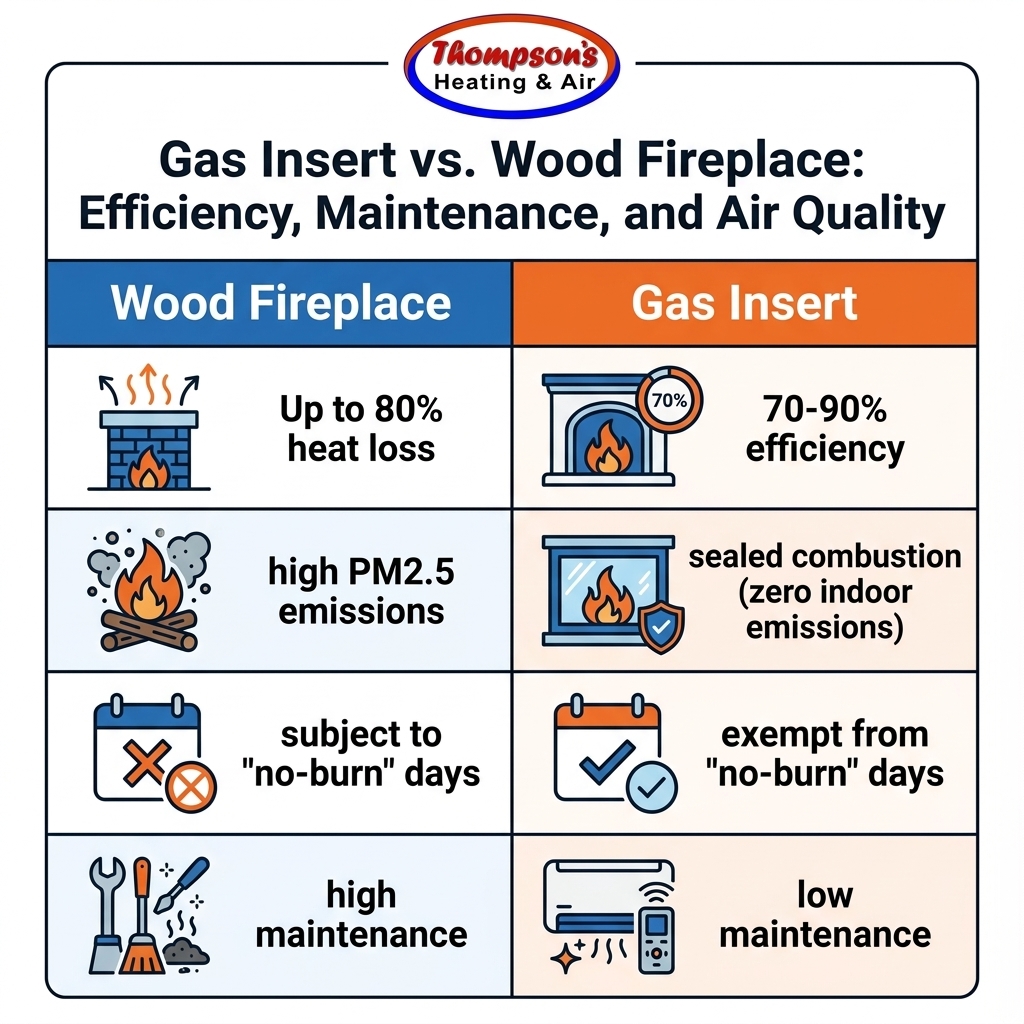
When you light a traditional wood fire, the immediate radiant heat feels comforting, but the overall thermal impact on your home is surprisingly negative. An open masonry fireplace is inherently inefficient by design. As the fire burns, it requires a massive amount of oxygen for combustion, which it pulls from the surrounding room. This process, known as drafting, creates a vacuum effect that sucks the pre-heated air generated by your central furnace right out of your living spaces and expels up to 80% of the fire's heat straight up the chimney. In Woodland and throughout Yolo County, this means your primary heating system has to work twice as hard just to replace the air lost to the fireplace.
Modern direct-vent gas inserts fundamentally solve this problem. Operating at 70% to 90% efficiency, these sealed systems keep the warmth exactly where you want it: inside your home. Because they do not rely on room air for combustion, they provide instant, on-demand supplemental heat without overworking your central HVAC system. If you are considering a heating installation or upgrade, adding a gas insert transforms a decorative focal point into a legitimate, high-performance zone heater.
• Heating Efficiency — Traditional Wood Fireplace: 10% to 20% (massive heat loss) — Direct-Vent Gas Insert: 70% to 90% (highly efficient)
• Combustion Air Source — Traditional Wood Fireplace: Pulls warm air from inside the room — Direct-Vent Gas Insert: Draws fresh air from completely outside
• Central HVAC Impact — Traditional Wood Fireplace: Forces central furnace to run longer — Direct-Vent Gas Insert: Complements system with zone heating
• Heat Control — Traditional Wood Fireplace: Unpredictable, depends on wood and draft — Direct-Vent Gas Insert: Precise, adjustable via remote or thermostat
• Warm-Up Time — Traditional Wood Fireplace: 30 to 45 minutes to build a coal bed — Direct-Vent Gas Insert: Instant, immediate radiant heat
The Hidden Costs of Drafty Chimneys
Even when a traditional fireplace is not actively burning, it remains a massive vulnerability in your home's thermal envelope. Open dampers—or even closed dampers that lack a perfect airtight seal—compromise your winter weatherization efforts. Cold downdrafts easily penetrate the living room, creating chilly pockets that force your central thermostat to call for heat more frequently. This ambient heat loss means you are continuously paying to heat air that escapes through the masonry, undermining the efficiency of your primary heating equipment.
Direct-Vent Technology Explained
The secret behind the superior performance of a gas insert lies in direct-vent technology. These systems utilize a specialized dual-pipe (coaxial or collinear) venting system routed through your existing chimney. One pipe draws fresh combustion air from the outdoors, while the other safely exhausts combustion byproducts outside. Because the glass front is completely sealed, no indoor air is consumed, and no heat escapes up the flue. This allows the insert to deliver a powerful combination of radiant heat (warming the objects and people in the room) and convective heat (warming the air), maximizing comfort while minimizing energy waste.
Navigating Local 'No-Burn' Restrictions in the Sacramento Valley
For residents in Woodland and Yolo County, the decision to upgrade a fireplace is heavily influenced by regional environmental regulations. During the winter months, specific atmospheric conditions—particularly temperature inversions—trap cold air and particulate matter close to the valley floor. To combat the resulting smog and health hazards, the Yolo-Solano Air Quality Management District (YSAQMD) enforces a strict "Don't Light Tonight" season, which typically runs from November through February.
The frustration of 'no-burn' days:
There is nothing more frustrating than investing time and money into cordwood, only to find out you are legally prohibited from lighting a fire on the coldest nights of the year. When the YSAQMD issues a mandatory curtailment, using a traditional wood-burning fireplace can result in significant fines. These regulations are designed to protect public health by reducing wintertime PM2.5 pollution, but they effectively render traditional fireplaces useless precisely when homeowners want to use them the most.
The compliant, everyday alternative:
Gas fireplace inserts offer a permanent workaround to these seasonal restrictions. Because they burn clean natural gas or propane and produce zero particulate matter emissions, gas inserts are entirely exempt from local 'no-burn' rules. You can turn on your gas insert every single evening, regardless of the air quality index outside. This guarantees that your living room remains a warm, inviting gathering space throughout the entire winter, providing total peace of mind and uninterrupted comfort.
Indoor Air Quality: What Are You Actually Breathing?
Beyond the outdoor environmental impact, it is crucial to consider how your fireplace affects the air inside your own home. Traditional wood fires produce a complex mixture of gases and fine particulate matter, commonly referred to as PM2.5. These microscopic particles are small enough to bypass the body's natural respiratory defenses and penetrate deep into the lungs.
• The drafting problem: Even with a well-maintained chimney, changes in air pressure, wind gusts, or an unbalanced central HVAC system can cause wood smoke to backdraft directly into your living room.
• Central filtration strain: When smoke enters the home, your central return vents pull those particulates into your ductwork, rapidly clogging your furnace filter and circulating contaminants into every other room.
• Lingering odors: The smell of a campfire might be pleasant outdoors, but stale wood smoke trapped in carpets, upholstery, and curtains degrades the overall freshness of your home.
By contrast, sealed direct-vent gas fireplaces provide a massive upgrade to your indoor air quality. Because the combustion chamber is entirely isolated behind a pane of high-temperature ceramic glass, it is physically impossible for exhaust fumes, carbon monoxide, or soot to enter your living space. The system draws outside air for combustion and expels all exhaust completely outdoors. Upgrading your Woodland or Yolo County home to a gas insert means you can enjoy the mesmerizing glow of a fire without ever compromising the health and safety of the air your family breathes.
Maintenance and Upkeep: Nostalgia vs. Convenience
The nostalgic appeal of a traditional fire often masks the grueling reality of the labor required to maintain it. Operating a wood fireplace is essentially a part-time job. Before the September pre-heating season even begins, you must source, purchase, stack, and season cordwood. Once winter arrives, every fire requires hauling heavy logs indoors, arranging kindling, coaxing the flame to life, and constantly tending the hearth to keep it burning evenly. After the fire dies, you are left with the messy chore of sweeping out toxic ash and soot, not to mention the mandatory, messy annual chimney sweeps required to prevent dangerous creosote buildup.
Gas inserts eliminate every single one of these chores, replacing heavy labor with push-button convenience. With a remote control or a wall switch, you can ignite a beautiful, roaring fire in seconds. You can adjust the flame height, control the multi-speed blower fan, and even set a thermostat to maintain a specific room temperature. When you are ready for bed, turning the fire off is as simple as clicking a button—no waiting for embers to die down, and no risk of leaving a smoldering hazard unattended.
One Woodland homeowner recently reached out because they needed a new fireplace for family enjoyment but dreaded the intense upkeep of traditional wood. By focusing on the long-term value benefits of a gas upgrade and opting for a professional installation, they completely bypassed the maintenance headaches. Today, they remain very happy with the welcoming family space it created, enjoying nightly fires without ever touching a broom or an ash bucket. While gas inserts do still require an annual professional check-up to clean the glass, inspect the valves, and verify the venting, the process is clean, quick, and entirely non-invasive.
Achieving the Perfect Evening Ambience and Aesthetic
A common hesitation homeowners have when considering a conversion is the fear that a gas fire will look artificial. Decades ago, gas logs looked like painted plastic and produced a uniform, unnatural blue flame. Today's hearth technology has advanced lightyears beyond those early models, offering an aesthetic experience that rivals, and often exceeds, the beauty of a natural wood fire.
Modern realism and customization:
High-end gas inserts feature hand-painted ceramic logs molded from actual wood species, complete with charred edges and intricate bark detailing. Beneath the logs, glowing ember beds utilize LED lighting and rock wool to perfectly mimic the pulsating, deep-orange heat of dying coals. The flames themselves are engineered to dance and flicker organically, providing the exact visual warmth you crave.
Furthermore, an insert installation is the perfect opportunity to update the entire look of your living room. You can surround the new unit with modern faceplates, sleek metallic louvers, or beautiful stacked stone surrounds that completely revitalize a dated masonry fireplace. Another local customer purchased and had a new fireplace insert installed after seeking advice on how to modernize their dark, outdated brick hearth. Through careful consultation and quality workmanship, the installation brought their vision to life, leaving them thrilled with the new fireplace insert and the dramatic focal point it created in their home.
Ultimately, a gas insert gives you the perfect evening ambience on your schedule. If you only have 45 minutes to relax after a long day in the September pre-heating season, you can enjoy a full, beautiful fire instantly, without the commitment of building and monitoring a wood fire.
The Holistic Approach: Balancing Your Hearth and HVAC
One of the most critical, yet frequently overlooked, aspects of upgrading a fireplace is understanding how it interacts with the rest of your home. A fireplace is not just a standalone decorative feature; it is an active heat source that fundamentally alters your home's airflow and central thermostat readings. If a gas insert is installed without considering the primary HVAC system, it can lead to "thermostat ghosting"—a scenario where the intense radiant heat from the living room tricks the central thermostat into thinking the whole house is warm, causing the furnace to shut off and leaving the bedrooms freezing.
This is why relying on a single trusted provider for both your central heating and your specialized hearth products is essential. Thompson's Heating & Air views fireplace installation holistically, ensuring the hearth product complements the central heating system and indoor air quality rather than competing with it. By evaluating the placement of your return vents, the location of your thermostats, and the overall cubic footage of the zone, a unified approach ensures flawless operation across the board.
Using separate contractors—one for the masonry and one for the HVAC—often results in disjointed communication and performance issues. When you work with a team that understands the advantages of using one provider for HVAC and hearth products, you guarantee that your new gas insert will enhance your Woodland or Yolo County home's comfort ecosystem perfectly, providing balanced, efficient warmth exactly where and when you need it.
Frequently Asked Questions About Fireplace Upgrades
Can you convert a wood fireplace to a gas insert?
Yes, converting a traditional masonry or factory-built wood fireplace to a direct-vent gas insert is a highly common and straightforward process. A professional installer will run dual venting pipes up your existing chimney structure and connect a dedicated gas line to the firebox. This conversion safely seals off the drafty open flue, instantly transforming your outdated hearth into a highly efficient, push-button heating appliance.
Do gas fireplace inserts provide good heat?
Gas fireplace inserts are exceptional zone heaters, often operating at 70% to 90% efficiency. Unlike open wood fires that lose the vast majority of their heat up the chimney, sealed gas inserts radiate warmth directly into the room while using built-in blower fans to circulate convective heat. They are highly effective at quickly warming large living spaces without forcing your central furnace to work overtime.
How do gas fireplaces affect indoor air quality compared to wood?
Direct-vent gas fireplaces have zero negative impact on your indoor air quality because the combustion chamber is completely sealed off from your living space behind ceramic glass. They draw outside air for the flame and push all exhaust directly outside. Wood fireplaces, on the other hand, frequently draft fine particulate matter (PM2.5), smoke, and carbon monoxide back into the room, which can aggravate allergies and clog central furnace filters.
Are gas fireplace inserts worth the investment?
For most homeowners, the transition to a gas insert pays off significantly in both lifestyle convenience and energy efficiency. You eliminate the physical labor of chopping and storing wood, bypass the mess of ash cleanup, and stop losing central heating energy through an open chimney damper. The ability to actually use the fireplace instantly, combined with the reduction in drafts, makes it a highly valuable upgrade for daily winter comfort.
What happens to a traditional fireplace on Yolo County 'no-burn' days?
During the Yolo-Solano Air Quality Management District's winter "Don't Light Tonight" season, using a traditional wood-burning fireplace on designated 'no-burn' days is strictly prohibited to curb PM2.5 pollution. Violating these rules can result in penalties. Gas fireplace inserts, however, burn cleanly and are entirely exempt from these restrictions, meaning you can enjoy your fireplace every single night of the winter.
How long does it take to install a direct-vent gas insert?
In most standard applications, a professional team can complete a gas insert installation in a single day. The process involves running the coaxial venting down the existing chimney, securing the insert into the firebox, connecting the gas and electrical lines, and testing the system for safety. If custom stonework or extensive masonry modifications are required, the timeline may extend slightly, but the core functional installation is remarkably fast.
Ready to Transform Your Living Room This Fall?
Transitioning from a high-maintenance, drafty wood fireplace to a high-efficiency gas insert is one of the smartest investments you can make in your home's comfort. You gain the beautiful evening ambience you love, eliminate the grueling chores, and secure a reliable source of supplemental heat that isn't restricted by local burn rules. With the September pre-heating season already underway, now is the perfect time to act before the winter chill sets in. Consult with our local experts who understand both aesthetic hearth upgrades and whole-home heating systems, and let us help you create the perfect, cozy gathering space for your family.



.avif)
.avif)
.png)
