
Don't Sweat It in Sac with a Perfectly Sized HVAC

Why Getting the Right Size HVAC for the Sacramento Valley Homes Is More Important Than You Think
Getting the right size HVAC for the Sacramento Valley homes is one of the most important decisions you'll make as a homeowner in this region — and it's one that's easy to get wrong.
Here's a quick answer before we dive deeper:
Quick Sizing Guide for Sacramento Valley Homes (Climate Zone 11)
• Up to 500 sq ft — Estimated Cooling Capacity: 1 ton (12,000 BTU) — Notes: Adjust for windows, insulation
• 500–1,000 sq ft — Estimated Cooling Capacity: 1–1.5 tons (12,000–18,000 BTU) — Notes: Add BTUs for south-facing glass
• 1,000–1,500 sq ft — Estimated Cooling Capacity: 1.5–2.5 tons (18,000–30,000 BTU) — Notes: Factor in ceiling height
• 1,500–2,000 sq ft — Estimated Cooling Capacity: 2.5–3 tons (30,000–36,000 BTU) — Notes: Account for insulation quality
• 2,000–2,500 sq ft — Estimated Cooling Capacity: 3–4 tons (36,000–48,000 BTU) — Notes: Consider wildfire season air quality needs
• 2,500+ sq ft — Estimated Cooling Capacity: 4+ tons — Notes: Professional Manual J load calculation strongly recommended
Note: These are starting estimates only. Sacramento Valley's Climate Zone 11 — with summers regularly topping 100°F — means your actual load calculation should always be done by a NATE-certified technician using Manual J software.
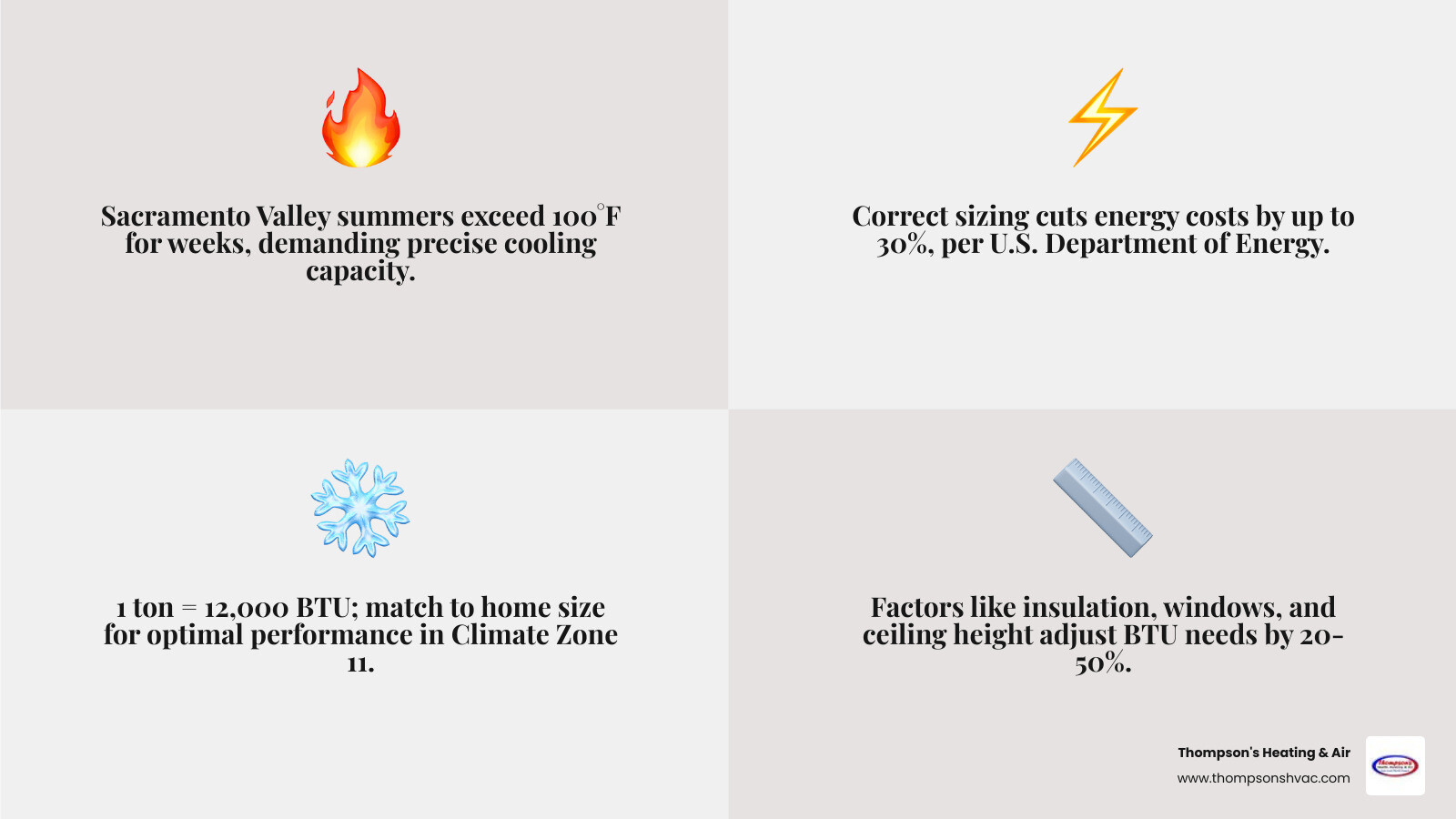
Sacramento summers are no joke. Temperatures push past 100°F for weeks at a time, wildfire smoke rolls through the valley, and a cooling system that's even slightly off in size can leave you sweating, running up your energy bill, or facing early equipment failure. Whether your system runs too long or shuts off too fast, the wrong size HVAC creates real problems — and they compound over time.
A correctly sized system, on the other hand, can reduce your cooling costs by up to 30%, according to the U.S. Department of Energy. That's not a small number. And in a climate like ours, the difference between a system that was properly sized and one that wasn't is felt every single day from May through October.
In this guide, we'll walk you through exactly what determines the right size for your home, what happens when you get it wrong, and how to make a smart, informed decision that keeps your home comfortable for years to come.
The Critical Importance of Getting the Right Size HVAC for the Sacramento Valley Homes
In the HVAC industry, we categorize the Sacramento Valley, including cities like Woodland, Davis, and West Sacramento, as Climate Zone 11. This isn't just a technical label; it dictates how much "muscle" your air conditioner needs. When we talk about HVAC Installation Maintenance Repair, sizing is the foundation of everything we do.
If your system is sized correctly, you gain several immediate benefits:
• Consistent Comfort: No more "hot spots" in the upstairs bedrooms while the living room feels like a walk-in freezer.
• Lower Utility Bills: A system that doesn't have to struggle or constantly restart uses significantly less electricity.
• Superior Dehumidification: Proper sizing allows the unit to run long enough to pull moisture out of the air, which is vital for preventing that "clammy" feeling.
• Quiet Operation: Systems that aren't overstressed tend to run much quieter, which is a blessing during those long July nights.
Avoiding the "Bigger is Better" Myth
One of the most common mistakes we see homeowners in Yolo County make is assuming that a "bigger" unit will cool the house faster and better. It sounds logical, right? If a 3-ton unit is good, a 4-ton unit must be great!
In reality, an oversized unit is a recipe for disaster. It will blast your home with cold air and reach the thermostat setting in just a few minutes. This sounds good until you realize the unit has "short-cycled." Because it turned off so quickly, it didn't have time to remove the humidity from the air. You’ll end up with a home that is cold but damp—a perfect environment for mold. Furthermore, the initial investment for a larger unit is higher, and the operational costs spike because the most energy-intensive part of an HVAC cycle is the startup.
Impact on System Lifespan
Think of your HVAC system like a car. If you only drove it in short, high-speed bursts where you slammed on the brakes every two minutes, the engine wouldn't last very long. That is exactly what happens to an oversized AC unit. The constant stopping and starting put immense strain on the compressor and fan motor.
On the flip side, an undersized unit is like a small car trying to tow a massive trailer up a hill in 100-degree heat. It will run 24/7, never reaching the desired temperature, and eventually, the components will simply burn out from exhaustion. By ensuring you are getting the right size hvac for the sacramento valley homes, you are protecting your investment. Regular HVAC Maintenance and Repair can only do so much if the system was fundamentally the wrong size from day one.
The Risks of an Undersized or Oversized System
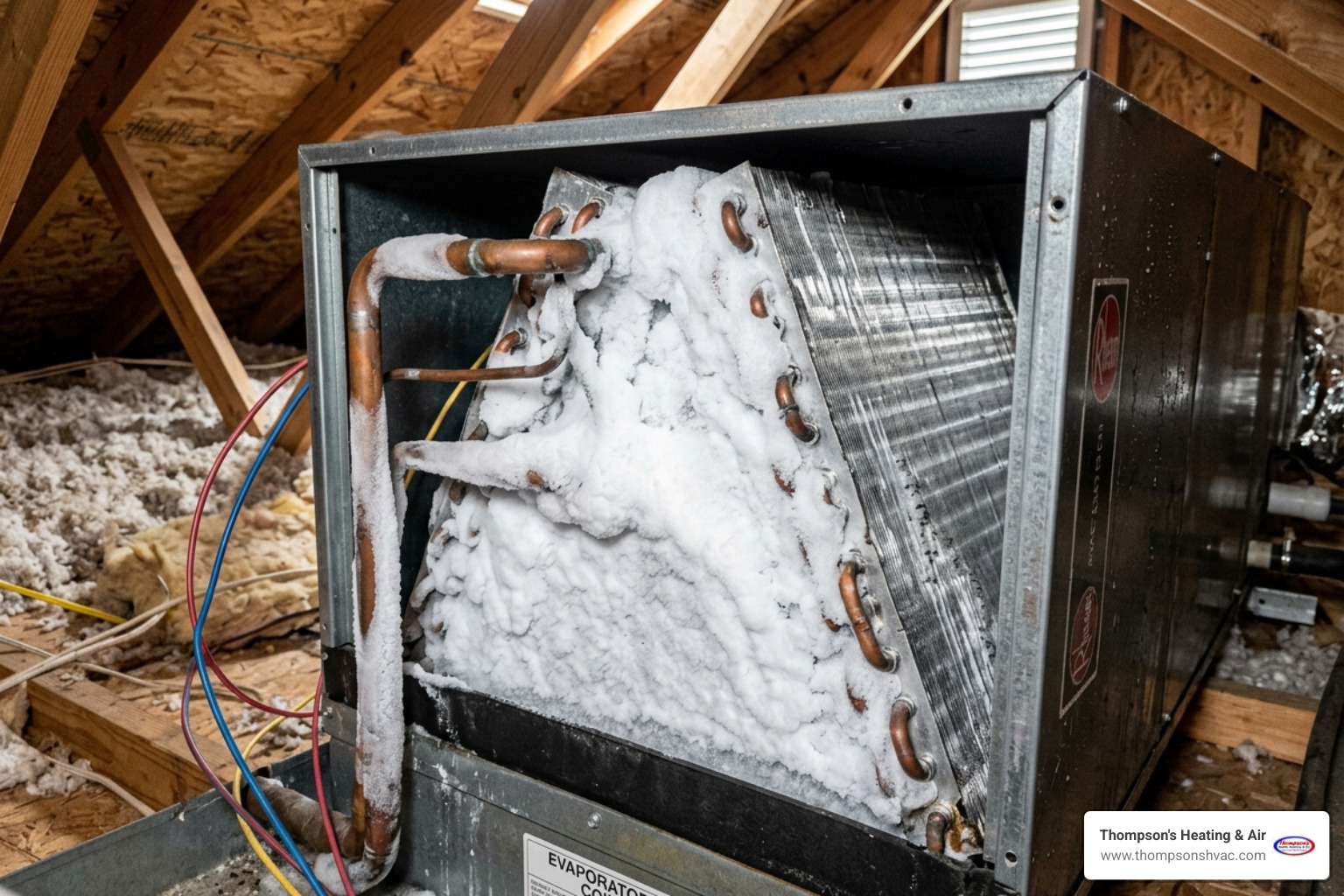
When sizing goes wrong, the symptoms are hard to ignore. We often see frozen evaporator coils—blocks of ice forming on the indoor unit—not just because of low refrigerant, but because the airflow doesn't match the cooling capacity.
• Cycle Length — Oversized System: Short, frequent bursts (5–8 mins) — Undersized System: Runs constantly without stopping
• Humidity — Oversized System: High (air feels "sticky" or "clammy") — Undersized System: Moderate to high (system can't keep up)
• Energy Bills — Oversized System: Spikes due to frequent startups — Undersized System: High due to 24/7 operation
• Temperature — Oversized System: Uneven (hot and cold spots) — Undersized System: Consistently too warm
• Wear & Tear — Oversized System: High compressor stress — Undersized System: High motor and fan stress
Short Cycling and Humidity Issues
In West Sacramento and Woodland, we deal with dry heat, but indoor humidity still matters for comfort and health. A cooling cycle should ideally last 10 to 15 minutes. This duration is necessary for the evaporator coil to stay cold enough to condense moisture out of the air and send it down the drain line.
Oversized systems "short cycle," meaning they shut off before the dehumidification process even begins. This leads to high indoor humidity, which can cause wood floors to warp, wallpaper to peel, and—most importantly—mold to grow in hidden corners.
Constant Running and Mechanical Failure
If you’ve ever noticed your AC running at 2:00 AM when it's only 75 degrees outside, you might have an undersized system. An undersized unit can't satisfy the thermostat's demands during a Sacramento heatwave. This constant operation leads to premature motor burnout and massive utility spikes. If you suspect your system is struggling, it’s worth getting a Heating and Air Estimate to see if a modern, correctly sized replacement would actually save you money in the long run.
How to Calculate Your Home's Specific Cooling Load
Many people use a "rule of thumb" like 20 BTUs per square foot. While that’s a fine starting point for a napkin sketch, it’s not how we do things at Thompson's Heating & Air. To get a truly accurate measurement, we look at the "cooling load," which is the amount of heat your home gains throughout the day.
Using Manual J to get the right size HVAC for the Sacramento Valley homes
The gold standard in our industry is the ACCA Manual J load calculation. This isn't just a simple math problem; it's a comprehensive analysis of your home's "thermal envelope." When we perform a Heating and Air Estimate, we use specialized software to input:
• The exact square footage of every room.
• The orientation of your home (does the front face the blazing afternoon sun?).
• The number of occupants (humans and pets generate heat!).
• The types of appliances you use.
This ensures that the tonnage of your new unit is based on data, not guesswork.
Adjusting for insulation and windows to get the right size HVAC for the Sacramento Valley homes
Not all square footage is created equal. A 1,500-square-foot home built in the 1950s in Woodland will have vastly different cooling needs than a 1,500-square-foot home built in 2026.
We look at the R-value of your insulation and the U-factor of your windows. If you have large, south-facing windows without shading, your home acts like a greenhouse, requiring more BTUs to stay cool. Conversely, an ENERGY STAR-qualified home is often 30% more efficient, meaning you might actually need a smaller (and less expensive) unit than you think. We also consider how the air moves; for example, high ceilings increase the volume of air that needs to be treated, which we factor into our Indoor Air Quality Products recommendations.
Sacramento Valley Climate Factors That Influence Sizing
Our local geography presents unique challenges. The Sacramento Valley is a giant bowl that traps heat, but it also benefits from the "Delta Breeze." These factors must be part of your sizing conversation.
Managing Extreme Heat and Wildfire Smoke
Sacramento experiences 10 to 20 wildfires each year on average. During these times, you can't just open the windows to cool down. Your HVAC system becomes your primary life-support system for clean air.
When getting the right size hvac for the sacramento valley homes, we have to ensure the blower motor is strong enough to pull air through high-efficiency MERV 13 filters or air purifiers without overheating. We often recommend Indoor Air Quality Products like whole-home scrubbers that work in tandem with your AC to remove smoke particles and pollutants.
The Role of the Delta Breeze in System Selection
In places like Davis and West Sacramento, the Delta Breeze can drop temperatures by 20 degrees in a matter of hours once the sun goes down. This is where variable-speed technology shines.
Instead of a system that is either "100% On" or "Off," a variable-speed motor can scale back to 30% capacity during the cooler evening hours. This maintains perfect comfort and incredible efficiency. We often pair these systems with a Smart Thermostat Installation in West Sacramento CA to automatically take advantage of these local weather patterns.
Maximizing Efficiency with SEER Ratings and Local Rebates
Once you know the size (tonnage) you need, the next step is choosing the efficiency (SEER2 rating). SEER stands for Seasonal Energy Efficiency Ratio. Think of it like MPG for your air conditioner.
Choosing the Right SEER for Northern California
In the Sacramento Valley, we recommend a SEER2 rating of at least 16. Because our cooling season is so long and intense, the extra efficiency pays for itself much faster here than it would in a cooler climate. Modern units with inverter technology can offer even higher ratings, providing whisper-quiet operation and lower monthly bills. Check out our Smart Thermostat Installation in West Sacramento CA services to see how technology can further boost these savings.
Leveraging Local Utility Incentives
The good news is that you don't have to shoulder the cost of efficiency alone. Local utility providers like SMUD and various Yolo County programs offer significant incentives for homeowners who install properly sized, high-efficiency systems.
There are also federal tax credits available for ENERGY STAR-certified equipment. We stay up-to-date on all Tax Credits and Rebates so we can help our customers in Woodland and surrounding areas maximize their return on investment.
Frequently Asked Questions About HVAC Sizing
What are the signs my current HVAC is the wrong size?
If your unit turns on and off every 5 minutes (short cycling), it’s likely oversized. If it runs all day and the temperature in your house never drops below 78 degrees during a heatwave, it’s likely undersized. Other signs include high humidity, uneven room temperatures, and unusually high energy bills.
Should I use a DIY BTU calculator or hire a professional?
DIY calculators are great for a "ballpark" idea, but they can't account for the specific R-value of your attic insulation, the leakiness of your ducts, or the solar gain from your specific windows. A professional Manual J calculation is the only way to ensure you aren't wasting money on a system that won't perform.
How does ceiling height affect my BTU requirements?
Standard calculations assume 8-foot ceilings. If you have vaulted ceilings or 10-foot heights, you have significantly more air volume to cool. A room with 12-foot ceilings can require up to 25-30% more cooling capacity than a standard room of the same square footage.
Conclusion
At the end of the day, getting the right size hvac for the sacramento valley homes isn't just about a number on a spec sheet—it's about your quality of life. You deserve a home where you can escape the 100-degree heat, breathe clean air during wildfire season, and not cringe when you open your utility bill.
Thompson's Heating & Air has been serving the Yolo County community since 1992. As a family-owned business, we take pride in our "measure twice, cut once" approach. Our NATE-certified technicians don't just swap out boxes; we evaluate your entire home to ensure your new system is a perfect fit for your lifestyle and our unique California climate.
Whether you are in Woodland, Davis, Dixon, or West Sacramento, we are here to provide reliable, 5-star service. Don't leave your comfort to chance or "rules of thumb." Contact us today for a professional evaluation and experience the difference that a perfectly sized system makes.



.avif)
.avif)
.png)
