
How Clean Ducts and Humidity Control Stop Mold in Its Tracks

Why Mold in Your Air Ducts Is a Whole-Home Problem — And What to Do About It
How clean ducts reduce mold risk in your home comes down to one core idea: remove the conditions mold needs to survive. Here's a quick breakdown:
How Clean Ducts Reduce Mold Risk — At a Glance:
1. Remove organic debris — Dust, pet dander, and skin cells trapped in ducts give mold a food source. Cleaning eliminates that.
2. Reduce moisture buildup — Clean ducts support better airflow, which helps prevent the condensation mold needs to grow.
3. Stop spore circulation — Dirty ducts can distribute mold spores to every room each time your HVAC runs.
4. Enable early detection — Professional cleaning includes inspection, so problems get caught before they spread.
5. Control humidity — Keeping indoor humidity below 50% is one of the most effective ways to prevent mold from taking hold.
Most homeowners picture mold on a bathroom ceiling or a basement wall. What's harder to see — and potentially more disruptive — is mold hiding inside your HVAC ductwork. Every time your system kicks on, air passes through those ducts and into every room of your home. If mold is present, that same airflow carries spores along with it.
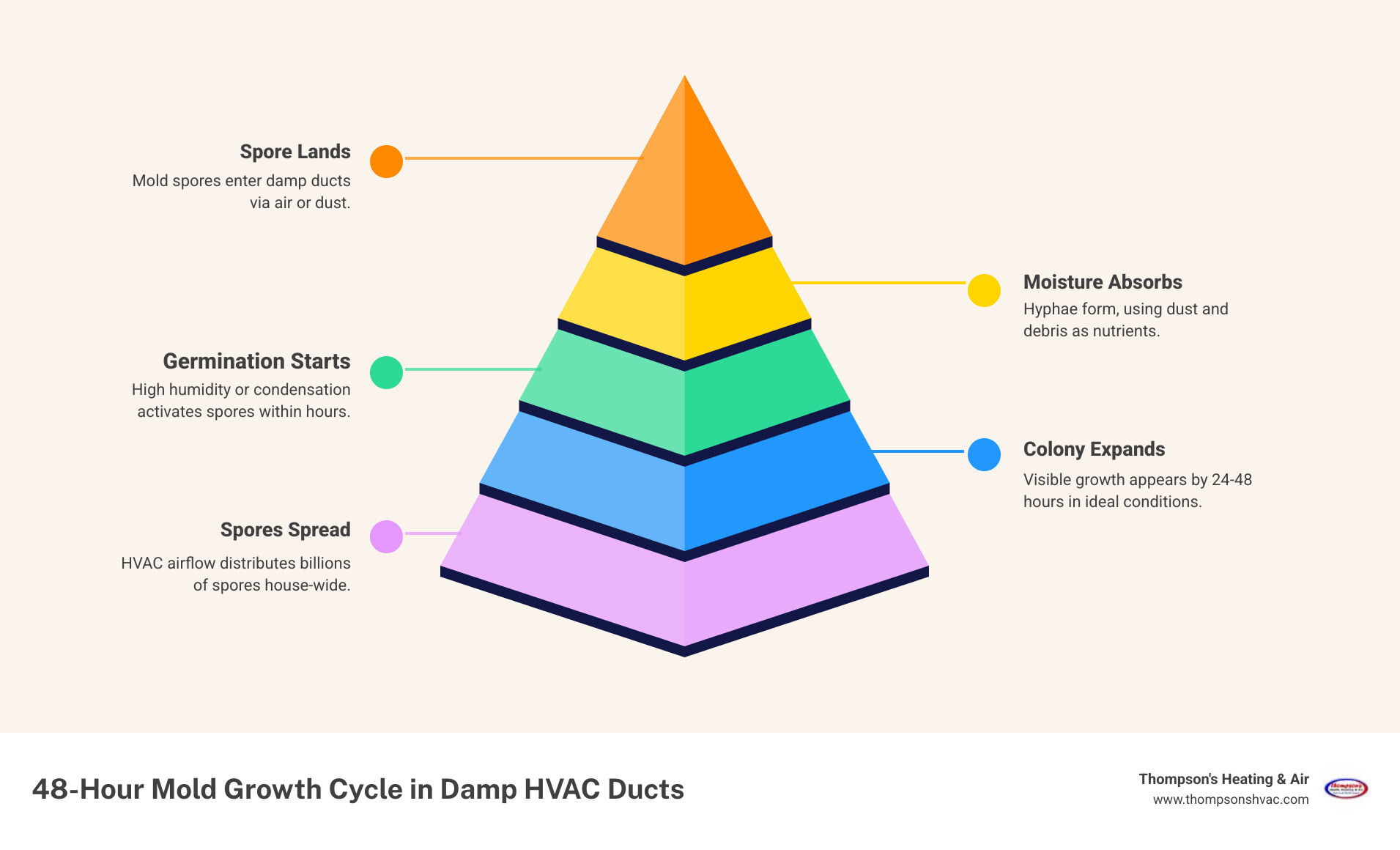
According to guidance from the EPA, mold can begin growing on damp HVAC components in as little as 48 hours. And because building codes often require air to be exchanged five to fifteen times per hour, a localized problem inside your ducts can quickly become a whole-house issue. For families in Woodland, CA — where seasonal humidity shifts can stress HVAC systems — that's a risk worth taking seriously.
The good news is that mold in ducts is preventable. Clean, well-maintained ductwork, combined with proper humidity control, is one of the most effective defenses you have.
Understanding the Connection: How Clean Ducts Reduce Mold Risk in Your Home
To understand how clean ducts reduce mold risk in your home, we first have to look at what mold actually needs to survive. Like any living organism, mold requires food and water. In the dark, secluded environment of your HVAC system, these two elements often come together in ways that are invisible to the naked eye until a problem becomes severe.

When we talk about "dirty ducts," we aren't just talking about a little bit of harmless dust. We are talking about a concentrated collection of organic matter. When this debris sits in a dark environment that occasionally becomes damp due to humidity or condensation, it creates a "biological film" that serves as a landing strip for mold spores. By removing this layer, we effectively take away the mold's "kitchen," making it much harder for colonies to establish themselves in the first place.
For those looking to take their air quality a step further, exploring Indoor Air Quality Products can provide additional layers of protection, such as UV lights that neutralize spores before they even land.
Why Dust and Debris Fuel Fungal Growth
Think of the dust in your ducts as a buffet. It isn't just dirt from outside; it’s a mixture of pet dander, dead skin cells (which are organic gold for fungi), textile fibers, and microscopic pollen. Mold is a decomposer by nature. When spores—which are naturally present in the air in Northern California—settle into this nutrient-rich base, they have everything they need to grow, provided there is a touch of moisture.
How clean ducts reduce mold risk in your home by removing contaminants
When we perform a professional cleaning, we are doing more than just "vacuuming." We are restoring the system to its original, hygienic state. How clean ducts reduce mold risk in your home involves three specific mechanical benefits:
• Spore Neutralization: By removing the physical dust, we remove the spores already clinging to it.
• Airflow Restoration: Debris buildup can obstruct airflow, leading to "dead zones" in your ductwork where air stagnates and moisture settles.
• Surface Hygiene: Smooth, clean metal surfaces are very difficult for mold to grip. Once the "fuzz" of dust is gone, mold has nowhere to anchor itself.
Identifying the Warning Signs of Mold in Your HVAC System
In Yolo County, we see a wide range of weather, from bone-dry summers to damp, foggy winters. These transitions are often when mold issues in HVAC systems become apparent. Because you can't see most of your ductwork, you have to rely on your other senses to detect a problem.
The most common indicator we hear from homeowners in Davis or Woodland is a "musty" or "earthy" smell that seems to get stronger right when the AC or heater kicks on. This is often because the initial blast of air carries concentrated odors from growth deeper in the system. If you notice these signs, it's time to look into HVAC Maintenance and Repair to identify the source before it spreads.
When to Schedule an Immediate Inspection
While routine checks are great, certain events should trigger an immediate call to a professional:
• Post-Flooding or Pipe Leaks: If water has entered your floor vents or sat near your air handler, mold can begin growing within 48 hours.
• New Home Transition: You don't always know how the previous owners maintained the system.
• Major Renovations: Construction dust is a massive food source for mold; if you've recently remodeled your kitchen in Winters or West Sacramento, your ducts are likely full of "mold food."
• Visible Growth: If you see black or green spotting on your vent covers, there is almost certainly more growth behind the drywall.
Recognizing "Dirty Sock Syndrome"
Have you ever walked into your living room and wondered why it smells like a locker room? This is a real HVAC phenomenon known as "Dirty Sock Syndrome." It’s typically caused by bacteria (and sometimes mold) growing on the moisture-laden evaporator coils of your air conditioner. As dust collects on the damp coils, it creates a stagnant environment that produces that signature foul odor. Professional coil cleaning is the only way to eliminate the smell and the biological growth causing it.
The Professional Process: How We Eliminate Mold and Prevent Its Return
At Thompson's Heating & Air, we don't just blow air through your vents and call it a day. To truly address how clean ducts reduce mold risk in your home, we follow industry-leading NADCA (National Air Duct Cleaners Association) standards.
The process involves creating "negative pressure" in your ductwork. We hook up a high-powered, HEPA-filtered vacuum to your system, which ensures that as we agitate the dust and mold inside the ducts, none of it escapes into your living room. We use specialized brushes and air whips to physically scrub the interior surfaces of the metal, ensuring the source of the problem is actually removed, not just shifted around. For comprehensive system health, this often goes hand-in-hand with HVAC Installation Maintenance Repair to ensure every component is functioning correctly.
Addressing the Limitations of Cleaning and EPA Guidelines
It is important to be realistic about what cleaning can achieve. The EPA notes that while hard surfaces like sheet metal can be cleaned and sanitized effectively, porous materials are a different story.
• Cleanability — Sheet Metal Ducts: High; can be scrubbed and sanitized — Fiberglass / Insulated Lining: Low; mold penetrates the fibers
• Remediation Method — Sheet Metal Ducts: Mechanical cleaning & HEPA vacuuming — Fiberglass / Insulated Lining: Often requires full replacement
• EPA Stance — Sheet Metal Ducts: Recommended if mold is visible — Fiberglass / Insulated Lining: Replacement is usually necessary
• Longevity — Sheet Metal Ducts: Excellent after professional cleaning — Fiberglass / Insulated Lining: Prone to recurring growth if wet
If the insulation inside your ducts has become wet and moldy, cleaning it is often a temporary fix. In these cases, we recommend replacing the affected sections to ensure the mold doesn't simply grow back from within the fibers.
How clean ducts reduce mold risk in your home through better airflow
When your ducts are clean, your HVAC system doesn't have to work as hard to push air through. This leads to more consistent "static pressure." Why does this matter for mold? Consistent airflow means that moisture—which naturally occurs during the cooling process—is evaporated quickly rather than sitting in puddles in your ductwork or drain pans. Improved airflow also helps maintain a consistent temperature throughout the house, preventing the "cold spots" on walls where condensation is likely to form.
Beyond Cleaning: Essential Moisture Control Strategies for Woodland Homeowners
Cleaning the ducts is only half the battle. If you don't fix the moisture problem, the mold will eventually return. In the Sacramento Valley, managing indoor humidity is the "secret sauce" to a mold-free home.
Experts agree that keeping your indoor humidity below 50% is the magic number. When humidity climbs above this threshold, the air holds enough moisture to allow mold spores to hydrate and grow on surfaces. Using a dedicated whole-home dehumidifier or ensuring your AC system is properly sized can help maintain this balance.
Maintaining Your System for Long-Term Prevention
To keep the mold from coming back after a professional cleaning, we recommend a few simple habits:
• Filter Changes: Use high-quality pleated filters and change them every 1–3 months. A clogged filter reduces airflow and allows dust to bypass the filter and settle in the ducts.
• Annual Tune-Ups: Having a technician inspect your condensate drain line and pan ensures that water is exiting your home correctly rather than backing up into your system.
• Vapor Barriers: If you have a crawlspace, ensuring a proper vapor barrier is in place can prevent ground moisture from rising into your floor ducts.
• Seal Your Ducts: Leaky ducts in an attic can pull in humid, unconditioned air, leading to condensation inside the pipes.
Choosing a Qualified Service Provider in Yolo County
When you're looking for someone to handle your air quality, don't just hire the person with the cheapest truck. Look for a team that is licensed in California and uses professional-grade HEPA equipment. A true professional will be able to show you "before and after" evidence—often through specialized cameras—to prove that the contaminants have been removed. At Thompson's Heating & Air, we take pride in our 5-star reputation across Woodland, Davis, and Dixon, providing evidence-based results that give you peace of mind.
Frequently Asked Questions about HVAC Mold Prevention
Can moldy fiberglass or insulated ducts be cleaned effectively?
Generally, no. According to NAIMA (North American Insulation Manufacturers Association) standards, once mold has deeply penetrated porous fiberglass insulation or duct board, it cannot be fully removed through mechanical cleaning. The spores hide within the weave of the material. In these instances, the safest and most effective route is to replace the contaminated insulation or duct sections entirely.
Is routine duct cleaning recommended for every home?
The EPA does not recommend duct cleaning as a "routine" annual service like you would an oil change for your car. Instead, it should be done on an as-needed basis. If you see visible mold, have a vermin infestation (like mice in the ducts), or notice a substantial amount of dust blowing out of your registers, then cleaning is highly beneficial. For many homes, this ends up being every 3 to 5 years.
What role do chemical biocides play in duct cleaning?
Chemical biocides or ozone treatments are sometimes used to "kill" remaining spores after mechanical cleaning. However, these should only be used on hard sheet metal surfaces and never on fiberglass. It is also vital that the physical mold is removed before any chemicals are applied. We always prioritize mechanical removal (scrubbing and vacuuming) as the most important step, as dead mold spores can still cause allergic reactions in sensitive individuals.
Conclusion
At the end of the day, how clean ducts reduce mold risk in your home is about creating an environment where mold simply isn't welcome. By removing the organic "food" (dust) and controlling the "water" (humidity), you turn your HVAC system from a potential spore-delivery network into a clean, efficient lung for your home.
As a family-owned business serving Woodland, CA, and the surrounding Yolo County communities since 1992, Thompson's Heating & Air understands the unique challenges our Northern California climate poses. From the humid mornings in Natomas to the dusty afternoons in Arbuckle, we are here to ensure your family breathes easy. Whether you need a seasonal tune-up or a deep system cleaning, our 5-star rated technicians are ready to help.
Breathe easier with professional indoor air quality products and give your home the fresh start it deserves. Reach out to us today to schedule your inspection!



.avif)
.avif)
.png)
