How the Inflation Reduction Act Saves California Homeowners Money


Why the Inflation Reduction Act Benefits for California Homeowners Are Too Big to Ignore
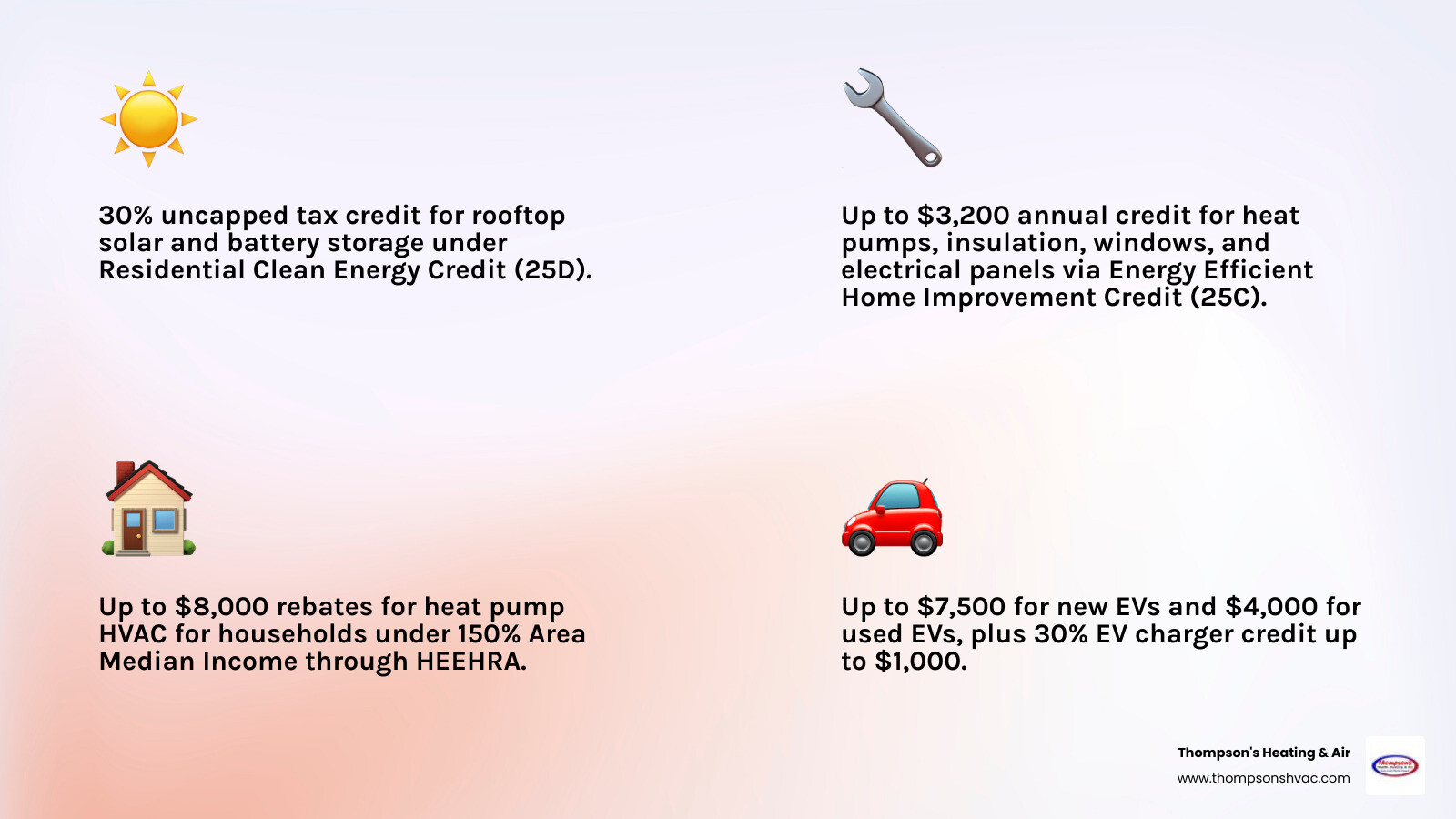
Inflation reduction act benefits for california homeowners represent one of the largest opportunities to cut energy costs in decades — and most people are leaving money on the table.
Here's a quick snapshot of what's available right now:
• Residential Clean Energy Credit (25D) — What You Get: 30% tax credit on solar + battery storage (no cap) — Who Qualifies: Most homeowners with tax liability
• Energy Efficient Home Improvement Credit (25C) — What You Get: Up to $3,200/year for heat pumps, insulation, windows, panels — Who Qualifies: Homeowners making qualifying upgrades
• HEEHRA Heat Pump Rebate — What You Get: Up to $8,000 for heat pump HVAC — Who Qualifies: Households under 150% AMI
• New EV Tax Credit — What You Get: Up to $7,500 — Who Qualifies: Income-eligible buyers
• Used EV Tax Credit — What You Get: Up to $4,000 — Who Qualifies: Income-eligible buyers
• EV Charger Credit (30C) — What You Get: 30% up to $1,000 — Who Qualifies: Homeowners in eligible locations
• Home Energy Audit Credit — What You Get: Up to $150 — Who Qualifies: Most homeowners
The Inflation Reduction Act (IRA), signed into law in August 2022, is the largest climate and energy investment in U.S. history. For homeowners in Woodland and across Yolo County, it means real, stackable savings on heating, cooling, solar, electric vehicles, and more. California alone received $590 million in federal funding for home energy rebates through the Department of Energy — covering everything from heat pump installations to whole-home efficiency retrofits.
The IRA is projected to save the average American family around $1,000 per year on energy costs. In Northern California, where PG&E rates have climbed steadily, those savings stretch even further.
Whether you're thinking about a new heat pump, rooftop solar, or just want to stop overpaying on your monthly utility bill, understanding these programs is the first step.
Understanding the Inflation Reduction Act Benefits for California Homeowners
As we navigate through April 2026, the landscape of home energy in California has shifted dramatically. The California Energy Commission (CEC) and the U.S. Department of Energy have worked tirelessly to roll out programs that make building decarbonization a reality for everyday residents. For us here in Yolo County, these programs aren't just about "going green"—they are about long-term utility bill reduction and home comfort.
The IRA is designed to cut U.S. greenhouse gas emissions by 40% by 2030. In Woodland, Davis, and West Sacramento, this translates to a massive push for energy efficiency. By utilizing these federal funds, California aims to transition homes away from volatile fossil fuel prices toward stable, electric solutions. With PG&E rates continuing to be a concern for many of our neighbors, the timing for these incentives couldn't be better.
Maximizing Inflation Reduction Act Benefits for California Homeowners via Solar
One of the most powerful tools in the IRA arsenal is the federal solar Investment Tax Credit (ITC), officially known as the Residential Clean Energy Credit (25D). This credit allows you to deduct 30% of the cost of installing solar energy systems from your federal taxes.
The best part? It’s uncapped. Whether your system costs $15,000 or $40,000, you get 30% back. This applies to:
• Solar photovoltaic (PV) panels
• Solar water heaters
• Wind turbines
• Battery storage systems
Speaking of batteries, the IRA introduced a major change: standalone battery storage systems with a capacity of 3 kWh or more now qualify for the full 30% credit, even if you don't install solar panels at the same time. This is a game-changer for homeowners in areas like Capay or Rumsey who want backup power during grid outages. The 30% rate is locked in through 2032, before it begins to phase down to 26% in 2033 and 22% in 2034. It's estimated that over 930,000 additional Californian households will install rooftop solar thanks to these extended benefits.
Income Eligibility for Inflation Reduction Act Benefits for California Homeowners
While tax credits are available to almost anyone with a tax liability, the rebate programs (like HEEHRA) are specifically tiered based on your household income. Eligibility is determined by your Area Median Income (AMI).
• Low-Income Households: Those earning less than 80% of the AMI can have up to 100% of their project costs covered (up to specific program caps).
• Moderate-Income Households: Those earning between 80% and 150% of the AMI can receive rebates covering up to 50% of their costs.
To make things easy, the state provides a HEEHRA income portal where you can verify your status. This focus on equitable building decarbonization ensures that families in Woodland and Esparto, regardless of their budget, can access high-efficiency technology that was once considered a luxury.
Federal Tax Credits for Energy-Efficient Upgrades (25C and 25D)
Understanding the difference between the 25C and 25D credits is essential for maximizing your return. While 25D focuses on renewable energy generation and storage, the Energy Efficient Home Improvement Credit (25C) focuses on the "envelope" of your home and the machines that keep you comfortable.
Under 25C, homeowners can claim up to $3,200 annually. This is an annual limit, not a lifetime one, which means you can spread your upgrades over several years to maximize your tax savings. For example, you could install a heat pump this year and upgrade your windows and doors next year.
• Annual Limit — 25C (Home Improvements): Up to $3,200 total — 25D (Clean Energy): No annual limit
• Heat Pumps — 25C (Home Improvements): Up to $2,000 — 25D (Clean Energy): N/A (Included in 25C)
• Solar/Battery — 25C (Home Improvements): N/A — 25D (Clean Energy): 30% of total cost
• Windows/Doors — 25C (Home Improvements): Up to $600 (windows), $500 (doors) — 25D (Clean Energy): N/A
• Electrical Panel — 25C (Home Improvements): Up to $600 — 25D (Clean Energy): N/A
• Home Audit — 25C (Home Improvements): Up to $150 — 25D (Clean Energy): N/A
To claim these, you'll typically use IRS Form 5695 when filing your taxes. We always recommend checking out our detailed guide on Tax Credits And Rebates to see how these federal incentives pair with local California programs.
Clean Vehicle and EV Charger Incentives
The IRA isn't just about your house; it’s about how you get around Yolo County. Switching to an electric vehicle can save you an average of $950 a year on fuel costs. To help with the upfront price, the New EV Tax Credit (30D) offers up to $7,500 for qualifying vehicles.
For those looking at the used market, there is a credit of 30% of the sale price, up to $4,000, for used EVs priced at $25,000 or less. As of 2024, these credits can often be applied as point-of-sale rebates, meaning the dealer takes the money right off the sticker price rather than making you wait for tax season.
Additionally, the 30C tax credit provides 30% (up to $1,000) for the installation of home EV chargers. With the growing charging infrastructure in Woodland and Davis, there's never been a better time to ditch the gas pump.
California Rebate Programs: HEEHRA and HOMES Status in 2026
As of early 2026, the rebate landscape in California has matured. The High-Efficiency Electric Home Rebate Act (HEEHRA) and the Home Owner Managing Energy Savings (HOMES) programs are the two primary vehicles for these state-administered federal funds.
HEEHRA Phase I launched with a focus on multifamily buildings and has since expanded. For single-family homes, the demand has been incredible. In fact, as of February 2024, many initial tranches of funding were reserved quickly, leading to waitlists in certain regions. However, HEEHRA Phase II has brought an additional $152 million into the fold, reopening opportunities for many homeowners.
These rebates are "point-of-sale," meaning the discount is applied directly by your contractor. This is why choosing the right partner for Hvac Installation Maintenance Repair is so critical — only certain certified contractors can process these rebates for you.
The HOMES Rebate Program and Measured Savings
While HEEHRA is focused on specific appliances, the HOMES program takes a "whole-home" approach. It uses a pay-for-performance model, where the size of your rebate depends on how much energy you actually save.
• Modeled Savings: If your contractor uses software to predict a 20% or greater energy reduction, you qualify for a rebate.
• Measured Savings: If you can prove a 15% or greater reduction in actual energy usage over time, you receive a rebate based on that performance.
This program is excellent for comprehensive projects that include energy-efficient windows, insulation upgrades, and air sealing. By tightening the "envelope" of your home, you can save up to 20% on your utility bills even before you upgrade your HVAC system.
Maximizing Savings with Heat Pumps and Electrical Upgrades
In HVAC, the heat pump is the undisputed king of the IRA. Unlike a traditional furnace that burns gas to create heat, a heat pump moves heat from one place to another. They are 2-3 times more efficient than conventional systems and provide both heating and cooling in a single unit.
For income-qualified households, HEEHRA provides up to $8,000 for a heat pump HVAC system. When you combine this with the $2,000 federal tax credit (25C), the cost of upgrading becomes significantly more manageable. We often see homeowners in Woodland pairing these installs with Hvac Maintenance And Repair plans to ensure their new high-tech systems run at peak efficiency for decades.
Many older homes in Zamora or Knights Landing may need an electrical panel upgrade to handle new electric appliances. The IRA has you covered here too, offering rebates up to $4,000 for panel upgrades and $2,500 for electrical wiring, provided these upgrades are done in conjunction with an electrification project.
Stacking Local Incentives with Federal Credits
One of the best secrets to saving money in California is "stacking." You aren't limited to just federal help. You can often combine IRA benefits with:
• SGIP (Self-Generation Incentive Program): Provides rebates for home battery storage, especially for those in high fire-threat districts.
• Property Tax Exclusions: In California, adding solar to your home does not increase your property taxes (extended through 2025/2026).
• TECH Clean California: A statewide initiative that provides additional incentives for heat pumps, often working behind the scenes with your contractor to lower your quote.
• Net Energy Metering (NEM): While NEM 3.0 changed the landscape, pairing solar with a battery still allows you to maximize your credits with PG&E.
How to Safely Claim Your IRA Incentives in Woodland
With hundreds of millions of dollars on the line, unfortunately, scams have become common. We’ve heard stories of unsolicited callers asking for financial information to "reserve your rebate." Don't fall for it.
To safely claim your incentives, follow these steps:
1. Find a TECH-certified contractor: Use the "Switch Is On" contractor finder. Only HEEHRA-trained professionals can access the state rebate portals.
2. Get a Home Energy Audit: For a $150 tax credit, a professional can identify exactly where your home is losing energy.
3. Verify Income: Use the official HEEHRA portal to see which tier you fall into before you sign a contract.
4. Secure a Reservation: Your contractor must submit a reservation request to the state before the work begins to ensure the funds are held for you.

Frequently Asked Questions about California IRA Benefits
What is the difference between HEEHRA and HOMES rebates?
HEEHRA is an "appliance-based" rebate for low-to-moderate income households (e.g., $8,000 for a heat pump). HOMES is a "performance-based" rebate open to all income levels that rewards you based on how much total energy your home saves through multiple upgrades.
Can I claim both a tax credit and a rebate for the same heat pump?
Yes! You can use the HEEHRA rebate to lower the upfront cost at the time of purchase and then claim the 25C tax credit on your year-end taxes for the remaining out-of-pocket balance. This "stacking" is the best way to maximize your inflation reduction act benefits for california homeowners.
Are renters in California eligible for Inflation Reduction Act incentives?
Yes. Renters can qualify for rebates on "portable" appliances like heat pump clothes dryers and window-unit heat pumps. Additionally, landlords are encouraged to upgrade multifamily units using IRA funds, which can lead to lower utility bills for tenants.
Conclusion
The Inflation Reduction Act has opened a new chapter for home comfort in Northern California. From the sunny streets of Davis to the rural homes of Arbuckle and Zamora, these incentives are making it possible for every family to enjoy a more efficient, comfortable, and affordable home.
At Thompson's Heating & Air, we’ve been part of the Woodland community since 1992. We know the local climate, we understand the nuances of the Yolo County power grid, and we are experts in navigating the paperwork required to get you these savings. Whether you need a simple repair or a full system overhaul, we’re here to help you achieve energy independence.
Maximize your savings with our guide to Tax Credits And Rebates and let's make your home the most efficient it's ever been.


.avif)
.avif)
.png)
