How to Apply for Energy Rebates in California Without the Headache


How to Apply for Energy Rebates in California (Without Losing Your Mind)
Knowing how to apply for energy rebates in California can put thousands of dollars back in your pocket — but the process isn't always obvious. Here's a quick overview to get you started:
Quick Steps to Claim California Energy Rebates:
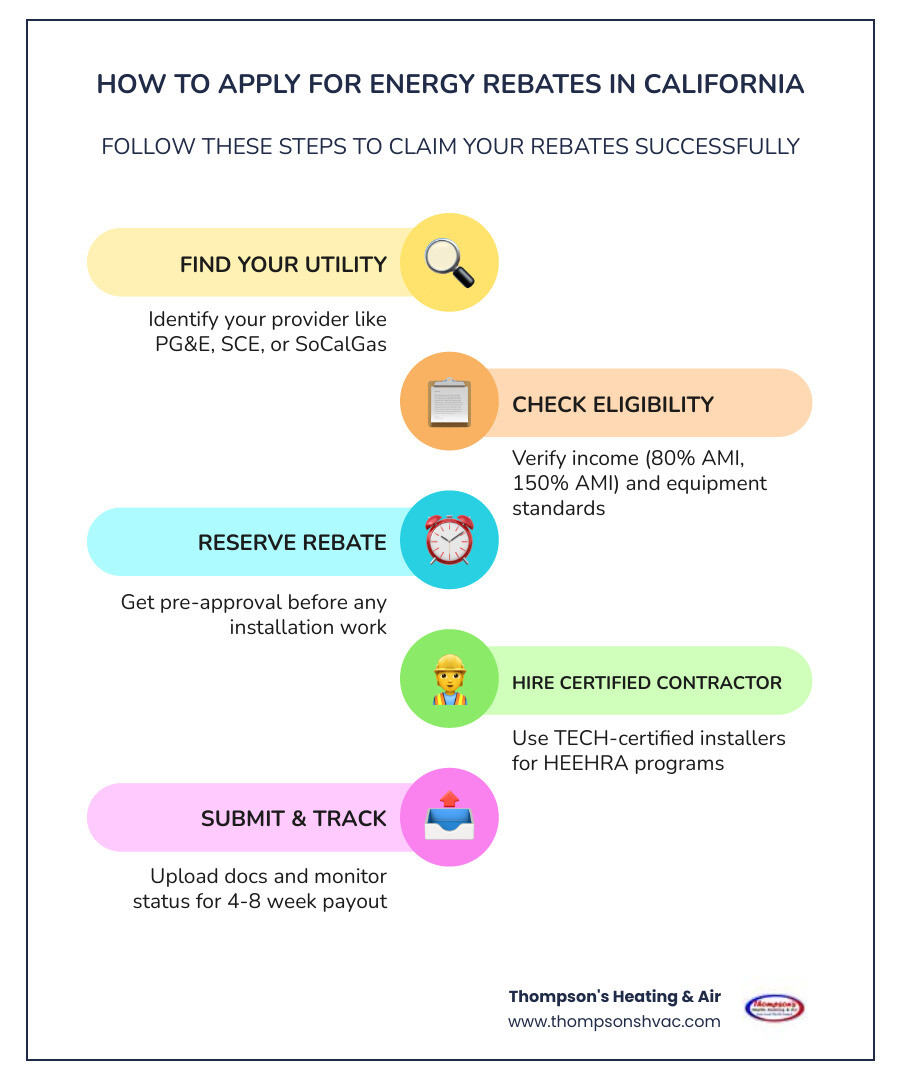
1. Find your utility provider (PG&E, SCE, SoCalGas, SDG&E, or a community choice aggregator like SVCE)
2. Check your income eligibility — programs differ for households under 80% AMI, 80–150% AMI, or above
3. Confirm your equipment qualifies — look for ENERGY STAR ratings or program-specific efficiency standards
4. Reserve your rebate before installation — most programs require pre-approval, not post-purchase claims
5. Work with a certified contractor — many programs, especially HEEHRA, require TECH-certified installers
6. Submit your documentation — receipts, installation photos, permits, and proof of purchase
7. Track your application — most programs issue rebate payments within 4–8 weeks of approval
California has set some of the most ambitious clean energy goals in the country — and to help homeowners get there, the state and its utilities have made hundreds of millions of dollars in rebates available. As of April 2026, programs funded through the Inflation Reduction Act alone have brought $590 million to California for residential energy upgrades. For Woodland homeowners and families across Yolo County, that means real money available for heat pumps, heat pump water heaters, EV chargers, and more.
The catch? The rebate landscape is genuinely complicated. You're dealing with overlapping programs from your utility company, the state, and the federal government — each with its own eligibility rules, deadlines, and application portals. Some programs are already fully reserved (HEEHRA single-family rebates hit their limit on February 24, 2026). Others are still open and actively accepting applications.
This guide cuts through the confusion so you can find the programs you actually qualify for, apply the right way, and avoid the common mistakes that get applications rejected or delayed.
Understanding the Main Types of Energy Rebates in California
When we talk about "energy rebates," we’re actually talking about a massive ecosystem of different funding sources. In California, these programs operate in parallel channels rather than a single, unified system. This is why you might hear your neighbor talking about a check they got from PG&E while your cousin in Silicon Valley is raving about a state-funded heat pump incentive.
The three primary buckets of money are:
1. Utility-Administered Rebates: These are funded by ratepayer charges and overseen by the California Public Utilities Commission (CPUC).
2. State-Level Initiatives: Programs like TECH Clean California or the Energy Savings Assistance (ESA) program.
3. Federal Incentives: This includes the Inflation Reduction Act (IRA) programs like HEEHRA and the HOMES program, as well as federal tax credits.
To maximize your savings, you should always check if you can "stack" these incentives. For example, you might qualify for a utility rebate, a state incentive, and a federal tax credit all for the same heat pump installation. For a detailed breakdown of how these interact, check out our guide on Tax Credits And Rebates.
Utility-Specific Programs (PG&E, SCE, SoCalGas)
For our neighbors in Woodland, Davis, and West Sacramento, PG&E is the primary player. PG&E offers several ways to save, ranging from instant discounts to post-purchase rebates.
• Golden State Rebates: This is one of the easiest ways to save. It provides instant coupons for energy-efficient products like smart thermostats and room air conditioners. You simply head to their website, verify your utility account, and get a coupon to use at major retailers.
• Residential EV Charging Rebates: If you're an income-eligible household, you could qualify for up to $5,000 toward EV charging equipment.
• Pre-Owned EV Rebate: PG&E offers up to $4,000 back on the purchase of a used electric vehicle, which is a fantastic way to make clean transportation more accessible.
• Backup Power Systems: There is currently a $300 rebate for portable backup power systems (like generators or batteries) for customers in high-fire-threat areas.
If you are further south in SCE or SoCalGas territory, the programs differ slightly. SCE’s Marketplace acts as a one-stop shop for vetted, top-rated products like pool pumps and heat pump water heaters. SoCalGas offers substantial rebates for natural gas upgrades, including up to $1,500 for high-efficiency tankless water heaters and up to $5,000 for solar thermal water heating systems.
State-Level Initiatives (TECH Clean California, ESA)
State programs often focus on "electrification"—moving homes away from gas and toward high-efficiency electric appliances.
TECH Clean California is a major initiative that provides tiered incentives for heat pump adoption. These incentives are often higher for low-income communities. The key here is that TECH incentives are typically managed through your contractor. When we install a qualifying system, we handle much of the backend work to ensure the incentive is applied correctly.
The Energy Savings Assistance (ESA) Program is a lifesaver for income-qualified renters and homeowners. If you qualify, the program provides no-cost energy-saving home improvements. This isn't just a rebate; it's a direct install program where the utility handles the contractor selection and scheduling for you.
For those looking to finance larger projects, GoGreen Home loans are a state-supported option with zero fees and broad credit score eligibility. These loans can be used by both renters and homeowners for a wide variety of energy efficiency projects.
How to Apply for Energy Rebates in California: A Step-by-Step Guide
The biggest "headache" in the application process is often the order of operations. Many homeowners buy an appliance, install it, and then look for a rebate. In California, that is often a recipe for disappointment.
Step 1: The Research PhaseBefore you spend a dime, visit "The Switch Is On" website. This is a statewide hub where you can enter your zip code and see every local, state, and utility rebate available for your specific project.
Step 2: Income VerificationFor the biggest rebates (like HEEHRA), you must verify your income first. Most programs use Area Median Income (AMI) thresholds. You’ll likely need to upload tax returns or proof of participation in programs like CARE or FERA to an official portal.
Step 3: Find a Certified ContractorThis is non-negotiable for most state and federal programs. For HEEHRA rebates, for example, you must work with a TECH-certified and HEEHRA-trained contractor. They are the ones who submit the "reservation request" to hold the funds for your project.
Step 4: The ReservationOnce your contractor is on board, they submit a request to reserve your rebate. This ensures that the money is actually there when the job is done. In April 2026, with many funds being first-come, first-served, this step is critical.
Step 5: Installation and DocumentationAfter the installation is complete, you’ll need to gather:
• Paid invoices and receipts.
• Photos of the installed unit and the manufacturer's nameplate (showing the model and serial number).
• Copies of required building permits.
• AHRI certificates (which prove the equipment meets efficiency standards).
Step 6: Final Submission and TrackingYour contractor will usually submit the final claim. You can track the status using an enrollment number provided by the program. Most rebates are issued as a digital or physical Prepaid Mastercard or a check within 6 to 8 weeks.
How to apply for energy rebates in California for emergency HVAC replacements
What happens if your air conditioner dies in the middle of a July heatwave in Woodland? You don't always have time to wait weeks for a rebate reservation.
Some programs, like Silicon Valley Clean Energy (SVCE), have specific "emergency exception" protocols. While Thompson’s Heating & Air primarily serves Yolo County, we see similar logic applied across the state. If you have an emergency replacement, you should:
1. Contact the program administrator immediately (often via a dedicated emergency email).
2. Document the failure (take photos of the old, broken unit).
3. Proceed with the installation using a certified contractor who understands the emergency filing process.
Always check the specific rules for your utility. Some programs allow a 120-day window to file after an emergency, but you must prove it was a "forced" replacement rather than a planned upgrade. For more on emergency situations, visit our Tax Credits And Rebates page.
How to apply for energy rebates in California while avoiding common scams
With hundreds of millions of dollars floating around, scammers are, unfortunately, very active. They often knock on doors or call claiming to be from "the government" or "your utility," offering free solar or "instant" IRA rebates.
How to stay safe:
• The "HEEHRA Badge": Only work with contractors who display the official HEEHRA-trained badge from TECH Clean California.
• Never share financial info: Official programs will never ask for your bank account or social security number over the phone or at your front door.
• No "Retroactive" Promises: If someone tells you they can get you a HEEHRA rebate for a system you installed last year, they are lying. These rebates are not retroactive.
• Use Official Portals: Only submit income information through the official TECH Clean California or state utility portals.
Navigating the Inflation Reduction Act (IRA) and HEEHRA Programs
The Inflation Reduction Act is the "big kahuna" of energy funding. California was awarded a total of $590 million from the U.S. Department of Energy for these programs. This funding is split primarily between two programs: HEEHRA (High-Efficiency Electric Home Rebate Act) and the HOMES (Home Owner Managing Energy Savings) program.
• Primary Focus — HEEHRA (Electrification): Switching to electric (Heat pumps, etc.) — HOMES (Efficiency): Whole-home energy savings (Insulation, HVAC)
• Eligibility — HEEHRA (Electrification): Income-qualified (<150% AMI) — HOMES (Efficiency): All income levels (but higher for low-income)
• Max Rebate — HEEHRA (Electrification): Up to $8,000 for HVAC; $14,000 total — HOMES (Efficiency): Based on energy savings (often $2,000 - $4,000+)
• Requirement — HEEHRA (Electrification): TECH-certified contractor — HOMES (Efficiency): Modeled or measured energy savings
HEEHRA Phase I and Phase II Status
As of April 2026, it is vital to understand the status of HEEHRA.
Phase I Status: In February 2026, the initial round of HEEHRA single-family rebates was fully reserved statewide. If you didn't get your application in before the February 24 deadline, you might find yourself on a waitlist. However, multifamily processing is still ongoing.
Phase II Status: The good news is that Phase II is currently under development. California has allocated approximately $152 million specifically for this next phase. We expect Phase II to open up more opportunities for single-family homeowners who missed the first boat. If you are planning an upgrade later in 2026, staying on the email list for the California Energy Commission (CEC) is the best way to catch the launch date.
The HOMES Program and Equitable Building Decarbonization
The HOMES program received $291 million in California. Unlike HEEHRA, which is about what you install, HOMES is about how much energy you save.
The funding is split 60/40:
• 60% ($130.3M) to Equitable Building Decarbonization (EBD): This is a "Direct Install" program for low-income households, aiming for at least a 20% reduction in energy use.
• 40% ($90.8M) to Pay for Performance (P4P): This program pays out based on actual, measured energy savings at your utility meter. If you do a major retrofit (insulation + new HVAC + smart controls) and your bills drop significantly, you get paid based on that performance.
Eligibility and Documentation for California Homeowners
Eligibility is almost entirely determined by your Area Median Income (AMI). This isn't just a "California" number; it’s specific to Yolo County.
• Low-Income (<80% AMI): You qualify for the highest rebates, often covering 100% of the project cost up to certain caps (e.g., $8,000 for a heat pump).
• Moderate-Income (80–150% AMI): You qualify for partial rebates, typically covering 50% of the cost.
• Above 150% AMI: You generally do not qualify for HEEHRA rebates, but you are still eligible for federal tax credits and many utility-specific rebates.
Income-Qualified Requirements (AMI Thresholds)
To verify your income, you’ll use the official TECH Clean California income portal. They use HUD-based data to determine where your household falls. If you are already enrolled in CARE (California Alternative Rates for Energy) or FERA (Family Electric Rate Assistance), the process is often fast-tracked because you’ve already proven your income status to the utility.
For those in "disadvantaged communities" (as defined by state law SB 535), there are often additional "bonus" incentives or no-cost solar programs like Energy for All.
Renters vs. Homeowners: Who Qualifies?
A common myth is that rebates are only for homeowners. That’s not true!
• Renters: You can apply for rebates on "portable" upgrades like window heat pumps or induction cooktop inserts. You are also eligible for the Green Tariff program, which offers a 20% discount on clean energy if you live in a disadvantaged community and can't install solar.
• Landlords: If you own a multifamily building and rent to income-qualified tenants, you can access massive HEEHRA multifamily rebates—up to $14,000 per unit for various upgrades.
• EV Charging: Renters can often access rebates for "pre-wiring" or portable charging equipment if they have landlord permission.
Frequently Asked Questions about California Energy Rebates
How long does it take to receive a rebate check?
Most California utility and state rebates take between 6 to 8 weeks to process once the final paperwork is submitted. Programs like SoCalGas or PG&E often use third-party processors like Choice Digital Corporation to issue payments. You will usually receive an email with a link to a digital Prepaid Mastercard, though you can request a physical card or check in some cases.
Can I stack utility rebates with federal tax credits?
Yes! This is the "secret sauce" of saving money. The Federal 25C Tax Credit allows you to claim 30% of the installation cost of a heat pump, up to $2,000 per year, through 2032. You can take a $2,000 rebate from PG&E and still claim the 30% tax credit on the remaining balance of your invoice. Always consult with a tax professional, but generally, these programs are designed to work together. Learn more at our Tax Credits And Rebates page.
What documentation is required for a successful application?
Don't let a missing piece of paper stand between you and your money. You will almost always need:
1. A Final Paid Invoice: It must show the date, the contractor's license number, and the specific model numbers of the equipment.
2. Installation Photos: Clear shots of the new unit in place.
3. AHRI Certificate: Your contractor should provide this. it proves the AHRI (Air-Conditioning, Heating, and Refrigeration Institute) rating of your system.
4. Permit Documentation: Proof that the job was inspected and cleared by your local building department (e.g., City of Woodland or Yolo County).
Conclusion
The journey to a more energy-efficient home doesn't have to be a nightmare. While the rules for how to apply for energy rebates in California are strict, they are also incredibly rewarding. By doing your homework, verifying your income early, and—most importantly—partnering with a contractor who understands the local and state landscape, you can save thousands.
At Thompson's Heating & Air, we've been serving the Woodland community and Yolo County since 1992. We know the local climate, we know the local utility quirks, and we are here to help you navigate the electrification transition. Whether you're in Davis, Dixon, or right here in Woodland, we’re committed to helping you find every dollar you’re entitled to.
Ready to upgrade your home's comfort and efficiency? Let's make it happen. Check out our comprehensive guide on Tax Credits And Rebates to see what's available for your next project today!


.avif)
.avif)
.png)
