
How Proper HVAC Maintenance Keeps Your Home Mold-Free

Why Mold Prevention and Your HVAC System Go Hand in Hand
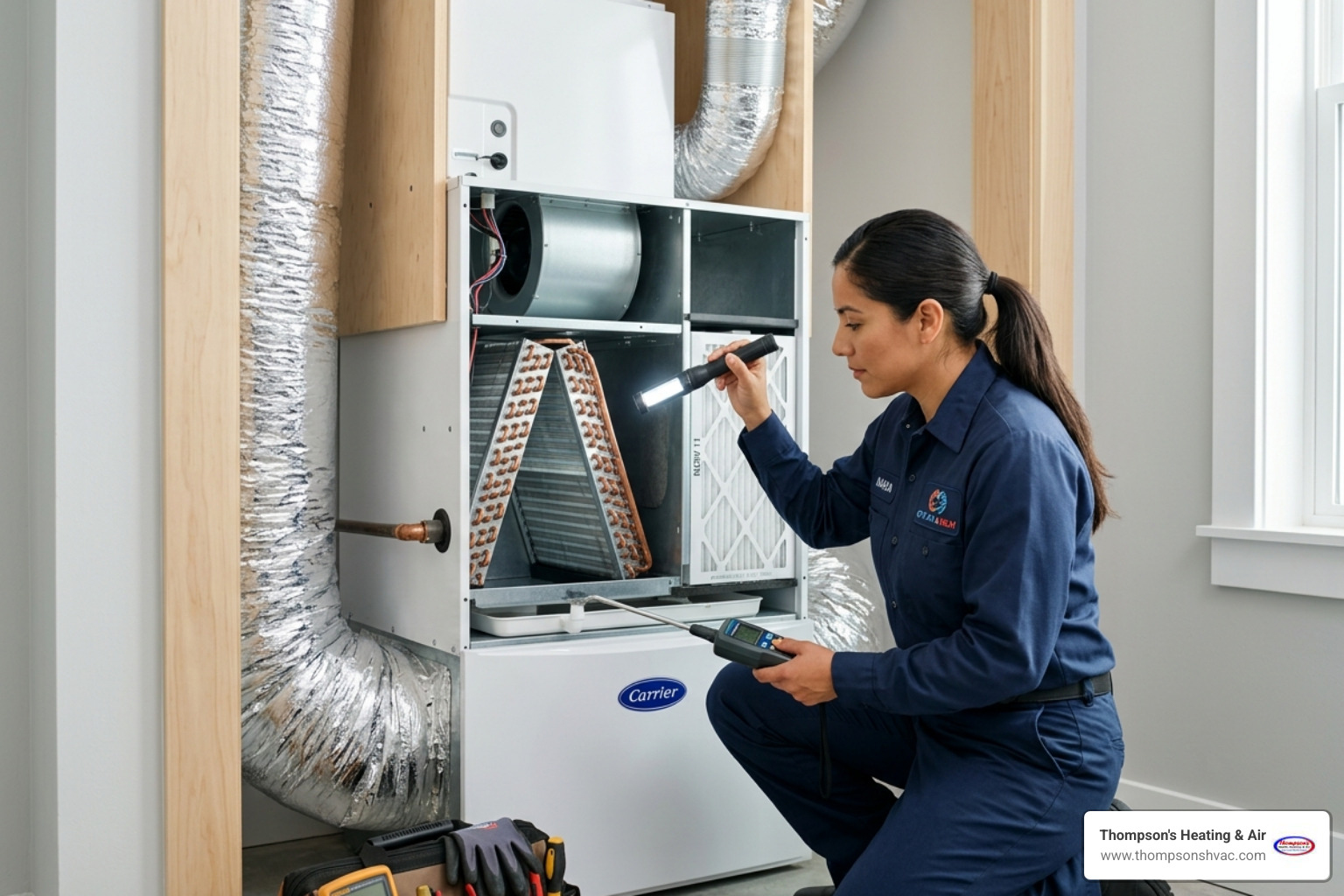
Mold prevention and your HVAC system are more connected than most homeowners realize. Here in Woodland, CA, where warm summers and seasonal humidity shifts are part of everyday life, your heating and cooling system is one of the biggest factors in whether mold takes hold inside your home — or doesn't.
Here's the key thing to understand: mold spores are always present in the air around us. They're invisible to the naked eye, floating through every room. They only become a problem when they land on a damp surface and get the conditions they need to grow. And your HVAC system — with its coils, drain pans, filters, and ductwork — can provide exactly those conditions if it isn't properly maintained.
The good news? Controlling mold in your home is largely about controlling moisture. Your HVAC system is your most powerful tool for doing that.
Here's a quick overview of how to prevent mold through your HVAC system:
• Control indoor humidity — Keep relative humidity between 30% and 50%
• Change air filters regularly — Every 30 to 90 days depending on filter type
• Keep drain pans and condensate lines clear — Standing water is a direct mold trigger
• Seal leaky ductwork — Leaks introduce moisture and reduce airflow
• Schedule annual HVAC maintenance — Technicians catch early moisture problems before mold spreads
• Consider UV germicidal lights — These disrupt mold DNA on evaporator coils
• Ensure your AC is properly sized — Oversized systems short-cycle and leave humidity behind
• Act within 48 hours — Mold can begin growing in as little as 48 hours after moisture accumulates
Read on and we'll walk through each of these in detail — what causes mold in HVAC systems, how to stop it, and when to call a professional.
Understanding the Causes of Mold Growth in Your HVAC System
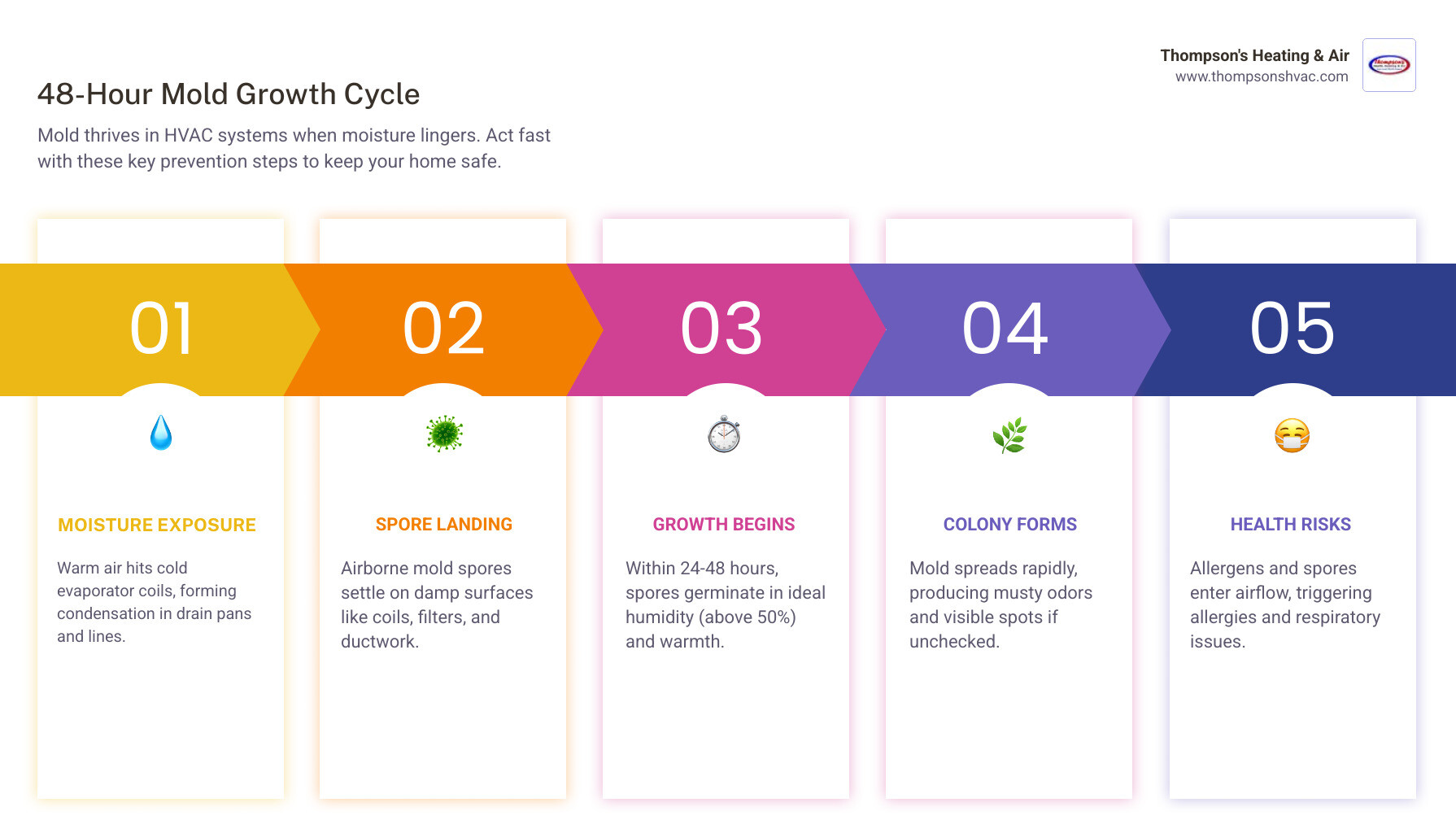
To effectively tackle mold prevention and your HVAC system, we first have to understand why mold likes your air conditioner so much. Mold isn't just a "dirty house" problem; it’s a biological process that requires three things: moisture, a food source, and the right temperature.
Your HVAC system naturally creates moisture through condensation. As warm air from your Woodland home passes over the cold evaporator coils, water droplets form—much like a cold glass of tea "sweats" on a July afternoon. If that water doesn't drain away quickly, you have a problem.
Furthermore, dust is the perfect food source for mold. Dust is comprised of organic materials like skin cells, pet dander, and pollen. When this dust accumulates on damp coils or inside dark ductwork, it creates a "buffet" for mold spores. Throw in the stagnant air found in poorly maintained systems, and you have a recipe for an outbreak. This is why regular HVAC Maintenance and Repair is so critical. We don't just fix things when they break; we clean the surfaces where mold loves to hide.
The Role of Humidity and Mold Prevention and Your HVAC System
In indoor air quality, humidity is the most significant factor we can control. Scientific research shows that mold begins to thrive when the relative humidity (RH) in your home hits 60% or higher. For maximum comfort and safety, we recommend keeping your indoor RH between 30% and 50%.
As of April 2026, modern standards emphasize using smart hygrometers—small, inexpensive devices that measure moisture in the air—to monitor different zones of your home. If your HVAC system is struggling to keep the air dry, it may be running too short a cycle or failing to pull enough moisture out of the air. When humidity stays high for more than 48 hours, mold spores can transition from dormant "seeds" into growing colonies.
Clogged Drain Pans and Condensate Lines
One of the most common "hidden" causes of mold is the condensate drain system. Your AC has a primary drain pan located right under the evaporator coils to catch all that dripping condensation. From there, the water should flow out of your house through a PVC condensate line.
However, dust and algae can create a sludge that clogs these lines. When the line clogs, water backs up into the pan. This standing water creates a high-moisture pocket directly in the path of your home’s airflow. Not only does this lead to musty smells, but it also allows mold to grow on the coil itself, where it can be blown directly into your living spaces. Ensuring the drain pan is properly sloped and the lines are clear is a foundational part of mold prevention and your HVAC system.
Essential Maintenance Steps for Mold Prevention and Your HVAC System
Prevention is always more affordable than remediation. By the time you see mold on a vent cover, it has likely been growing inside the system for quite a while. That’s why we advocate for a proactive approach.
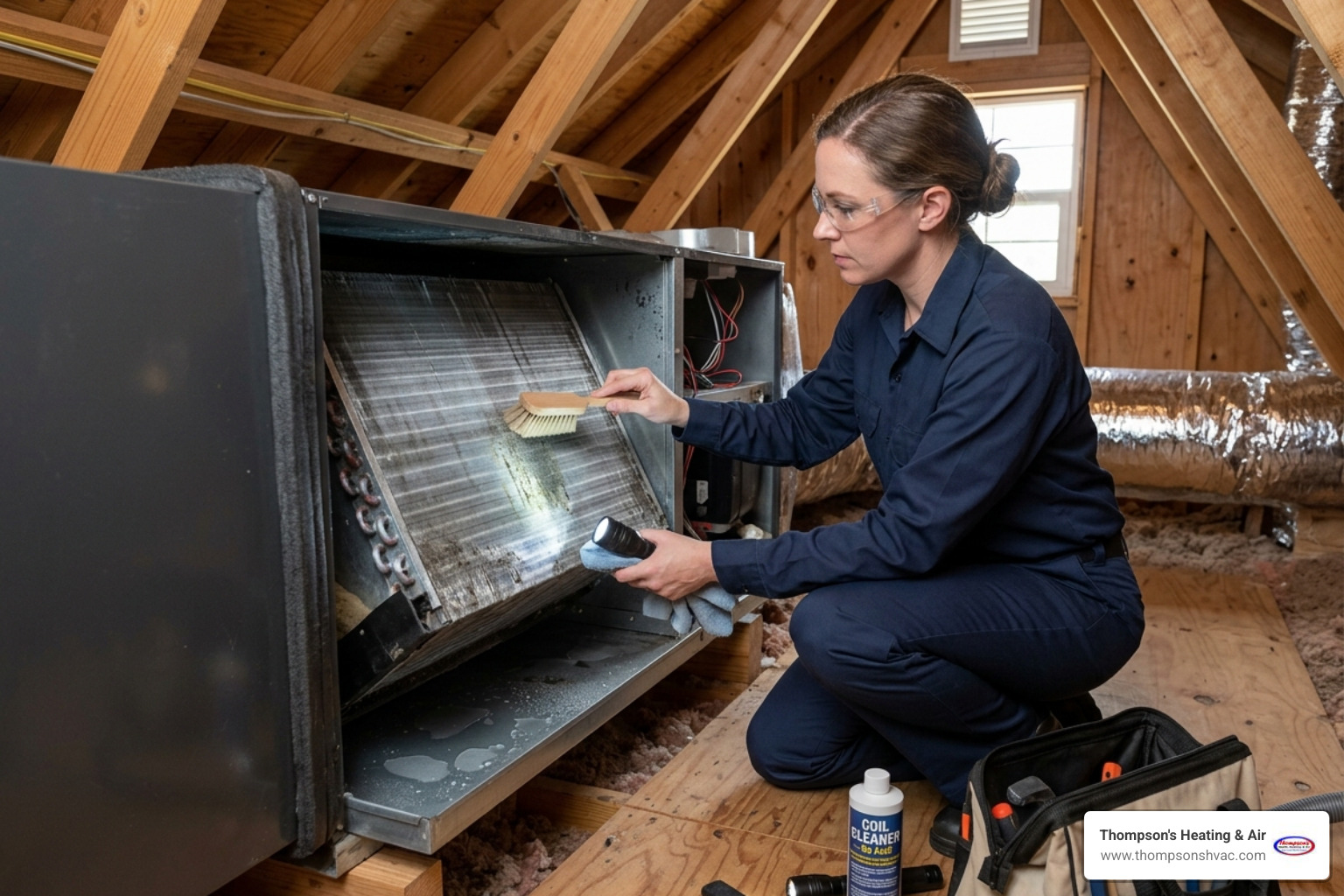
Annual tune-ups are the single best way to protect your home. During a professional visit, we don't just check the electrical connections; we perform deep coil cleaning. A clean coil transfers heat better, meaning your system runs more efficiently and removes more moisture from the air. If you haven't had your system checked recently, our team specializes in HVAC Installation Maintenance Repair to keep things running cleanly.
Air Filter Management for Mold Prevention and Your HVAC System
Think of your air filter as the "security guard" for your HVAC system. Its job is to catch the organic dust that mold uses for food. However, if a filter gets damp—perhaps from high humidity or a nearby leak—it can actually become a breeding ground for mold itself.
We recommend changing your air filters every 30 to 90 days. In homes with pets or high occupancy, sticking closer to the 30-day mark is safer. It’s also important to look at MERV ratings. A MERV 8 to MERV 13 filter is usually the "sweet spot" for residential homes in Yolo County. These filters are dense enough to trap mold spores and fine dust without putting too much strain on your blower motor. A high-efficiency filter that is left in too long will eventually restrict airflow, leading to the very stagnant conditions mold loves.
Sealing Leaky Ductwork and Improving Ventilation
Your ductwork is like the veins of your home, carrying "conditioned" air to every room. If your ducts have leaks—especially in unconditioned spaces like attics or crawlspaces—warm, humid air can be sucked into the system. When that humid air hits the cool metal or plastic of the duct, condensation forms inside the pipe where you can't see it.
Proper duct insulation and sealing prevent this "sweating" effect. Furthermore, balanced airflow is essential. If a room has poor ventilation or a blocked supply vent, moisture can linger in the corners, leading to those "musty" spots behind furniture. Ensuring your vents are open and unobstructed helps keep the air moving, which is a natural deterrent for mold growth.
Advanced Solutions: UV Lights and Proper AC Sizing
Sometimes, standard maintenance needs a little extra help, especially in the more humid pockets of Northern California. This is where advanced Indoor Air Quality Products come into play.
One of the most effective tools we use is the UV germicidal light. These lights are installed inside your air handler, specifically targeting the evaporator coil. They emit UVC radiation—the same type used in hospitals—to disrupt the DNA of mold spores and bacteria. Because the mold cannot replicate, it cannot grow into a colony. It’s a "set it and forget it" solution that works 24/7 to keep the heart of your HVAC system sterile.
Why Correct System Sizing Matters
You might think a bigger air conditioner is always better, but when it comes to mold prevention and your HVAC system, an oversized unit is actually a liability. This is because of a process called "short cycling."
A massive AC unit will cool your Woodland home down to the target temperature very quickly and then shut off. However, the cooling process is also the dehumidification process. It takes time for the air to pass over the coils enough times to remove significant moisture. If the system shuts off too soon, the air feels "cool but clammy."
We use a "Manual J" calculation to ensure your system is sized perfectly for your home's square footage, insulation levels, and window types. A correctly sized system runs longer cycles, which allows it to pull the maximum amount of water out of the air, keeping your humidity levels safely below that 50% threshold.
Identifying Signs of Mold and Health Risks
How do you know if mold has already moved in? Your senses are usually your best diagnostic tools.
The most common sign is a "dirty sock" smell—a persistent, musty odor that gets stronger when the AC or heater kicks on. You might also see visible spots. These could be black, green, or white fuzzy patches on your vent registers or around the AC cabinet.
Beyond the physical signs, pay attention to your health. Mold spores are major triggers for allergies and respiratory issues. If you find that you’re sneezing, having itchy eyes, or experiencing headaches only when you’re inside your home, your HVAC system might be circulating mold spores. For those with asthma, HVAC mold can lead to more frequent flare-ups.
When to Call for Professional Remediation
If you suspect mold is growing inside your ductwork or deep within the air handler, it is time to stop the DIY efforts and call in the experts. Cleaning mold incorrectly can actually make the problem worse by sending a massive cloud of spores through your vents and into every room of the house.
Professional remediation involves specific safety protocols, including HEPA-filtered vacuums and EPA-registered antimicrobial cleaners designed specifically for HVAC use. If porous materials like internal duct insulation have become water-logged and moldy, they cannot be cleaned—they must be replaced. At Thompson’s Heating & Air, we can perform a thorough inspection to determine the extent of the contamination and help you get back to breathing clean air.
Frequently Asked Questions about HVAC Mold
What is the ideal indoor humidity level to prevent mold?
The ideal range is between 30% and 50%. If your home stays above 60% humidity for more than two days, the risk of mold growth increases significantly. Using a whole-home dehumidifier can help maintain these levels even during the stickiest Woodland summers.
Should I attempt DIY mold cleaning in my HVAC system?
We generally advise against it for anything beyond wiping down external vent covers. HVAC systems have sensitive components like fins and sensors that are easily damaged. More importantly, without the right containment equipment, you risk spreading spores throughout your entire home.
How often should I have my HVAC system inspected for mold?
You should have a professional inspection at least once a year as part of your seasonal maintenance. However, if you notice musty odors, visible moisture around your indoor unit, or a sudden increase in allergy symptoms, you should schedule an inspection immediately.
Conclusion
Living in Northern California means enjoying a beautiful climate, but it also means staying vigilant about the moisture in our homes. Mold prevention and your HVAC system go hand-in-hand because your air conditioner is essentially a giant dehumidifier. When it’s well-maintained, it’s your best friend; when it’s neglected, it can become a source of trouble.
Since 1992, Thompson's Heating & Air has been helping families in Woodland, Davis, and throughout Yolo County stay comfortable and healthy. As a family-owned business, we take indoor air quality personally. Whether you need a routine tune-up, a ductwork inspection, or the latest Indoor Air Quality Products like UV lights, we are here to help.
Don't let moisture take over your home. Keep your system clean, your filters fresh, and your humidity low. If you're worried about mold or just want to ensure your system is prepared for the season ahead, give us a call. We're proud to serve our neighbors in Woodland, Winters, Esparto, and the surrounding communities with 24/7 technician access and a commitment to 5-star service.



.avif)
.avif)
.png)
