
Membership Plan vs Pay Per Visit: The Ultimate Guide

Which Service Model Actually Saves You Money? A Membership Plan vs Pay Per Visit Comparison
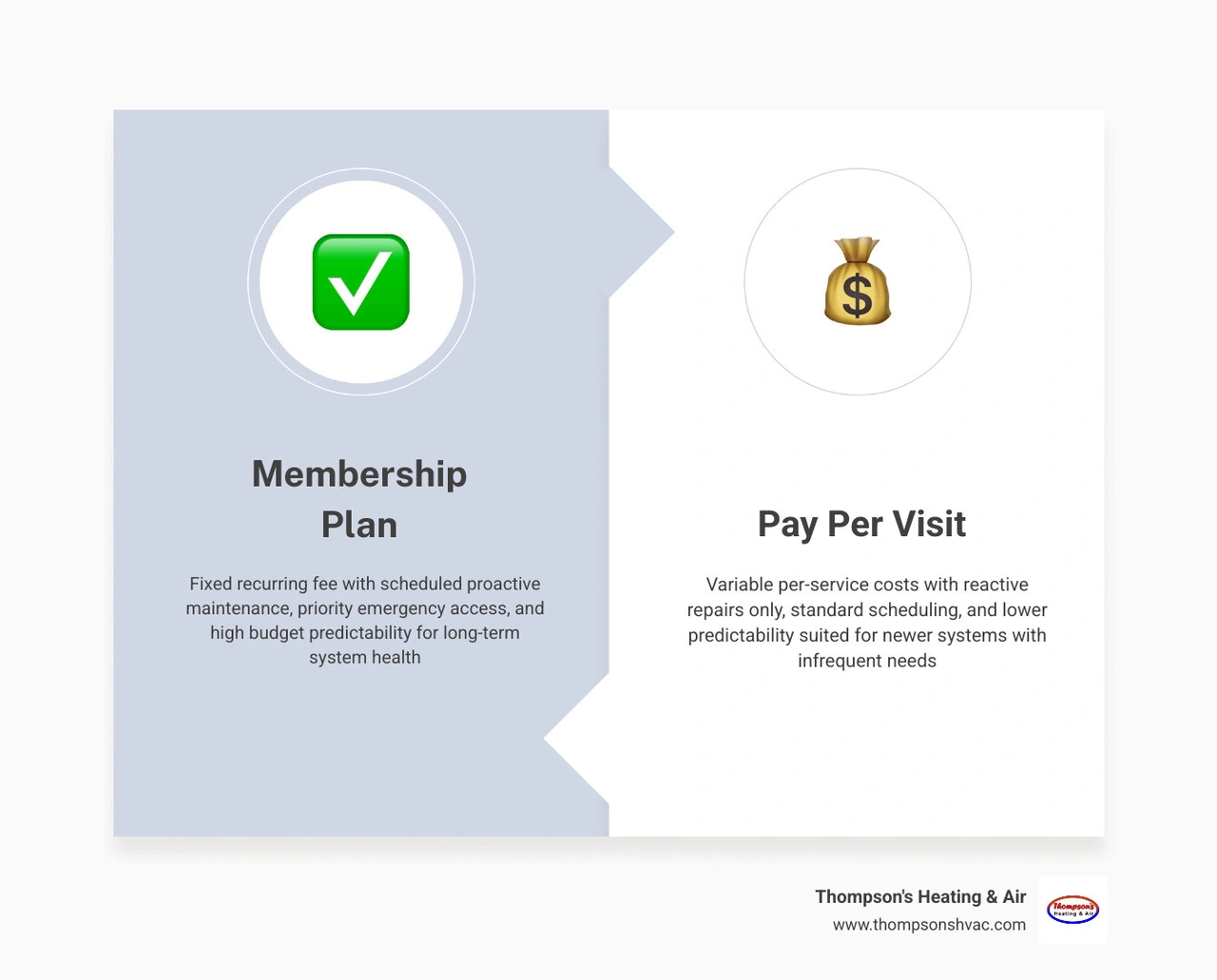
When it comes to a membership plan vs pay per visit comparison for your home's HVAC system, the short answer is this: membership plans work best for homeowners who want predictable costs and consistent care, while pay-per-visit works better for those with newer systems and very infrequent service needs.
Quick comparison at a glance:
• Cost structure — Membership Plan: Fixed recurring fee — Pay Per Visit: Variable, per-service cost
• Best for — Membership Plan: Frequent users, older systems — Pay Per Visit: Infrequent users, newer systems
• Maintenance — Membership Plan: Scheduled and proactive — Pay Per Visit: Reactive, as-needed
• Emergency access — Membership Plan: Often priority scheduling — Pay Per Visit: Standard scheduling
• Budget predictability — Membership Plan: High — Pay Per Visit: Low
• System longevity — Membership Plan: Better (preventive care) — Pay Per Visit: Depends on usage
But the full picture is a bit more nuanced — especially for homeowners in Woodland, CA, where summer heat and winter cold put real stress on HVAC systems year-round.
Here's the thing: most homeowners don't think about their heating or cooling system until something goes wrong. That one reactive service call often costs far more than months of proactive maintenance would have. Research shows that regular HVAC check-ups can prevent up to 95% of major breakdowns — a number that's hard to ignore when you're facing a failed AC in July or a broken furnace in January.
The choice between a membership plan and pay-per-visit isn't just about money. It's about how much uncertainty you're comfortable with — and how much your comfort and peace of mind are worth to you.
Understanding the Membership Plan vs Pay Per Visit Comparison
To truly weigh your options, we must look at the underlying philosophies of these two service models. A pay-per-visit model is transactional. You call us when you need a specific repair, a one-off tune-up, or when a strange clanking noise starts coming from your attic. It offers absolute freedom—you only pay when a technician is actively working in your home. However, this freedom comes with a hidden cost: a lack of service consistency.
On the other hand, a membership plan functions as an ongoing partnership. It is designed to shift your home comfort strategy from reactive firefighting to proactive management. Instead of waiting for a system failure, you establish a consistent schedule of professional care.
This model relies on the psychology of commitment. In the fitness and wellness industries, studies show that people with long-term commitments are 20% more consistent than casual visitors. The same principle applies to your home. When you belong to a structured plan, you are far more likely to actually schedule your vital seasonal check-ups rather than letting them slide year after year.
By standardizing your system's upkeep, you ensure that small, hidden issues—like a failing capacitor or a clogged condensate drain—are caught and resolved before they turn into major system failures. For a complete look at how we keep your home running smoothly through every season, you can explore our full range of Services.
Financial Predictability in a Membership Plan vs Pay Per Visit Comparison
Let us talk about budgeting. The biggest drawback of the pay-per-visit model is its financial volatility. We often refer to these as "lumpy" expenses. You might go a year or two paying absolutely nothing for your HVAC system, only to be hit with a massive, unexpected repair bill during a peak summer heatwave. This unpredictability makes long-term household budgeting incredibly difficult.
A membership plan replaces these sudden financial spikes with smooth, predictable recurring fees. You know exactly what you are paying and when, allowing you to incorporate your home's climate maintenance seamlessly into your monthly or annual budget.
However, some homeowners worry about underutilization. This is a valid concern. In the subscription economy, behavioral economists study how consumers interact with recurring plans. For example, the average American wastes $397 per year on underutilized gym memberships. In the fitness world, a high-end club member typically needs to hit a break-even point of exactly 5.2 visits per month to justify their subscription; attending fewer than five sessions means effectively paying a 40% premium over standard drop-in rates.
Fortunately, home services do not suffer from this "sleepy member" trap if the plan is structured correctly. Unlike a gym membership that requires you to show up dozens of times a year, an HVAC membership plan is designed around high-value, scheduled touchpoints that directly protect your equipment. You do not need to use it daily to get your money's worth—just completing your scheduled spring and fall tune-ups easily offsets the cost of the plan. To dive deeper into the financial breakdown of these models, check out our detailed analysis on Is an HVAC Maintenance Plan Worth It.
Long-Term Value in a Membership Plan vs Pay Per Visit Comparison
When looking at the lifetime value of your home comfort systems, the comparison becomes even clearer. An HVAC system is one of the most expensive appliances in your home. Extending its lifespan by even two or three years can save you thousands of dollars in premature replacement costs.
Preventive care is the single most effective way to protect this investment. When a system is neglected, it has to work harder to achieve the same indoor temperature, which accelerates wear and tear on crucial components. By contrast, regular, professional attention keeps your system running at peak efficiency, reducing energy consumption and minimizing strain.
From a service provider perspective, businesses often look at retention patterns and churn rates. In the subscription world, average monthly churn hovers around 5.3%, compounding to 46% to 58% annually. However, organizations with exceptionally high satisfaction and value—like Costco, which boasts a 92.3% renewal rate in the U.S. and Canada—succeed because members see undeniable, ongoing utility.
In our industry, annual contract members show 55% lower churn in months two through six compared to month-to-month members. This stability allows us to build long-term relationships with homeowners, keep detailed histories of their equipment, and provide highly personalized care that simply is not possible with transactional, pay-per-visit customers. For a step-by-step breakdown of what goes into these protective check-ups, read our Annual HVAC Maintenance Complete Guide.
Comparing Routine Maintenance and Preventive Care Models
To understand why scheduled care outperforms reactive service, it helps to look at how your system degrades over time. Dust, dirt, and friction are the silent killers of heating and cooling systems. Without regular intervention, airflow decreases, electrical connections loosen, and moving parts lose lubrication.
A pay-per-visit approach to maintenance often means calling for a tune-up only when you notice a drop in performance. By that point, the system has already been operating under stress, wasting energy and sustaining minor damage. A membership plan, by contrast, schedules these visits automatically.
Here is a direct comparison of how these two approaches impact your home and your wallet:
• Scheduling — Scheduled Maintenance (Membership Plan): Automated, proactive reminders before peak seasons — Reactive Service (Pay-Per-Visit): Manual, initiated by homeowner after a problem starts
• System Efficiency — Scheduled Maintenance (Membership Plan): Consistently high; utility bills stay optimized — Reactive Service (Pay-Per-Visit): Declines over time; system uses more power to run
• Breakdown Risk — Scheduled Maintenance (Membership Plan): Reduced by up to 95% due to early detection — Reactive Service (Pay-Per-Visit): High; minor issues compound into major component failures
• Component Wear — Scheduled Maintenance (Membership Plan): Minimal; parts are cleaned, adjusted, and lubricated — Reactive Service (Pay-Per-Visit): High; dirty or unaligned parts put strain on the whole system
• Manufacturer Warranty — Scheduled Maintenance (Membership Plan): Fully protected with documented annual service — Reactive Service (Pay-Per-Visit): At risk of being voided due to lack of maintenance proof
• Emergency Risk — Scheduled Maintenance (Membership Plan): Low; potential issues are caught in mild weather — Reactive Service (Pay-Per-Visit): High; failures typically occur during extreme weather peaks
By investing in regular AC Maintenance, you ensure your cooling system is fully prepared to handle the intense summer heat. Similarly, consistent Heat Pump Maintenance keeps your dual-heating and cooling system running efficiently through every seasonal transition.
Access, Priority Service, and Emergency Response Times
The middle of a blistering July afternoon is the worst possible time to find out your air conditioner has stopped blowing cold air. During these peak summer weeks, every HVAC service provider in Northern California receives a massive influx of emergency calls.
If you rely on a pay-per-visit model, you are placed in the standard service queue. During high-demand periods, this can mean waiting days for an available technician, as dispatchers must juggle dozens of urgent requests.

Membership plans solve this bottleneck through priority scheduling. As a plan member, you bypass the standard waitlist. Even during the busiest times of the year, members receive guaranteed, expedited service windows. This fast-track access is one of the most valuable aspects of a membership, providing a safety net when you need it most.
Furthermore, regular maintenance is your best defense against these stressful situations in the first place. Catching a worn belt or a failing motor in spring means you avoid the emergency call altogether. To learn more about how consistent care keeps you out of these high-stress situations, read our guide on How to Prevent HVAC Emergencies with Maintenance.
Choosing the Right Model for Your Home and Climate
Your geographic location plays a major role in deciding which model makes the most sense for your household. Here in Yolo County and the surrounding Northern California areas, our climate features distinct seasonal extremes.
In cities like Woodland, CA, Davis, CA, and West Sacramento, CA, summers are consistently hot and dry, while winters bring damp, chilly winds. This means your HVAC system does not get much of a break. Your air conditioner works overtime for several months, followed shortly by your heating system stepping up to keep your family warm.
Because our local weather demands so much from your equipment, a reactive pay-per-visit strategy can be highly risky. A system that runs almost continuously for months on end requires consistent, professional calibration to survive the yearly cycle without breaking down.
To ensure your home remains a comfortable sanctuary regardless of the outdoor temperature, we offer specialized local services tailored to our regional climate:
• Keep your furnace or heater ready for those chilly winter nights with professional Heating Maintenance in Woodland CA.
• Ensure your heating system is safe, clean, and efficient with timely Heating Maintenance in Davis CA.
• Avoid sudden winter heating failures with proactive Heating Maintenance in West Sacramento CA.
• Protect your zoned comfort systems and keep your energy bills low with dedicated Ductless Maintenance.
For homeowners in these areas, the continuous wear and tear of our local climate makes the membership plan an exceptionally smart, protective choice.
Frequently Asked Questions about Home Service Models
Can a maintenance plan prevent emergency breakdowns?
Yes, a structured maintenance plan is the single most effective way to prevent unexpected system failures. During a routine tune-up, a technician does not just clean your system; they perform a comprehensive safety and performance inspection.
They test electrical connections, measure airflow, check refrigerant levels, and inspect critical moving parts. By identifying and replacing worn components before they fail, we can prevent up to 95% of major HVAC breakdowns. To see how our plan is structured to protect your home, visit our Maintenance Plan page.
Is pay-per-visit better for newer HVAC systems?
While it might seem tempting to use a pay-per-visit model for a brand-new HVAC system because "nothing should go wrong yet," this can actually backfire. Almost all major HVAC manufacturers require proof of regular, professional maintenance to keep their equipment warranties valid.
If a major component fails three years into its lifespan, but you cannot provide documented proof of annual professional servicing, the manufacturer may deny your warranty claim. A membership plan ensures you have a continuous paper trail of certified care, keeping your valuable warranty fully intact.
How do cancellation policies work for home service memberships?
We believe in complete customer autonomy and flexibility. While some subscription-based services in other industries rely on complex contracts and high early termination fees to keep their churn low, we focus on delivering continuous value.
In the broader market, about 38% of consumers actively avoid signing up for services with mandatory, rigid contracts. That is why hybrid models—which offer the stability of a plan alongside the flexibility to adjust or cancel—are becoming the gold standard for customer satisfaction. Our goal is to earn your loyalty through exceptional service, not restrictive legal clauses.
Conclusion
Choosing between a membership plan and a pay-per-visit model ultimately comes down to how you prefer to manage your home. If you prefer a hands-off, highly predictable, and deeply protective approach to your home comfort, a membership plan is the clear winner. If you have a highly reliable system, live in a very mild climate, and do not mind the risk of waiting in line during a heatwave, pay-per-visit may suit your needs.
At Thompson's Heating & Air, we have been helping our neighbors throughout Yolo County stay comfortable in their homes since 1992. Whether you need a quick, reliable repair or want the ultimate peace of mind that comes with a dedicated maintenance plan, our team is always here to provide 5-star service.
Ready to protect your home's comfort system and secure priority service when you need it most? Explore our options for professional HVAC Maintenance and Repair or contact us today to find the perfect fit for your home.



.avif)
.avif)
.png)
