
What to Expect When Our Technicians Arrive for an Emergency AC Repair in Woodland

Navigating a Sudden AC Failure During an August Late-Summer Heatwave
When an August late-summer heatwave hits the Sacramento Valley and your indoor temperatures start climbing, knowing exactly what to expect when our technicians arrive for an emergency AC repair in Woodland can make all the difference between panic and peace of mind. Losing your cooling system when temperatures soar past 100 degrees is more than just an inconvenience; it quickly becomes a safety concern for your family, your pets, and your home. The immediate stress of a sudden breakdown often leaves homeowners wondering how long they will have to wait, what the diagnostic process entails, and how quickly their comfort can be restored.
If you are currently dealing with a sudden cooling failure, our comprehensive air conditioning services are designed to provide rapid relief. We prioritize clear communication and swift action, ensuring you get the emergency AC repair in Woodland you need without unnecessary delays.
During a severe August late-summer heatwave, AC systems are pushed to their absolute limits. One local homeowner recently experienced a complete AC failure that persisted for three days during a punishing stretch of 100-plus degree weather. When a professional was dispatched to the property, the technician arrived promptly, identified the root cause of the failure, and resolved the issue on the spot, restoring the home's comfort when it was needed most. This level of responsiveness is built on a structured, step-by-step diagnostic protocol designed specifically for urgent, high-heat situations. By understanding the exact steps a technician takes from the moment they pull into your driveway, you can set realistic expectations and feel confident that your system is in expert hands.
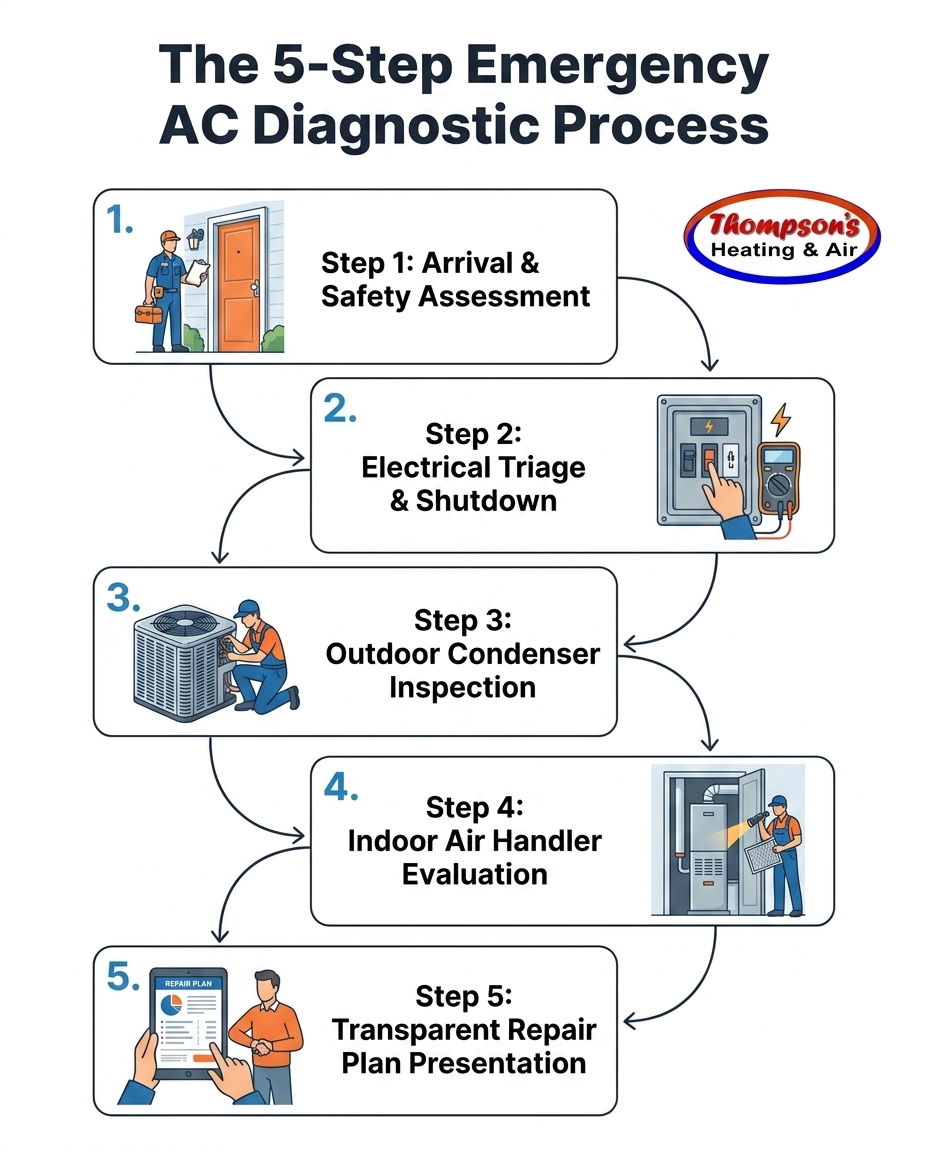
Step 1: Immediate Arrival, Introductions, and Property Respect
The diagnostic process begins the moment the service vehicle arrives at your property. Professionalism and clear communication are the foundations of a successful service visit, especially when you are dealing with the stress of a hot, uncomfortable home. Our Woodland HVAC experts follow a strict arrival protocol to ensure you know exactly who is on your property and what they will be doing.
Here is the standard arrival sequence you can expect:
1. Identifiable arrival: The technician arrives in a fully stocked, clearly marked company vehicle. This truck operates as a mobile warehouse, carrying the specialized tools and replacement parts needed to tackle the most common high-heat failures immediately.
2. Professional introductions: Before entering your home, the technician will introduce themselves, present their credentials, and confirm the details of your service request. This transparent approach eliminates the fear of the unknown.
3. The initial interview: The technician will ask a few targeted questions about your system's behavior. They will want to know exactly when the system stopped working, if you noticed any unusual noises (like grinding or buzzing), and if there were any strange smells leading up to the failure.
4. Property protection: Respecting your home is a top priority. The technician will use protective measures, such as wearing shoe covers or laying down drop cloths, to ensure your floors and belongings remain clean throughout the inspection process.
Gathering Technical Details
During this initial conversation, the technician is already beginning to piece together the diagnostic puzzle. For example, when homeowners require technical details on complex systems like heat pumps, having knowledgeable staff arrive ready to explain the intricacies of the equipment is vital. Whether you have a standard central air conditioner or a specialized heat pump system, this initial exchange of information helps the technician narrow down the potential causes before they even touch a tool.
Step 2: System Shutdown and Electrical Safety Triage
Once the introductions are complete, the very first technical step is securing the system. Before any physical components are opened, tested, or dismantled, the technician must perform an electrical safety triage. Air conditioning systems operate on high-voltage electricity, and a sudden failure during an August late-summer heatwave often points to an electrical fault or a thermal overload.
Ensuring safe disconnection: The technician will ensure the system is safely disconnected from live power. This prevents electrical hazards and protects both the technician and your home's electrical grid. Attempting to bypass safety switches or force a failing system to run can cause catastrophic damage to the compressor, turning a minor repair into a major replacement.
Checking the breaker panel: Next, the technician inspects your home's main electrical panel. A tripped breaker is a common symptom of a severely overworked system drawing too much amperage. If the breaker has tripped, it is a clear indicator that a component within the AC is failing and pulling excess current.
Evaluating the thermostat: A preliminary inspection of the thermostat confirms whether the issue is a simple communication error or a deeper mechanical fault. Sometimes, a blank thermostat screen simply means the batteries are dead or the low-voltage wire has lost connection. The technician will verify that the thermostat is sending the correct cooling signals to the equipment.
Why Safety Triage Matters
Safety triage is not just about protecting the technician; it prevents further damage to your unit while the diagnostic process continues. If a motor is seized or a compressor is shorted to ground, allowing power to flow to the unit could cause a dangerous electrical short. By systematically securing the power supply, the technician sets a safe foundation for a thorough mechanical inspection.
Step 3: Diagnosing the Outdoor Condenser and Compressor
With the system safely secured, the technician moves outside to inspect the condenser unit. Woodland's dry, extreme summer heat puts unique and intense stress on outdoor condenser units, making electrical component failures a top emergency finding during the peak of summer.
The outdoor unit takes the brunt of the extreme weather, sitting in direct sunlight while attempting to release the heat absorbed from inside your home. If you keep up with routine AC service, your outdoor unit is better equipped to handle this stress, but sudden failures can still occur under extreme conditions.
Testing electrical components: The technician will remove the access panel on the condenser to inspect the electrical controls. Using specialized multimeters, they will test the dual run capacitor and the contactor. The capacitor acts as a battery that provides the initial jolt of energy needed to start the compressor and fan motor. These components frequently fail under extreme thermal stress, bulging or leaking fluid when they can no longer hold a charge.
Evaluating the compressor and fan motor: The compressor is the heart of the air conditioning system. The technician will test the electrical windings inside the compressor to ensure they are intact and not shorted. They will also inspect the condenser fan motor, which pulls air through the metal fins to cool the refrigerant. If the fan motor fails, the compressor will quickly overheat and shut down on a thermal limit switch.
Assessing refrigerant levels: While the technician will not hook up pressure gauges unless necessary (to avoid losing trace amounts of refrigerant), they will look for visual signs of a leak, such as oil stains on the copper lines or ice buildup on the valves. Proper refrigerant levels are critical for the system's ability to cool your home efficiently.
Step 4: Inspecting the Indoor Air Handler and Ductwork
After the outdoor condenser is fully evaluated, the focus shifts to the indoor air handler. An air conditioning system is a closed loop, meaning a problem indoors can easily cause symptoms outdoors, and vice versa. To ensure the entire system is evaluated holistically, the technician must inspect the equipment located in your attic, garage, or interior closet.
Examining the evaporator coil: The indoor evaporator coil is responsible for absorbing heat and humidity from your home's air. The technician checks this coil for freezing, which often happens if airflow is severely restricted or if the system is low on refrigerant. A frozen coil encased in solid ice cannot absorb heat, causing the system to blow warm air or shut down entirely.
Inspecting the blower motor: The blower motor pushes the conditioned air through your ductwork and into your living spaces. The technician will check the motor's amperage draw and inspect the blower wheel for excessive dirt buildup. A dirty blower wheel struggles to move air efficiently, putting extra strain on the motor during an August late-summer heatwave.
Checking the condensate drain lines: As the AC removes humidity from the air, that moisture must drain away safely. The primary condensate drain line is inspected to ensure water is flowing properly. If this line clogs with algae or debris, water can back up and trip a safety float switch, shutting the entire system down to prevent water damage to your ceiling or floors.
Evaluating air filtration: Finally, the technician will examine your air filters. Heavily clogged filters are a leading cause of sudden system shutdowns. A dirty filter suffocates the system, causing the evaporator coil to drop below freezing and forcing the blower motor to work twice as hard.
Step 5: Presenting a Transparent and Actionable Repair Plan
Once the comprehensive diagnostic is complete—which typically takes within 30 to 60 minutes—the technician compiles their findings into a clear, actionable report. This step is where professional transparency truly shines. The goal is to eliminate the fear of the unknown by positioning the technician as an educator rather than just a repair worker.
Clear, jargon-free explanations: The homeowner receives a straightforward explanation of exactly what failed and why. The technician will show you the faulty parts (like a bloated capacitor or a burnt contactor) and explain how that specific failure impacted the rest of the system. You will not be overwhelmed with confusing technical terms; instead, you will get a clear picture of your system's current health.
Presenting all available options: Every situation is different, and the technician will present all available repair options. Whether the solution is a simple part replacement, a minor tune-up, or a more complex mechanical repair, you will see the exact scope of work required. This allows you to make an informed, pressure-free decision based on facts.
Authorization before action: No repair work begins until you fully understand the findings and authorize the next steps. This transparent communication ensures there are no surprises and that you are in complete control of the service visit.
Safe Steps to Take While Waiting for Your Dispatch
While you wait for the technician to arrive during an August late-summer heatwave, there are several safe, proactive steps you can take to protect your equipment and keep your home as comfortable as possible. Knowing what to check when your AC is not cooling properly can help you manage the situation until professional help arrives.
• Turn the thermostat to the 'off' position: This is the most important step. Leaving a broken system running will only cause it to continuously try to operate, which can lead to severe mechanical damage, overheating, or a frozen coil.
• Close blinds and curtains: Block out as much radiant heat as possible. Keeping direct sunlight out of your home will significantly slow down the rate at which your indoor temperature rises.
• Check your air filter: If you know where your filter is located, pull it out and inspect it. If it is completely caked in dust, leave it out while you wait. However, do not attempt to run the system without a filter once the technician arrives.
• Do not attempt DIY electrical repairs: Never attempt to open electrical panels, reset sparking breakers multiple times, or perform DIY repairs on high-voltage equipment. This is extremely dangerous and can void your equipment warranties.
• Gather previous service records: If you have invoices or notes from previous maintenance visits, gather them for the technician. Understanding the system's history helps the technician diagnose recurring issues much faster.
Detailed FAQ: Understanding Emergency AC Diagnostics
When an AC system fails unexpectedly, homeowners naturally have a lot of questions. Below are detailed answers to the most common questions regarding the emergency diagnostic process in Woodland.
What exactly happens during an AC service call?
During a professional AC service call, a technician performs a comprehensive, multi-point inspection of your entire cooling system. The process begins with an initial consultation to understand the symptoms, followed by an electrical safety triage to secure the unit. The technician then moves outside to test the condenser's electrical components, such as the capacitor and compressor, before moving indoors to inspect the air handler, blower motor, and evaporator coil. The visit concludes with a full, jargon-free report of the findings and a proposed, step-by-step repair plan tailored to your system's specific needs.
How long does it take a technician to diagnose an AC?
A standard comprehensive AC diagnostic typically takes between 30 to 60 minutes to complete. The exact time depends heavily on the accessibility of your equipment and the complexity of the electrical issue. For example, an air handler located in a cramped attic may take slightly longer to inspect than a unit located in an easily accessible garage. Additionally, if the system is experiencing intermittent electrical shorts, the technician may need to run multiple tests to isolate the exact wire or component causing the failure.
How do you know if your AC situation is a true emergency?
An AC situation is considered a true emergency when the failure poses a direct risk to your property or your family's health. Total system failure during a severe, 100-plus degree heatwave always warrants an urgent dispatch, as indoor temperatures can quickly reach dangerous levels for elderly residents, young children, and pets. Other clear signs of an emergency include electrical burning smells coming from the vents, sparking at the outdoor unit, or heavy water leaking from the indoor air handler that threatens to damage your ceilings or floors.
• System completely dead during a 100°F heatwave — Urgency Level: High (Emergency) — Recommended Action: Turn thermostat off, call for immediate dispatch.
• Electrical burning smell from vents — Urgency Level: High (Emergency) — Recommended Action: Shut off power at breaker, call for immediate dispatch.
• AC running but blowing slightly warm air — Urgency Level: Moderate — Recommended Action: Turn off system, schedule next-available service.
• Unusual rattling noise on startup — Urgency Level: Low — Recommended Action: Monitor system, schedule a standard diagnostic visit.
Will the technician fix the problem during the diagnostic visit?
The primary goal of the diagnostic visit is to accurately identify the problem; however, professional technicians carry fully stocked trucks designed to resolve the most common issues immediately upon your approval. If the diagnostic reveals a failed capacitor, a blown fuse, or a bad contactor, the technician can typically replace the part and restore cooling during the same visit. If a highly specialized part or a major component like a compressor is needed, the technician will secure the system, explain the timeline, and expedite the part order to get you up and running as quickly as possible.
Can a frozen AC coil be diagnosed immediately?
If the indoor evaporator coil is frozen solid, the technician must wait for the ice to melt before they can complete a full pressure and airflow diagnostic. A block of ice restricts airflow and alters the refrigerant pressures, making it impossible to get accurate readings on the diagnostic gauges. Turning your system to the "off" position and turning the fan setting to "on" before the technician arrives helps speed up this melting process, allowing the technician to diagnose the root cause—such as low refrigerant or a dirty blower wheel—much sooner.
Restore Your Comfort with Expert Woodland AC Diagnostics
Dealing with a sudden AC breakdown in the middle of summer is undoubtedly stressful, but a clear, professional diagnostic process takes the anxiety out of the equation. By understanding exactly what happens when a technician arrives at your home, you can feel confident that your cooling issues will be identified accurately and resolved efficiently. Our comprehensive, step-by-step approach ensures that no detail is missed, from the initial safety triage to the final transparent presentation of your repair options.
You do not have to suffer through the sweltering heat of a Woodland summer. Expert help is available to quickly diagnose your system, provide a clear resolution plan, and get your home comfortable again. Schedule your diagnostic inspection today and take the first step toward restoring reliable, efficient cooling to your living space.



.avif)
.avif)
.png)
