
The Reality of Matching a New Heat Pump to Existing Ductwork

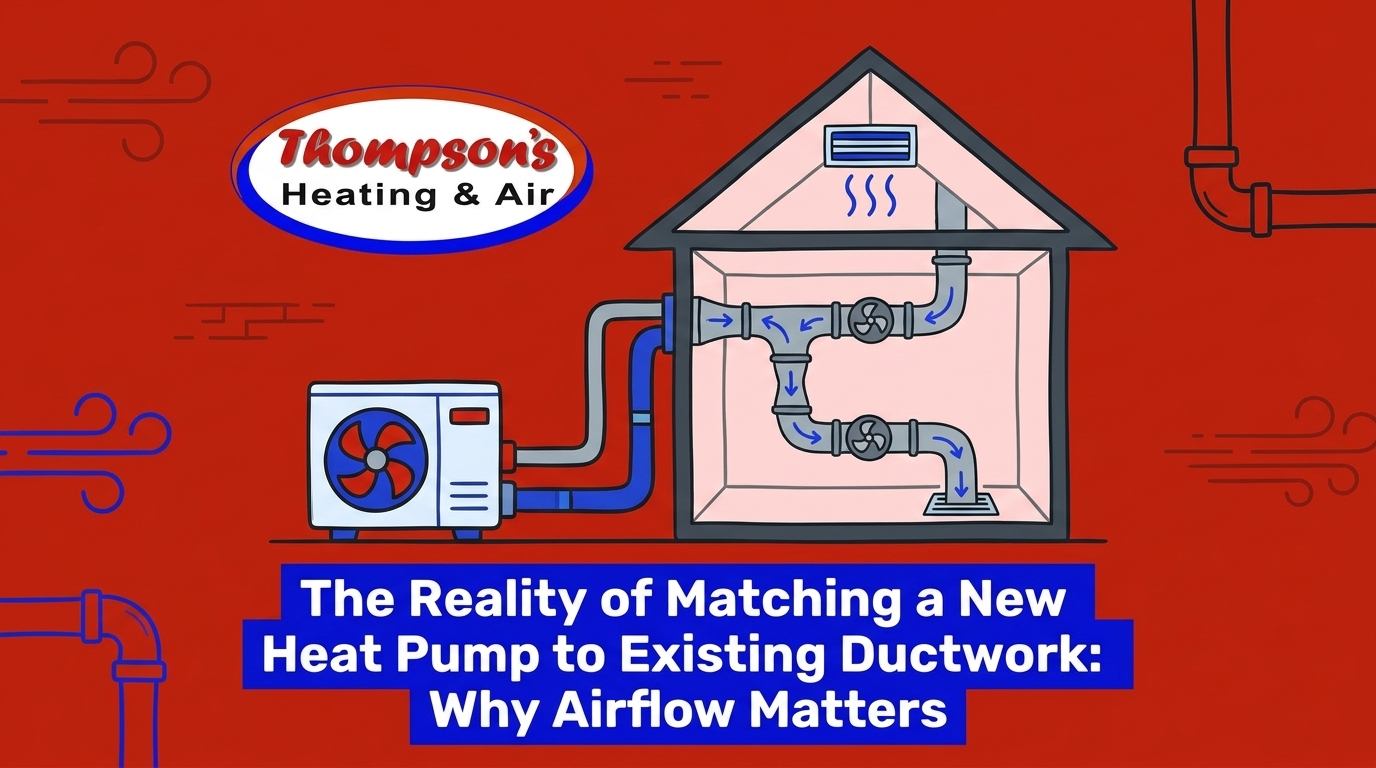
The Hidden Challenge of Upgrading Your Heating System Before Fall
Your old heating equipment is making strange noises, and you have decided it is finally time for an upgrade. But just as the project gets underway, a significant roadblock pauses the entire process: your HVAC contractor informs you that your home's existing ductwork is too small to handle a modern heat pump. This is the reality of matching a new heat pump to existing ductwork, and it is a hurdle that catches many homeowners off guard.
In our years of preparing Woodland CA homes for the busy September pre-heating season, our team frequently sees this scenario play out. Discovering that your home's infrastructure is incompatible with your new equipment forces a critical decision. Do you authorize the necessary ductwork modifications to support the higher airflow requirements, or do you pivot back to a traditional gas system? Making the right choice requires understanding exactly why this compatibility issue exists in the first place.
If you are exploring heat pump systems for your home, understanding these airflow requirements is the first step toward a successful heat pump installation.
Why Your Old Gas Furnace Got Away with Smaller Ducts
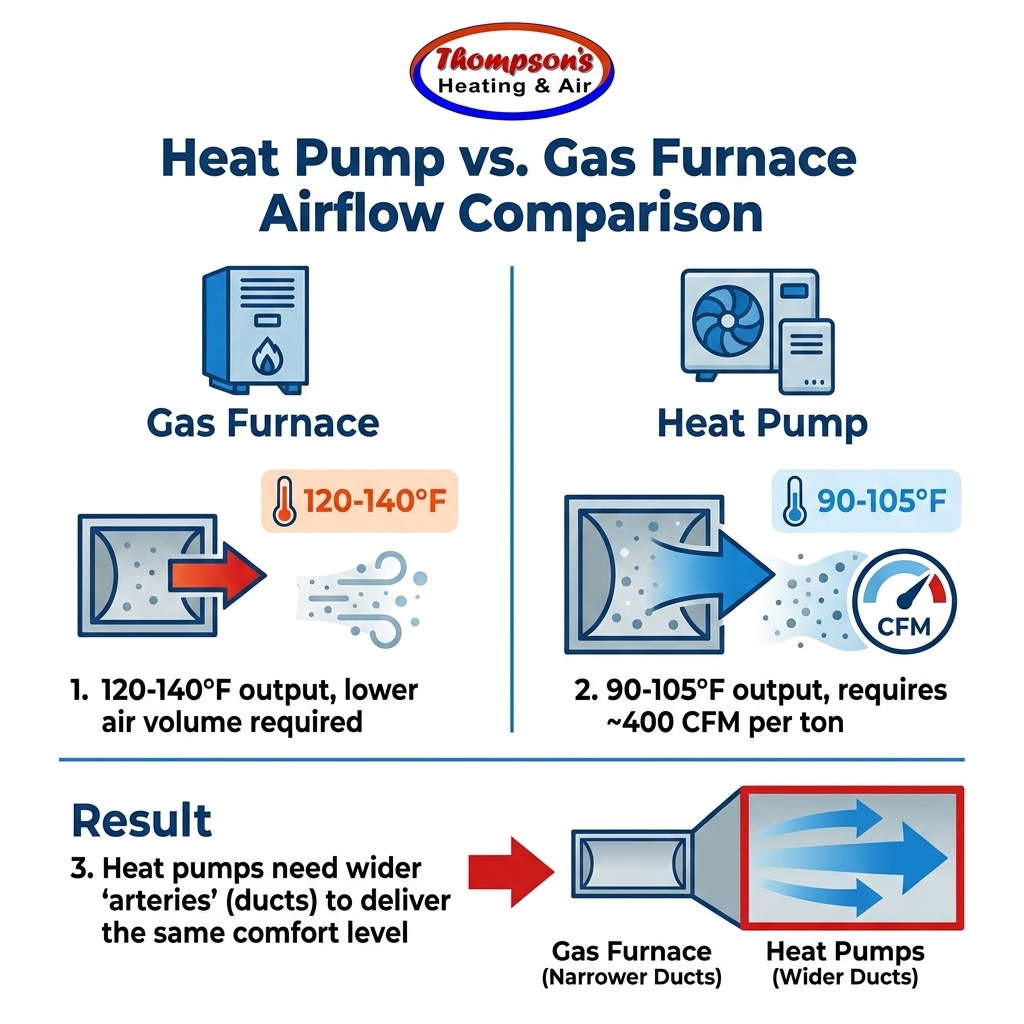
To understand why a modern heat pump struggles with older ductwork, we first need to look at how traditional heating systems operate. For decades, home construction relied on combustion heating. When a gas furnace ignites, it produces extremely high-temperature air, typically ranging between 120 and 140 degrees Fahrenheit at the supply vents.
Because the air is scorching hot, the system does not need to move a massive volume of it to effectively raise the temperature of a room. A smaller amount of very hot air can quickly satisfy the thermostat.
The Legacy of Low-Volume Infrastructure
Having crawled through countless attics in our service area, our technicians have noticed a distinct pattern: many Woodland CA homes with older gas furnaces were architecturally designed around these low-volume, high-heat blasts. The sheet metal or flexible ducts running through the attic or crawlspace were sized specifically for the minimal airflow required by combustion equipment. Builders saved space and materials by installing narrower duct trunks and smaller supply branches, knowing the intense heat of the furnace would compensate for the restricted air volume.
This historical building practice creates a distinct challenge today. When homeowners decide to pursue a gas furnace replacement, sticking with a similar combustion unit usually means the existing ducts are perfectly adequate. However, introducing dual-purpose, energy-efficient technology changes the mathematical equation of your home's airflow entirely.
• Traditional Gas Furnace — Typical Supply Temperature: 120°F - 140°F — Air Volume Requirement: Lower — Duct Size Need: Narrower / Standard
• Modern Heat Pump — Typical Supply Temperature: 90°F - 105°F — Air Volume Requirement: Significantly Higher — Duct Size Need: Wider / Expanded
Relying on this older, narrower infrastructure severely limits the effectiveness of newer technologies. The ducts that perfectly served a 1990s gas furnace act as a bottleneck for modern equipment that operates on entirely different thermodynamic principles.
The Science of Airflow: Understanding CFM Requirements
The core difference between old and new heating technology comes down to a measurement called CFM, or Cubic Feet per Minute. CFM is the standard metric used to quantify airflow volume—literally how much air the blower motor pushes through your home's ductwork every sixty seconds.
Modern heat pumps typically require around 400 CFM per ton of heating or cooling capacity to operate efficiently. This is a significantly higher cubic feet per minute (CFM) airflow requirement than a traditional furnace. Instead of blasting a room with 140-degree air for ten minutes, a heat pump delivers a steady, continuous stream of warm air—usually between 90 and 105 degrees Fahrenheit—over a longer cycle. This constant circulation of moderate heat provides exceptionally even comfort, eliminating the drastic temperature swings associated with older systems.
The Fire Hose vs. The River Analogy
Think of your old gas furnace like a high-pressure fire hose. It delivers a concentrated, intense blast of heat through a narrow opening, quickly flooding a room with warmth before shutting off. A heat pump, on the other hand, operates more like a wide, steady river. It requires a broader channel to move a larger volume of water (or air) at a more moderate, continuous pace.
If you try to force the wide river through the narrow fire hose, the pressure builds up, the flow is restricted, and the system backs up. Airflow is so critical to system performance that a lack of it is frequently misdiagnosed as total equipment failure. For example, during a recent summer, our team responded to a local homeowner who thought their air conditioning system was completely dead and prepared to purchase a whole new system. One of our technicians examined the unit and determined it only needed a minor tune-up to correct a severe airflow restriction. Once the air could move freely again, the system worked perfectly, saving the customer from an unnecessary replacement. That same principle applies to proper duct sizing: without enough room to breathe, the system cannot function.
What Happens When You Connect a Modern Heat Pump to Undersized Ducts?
We have replaced far too many burnt-out blower motors to ignore the reality of matching a new heat pump to existing ductwork. When you force a high-volume system to breathe through narrow channels, the immediate result is a drastic increase in static pressure. High static pressure acts exactly like a clogged artery, forcing the system's "heart" (the blower motor and compressor) to work exponentially harder just to survive.
Failing to modify incompatible ductwork leads to a cascade of negative consequences:
1. Excessive Noise at the Vents: When a high volume of air is forced through a small opening, velocity increases dramatically. This results in loud rushing, whistling, or roaring noises every time the system turns on.
2. Uneven Temperatures: Because the system cannot push enough air to the furthest reaches of the house, rooms closest to the indoor unit may feel comfortable, while distant bedrooms remain stubbornly hot or cold.
3. Premature Equipment Failure: Constantly straining against high static pressure causes the blower motor to overheat and the compressor to overwork. What should be a long-lasting investment can suffer catastrophic failure years before its time.
4. The Summer Cooling Risk: Undersized ducts will not only struggle in winter but will completely fail to deliver the necessary cooling power during intense Sacramento Valley summer heatwaves. Restricted airflow prevents enough warm indoor air from passing over the indoor evaporator coil, causing the coil to freeze solid in the middle of summer.
Because heat pumps are designed to operate year-round, our installers ensure these higher cubic feet per minute (CFM) airflow requirements are met to protect the system during both the heating and cooling seasons.
The Importance of a Comprehensive Duct Assessment
Because the consequences of high static pressure are so severe, a professional evaluation of your ductwork is mandatory before any installation begins. A simple visual inspection—glancing into the attic and guessing the duct size—is never enough. Proper evaluation requires accurate static pressure testing using specialized diagnostic tools to measure exactly how much resistance exists in your current setup.
Following ACCA Manual D Standards
Proper duct sizing is governed by strict industry guidelines known as ACCA Manual D standards. These engineering calculations take into account the size of your home, the friction rate of your duct materials, the number of elbows and turns in the layout, and the specific CFM requirements of the new equipment.
Unfortunately, we see this happen frequently in the HVAC industry: many contractors skip these vital assessments entirely to keep their initial bids artificially low. They will gladly connect a high-efficiency heat pump to undersized 1980s ductwork, leaving the homeowner to deal with the noise, poor performance, and eventual breakdowns.
At Thompson's Heating & Air, we refuse to install mismatched systems just to win a cheap bid. Our commitment to proper sizing is rooted in a dedication to reliable comfort. For example, during a recent stretch of three days of 100+ degree weather, our owner personally came out to fix a failing AC unit immediately for a customer, despite a severe scheduling conflict. We bring that same uncompromising standard to our installations. We view a comprehensive duct assessment not as an optional upgrade, but as a mandatory requirement for system integrity and long-term comfort in Woodland CA homes with older gas furnaces. This thorough approach is exactly why your neighbors are switching to heat pumps in the Sacramento Valley with confidence.
Solutions for Incompatible Ductwork
When our team performs a static pressure test and reveals that your existing ducts are too small, there is no need to panic. Undersized ducts do not mean a heat pump is impossible; it simply means the infrastructure needs to be adapted to handle the new technology.
Addressing these issues during the September pre-heating season ensures your home is fully prepared before the cold weather sets in. In our experience, the solutions are often highly targeted and do not necessarily require ripping out every pipe in your walls.
Targeted Modifications for Better Airflow
The most common restriction point in an older HVAC system is the return air side—the pathways that pull air from your home back into the equipment. If the system cannot pull enough air in, it cannot push enough air out.
• Increasing the Return Air Drop: The large metal duct connecting the return trunk to the bottom of the air handler is often expanded to allow a greater volume of air to enter the equipment smoothly.
• Adding Larger Return Grilles: Installing larger or additional return air grilles in central hallways or master bedrooms dramatically reduces static pressure and eliminates whistling noises.
• Duct Sealing and Insulation: If your ducts are slightly undersized, losing 20% of your airflow to leaks in the attic is devastating. Professional sealing and proper insulation maximize the efficiency of the existing layout, ensuring every cubic foot of air makes it to your living space.
Finally, we always tell our customers that addressing ductwork presents a prime opportunity to upgrade your home's health. While the system is being modified for better airflow, it is the perfect time to integrate advanced indoor air quality solutions, such as high-efficiency media cabinets or air purifiers, which also require properly sized ducts to function without restricting the system.
Frequently Asked Questions
Can you use existing ductwork for a heat pump?
Yes, you can often use existing ductwork for a heat pump, provided it meets the necessary airflow requirements. However, because heat pumps push a higher volume of air than traditional furnaces, the existing ducts must be tested for static pressure. If the ducts are too narrow, targeted modifications will be required to prevent system damage and ensure proper comfort.
Do heat pumps require larger ducts?
In many cases, heat pumps do require larger ducts than older gas furnaces. Gas furnaces deliver small amounts of very hot air, while heat pumps deliver large volumes of moderate-temperature air. This increased volume (measured in CFM) requires wider duct trunks and larger return drops to move the air without creating severe static pressure.
How do I know if my ducts are big enough for a heat pump?
The only way to know if your ducts are big enough is through professional static pressure testing. A technician will measure the resistance in your current ductwork and compare it against the ACCA Manual D requirements for the specific heat pump you want to install. Visual inspections alone cannot accurately determine duct capacity.
Can I put a heat pump on an old furnace?
You can pair a heat pump with an existing gas furnace in a dual-fuel configuration, but the ductwork must still support the heat pump's airflow needs. When the heat pump operates during mild weather, it will rely on the existing blower motor and duct layout. If the ducts are too small, the heat pump will struggle to perform efficiently, even if the furnace is left in place.
Why does my heat pump need more airflow than my furnace?
A heat pump needs more airflow because it operates at a lower supply temperature (typically 90-105°F) compared to a gas furnace (120-140°F). To deliver the same amount of total heating power to your home, the system must move a significantly larger volume of this moderately warm air over a longer, continuous cycle.
How does static pressure affect heat pump efficiency?
High static pressure severely degrades heat pump efficiency by forcing the blower motor to work harder to push air through restricted ducts. This increased strain draws more electricity, drives up utility bills, and prevents the system from properly conditioning the home. Over time, excessive static pressure leads to premature wear on the compressor and blower motor.
Making the Right Call for Your Home's Comfort
The reality of matching a new heat pump to existing ductwork is that airflow dictates performance. By acknowledging these higher volume requirements and authorizing the necessary modifications with a trusted local team, you protect your investment from premature failure. We've seen firsthand how a clear understanding of these airflow differences validates why proper duct sizing is the foundation of a truly comfortable, efficient home.



.avif)
.avif)
.png)
