Troubleshooting a Blue Oval Wall Heater That Won't Stay Lit

Why Does My Wall Heater Pilot Light Die When I Release the Button?
Are you currently troubleshooting a blue oval wall heater that won't stay lit the moment you take your finger off the gas valve button? Here at Thompson's Heating & Air, our technicians receive countless calls about this exact issue when homeowners test their systems during the September pre-heating season. It is one of the most common—and frustrating—issues you can encounter. You follow the instructions perfectly: you turn the dial, press the button, light the pilot, and hold it down for the recommended 30 to 60 seconds. The flame burns bright and steady. But the absolute second you release the pressure on that button, the flame vanishes with a quiet click.
This specific symptom is rarely a random fluke or a sign that you are lighting the heater incorrectly. Instead, it is a clear indicator that a built-in safety mechanism is doing exactly what it was designed to do: shutting off the gas supply. When a pilot light refuses to hold on its own, it forces a critical decision point for homeowners. You must decide whether the unit just needs a professional cleaning or if a core safety component has failed entirely. Because we are dealing with combustible gas, guessing is never the right approach. If you are looking for reliable heating services to diagnose the issue safely, reaching out to a licensed professional is always the smartest first step.
Common signs that your safety mechanism has engaged:
• Immediate shutoff: The flame dies instantly upon releasing the button, not gradually.
• Audible clicking: You may hear a faint click from the gas valve when the button is released.
• Repeated failure: Holding the button for two minutes yields the same result as holding it for thirty seconds.
• No main burner ignition: The main burner will never ignite if the pilot cannot sustain itself.
Understanding the 'Why': The Role of the Thermocouple in a Vintage Blue Oval Wall Heater
To understand exactly why your pilot light is failing, we have to look closely at a small but mighty component called the thermocouple. If you are trying to find information on identifying the blue oval logo on older wall heaters, our team often sees these vintage units (frequently manufactured by Williams or a similar legacy brand) relying on a traditional millivolt standing pilot system in many of Woodland's older neighborhoods. In these systems, the thermocouple is the ultimate gatekeeper for your home's safety.
A thermocouple is a small metallic probe that sits directly in the path of the pilot flame. It is made of two dissimilar metals joined together at the tip. When the pilot flame heats this tip, the temperature difference between the metals creates a tiny electrical current—measured in millivolts. This microscopic electrical charge travels down the copper wire to a magnetic coil inside the main gas valve. As long as the electricity flows, the electromagnet stays energized, holding the gas valve open so the pilot can keep burning.
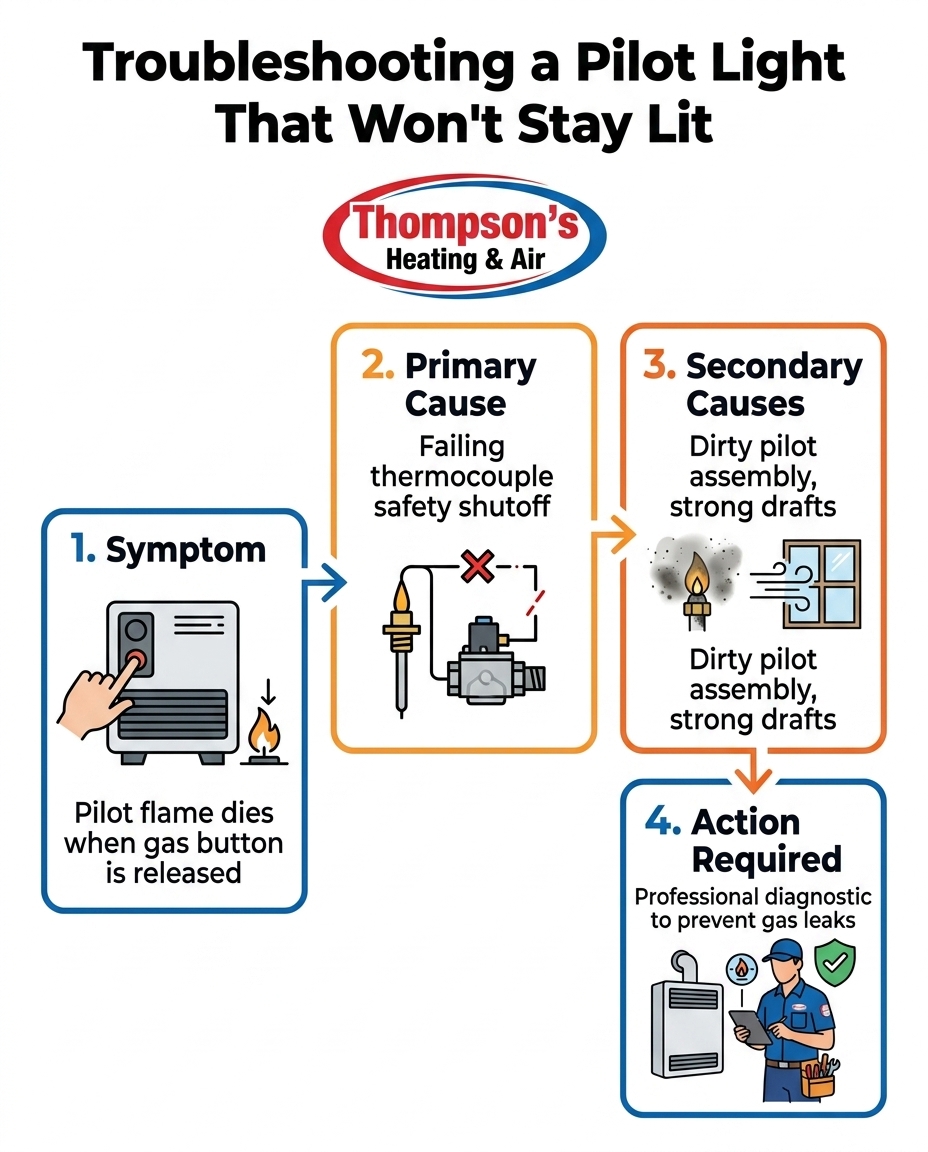
If the thermocouple degrades over time or becomes coated in severe soot, it can no longer generate that millivolt current. Without the electrical charge, the electromagnet inside the valve de-energizes instantly. A heavy spring snaps the valve shut, cutting off all gas flow. This is why the flame holds while your finger manually depresses the button (bypassing the magnet), but dies the second you let go.
How the Millivolt Safety Mechanism Protects Your Home
The automatic gas shutoff feature is a brilliant piece of engineering that protects your family from catastrophic danger. If a strong draft were to blow out the pilot light while you were asleep, the thermocouple would rapidly cool down. Within about 30 to 45 seconds, the electrical current would drop to zero, and the valve would snap shut.
If this mechanism did not exist, the gas valve would remain open, silently pumping raw, uncombusted natural gas or propane directly into your living space. This is precisely why bypassing this safety feature—or attempting to wedge the gas button down permanently—is incredibly dangerous and should never be attempted under any circumstances.
Other Potential Culprits: Dirty Pilot Assemblies and Drafts
While a failed thermocouple is the most common reason our technicians find a vintage blue oval wall heater refusing to stay lit, it is not the only possibility. Often, the thermocouple itself is perfectly fine, but the environment around it is preventing it from doing its job. This is a pattern we see often during the September pre-heating season, right after the unit has sat idle for several months.
The impact of a dirty pilot assembly: Over the spring and summer, dust, pet hair, and even small spider webs can accumulate inside the pilot tube. When you attempt to light the heater in the fall, this debris restricts the flow of gas. Instead of a sharp, strong, blue cone of flame that directly engulfs the top half-inch of the thermocouple, you get a weak, lazy, yellow flame. This yellow flame doesn't burn hot enough to generate the required millivolts, causing the safety valve to shut off just as if the flame had blown out.
Drafts and environmental factors: Older homes often have quirks with airflow. A strong draft pulling down the venting system or across the floor can constantly disrupt a weak pilot flame, cooling the thermocouple just enough to trigger a shutdown.
• Failed Thermocouple — Visual Symptom: Flame is strong and blue, but dies instantly upon button release. — Professional Solution: Testing millivolt output and replacing the component.
• Dirty Pilot Tube — Visual Symptom: Flame is weak, yellow, flickering, or split. — Professional Solution: Disassembling and clearing the pilot orifice safely.
• Draft Interference — Visual Symptom: Flame dances wildly or blows out randomly after holding. — Professional Solution: Evaluating venting, flue draft, and room airflow.
Even if the issue is just a dirty assembly, cleaning it requires specialized small tools and a deep understanding of gas line fittings. Adjusting an aging unit always requires professional care to ensure no delicate lines are cracked or disturbed during the cleaning process.
The Hidden Dangers of DIY Thermocouple Replacement
With so many video tutorials available online, it can be tempting to treat a thermocouple replacement as a quick weekend project. However, our team at Thompson's Heating & Air strongly advises against this. Handling gas infrastructure is never a DIY job, especially on aging equipment. The Consumer Product Safety Commission (CPSC) and Department of Energy (DOE) have strict guidelines regarding the maintenance of vintage gas space heaters, and for good reason.
The risks of improper installation: Threading a new thermocouple into a vintage gas valve requires exact precision. If the copper line is cross-threaded or over-tightened, it can permanently damage the soft metal threads inside the gas valve body. Worse, if the fitting is under-tightened, it can create a micro-leak that slowly fills the wall cavity with natural gas. Furthermore, if the tip of the thermocouple is positioned incorrectly—too high or too low in the flame—the safety shutoff will not trigger in the correct amount of time during a real emergency.
Because a vintage blue oval wall heater has likely outlived its original warranty and many of its initial safety components, professional handling is mandatory. A licensed technician doesn't just swap the part; they perform a comprehensive leak check, test the draft of the exhaust flue, and ensure the unit isn't producing lethal carbon monoxide. Generic online wikis cannot account for the specific wear and tear on your unique system. If your pilot won't light, skip the hardware store and schedule a proper heating repair to protect your home and family.
Honest Assessments for Historic Home Heating Systems
Woodland is celebrated for its beautiful, historic architecture. In our years of servicing properties here, we've found that many still rely on the robust, built-in heating systems that were installed decades ago. These older systems have unique characteristics and a reputation for long-term reliability, provided they are maintained correctly.
A common fear among homeowners is that a failing pilot light automatically means the entire heater is dead and requires a massive, expensive replacement. Here's the thing: that is rarely the case. A thorough professional diagnostic can often resolve these issues with a minor tune-up or a targeted part replacement, saving you from unnecessary stress.
At Thompson's Heating & Air, our commitment to honest assessments and technical education extends to every system we service. For instance, one fall, a customer reached out to us trying to understand the technical details of modern heat pump systems after finding that other HVAC vendors lacked the necessary knowledge. Our staff provided detailed, straightforward answers that gave the customer total confidence in their decision. We bring that exact same level of thorough, knowledgeable service to diagnosing vintage units in older Woodland CA homes. We prioritize your safety and comfort above all else, ensuring you get an honest evaluation of your equipment's true condition without aggressive sales tactics.
Why Early Fall Testing is Critical for Sacramento Valley Winters
The weather patterns in our region can be highly deceptive. As our local technicians know all too well, while early September days might still feel quite warm, the Sacramento Valley is notorious for sudden, chilly winter nights and unexpected cold snaps that can catch families entirely off guard. Temperatures can easily plummet into the 30s and 40s overnight once the season shifts.
Discovering a pilot light issue during a September pre-heating season test run is vastly preferable to waking up shivering in a freezing house in mid-December. By testing your wall heater early, you give yourself ample time to schedule a diagnostic without the stress of an emergency service call.
Proactive steps for the season:
• Test early: Light your pilot in September to verify the thermocouple holds the valve open.
• Listen closely: Pay attention to any odd sounds, like delayed ignition or rattling, when the main burner kicks on.
• Check the flame: Ensure the pilot flame is a crisp blue, not a lazy yellow.
Scheduling annual heating maintenance guarantees that your millivolt safety systems are fully operational and ready to handle whatever the winter weather brings to the valley.
Frequently Asked Questions About Older Wall Heaters
Why won't my blue oval heater stay lit?
The most common reason your heater won't stay lit is a failing thermocouple that has triggered the automatic safety shutoff. When this small probe stops sensing heat accurately, it cuts off the gas supply to prevent dangerous leaks into your home. A dirty pilot assembly or a strong draft can also cause the flame to drop, but a failed thermocouple is usually the primary culprit in vintage units.
Why does my wall heater pilot light go out when I let go of the button?
When you hold the button down, you are manually overriding the safety valve to allow gas to flow. Once you let go, the system relies entirely on the electrical current generated by the thermocouple to keep the valve open. If the pilot goes out immediately upon release, it means the thermocouple is not generating enough millivolts to hold the internal electromagnet open.
How do I know if my wall heater thermocouple is bad?
The primary symptom of a bad thermocouple is a pilot light that dies the exact second you release the gas valve button, even after holding it down for 30 to 60 seconds. Additionally, if the pilot flame is strong, blue, and directly engulfing the tip of the thermocouple, yet the flame still won't hold, the component has likely degraded internally and needs professional replacement.
What brand is the blue oval logo on a wall heater?
The blue oval logo is a very common vintage identifier found on older wall heaters, most frequently associated with brands like Williams. These legacy units were built to last and are frequently found in historic homes, but they require specific manufacturer safety protocols and regular inspections to ensure their aging gas valves remain safe to operate.
Is it safe to relight an old wall heater?
It is generally safe to attempt relighting an old wall heater once by carefully following the manufacturer's printed instructions. However, if the pilot refuses to hold or you smell natural gas, you must stop immediately. Repeatedly trying to force a failing system to light can lead to undetected gas leaks or severe carbon monoxide risks, requiring immediate professional diagnosis.
What causes a wall heater thermocouple to fail?
Thermocouples fail primarily due to natural degradation over time, as the constant exposure to a direct flame slowly breaks down the dissimilar metals inside the probe. Soot buildup from a dirty pilot flame can also insulate the probe, preventing it from reading the heat accurately. In vintage units, age-related wear and tear is the standard cause for this eventual failure.
Schedule a Professional Diagnostic for Your Wall Heater
A pilot light that won't stay lit is far more than just a seasonal nuisance; it is a critical safety warning from your heating system. When the thermocouple steps in to shut down the gas flow, it is actively protecting your home from potential hazards. Attempting to bypass this system or fix it without proper licensing puts your household at unnecessary risk.
Before the cold weather sets in, give yourself the satisfaction of knowing the vintage heater in your older Woodland CA home is operating safely and efficiently. Reach out to our local experts at Thompson's Heating & Air today for a thorough, honest diagnostic. We will evaluate your system, explain exactly what is happening, and ensure your home stays warm and secure all winter long.



.avif)
.avif)
.png)
