
Deciphering the PG&E Summer Tiered Rate Structure for Heavy AC Users

Surviving July Heatwaves Without the PG&E Bill Shock in Woodland CA
Your air conditioner is running nonstop to fight off the afternoon sun, but you know that every minute the compressor hums, you are inching closer to the highest utility pricing tiers. Deciphering the PG&E Summer Tiered Rate Structure for Heavy AC Users is often the most frustrating part of living in the Central Valley. When temperatures climb well past 100 degrees, shutting the system off completely simply is not a safe or realistic option. You need reliable indoor cooling, but you also need a mechanical strategy to keep your home's electrical draw in check.
In our years of keeping Woodland families comfortable, our team at Thompson's Heating & Air has learned that surviving the summer requires more than just a working unit—it requires a smart strategy. If you are looking for ways to maximize your home's cooling efficiency, our local experts install and service air conditioning systems designed to handle the heavy load.
The intense July peak heat in the Central Valley puts an incredible burden on residential HVAC equipment. In Woodland CA, a typical summer afternoon means your air conditioner is fighting an uphill battle against triple-digit heat. A pattern we see often is the central conflict for most homeowners: finding the balance between staying comfortable and triggering the most expensive time-of-use rates on their utility bill. Many people assume they simply have to suffer through the heat to save money, or pay a fortune to stay cool.
Fortunately, comfort and energy efficiency can absolutely coexist with the right mechanical strategies. By strategically scheduling your AC run times and utilizing smart pre-cooling techniques, you can minimize your energy draw during those critical peak hours. Understanding how your equipment interacts with the grid is the key to maintaining a cool, comfortable home without the dreaded end-of-the-month bill shock.
Breaking Down PG&E's Summer Peak Hours and Tiered Allowances
Understanding the utility rules is the first step in regaining control over your monthly electrical usage. The summer rate season officially runs from June 1 through September 30, which perfectly aligns with our most extreme regional weather patterns. During this window, Time-of-Use (TOU) plans heavily penalize electricity consumption during specific peak hours, typically falling between 4:00 PM and 9:00 PM or 5:00 PM and 8:00 PM depending on your exact rate schedule.
When researching PG&E summer pricing tiers AC run times, you will quickly notice that it is not just about the total volume of electricity you use, but exactly when you use it. Running a high-draw appliance like a central air conditioner during the late afternoon accelerates your transition from the standard baseline allowance into Tier 2 or higher.
• Off-Peak — Typical Timeframe: Morning to early afternoon — Impact on Utility Tier: Lowest impact; the ideal time for heavy cooling and pre-chilling the home.
• Peak Hours — Typical Timeframe: 4:00 PM to 9:00 PM — Impact on Utility Tier: Highest impact; rapidly consumes your baseline allowance and triggers higher rates.
• Tier 1 (Baseline) — Typical Timeframe: Daily allotment — Impact on Utility Tier: The standard rate applied to your baseline necessary usage for the climate zone.
• Tier 2 (Over Baseline) — Typical Timeframe: Varies based on total usage — Impact on Utility Tier: A significantly higher rate triggered the moment your baseline is exceeded.
The Difference Between Baseline and Peak Usage
The baseline allowance is a daily quantity of electricity allocated based on your specific climate zone. In the Valley, this allowance accounts for the necessity of summer cooling, but it is easily exhausted if your system runs continuously during peak windows. The compounding effect of running your air conditioner, electric oven, and clothes dryer simultaneously between 4:00 PM and 9:00 PM will drain your baseline allowance at an alarming rate.
For homeowners looking to offset some of these operational costs, exploring general energy incentives can be highly beneficial. Many local and federal programs exist to help upgrade aging, inefficient infrastructure (for instance, federal tax credits may apply to qualifying heat pump installations). We highly recommend looking into current Sacramento PG&E energy incentives to see if your home qualifies for assistance with efficiency upgrades, which can permanently lower your daily consumption. Always be sure to verify current programs with your utility provider or a tax professional.
The Mechanical Reality of Cooling a Sacramento Valley Home at 5 PM
The billing structure is only half of the equation; the physical limitations of your cooling equipment make up the rest. When ambient outside temperatures exceed 100 degrees, your air conditioning compressor has to work significantly harder to reject heat from your home into the outdoor air.
The mechanical strain: An AC unit draws more electrical amperage (measured in kilowatt-hours) to achieve the exact same cooling output during a 105-degree afternoon than it does during an 80-degree morning. The hotter it gets outside, the higher the head pressure inside the outdoor compressor. This physical resistance means the system demands more electricity just to keep the fan blades turning and the refrigerant pumping through the lines.
The compounding problem: A struggling system not only fails to cool the home effectively, but it also rapidly consumes your daily baseline allowance right when electricity is most heavily penalized. The unit runs continuously, pulling maximum amperage, yet the indoor temperature barely drops.
The solution: Ensuring your system is mechanically sound and properly sized for Woodland CA and surrounding Valley communities is non-negotiable. Based on our extensive experience handling climate-specific cooling, our technicians at Thompson's Heating & Air understand the precise mechanical intersection between PG&E's billing structure and the physical realities of our extreme summer heat. We know exactly how hard these systems work under pressure and how to optimize them to draw less power.
Just last summer, our team saw this mechanical reality firsthand when a Woodland homeowner's AC failed completely due to the extreme heat load during a brutal stretch of 100-plus degree weather. Despite a scheduling mix-up with the address initially, our owner personally came out to fix the AC unit right away, even though the board was fully booked. The system was fixed promptly, restoring cooling before the house became dangerously hot.
When your system is fighting this kind of uphill battle against the afternoon sun, you need reliable Woodland CA HVAC services to ensure it is operating at peak mechanical efficiency.
Mastering the Pre-Cooling Strategy for Our Local Dry Heat
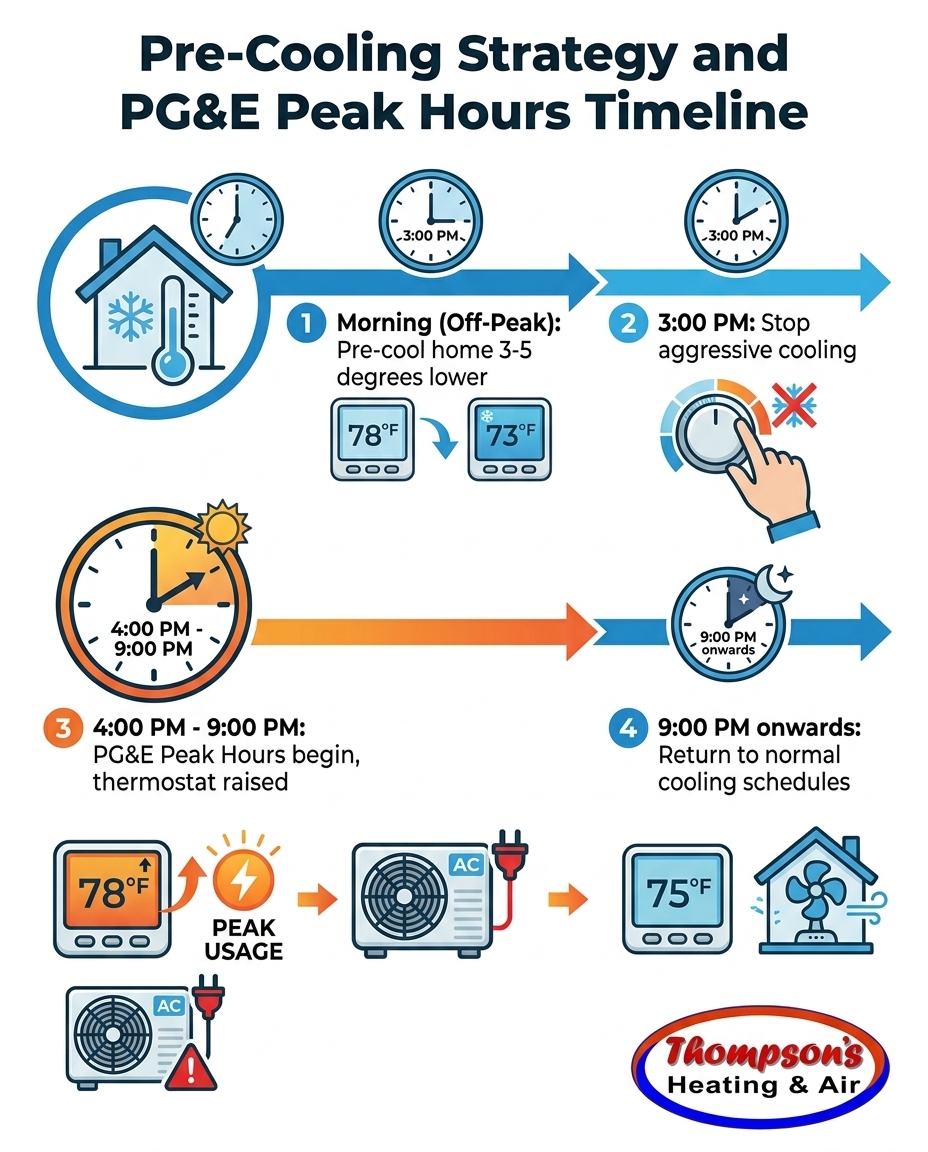
One of the most effective ways to manage your electrical consumption during July peak heat in the Central Valley is a technique known as pre-cooling. This strategy involves dropping your home's internal temperature significantly during the off-peak morning hours so you can coast through the expensive late afternoon without the compressor running continuously.
Because the Sacramento Valley experiences a distinct dry heat, our homes can hold onto morning coolness much better than houses in humid, sticky climates. This dry heat advantage allows you to build a "thermal battery" within your walls, furniture, and flooring. By chilling the physical mass of your home, you delay how quickly the indoor air heats up later in the day.
Here is the step-by-step method we recommend to our customers for pre-cooling your home effectively:
1. Start early in the day: Begin your aggressive cooling cycle around 8:00 AM when outside temperatures are still relatively low and electricity is billed at off-peak rates.
2. Drop the thermostat: Set your thermostat 3 to 5 degrees lower than your normal preferred temperature. If you usually like it at 75 degrees, drop it to 70 or 71 degrees.
3. Build the thermal battery: Allow the air conditioner to run consistently through the late morning and early afternoon. The compressor draws far less amperage because the outside air is cooler, making this highly efficient.
4. Raise the temperature before peak hours: Right before the 4:00 PM or 5:00 PM TOU window begins, adjust your thermostat up to 78 or 79 degrees.
5. Coast through the evening: Because your walls and furniture are thoroughly chilled, the house will slowly warm up over several hours. Your AC compressor will cycle on rarely, if at all, during the most penalized billing hours.
Why Routine Maintenance is Your Best Defense Against High Kilowatt Draw
The physical condition of your cooling equipment is directly tied to your electrical consumption. During our routine summer service calls, our technicians frequently notice that many homeowners in Woodland CA and surrounding Valley communities do not realize that a neglected air conditioner is a massive liability for their utility bill, regardless of how carefully they schedule their thermostat.
When condenser coils are caked in dust or air filters are clogged with pet hair, the system's internal airflow is restricted. This restriction forces the blower motor and the outdoor compressor to work overtime just to move a basic volume of air. This mechanical inefficiency directly translates to higher kilowatt-hour consumption. Proactive tune-ups keep the system's electrical draw as low as possible, which is a critical factor in staying within your lower baseline tiers.
Catching poor performance before a heatwave hits is the smartest way to prevent emergency breakdowns during periods of peak stress. If you want to keep your energy draw lean and your home comfortable, scheduling routine AC maintenance is the most reliable path forward.
The Hidden Electrical Cost of Neglected Equipment
• Restricted airflow: A clogged filter forces the indoor blower motor to pull more amperage just to move the same volume of air through your vents. Over hundreds of hours a month, this minor increase in electrical draw adds up significantly.
• Improper refrigerant charge: If your system is low on refrigerant, it cannot absorb heat effectively. This leads to extended cooling cycle times. Instead of running for 15 minutes and shutting off, the unit runs for 45 minutes, drawing electricity the entire time.
• Dirty outdoor coils: The outdoor unit needs to release heat into the outside air. If the metal fins are covered in dirt and debris, the heat remains trapped, forcing the compressor to run hotter, work harder, and draw far more power.
When to Consider High-Efficiency Upgrades for Long-Term Relief
There comes a point where aging equipment simply cannot operate efficiently enough to avoid high TOU tiers, regardless of how well you schedule your cooling or maintain the system. Older, single-stage air conditioners have one speed: full blast. Every time they turn on, they draw a massive surge of electricity to start the compressor, and they continue to pull high amperage until the cycle finishes.
If you are constantly researching PG&E summer pricing tiers AC run times and still struggling to keep your usage down, it might be time to look at modern alternatives. Today's variable-speed technology operates entirely differently. Instead of turning on at 100 percent capacity, a variable-speed compressor can run at 30 or 40 percent capacity, drawing a fraction of the electricity while maintaining steady, consistent cooling.
These energy-efficient alternatives can dramatically lower your peak hour consumption. Upgrading before a predicted record high causes a complete system failure gives you the advantage of choosing the right system without the pressure of an emergency replacement.
A local customer recently called our team when their aging system broke down right as a record high temperature was predicted for the Valley. We were able to send a technician out the same day to address the issue promptly, ensuring their home remained safe during the dangerous heat wave. Upgrading on your own terms prevents these stressful situations.
If you are tired of battling high utility usage with outdated equipment, exploring energy-efficient heat pumps or modern variable-speed air conditioners is a smart long-term strategy for consistent relief. A high-efficiency system is the ultimate defense against rising summer utility costs.
Frequently Asked Questions About Summer Cooling and Utility Rates
What are PG&E peak hours in summer?
PG&E summer peak hours generally run from 4:00 PM to 9:00 PM or 5:00 PM to 8:00 PM, depending on your specific Time-of-Use plan. During these late afternoon and evening windows, electricity is billed at a significantly higher rate. Avoiding heavy appliance usage during these hours is the most effective way to manage your overall utility costs and stay within your baseline allowance.
How can I lower my PG&E bill with AC?
Lowering your utility costs while running the AC requires a combination of smart scheduling and routine mechanical maintenance. We always recommend pre-cooling your home during the cheaper morning hours, which allows you to raise the thermostat during the expensive afternoon peak. Additionally, keeping your filters clean and scheduling annual tune-ups ensures the unit draws the least amount of electrical amperage possible.
Is it cheaper to leave AC on all day or turn it off?
It is generally more efficient to use a programmable thermostat to adjust temperatures rather than turning the system completely off. If you turn the AC off all day, the home's structure bakes in the heat, forcing the system to run continuously at maximum capacity to catch up when you turn it back on. Our team advises setting the thermostat 5 to 7 degrees higher when you are away to prevent this massive thermal buildup while still conserving energy.
What is the PG&E Time of Use rate?
A Time-of-Use (TOU) rate is a billing structure where the cost of electricity changes based on the time of day it is consumed. Electricity is less expensive during off-peak hours, like mornings and late nights, when overall grid demand is low. Conversely, rates increase during the late afternoon and evening when demand spikes, encouraging homeowners to shift their heavy usage to different parts of the day.
How to pre-cool house for PG&E peak hours?
To pre-cool your house, drop your thermostat 3 to 5 degrees below your normal comfort level starting in the early morning. Allow the AC to run during these off-peak hours to thoroughly chill the walls, floors, and furniture. Right before peak hours begin at 4:00 PM, raise the thermostat to 78 or 79 degrees so the system stays off while the house slowly warms up.
Why does my AC draw more power during the late afternoon in Woodland?
Your AC draws more power in the late afternoon because the ambient outside temperature is at its highest, often exceeding 100 degrees. The hotter it is outside, the harder the compressor has to work to push heat out of your home. This increased mechanical resistance causes the system to pull more electrical amperage to achieve the exact same amount of cooling it does in the morning.
Take Control of Your Summer Comfort
Surviving the Central Valley heat shouldn't mean sacrificing your budget. By understanding how your equipment operates under pressure and timing your usage to avoid peak utility windows, you can stay cool all season long. If you are ready to implement a reliable strategy, schedule your routine AC maintenance with our experienced team to ensure your system is running as efficiently as possible.



.avif)
.avif)
.png)
