
Standard Fiberglass Filters vs. Pleated Alternatives for Fall Dust Control

The Filter Aisle Myth: Is Thicker Always Better for Your HVAC?
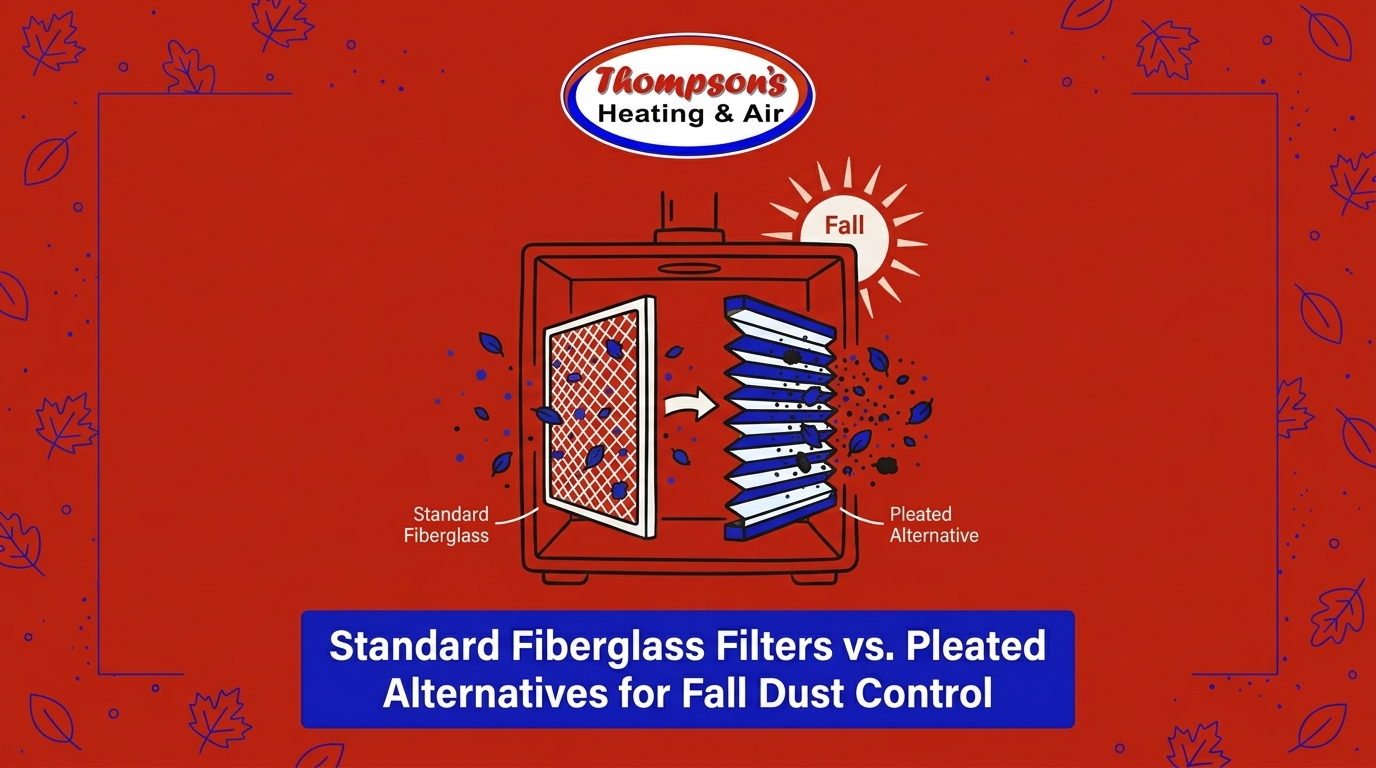
Deciding between standard fiberglass filters vs. pleated alternatives for fall dust control often comes down to a common myth: that a thicker, more expensive filter is automatically the best choice for your HVAC system. At Thompson's Heating & Air, we see this decision paralysis firsthand when talking to homeowners during our September pre-heating season tune-ups. Faced with dozens of ratings, materials, and marketing claims in the hardware store filter aisle, the natural instinct is to grab the filter that promises to trap the highest percentage of microscopic particles. However, choosing a filter based solely on its capture rate ignores a critical piece of the puzzle: your HVAC system's mechanical limits.
The central conflict in filter selection is balancing the need to capture fine particulates against the risk of suffocating your HVAC blower motor. A filter that traps everything will inevitably restrict the air trying to pass through it. For comprehensive guidance on balancing system airflow with clean breathing, explore our resources on Indoor Air Quality or reach out to our team for professional air filtration services.
Understanding the mechanical impacts of different filter materials is essential for protecting both your respiratory comfort and your equipment. Instead of relying on the highest rating on the box, homeowners need to evaluate how specific materials interact with their unique environmental challenges and system capabilities.
Understanding the Unique Threat of Heavy Agricultural Dust
The dry, dusty falls in the Sacramento Valley and Woodland area are significantly exacerbated by agricultural harvest, making effective filtration a mechanical necessity rather than just a luxury. Our team at Thompson's Heating & Air has spent years servicing systems in this unique micro-environment, where heavy harvest dust mixes with seasonal weather patterns, creating an intense load on residential HVAC equipment. Consulting with Woodland indoor air quality experts can help you navigate these specific environmental challenges effectively.
The Impact of Peak Harvest Activities
Regional agricultural activities drastically increase the volume of airborne silica, organic matter, and topsoil. Unlike standard household dust—which largely consists of dead skin cells, pet dander, and fabric fibers—agricultural dust is heavier, denser, and far more abrasive. We frequently pull filters out of local systems that are completely caked due to these factors:
• Increased airborne organic matter: Combine harvesters, tractors, and processing equipment kick up massive plumes of soil and plant material that drift into residential neighborhoods.
• Accelerated filter loading: Because harvest dust is so dense, it coats and clogs HVAC filter media at an astonishing rate, blinding the filter much faster than typical indoor contaminants.
• Compounding environmental factors: During early autumn, this heavy agricultural dust often mixes with potential wildfire smoke, creating a highly complex particulate load that demands a strategic filtration approach.
Why Standard Guidelines Fall Short
Generic filter maintenance advice rarely applies to the Woodland agricultural surroundings during the peak of fall.
• Inadequate 90-day cycles: The standard recommendation to change your HVAC filter every three months is completely inadequate for heavy particulate loads. During harvest season, we routinely see filters become dangerously compacted in just three to four weeks.
• Adapting maintenance schedules: Homeowners must adapt their maintenance schedules to the environmental realities outside their doors. Waiting for a calendar reminder rather than checking the physical condition of the filter often leads to severe system strain.
Standard Fiberglass Filters: The Low-Resistance Baseline
Basic spun fiberglass filters are the most ubiquitous option on the market. Often identifiable by their blue or green webbed appearance and flimsy cardboard frames, these filters are designed for one primary purpose: protecting the furnace equipment from large debris.
Maximum Airflow Protection
The defining characteristic of a standard fiberglass filter is its incredibly low resistance to airflow. The loosely spun glass fibers create large gaps that allow air to pass through with almost zero friction.
• Ideal for older systems: Older HVAC units, or systems with undersized ductwork, are highly sensitive to static pressure. Fiberglass filters ensure that the blower motor does not have to struggle to pull air from the return registers.
• Preventing system overheating: By allowing maximum airflow, these filters prevent the furnace heat exchanger from overheating and keep the air conditioning coils from freezing over due to lack of air circulation.
Vulnerabilities Against Fine Particulates
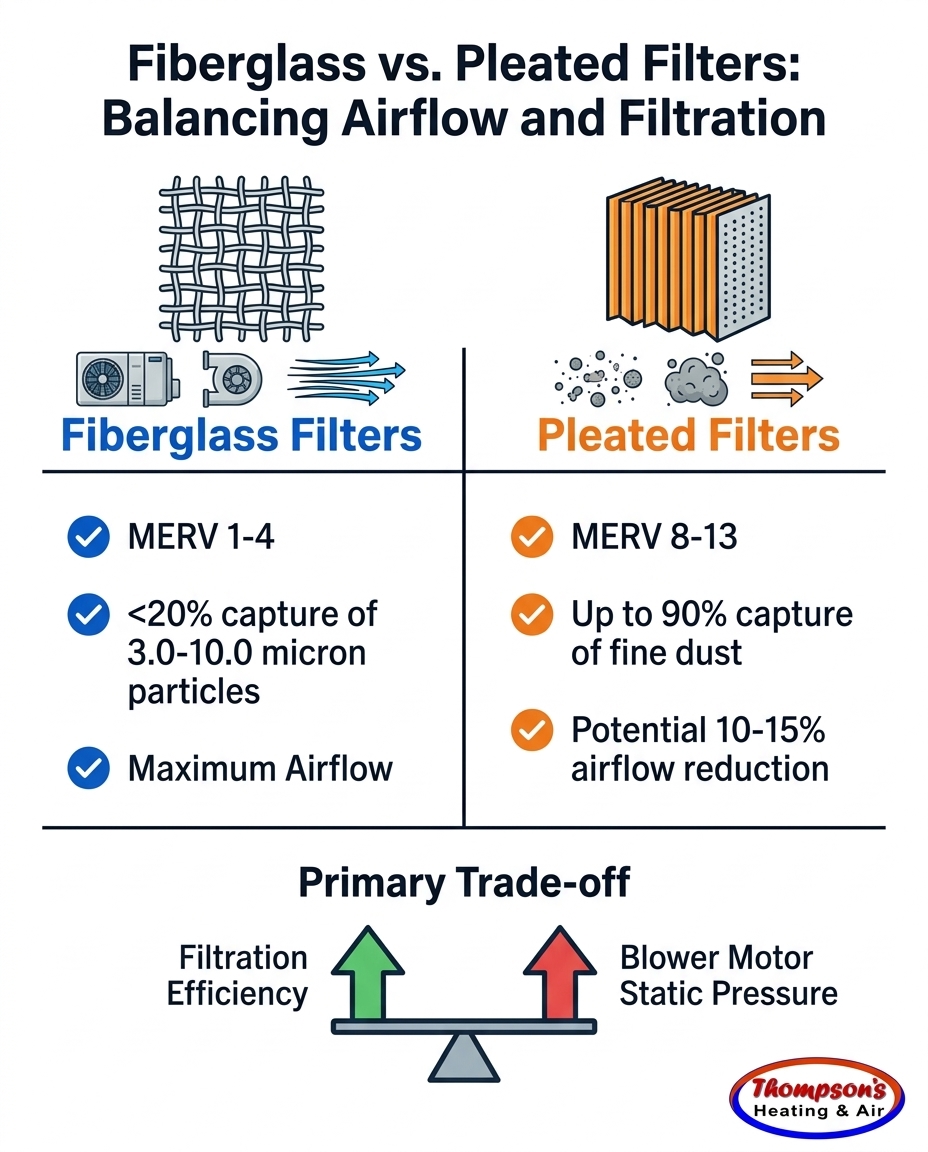
The massive downside to this low-resistance design is poor filtration efficiency. Standard fiberglass filters typically offer a MERV 1 to MERV 4 rating, meaning they capture less than 20% of particles between 3.0 and 10.0 microns.
• Ineffective against agricultural silt: The fine silica dust kicked up during the September harvest season slips right through the large gaps in spun fiberglass.
• Poor respiratory protection: While these filters keep dog hair and large dust bunnies out of your blower motor, they do almost nothing to improve human respiratory health. Microscopic contaminants, pollen, and smoke particles are allowed to circulate freely through the living space.
• Rapid overwhelming: Even though they let fine dust pass, the sheer volume of large debris during peak airborne particulate events can still overwhelm a fiberglass filter, causing the weak cardboard frame to buckle under pressure.
Pleated Alternatives: Superior Filtration with a Catch
Pleated filters represent a significant step up in air quality management. Made from dense synthetic materials like polyester or cotton blends, these filters are designed to capture a much wider spectrum of airborne contaminants. If you are researching the best air filter for your home, pleated options are likely at the top of your list—but they require careful consideration.
Capturing Microscopic Contaminants
The defining feature of a pleated filter is its accordion-style folds. This design drastically increases the surface area of the filter media without increasing the size of the cardboard frame. Because there is more material for the air to pass through, the synthetic fibers can be woven much tighter.
• Effective trapping of fine particles: Pleated filters can capture up to 90% of fine dust particles, effectively trapping pollen, fine agricultural silt, and even smoke particles depending on their specific rating.
• Significant indoor comfort improvements: Upgrading from a basic fiberglass filter to a pleated alternative offers noticeable improvements for indoor respiratory comfort, significantly reducing the amount of dust that settles on furniture and circulates in the air you breathe.
The Mechanics of Airflow Restriction
The catch to this superior filtration is the mechanical resistance it creates. The same dense synthetic fibers that trap microscopic dust also make it harder for air to push through the filter.
• Forcing the blower motor to work harder: When you jump from a MERV 8 vs MERV 13 pleated filter, the weave becomes incredibly tight. This dense media creates resistance against the blower motor, forcing it to consume more energy to move the same volume of air.
• The 10-15% airflow drop: High-efficiency pleated filters can reduce system airflow by 10% to 15% if the system isn't specifically rated for them.
• Filter depth matters: The relationship between filter depth and airflow capacity is critical. A standard 1-inch thick pleated filter with a high MERV rating restricts air far more than a 4-inch or 5-inch thick pleated filter, because the deeper filter has exponentially more surface area to distribute the air pressure.
Static Pressure and Your Blower Motor: The Hidden Danger
Understanding static pressure is the key to mastering HVAC maintenance. In simple terms, static pressure is the resistance your system must overcome to push and pull air through the ductwork and filters. Our core philosophy at Thompson's Heating & Air centers on educating homeowners that filter choice isn't just about breathing easier—it's about protecting the lifespan and efficiency of your expensive HVAC equipment from unnecessary strain.
Recognizing Signs of System Strain
When you install a filter that is too dense for your specific blower motor, the static pressure spikes. The system begins to suffocate, unable to pull enough return air to satisfy the thermostat.
• Unusual noises: A suffocating system often produces strange noises from the blower compartment, such as a high-pitched whistling sound as air tries to squeeze past the dense filter media, or a deep humming from a struggling motor.
• Weak airflow: You may notice weak airflow at the supply registers in your rooms, despite the system running constantly to try and reach the target temperature.
• Short-cycling: The equipment may turn on and off rapidly. A furnace will shut down if its internal heat exchanger gets too hot from lack of airflow, while an air conditioner's evaporator coil will freeze solid into a block of ice.
Long-Term Consequences for HVAC Efficiency
Severe airflow restriction mimics total system failure, often leading homeowners to panic. In fact, a pattern we see often during early fall tune-ups involves homeowners convinced their system is completely dead. Just last season, one of our Woodland customers reached out believing they needed a full replacement. After a thorough examination, our technicians at Thompson's Heating & Air discovered the system was simply suffocating under severe airflow restriction from a mismatched, overly dense filter. By correcting the airflow issue and performing a minor tune-up, we restored the system—ultimately extending its functional life by nine years.
• Increased energy consumption: As the motor works harder to overcome a dense MERV 8 vs MERV 13 filter, it draws more electricity, driving up monthly utility bills.
• Premature wear and tear: Continuous operation under high static pressure causes the blower motor to overheat and degrade, leading to costly premature repairs or complete motor failure. Emphasizing the importance of matching filter density to your specific blower motor's capabilities cannot be overstated.
Side-by-Side Comparison: Evaluating Performance Under Heavy Dust
To make an informed decision for your Woodland agricultural surroundings, it helps to see exactly how these two materials stack up against the specific challenges of the fall season.
• Filtration Efficiency (Ag Dust) — Standard Fiberglass Filters: Poor. Captures less than 20% of fine particulates; allows silt to pass. — Pleated Alternatives (MERV 8-13): Excellent. Captures up to 90% of fine dust, pollen, and airborne organic matter.
• Impact on System Airflow — Standard Fiberglass Filters: Minimal. Creates almost zero static pressure; very safe for older motors. — Pleated Alternatives (MERV 8-13): Moderate to High. Can reduce airflow by 10-15% depending on MERV rating and filter depth.
• Replacement Frequency (Fall) — Standard Fiberglass Filters: Every 30 days. Frame can buckle if overloaded with heavy debris. — Pleated Alternatives (MERV 8-13): Every 30-45 days during peak harvest to prevent severe airflow restriction.
• Ideal Use-Case Scenario — Standard Fiberglass Filters: Older systems with weak blowers, or homes prioritizing airflow over IAQ. — Pleated Alternatives (MERV 8-13): Homes needing respiratory relief from harvest dust, provided the system can handle the pressure.
Finding the Sweet Spot: Recommendations for Optimal Balance
Choosing the right filter requires finding the middle ground. Based on our years of experience optimizing indoor air quality in Woodland, we've found you need a filter strong enough to handle fall agricultural dust, but porous enough to keep your HVAC system breathing easily. For many residential systems, our team recommends achieving this balance by carefully navigating the MERV rating scale and maintaining a proactive HVAC maintenance plan.
Navigating the Rating Scale Safely
1. Target the middle ground: A mid-range pleated filter, typically rated around MERV 8, often provides the best compromise. It is dense enough to capture the majority of irritating harvest dust and pollen, but not so restrictive that it immediately suffocates a standard blower motor.
2. Understand the MERV 13 risk: When evaluating MERV 8 vs MERV 13, remember that pushing past MERV 10 often requires system modifications. A standard 1-inch thick MERV 13 filter is incredibly dense and poses a high risk of freezing your coils or overheating your furnace if your ductwork isn't optimized for it.
3. Consider a media cabinet upgrade: If your family requires high-efficiency filtration for respiratory health, we advise upgrading to a wider filter housing. A 4-inch or 5-inch thick media cabinet can safely accommodate high MERV ratings because the deep pleats provide vastly more surface area, dropping the static pressure back down to safe levels.
4. Check your system manual: Always review your HVAC system's manual for maximum static pressure ratings before experimenting with high-efficiency filters.
5. Schedule a professional evaluation: If your system seems to struggle, short-cycle, or produce weak airflow even with standard pleated filters, reach out to us for a professional evaluation to measure your ductwork's static pressure.
Frequently Asked Questions About Fall Filter Choices
Are pleated filters bad for my HVAC blower motor?
Pleated filters are not inherently bad for your blower motor, provided they are matched to your system's capabilities. A standard MERV 8 pleated filter works perfectly in most modern HVAC systems. However, problems arise when homeowners install highly restrictive, high-MERV pleated filters in older systems or systems with undersized ductwork, which spikes static pressure and strains the motor.
Do fiberglass filters actually do anything to improve air quality?
Fiberglass filters do very little to improve indoor air quality for human breathing. Their primary function is mechanical protection—keeping large debris, hair, and massive dust bunnies out of the furnace's internal components. Because they typically capture less than 20% of fine particles, microscopic agricultural dust and pollen will pass right through them and circulate into your living space.
Should I use fiberglass or pleated filters for heavy agricultural dust?
For heavy agricultural dust during the September harvest season, a pleated filter is highly recommended to keep the fine silt out of your home's air. A MERV 8 pleated filter strikes the best balance, capturing the majority of the irritating organic matter without severely choking the system. If you use fiberglass during this time, you will likely notice a rapid accumulation of fine dust on your furniture and in your airways.
What MERV rating is safe for most residential HVAC systems?
A rating between MERV 5 and MERV 8 is generally considered safe for the vast majority of standard residential HVAC systems using 1-inch filter slots. This range provides a noticeable upgrade in air quality over fiberglass while keeping static pressure within acceptable limits. Ratings of MERV 11 or higher in a 1-inch slot should be approached with caution and ideally verified by an HVAC technician.
Does a pleated filter restrict airflow enough to cause system damage?
Yes, if the filter is too dense for the system, it can absolutely cause damage. Severe airflow restriction forces the blower motor to overheat and can cause the air conditioning evaporator coil to freeze solid. Over time, running a system with a highly restrictive filter will dramatically shorten the lifespan of the blower motor and increase energy consumption.
How often should I change my filter during the fall harvest season?
During peak agricultural activity, you should physically inspect your filter every 30 days, regardless of the manufacturer's suggested lifespan. The sheer volume of airborne dirt and organic matter can completely blind a standard 1-inch pleated filter in just a few weeks. Do not rely on a 90-day calendar reminder when heavy environmental dust is present.
Protect Your Equipment and Your Air Quality This Fall
Evaluating standard fiberglass filters vs. pleated alternatives for fall dust control reveals that the right choice is always a balancing act. Our team at Thompson's Heating & Air knows you need to protect your family's lungs from the heavy particulate matter native to the Woodland agricultural surroundings, but you must also protect your HVAC system's lifespan from the dangers of high static pressure. By understanding the mechanical differences between these materials, you can make an informed choice that keeps your home comfortable and your equipment running smoothly.
If you are unsure about your system's static pressure limits, or if you want to explore advanced filtration solutions like a 4-inch media cabinet to safely handle high-efficiency filters, professional guidance is the safest route. Secure a pre-season system check with us today to ensure your ductwork and blower motor are fully prepared to handle whatever the fall harvest season kicks up.



.avif)
.avif)
.png)
