Why We Inspect the Flue Pipe Pitch During Every Heating Tune-Up

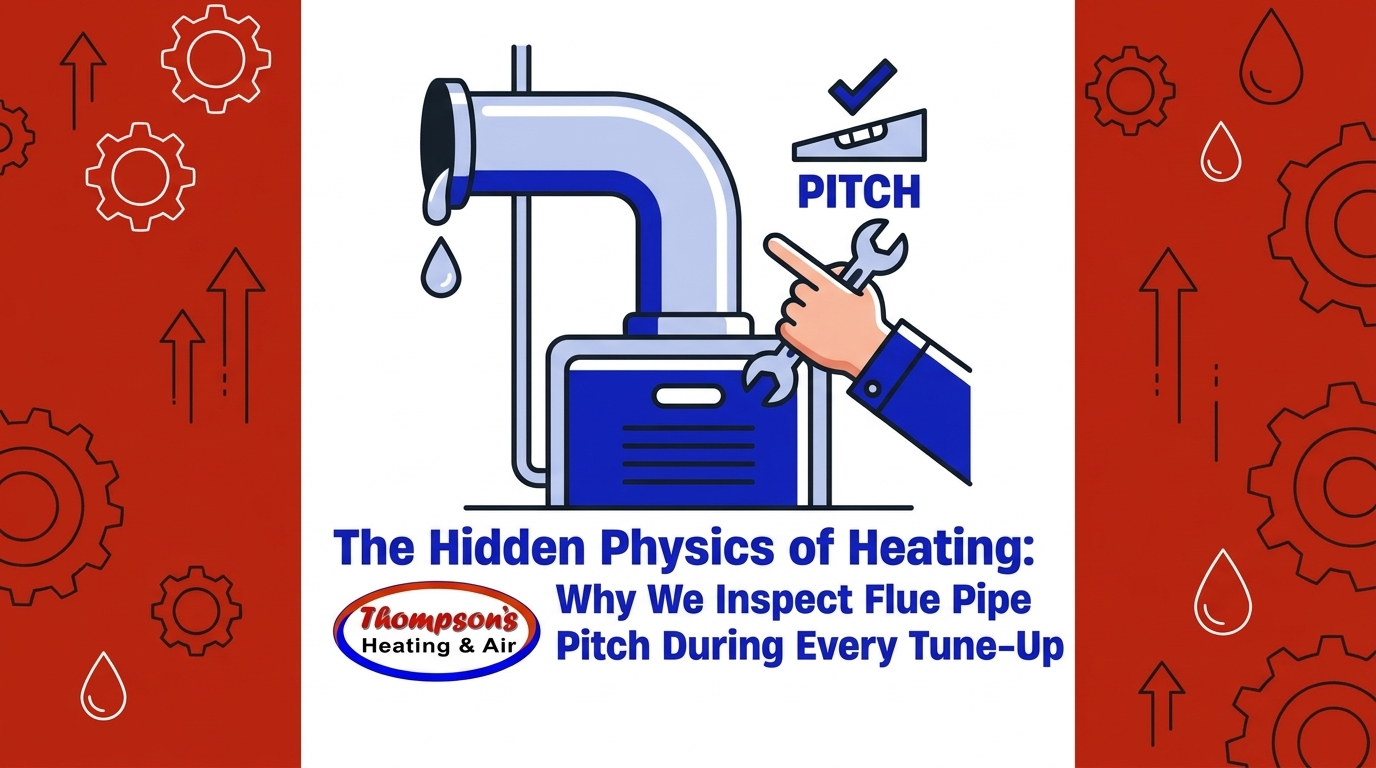
The Hidden Danger Lurking Above Your Furnace
Your furnace kicks on, warm air fills the room, and everything seems to be working perfectly—but there might be a silent hazard developing right above the unit. When our technicians at Thompson's Heating & Air arrive for a fall service visit, homeowners often ask why we inspect the flue pipe pitch during every heating tune-up, and the simple answer is that this hidden exhaust pipe is the only thing standing between your family and dangerous combustion gases. Many people assume a standard furnace check just involves swapping out a dirty air filter and wiping down the cabinet, completely missing the critical physics happening overhead.
When you need reliable heating services, scheduling a comprehensive heating tune-up ensures these vital life-safety checks are never skipped.
The Misconception of the Basic Furnace Check
It is easy to view your heating system as a simple box that produces warm air. Because the internal combustion process is hidden behind metal panels, the exhaust system rarely gets a second glance. However, improperly pitched heating flue pipes can trap acidic condensation and carbon monoxide, creating a silent hazard that puts both your equipment and your household at risk. If the pipe above your furnace is completely flat or sagging, the exhaust gases cannot escape your home efficiently.
Understanding why this seemingly minor visual check is actually a critical life-safety inspection is the first step in protecting your home. A professional technician is not just looking for dust; they are evaluating the structural integrity of your venting system. In our experience servicing Woodland CA homes, we find that identifying these drafting issues early ensures your system is safe to operate before the heavy winter heating load begins. By catching a sagging or improperly angled pipe early, you prevent exhaust back-drafting and secure your peace of mind for the season ahead.
Understanding the Simple Physics of Flue Drafting
To understand why the angle of that exhaust pipe matters so much, you have to look at the fundamental physics of how a furnace operates. When your furnace burns fuel to create heat, it does not just produce warm air. Natural gas combustion produces a mixture of hot exhaust gases, primarily consisting of water vapor and carbon dioxide. These byproducts are harmful to breathe and must be removed from your home continuously while the furnace is running.
How Thermal Buoyancy Drives Your Exhaust System
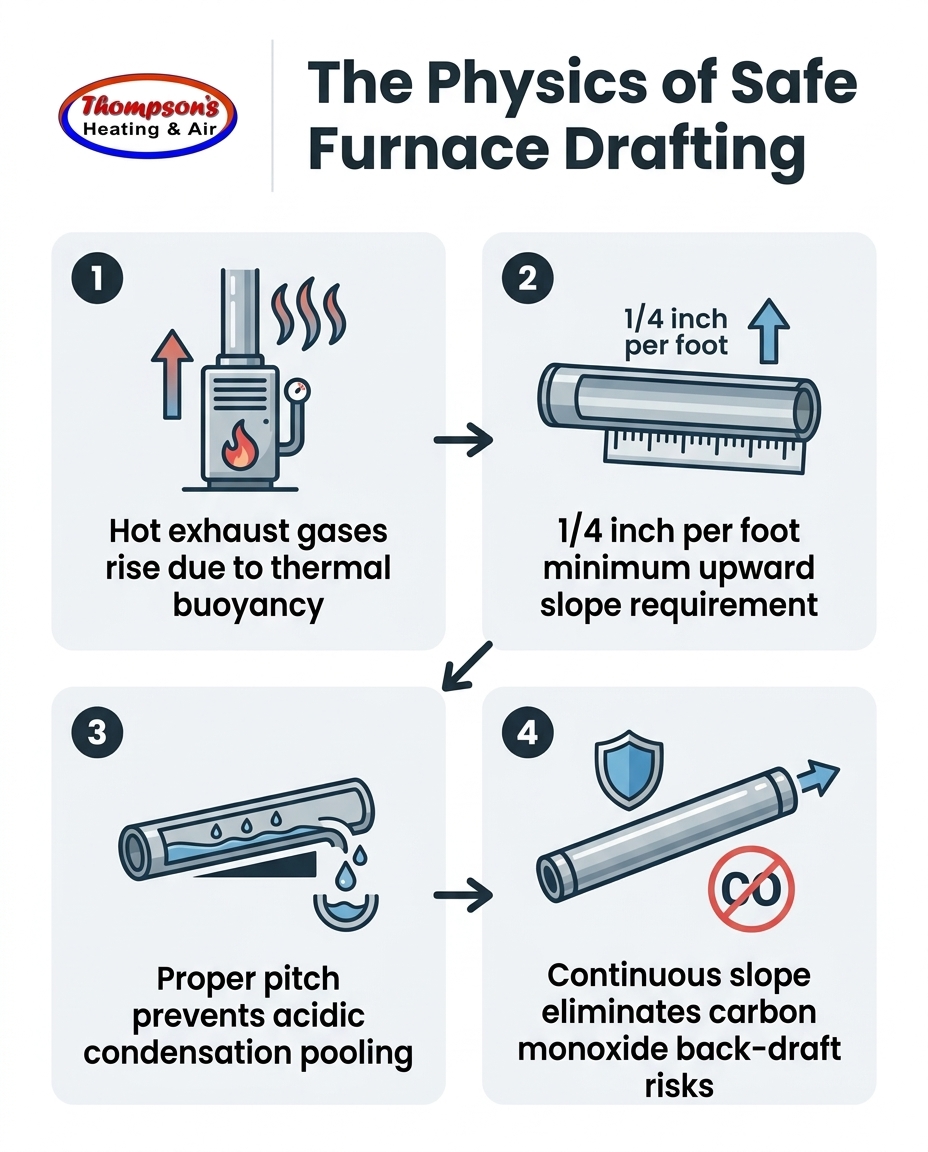
Your furnace relies on a principle called thermal buoyancy to get rid of these gases. Because hot air is significantly less dense than cold air, it naturally wants to rise. As the hot exhaust exits the combustion chamber, it travels upward through the flue pipe, riding that natural lift all the way up to your roof and out into the atmosphere. Proper drafting relies entirely on this uninterrupted thermal buoyancy to carry the gases safely outside. There are no fans pushing this exhaust in a standard natural-draft system; it is entirely dependent on heat and gravity.
The Threat of Rapid Cooling
The physics of drafting encounter a major obstacle when the exhaust gases cool down too quickly. If the exhaust loses its heat before escaping the chimney or vent, the water vapor inside that gas condenses back into a liquid state. Our team frequently sees the effects of chilly winter nights in Woodland CA causing frequent furnace cycling, which makes the metal flue pipes get very cold between cycles. When the furnace fires up again, the hot exhaust hits the freezing cold pipe, dramatically increasing the risk of the exhaust cooling rapidly inside the pipe if the drafting is not absolutely optimal.
The 1/4-Inch Rule: Why Upward Slope is Non-Negotiable
Because thermal buoyancy is so sensitive to changes in temperature and pipe layout, building codes have established strict mathematical rules for how these pipes must be installed. This is not a matter of a technician's personal preference; it is a rigid standard designed to keep homes safe from exhaust leaks and water damage.
The Code Requirement and the Role of Gravity
1. The International Fuel Gas Code (IFGC) Mandate: The IFGC strictly mandates a minimum upward slope of 1/4 inch per foot for all horizontal runs of gas vent piping. This means for every four feet the pipe travels horizontally across your basement or attic, it must rise by at least one full inch.
2. Facilitating Safe Drainage: This precise angle ensures that any incidental condensation that forms inside the pipe naturally drains back toward the unit's collection system, rather than pooling inside the horizontal sections of the pipe.
3. Combating Structural Settling: Over time, the natural settling of a house, vibrations from the furnace itself, or accidental bumps from moving storage boxes can alter this critical angle. Our installation and service teams often notice that a pipe that was perfectly pitched five years ago might be sagging today, making periodic professional inspections absolutely vital.
4. Strict Prohibition on DIY Adjustments: Adjusting flue pipes is dangerous and requires a licensed professional to ensure proper sealing, structural support, and code compliance. It must never be attempted as a DIY project, as moving the pipes incorrectly can break the seals and release carbon monoxide directly into your living space.
The September pre-heating tune-up season is the ideal time for a professional to verify this 1/4-inch rule. Catching a sagging pipe during early fall prevents a minor structural shift from turning into a major safety hazard once the system is running heavily in December.
Acidic Condensation: What Happens When Exhaust Rolls Back
When the 1/4-inch rule is violated, the consequences go far beyond a simple code infraction. The physics of combustion create a highly corrosive environment inside a failing flue pipe, leading to severe, irreversible damage to your expensive heating equipment.
The Chemical Reaction Inside the Pipe
The Problem: When water vapor mixes with combustion byproducts like carbon dioxide and trace sulfur, it forms a highly acidic liquid. This is not clean, pure water dripping from your exhaust; it is a corrosive compound that aggressively eats away at metal surfaces. If the flue is flat or pitched downward, this acidic moisture pools inside the pipe instead of safely venting out or draining properly.
The Cause: Without the proper upward pitch to guide the moisture safely away, gravity takes over in the worst way possible. The acidic condensation pools in the sagging sections of the vent, eating through the galvanized metal. Worse, if the pitch slopes back toward the unit too steeply without proper drainage, the acid rolls directly back into the furnace heat exchanger. This leads to rapid, premature rusting and corrosion of the most critical and expensive metal components inside your heating system.
The Solution: The only way to stop this corrosive cycle is to have a professional correct the pitch of the flue pipe and thoroughly inspect the heat exchanger for existing damage. If you notice visible rust, white powdery residue, or water marks on the exterior of the flue pipe, these are urgent warning signs that drafting is failing. Catching this early can save your system, which is why scheduling prompt heating repair in Woodland is critical the moment you spot rust on your venting. At Thompson's Heating & Air, protecting Woodland CA homes from this hidden acidic decay is a primary focus of our comprehensive maintenance visits.
Preventing Carbon Monoxide Back-Drafts
While acidic condensation destroys your equipment, poor flue drafting poses an even more severe threat to your family's actual health and safety. The most dangerous byproduct of natural gas combustion is carbon monoxide, and your flue pipe is the only designated exit route for this toxic gas.
The Mechanics of a Carbon Monoxide Back-Draft
Carbon monoxide (CO) is a colorless, odorless, and tasteless gas produced by incomplete combustion. Because human senses cannot detect it, you rely entirely on your venting system to keep it out of your breathing air. A poorly pitched, sagging, or blocked flue pipe prevents CO from venting outdoors. When the hot exhaust hits a pool of acidic water trapped in a sagging pipe, or when the pipe lacks the upward angle to maintain thermal buoyancy, the exhaust has nowhere to go. It quickly backs up and spills out of the draft hood, back-drafting directly into your living space.
Why Visual Inspections Trump Detectors Alone
Many homeowners assume their plug-in carbon monoxide detectors are a sufficient defense against this risk. While a functioning CO detector is an essential backup alarm, it is only a reactive measure—it only goes off once the poisonous gas is already inside your home. Proper flue physics is the primary, proactive defense.
• Verifying Structural Support: Professional visual inspections verify that the entire length of the vent is properly supported by approved strapping, preventing the sags that cause blockages.
• Confirming Continuous Upward Slope: Our technicians use specialized levels to ensure the 1/4-inch per foot rule is maintained across the entire run.
• Checking for Seal Integrity: Inspectors look for signs of heat damage or broken seals at every joint where back-drafting could occur.
By prioritizing these checks during the September pre-heating tune-up season, professionals eliminate back-draft risks before the furnace is locked into daily winter operation.
Why Early Fall is the Critical Window for Safety Checks
Timing is everything when it comes to preventative maintenance. Waiting until your furnace is running around the clock to find out if your flue pipe is properly pitched is a risky gamble. The transition period between summer and winter offers a brief, crucial window to secure your system.
Preventing the Mid-Winter Breakdown
Identifying drafting issues before the furnace is subjected to heavy, daily usage prevents sudden mid-winter failures. When temperatures drop, your furnace works overtime. Any existing weakness in the venting system—like a slight sag or a developing rust spot—will rapidly accelerate under the stress of continuous operation. A proactive check ensures the system is structurally sound before emergency scenarios arise.
We often see the consequences of skipped maintenance when the cold weather truly sets in. For example, one local homeowner's heater went out completely on a chilly Sunday winter morning. Fortunately, our team was able to schedule a technician for the very next day, get the unit repaired, and restore their heat promptly. However, emergency situations like this underscore why preventative checks are so vital. Catching a failing flue pipe early prevents the cascading damage of acidic rust from ruining the furnace on the coldest day of the year.
Scheduling service during the September pre-heating tune-up season provides profound peace of mind. You can turn your thermostat up during the first major temperature drop knowing that your exhaust system has been mathematically verified to carry hazardous gases safely out of your home.
Life-Safety Inspections vs. Basic Maintenance
Not all furnace tune-ups are created equal. The HVAC industry is sometimes known for offering deeply discounted "blow-and-go" specials that do little more than wipe down the outside of the cabinet and hand you a new filter. True maintenance requires a deep understanding of combustion physics and a commitment to rigorous safety standards.
The Thompson's Heating & Air Difference
We often tell our customers that the flue pitch inspection is a "behind the scenes" look at Thompson's Heating & Air's rigorous safety protocols. This proves that a real tune-up is a life-safety check, not just a superficial cleaning. Protecting Woodland CA families from hidden dangers like carbon monoxide and acidic moisture damage requires specialized training and a refusal to cut corners.
Here is a breakdown of how a comprehensive life-safety inspection differs from a basic maintenance visit:
• Flue Pipe Pitch — Basic Maintenance Check: Brief visual glance, often ignored if no obvious holes exist. — Comprehensive Life-Safety Inspection: Measured for the exact 1/4-inch per foot upward slope requirement.
• Condensation Signs — Basic Maintenance Check: Rarely checked unless water is actively dripping. — Comprehensive Life-Safety Inspection: Thorough inspection for dried acidic water marks and hidden rust scaling.
• Heat Exchanger — Basic Maintenance Check: Quick look at the visible front panels. — Comprehensive Life-Safety Inspection: Deep analysis, often involving testing furnace heat exchangers for micro-cracks.
• Drafting Physics — Basic Maintenance Check: Assumes drafting is fine if the furnace turns on. — Comprehensive Life-Safety Inspection: Evaluates the entire venting physics to guarantee uninterrupted thermal buoyancy.
This level of detail ensures the equipment operates safely, reaches its maximum lifespan, and keeps dangerous exhaust gases far away from your living spaces.
Frequently Asked Questions
What is the correct pitch for a furnace flue pipe?
The correct pitch for a horizontal furnace flue pipe is a minimum upward slope of 1/4 inch per foot of horizontal run. This standard is mandated by the International Fuel Gas Code to ensure safe operation. Maintaining this precise angle allows hot exhaust gases to rise naturally and prevents hazardous condensation from pooling inside the vent.
Why does a furnace flue pipe need to be pitched upward?
A furnace flue pipe must be pitched upward to support the natural thermal buoyancy of hot exhaust gases. Because hot air rises, the upward angle guides the toxic combustion byproducts safely out of your home. Additionally, the slope ensures that any condensation that forms inside the pipe drains back properly instead of sitting in the pipe and causing corrosion.
Can a flue pipe be completely horizontal?
No, a furnace flue pipe should never be completely horizontal. A flat pipe disrupts the natural draft of the exhaust gases, increasing the risk of carbon monoxide back-drafting into your home. It also allows acidic water vapor to pool in the pipe, which will rapidly rust and destroy the metal venting.
What happens if exhaust gas condenses in the flue?
If exhaust gas condenses in the flue, it turns into a highly acidic liquid that attacks the metal components of your heating system. This corrosive moisture can eat through the flue pipe itself or roll backward into the furnace, destroying the heat exchanger. Over time, this leads to expensive premature equipment failure and severe safety hazards.
Why is my furnace exhaust pipe dripping water or rusting?
Dripping water or visible rust on your furnace exhaust pipe usually indicates a severe drafting issue or improper pipe pitch. It means the hot exhaust gases are cooling too quickly and condensing into acidic water inside the vent. If you see rust, white powdery streaks, or water marks, you should call a licensed HVAC professional immediately to correct the venting.
How often should a professional inspect my furnace venting?
A professional should inspect your furnace venting at least once a year, ideally during an early fall preventative maintenance visit. Annual inspections ensure that normal house settling or accidental bumps haven't altered the critical 1/4-inch upward pitch of the pipe. Regular checks catch small structural issues before they evolve into major carbon monoxide hazards.
Secure Your Home for the Winter
Protecting your home goes far beyond simply changing an air filter; it requires verifying the hidden physics that keep dangerous gases out of your living space. By scheduling your comprehensive heating tune-up before the cold weather hits, you gain the ultimate peace of mind. Knowing your flue pipe is perfectly pitched means you can enjoy the warmth of your home, confident that your family is safe and secure all season long.



.avif)
.avif)
.png)
