
Why Your Home Needs a Fresh Air Intervention


Why Fresh Air Exchange Is the Most Overlooked Way to Protect Your Family's Health
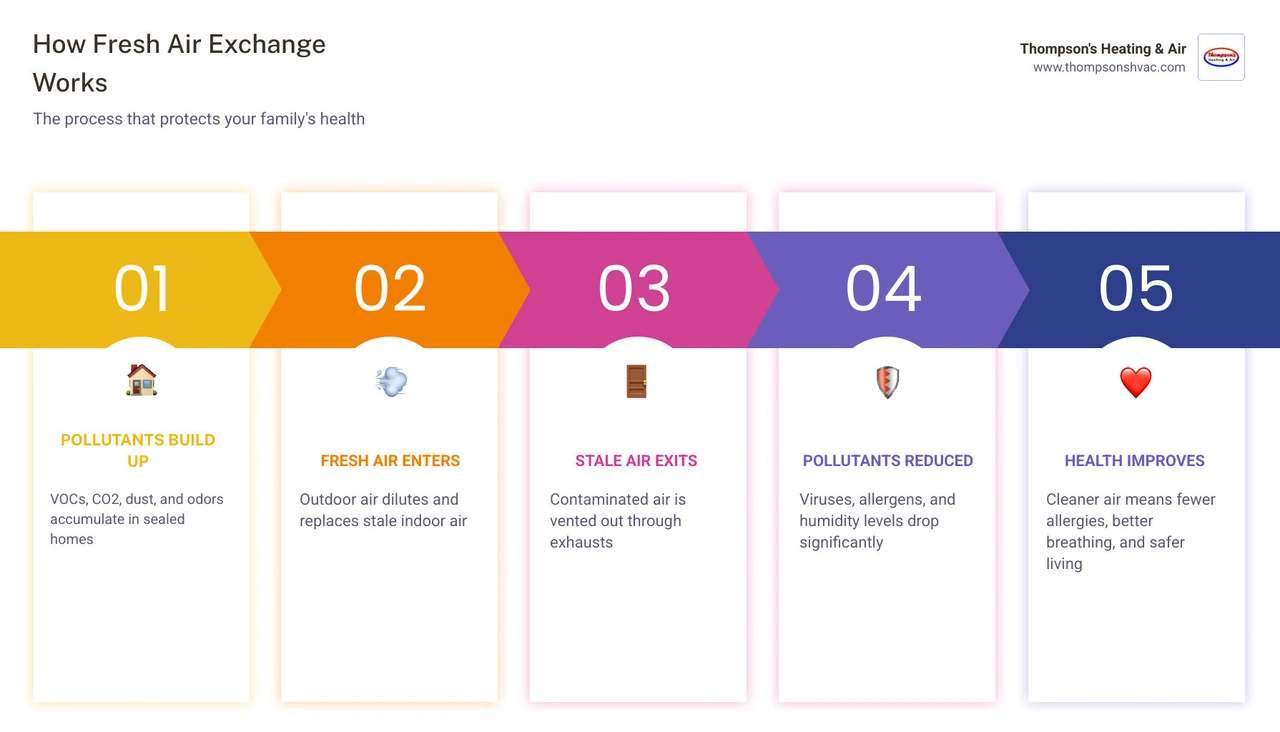
How fresh air exchange protects your family comes down to one simple idea: the air inside your home is often far more polluted than the air outside, and regularly replacing it keeps your family safer, healthier, and more comfortable.
Here's a quick summary:
• Dilutes pollutants – Fresh outdoor air flushes out VOCs, carbon dioxide, dust, and odors that build up indoors
• Reduces airborne viruses – Increasing air changes per hour lowers the concentration of virus particles in the air
• Controls humidity – Proper exchange keeps indoor humidity between 30–50%, preventing mold growth
• Removes allergens – Regular airflow reduces pollen, pet dander, and other triggers
• Protects vulnerable family members – Children, elderly adults, and those with asthma or allergies are especially sensitive to stale indoor air
Most people spend around 90% of their time indoors. And according to the EPA, indoor air can be 2 to 5 times more polluted than the air right outside your front door. In a well-sealed, energy-efficient home — exactly the kind many Woodland, CA homeowners have — that pollution has nowhere to go unless you actively move it out.
Think of your home like a pair of lungs. Without regular, fresh air coming in and stale air going out, everything just sits there and builds up. That buildup is what causes persistent headaches, worsening allergies, musty smells, and in serious cases, long-term respiratory damage.
The good news is that improving your home's air exchange doesn't have to be complicated or expensive. This guide walks you through everything you need to know — from understanding the basics to choosing the right ventilation system for your family's needs.
Understanding How Fresh Air Exchange Protects Your Family
When we talk about "air exchange," we are essentially talking about the rate at which indoor air is replaced by outdoor air. In the HVAC world, we measure this using the "Air Exchange Rate." If your home has a low exchange rate, pollutants remain trapped, recirculating through your bedrooms and living spaces.
How fresh air exchange protects your family is through the scientific principle of dilution. Think of a drop of red food coloring in a thimble of water versus a drop in a swimming pool. By bringing in fresh, outdoor air, we dilute the concentration of indoor contaminants like carbon dioxide (CO2), volatile organic compounds (VOCs), and microscopic dust particles.
To ensure homes remain healthy, experts at ASHRAE (the American Society of Heating, Refrigerating and Air-Conditioning Engineers) have developed Standard 62.2. As of April 2026, these standards remain the gold standard for residential health. ASHRAE recommends that a home receive at least 0.35 air changes per hour (ACH). This means that every three hours, the entire volume of air in your home should be replaced with fresh air from the outside. Additionally, they suggest a minimum of 15 cubic feet of air per minute (cfm) per person.
At Thompson's Heating & Air, we’ve seen that many modern homes in Davis and Woodland fall short of these numbers because they are built so tightly to save on energy. While great for your utility bill, it’s not always great for your Indoor Air Quality.
How Fresh Air Exchange Protects Your Family from Airborne Viruses
One of the most critical lessons we’ve learned in recent years is how much ventilation impacts the spread of respiratory illnesses. Whether it’s the common flu or more serious concerns like COVID-19, virus particles linger in stagnant air like an invisible mist.
When you improve your home's ventilation, you are effectively "washing" the air. By introducing fresh air and creating cross-ventilation—where air enters one side of the house and exits another—you significantly reduce the number of viral particles present. For optimal safety, especially when you have visitors, health experts often recommend aiming for 5 air changes per hour.
This is where Air Purification systems come into play. While ventilation brings in new air, purification cleans the air that is already there. Combining the two creates a "search and destroy" mission for airborne pathogens, ensuring your family isn't just breathing "new" air, but "clean" air.
How Fresh Air Exchange Protects Your Family During Allergy Season
Living in the Sacramento Valley means dealing with some of the most intense pollen counts in California. You might think that opening a window is a bad idea during allergy season, and you’d be right—if you aren't filtering that air.
Proper fresh air exchange systems, like Energy Recovery Ventilators (ERVs), use high-quality filters to strip out pollen and pet dander before the air ever enters your living room. We look at two main metrics here:
1. HEPA Standards: High-Efficiency Particulate Air filters can trap 99.97% of particles as small as 0.3 microns.
2. CADR Ratings: The Clean Air Delivery Rate tells you how quickly a system can clear specific pollutants like smoke, dust, and pollen.
If you find yourself sneezing the moment you step inside your home in Winters or Dixon, it’s a sign that your indoor environment is holding onto allergens. Professional Air Purification Installation Woodland CA ensures that your "fresh" air is actually free of the triggers that cause itchy eyes and runny noses.
The Hidden Dangers of Airtight Homes in Woodland
There is a bit of a paradox in modern home construction. We want our homes to be "airtight" to keep the heat in during our chilly Winters nights and the cool air in during our scorching 100-degree Woodland summers. However, an airtight home is essentially a sealed plastic bag.
Inside that bag, several dangerous elements can accumulate:
• VOCs (Volatile Organic Compounds): These are gases emitted from carpets, furniture, cleaning supplies, and even your dry-cleaned clothes. Without exchange, VOC levels can skyrocket.
• Radon: A naturally occurring radioactive gas that can seep in from the soil. Ventilation is a key component of radon mitigation.
• Carbon Monoxide (CO): If you have gas appliances, any small leak or back-drafting can lead to deadly CO buildup in a home that doesn't "breathe."
This is why Indoor Air Quality Woodland CA is such a hot topic. We need to find the balance between keeping your home energy-efficient and keeping it ventilated.
Signs Your Home Needs Better Ventilation
How do you know if your home is suffering from "Sick Building Syndrome"? Your house will usually tell you if you know what to look for:
• Lingering Odors: If you can still smell last night’s fish tacos at breakfast the next morning, your air is stagnant.
• Condensation on Windows: Foggy windows in the morning are a sign that moisture is trapped inside.
• Visible Mold: Mold thrives in high-humidity, low-airflow environments. Check your bathroom corners and window sills.
• Health Symptoms: Frequent headaches, fatigue, or increased asthma attacks when you are at home are major red flags.
If you spot these issues, it’s worth checking for Signs of Mold in Your HVAC System as well, as your ductwork can become a breeding ground for spores if the air is too humid.
Measuring Your Home's Air Exchange Rate
You don't have to guess whether your home meets the ASHRAE standards. We use specialized tools to calculate the "CFM per person" and the "Air Changes per Hour" (ACH). This involves looking at the total square footage of your home, the number of occupants, and the efficiency of your current exhaust fans.
A professional Air Quality Testing Woodland CA service can provide a detailed report. We often find that older homes in places like Esparto or Capay have high "natural" ventilation (they are drafty!), while newer builds in Natomas or West Sacramento are often too tight and require mechanical help to reach healthy air exchange levels.
Mechanical Solutions: ERVs, HRVs, and Balanced Ventilation
When natural ventilation (opening windows) isn't enough or isn't practical due to outdoor heat or pollution, we turn to mechanical solutions. The most effective of these are "Balanced Ventilation" systems, specifically ERVs and HRVs.
Energy Recovery Ventilators (ERVs) and Heat Recovery Ventilators (HRVs) are the superheroes of the HVAC world. They work by pulling stale air out of your home and pushing fresh air in. The magic happens in the "core" of the unit, where the two air streams pass each other without mixing. The outgoing air transfers its heat (and in the case of ERVs, its moisture) to the incoming air.
This allows you to retain up to 80% of the energy you’ve already spent heating or cooling your home while still getting a 100% fresh air supply.
• Primary Goal — HRV (Heat Recovery): Transfers heat only — ERV (Energy Recovery): Transfers heat AND moisture
• Best Climate — HRV (Heat Recovery): Cold, dry climates — ERV (Energy Recovery): Humid summers / mild winters
• Humidity Control — HRV (Heat Recovery): Dries out indoor air — ERV (Energy Recovery): Helps balance indoor humidity
• Woodland Fit — HRV (Heat Recovery): Good for winter — ERV (Energy Recovery): Best for year-round comfort
Choosing the right Indoor Air Quality Products depends entirely on your home's specific needs and the local micro-climate of your town, whether you're in the breezy hills of Rumsey or the flatlands of Arbuckle.
Practical Steps to Improve Air Exchange Today
While we love installing high-tech systems, there are things you can do right now to help your home breathe.
1. Use Your Exhaust Fans: Your bathroom and kitchen fans are "spot ventilation." They remove moisture and cooking fumes at the source. Run your bathroom fan for 30–45 minutes after a shower to prevent mold.
2. HVAC "On" vs. "Auto": Most people leave their thermostat on "Auto," meaning the fan only runs when the AC or heater is running. If you have guests over, switch it to "On." This keeps the air moving through your filters even when the temperature is stable.
3. Upgrade Your Filters: Switch from basic fiberglass filters to pleated filters. These have more surface area to catch pollutants.
Proper Air Filtration is the first line of defense. By combining filtration with movement, you’re already ahead of the curve.
Safety Precautions for Natural Ventilation
Opening windows is the oldest form of air exchange, but it’s not always the safest. In Northern California, we have to be mindful of our outdoor conditions.
• Check AirNow.gov: Before opening your house up, check the local Air Quality Index (AQI). If there is wildfire smoke or high ozone levels, keep the windows shut and rely on your HVAC system.
• Wildfire Smoke: During "smoke season," natural ventilation is your enemy. You want your home to be as airtight as possible then, using internal air purification rather than fresh air exchange.
• Child Safety: If you have little ones, ensure that windows are equipped with safety guards or only open a few inches (less than 4 inches is a common safety standard) to prevent falls.
For more localized advice, check out our Mold Prevention Tips for the Sacramento Valley Homeowners.
Protecting Vulnerable Family Members Through Better IAQ
How fresh air exchange protects your family is most evident when you look at the most vulnerable members of your household.
• Children: Kids breathe more air per pound of body weight than adults. Their lungs are still developing, making them highly susceptible to respiratory infections and asthma triggers. Good air exchange has even been linked to better sleep and improved cognitive development.
• The Elderly: Seniors often spend more time indoors and may have weakened immune systems. Fresh air reduces the viral load in the home and helps prevent "Sick Building Syndrome," which can cause fatigue and confusion.
• Asthma and Allergy Sufferers: For these individuals, air quality isn't just about comfort—it's about safety. Removing triggers like dust mites and mold spores through consistent air exchange can mean the difference between an easy breath and a trip to the ER.
Our Indoor Air Quality Services in Sacramento CA are designed with these families in mind. We don't just look at the thermostat; we look at the health of the people in the room.
Frequently Asked Questions about Home Ventilation
How much fresh air does my home actually need?
As a rule of thumb, you want to follow the ASHRAE guideline of 0.35 air changes per hour. For a family of four in a standard 2,000-square-foot home, this usually means introducing about 60 to 80 cubic feet of fresh air per minute to maintain optimal health levels.
What is the difference between an ERV and an HRV?
An HRV (Heat Recovery Ventilator) only transfers heat between the air streams. An ERV (Energy Recovery Ventilator) transfers both heat and moisture. In our part of California, where summers can be dry and winters can be damp, an ERV is often the preferred choice because it helps keep your indoor humidity in that "sweet spot" of 30–50%.
Can I improve ventilation without increasing my energy bill?
Yes! That is exactly what ERVs and HRVs are designed to do. By "recovering" the energy from the air you've already conditioned, they provide fresh air at a fraction of the cost of just opening a window. Additionally, keeping your HVAC system maintained ensures it doesn't have to work harder to push air through dirty filters or clogged ducts.
Conclusion
At Thompson's Heating & Air, we believe that your home should be your family's safest sanctuary. Since 1992, our family-owned business has been helping our neighbors in Woodland, Davis, and throughout Yolo County breathe easier. We know the local climate, we know the local pollen counts, and we know exactly how to balance energy efficiency with life-saving ventilation.
Whether you're concerned about allergies, viruses, or just that "stuffy" feeling in your guest room, we are here to help. With 24/7 technician access and a commitment to 5-star service, we’re ready to help you clear the air.
Don't let stale air compromise your family's health. Schedule your fresh air intervention today and experience the difference that true fresh air exchange can make.



.avif)
.avif)
.png)
