
Upgrading Your Thermostat Wiring to Support a Smart Heating Schedule

The Pre-Winter Smart Thermostat Surprise
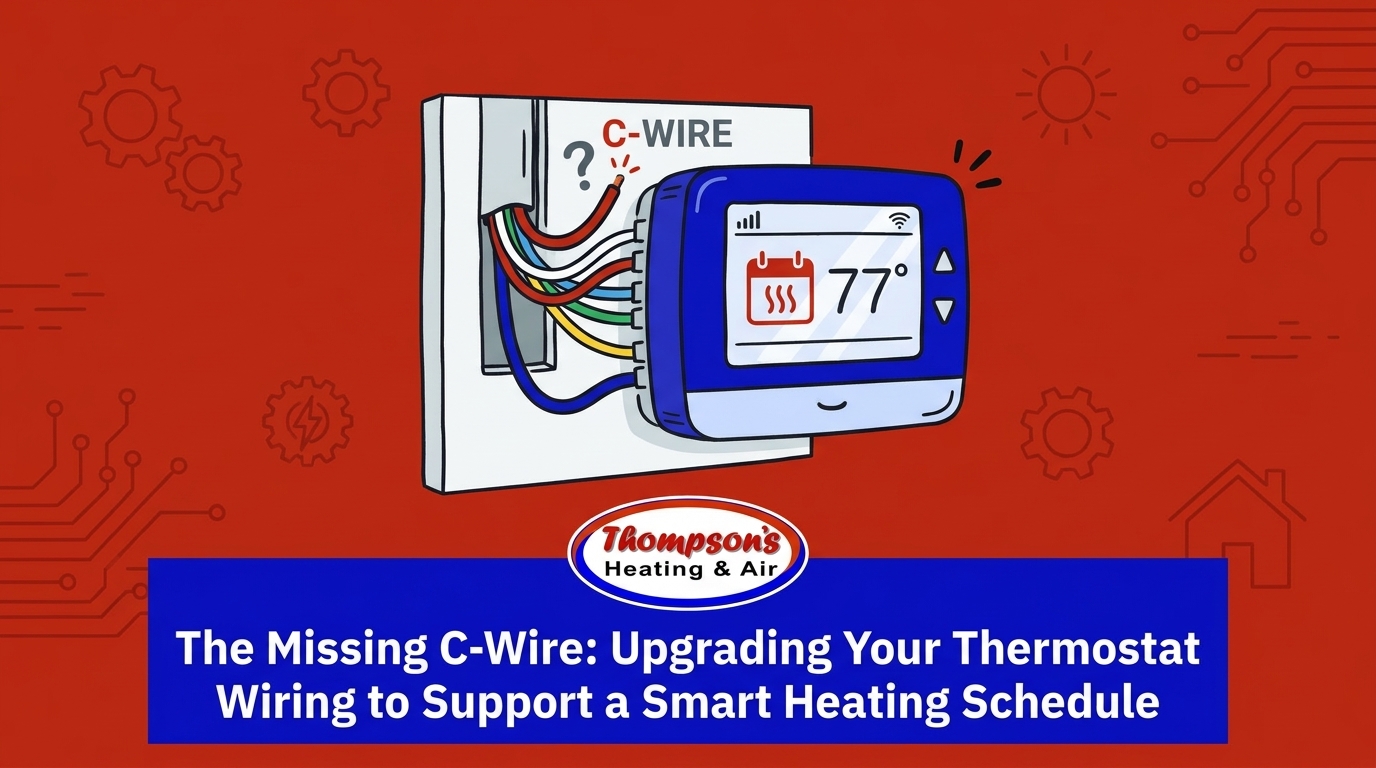
At Thompson's Heating & Air, we frequently find that upgrading your thermostat wiring to support a smart heating schedule is often the unexpected hurdle standing between you and a comfortable winter. You unbox a brand-new smart thermostat, ready to optimize your home's energy usage, only to remove the old unit from the wall and discover you are missing a crucial wire. This missing connection—known as the C-wire—turns what should be a quick weekend project into a frustrating roadblock just as the weather begins to turn.
For reliable heating services, scheduling professional heating repair and wiring ensures your system is permanently ready for the season without relying on risky workarounds.
The September scramble: As September pre-heating season prep gets underway, homeowners across the region rush to finalize their winter upgrades. Discovering an incompatible wall setup right before the first major cold snap forces a critical decision. You can either risk unreliable battery workarounds that might fail when you need heat the most, or you can opt for a permanent, professional wiring solution from our team that guarantees uninterrupted climate control.
Why Modern Smart Thermostats Demand Continuous 24V Power
The problem: Older manual thermostats function like simple on-and-off light switches. They bridge a connection to tell the furnace to turn on, but they do not require their own dedicated power source to operate. Modern smart thermostats, however, are essentially miniature computers mounted to your wall, and they require a steady stream of electricity to function.
The cause: A smart thermostat is always working, even when the furnace is off. It maintains an active Wi-Fi connection, powers a bright touchscreen display, constantly polls local weather data, and communicates back and forth with your HVAC system. Relying on internal batteries alone is completely insufficient for this level of heavy, automated seasonal scheduling. Batteries will drain rapidly, leaving your system unresponsive.
The solution: The C-wire, or "Common Wire," solves this by delivering continuous 24-volt power directly from the HVAC control board to the thermostat unit. This dedicated power line ensures the thermostat remains fully functional and responsive during critical seasonal transitions, especially during September pre-heating season prep when you are testing and programming your winter schedules.
Power Draw Comparison: Manual vs. Smart Thermostats
• Classic Manual/Mercury — Power Source Requirement: None (Acts as a basic switch) — Continuous Energy Drain: Zero — Wi-Fi & Automation Capability: None
• Basic Digital (Non-Smart) — Power Source Requirement: AA or AAA Batteries — Continuous Energy Drain: Very Low (LCD screen only) — Wi-Fi & Automation Capability: None
• Modern Smart Thermostat — Power Source Requirement: Continuous 24V (C-Wire required) — Continuous Energy Drain: High (Screen, Wi-Fi, Sensors) — Wi-Fi & Automation Capability: Full integration and scheduling
The Wiring Gap in Classic Sacramento Valley Homes
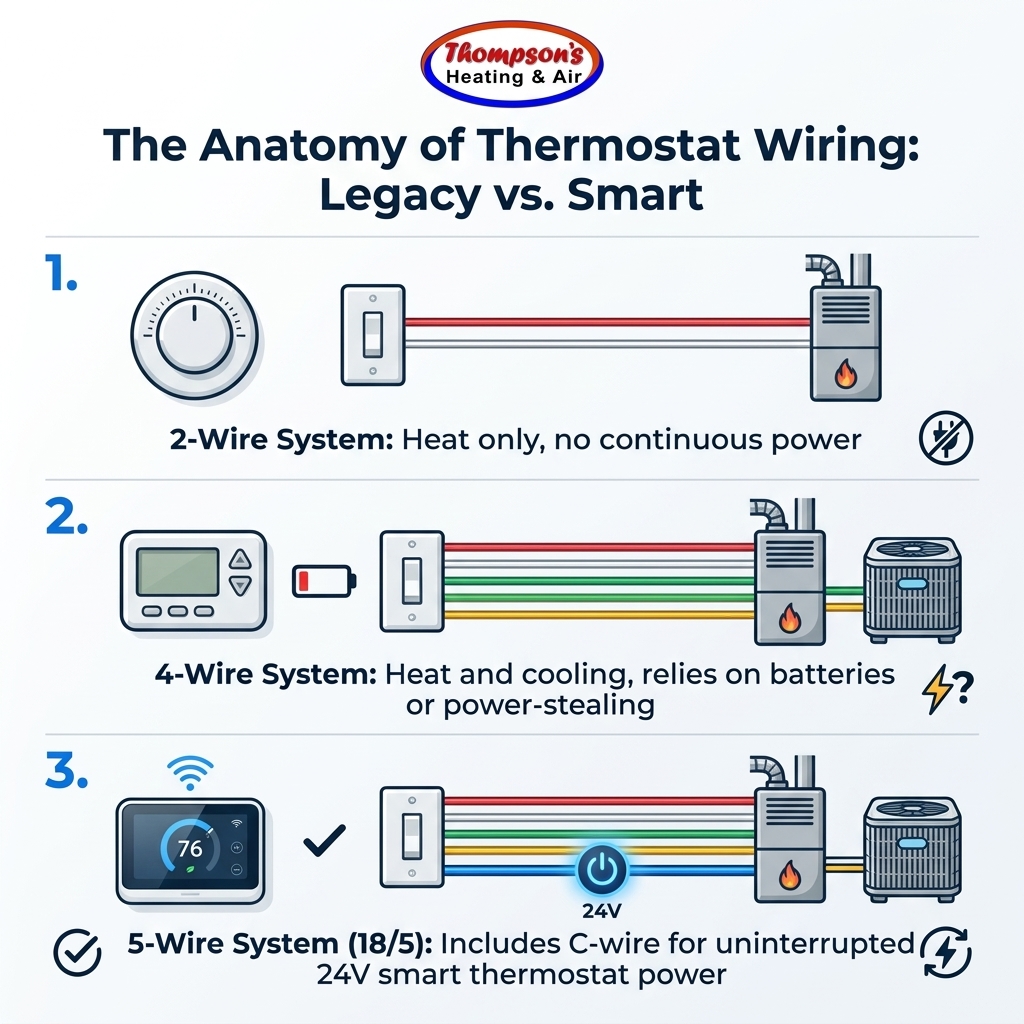
The missing C-wire is not a defect in your new thermostat; it is a structural characteristic of historic homes. Our technicians at Thompson's Heating & Air spend a lot of time working in the older residential neighborhoods in Woodland, CA, and we know firsthand that these homes were built long before smart home technology existed. During the mid-to-late 20th century, builders typically ran 2-wire or 4-wire setups designed specifically for simple mercury switches or basic digital models.
Because thermostats in previous decades did not require independent power, running a 5th common wire was considered an unnecessary expense. Today, this legacy wiring creates a noticeable gap between the capabilities of modern HVAC equipment and the infrastructure hidden behind your walls.
How to check your current terminal block:
• Remove the faceplate: Gently pull the current thermostat off its wall mount to expose the wiring block.
• Count the wires: Look at how many individual colored wires are coming out of the wall cavity.
• Check the "C" terminal: Look for a terminal labeled "C". If there is no wire connected to it—or if the terminal doesn't exist on your old baseplate—you lack a dedicated common wire.
• Identify the existing connections: You will typically see wires connected to R (Power), W (Heat), Y (Cooling), and G (Fan). A true smart setup requires that fifth C-wire to complete the 24V circuit.
The Hidden Risks of Power-Stealing and Add-a-Wire Kits
The problem: Homeowners eager to get their new devices running often turn to "power-stealing" thermostats or aftermarket add-a-wire kits. While these solutions are marketed as easy DIY workarounds for missing C-wires, our team strongly advises against them as they introduce significant hidden risks to your entire heating system.
The cause: Power-stealing thermostats attempt to draw a charge by rapidly pulsing the heating circuit without actually turning the furnace on. In our experience servicing older residential neighborhoods in Woodland, CA, our team has seen this constant pulsing wreak havoc on aging furnace control boards. Modern, sensitive circuit boards interpret these rapid pulses as electrical faults, which can cause premature wear, blown fuses, or even catastrophic shorts. Similarly, add-a-wire adapter kits (which use a diode splitter to share the fan wire's power) often fail under heavy seasonal scheduling loads.
The solution: Avoiding these unreliable adapters and investing in a true 5-wire upgrade protects your HVAC equipment from electrical damage. We often find that the false economy of skipping a professional wire pull results in expensive furnace board replacements later in the season.
Symptoms of a Failing Wiring Workaround
• Dropped connections: The thermostat frequently disconnects from your home Wi-Fi network to conserve its limited power.
• Unresponsive displays: You might be left wondering why your thermostat screen goes blank right when you need to adjust the temperature.
• Short cycling: The furnace turns on and off rapidly before reaching the target temperature because the thermostat is losing and regaining power.
• Strange clicking noises: Rapid clicking from the HVAC equipment cabinet as the control board struggles with the power-stealing pulses.
Handling Drastic Daily Temperature Swings with Robust Scheduling
The technical need for continuous power becomes even more obvious when you factor in the specific environmental demands of our local climate. Woodland experiences drastic daily temperature swings, particularly during the transition seasons. It is entirely common to wake up to a chilly 45-degree morning and end up sweating through an 85-degree afternoon. These rapid shifts force your HVAC system to work overtime to maintain a consistent indoor environment.
To manage these swings efficiently, smart thermostats require aggressive, robust scheduling. They must frequently switch between heating cycles, idle modes, and cooling cycles. Every time the thermostat commands the system to change modes, it draws a burst of power. For battery-powered or adapter-reliant thermostats, this frequent switching is exhausting. The batteries drain rapidly, and the device may go into a deep sleep mode right when it needs to be monitoring the indoor and outdoor temperatures.
Uninterrupted, hardwired power allows the thermostat to continuously track these drastic temperature changes without ever going offline. By maintaining a steady 24-volt connection, your smart thermostat can execute complex daily schedules flawlessly. This reliability ensures your home stays comfortable during those chilly mornings and hot afternoons, significantly reducing the need for emergency calls or off-schedule routine heating service as part of your September pre-heating season prep.
The Professional Retrofit: Safely Pulling a New 18/5 Wire
Upgrading thermostat wiring is not a Saturday afternoon DIY project. It involves interacting with live electrical control boards, navigating hidden wall obstacles, and ensuring compliance with modern HVAC standards. When the Thompson's Heating & Air team retrofits a home with new 18/5 wire (18-gauge wire with 5 internal conductors), we utilize specialized tools and deep technical knowledge to get the job done right.
Particularly in older residential neighborhoods in Woodland, CA, our primary concern is protecting the structural and aesthetic integrity of historic walls. Working with a company that possesses deep local expertise in retrofitting older Sacramento Valley homes means our technicians know exactly how to safely pull new C-wires without causing unnecessary damage to delicate lath-and-plaster walls.
Here is how our technicians handle the professional wire-pulling process:
1. Pathway Assessment: Our technicians begin by tracing the route from the wall-mounted thermostat down to the furnace control board. We check for fire blocks, cross-bracing, and tight corners inside the wall cavity that could snag the wire.
2. Securing the New Line: Using specialized fiberglass fish tape, our experts carefully navigate the wall space. In many cases, we use the old 4-wire bundle as a pull string to gently guide the new 18/5 wire down the exact same path without cutting new holes in the drywall or plaster.
3. Terminating the Connections: Once the new wire reaches the equipment cabinet, our installer strips the protective casing and securely terminates each conductor to the correct terminal on the furnace control board, ensuring the C-wire is properly seated.
4. Thermostat Mounting and Calibration: Back at the wall, we install the new smart thermostat baseplate, connect the five wires, and power the system back on. Our team then configures the software to recognize the new hardwired power source.
Maximizing Comfort and Efficiency with a Fully Integrated System
A properly hardwired smart thermostat is the foundation of a modern, efficient home comfort system. By guaranteeing uninterrupted smart schedules and reliable Wi-Fi connectivity, a dedicated C-wire unlocks the full potential of your HVAC equipment. You gain access to advanced automation features, detailed energy tracking, and the ability to integrate your system with whole-home zoning.
We recently worked with a local family who purchased a new home, but quickly found it was uncomfortable year-round due to an aging, poorly configured HVAC setup. Before they officially moved in, our team installed an integrated HVAC system featuring advanced zoning. Because our installation included proper, hardwired thermostats with dedicated C-wires, the system was able to communicate flawlessly across different zones. The outcome was a home that became perfectly comfortable in every room, no matter the season.
Proper thermostat wiring is a foundational step for any major upgrade. Whether you are finalizing your September pre-heating season prep or planning a complete heating system installation in the future, establishing a reliable 24-volt connection today ensures your equipment will run safely and efficiently for years to come.
Frequently Asked Questions About Smart Thermostat Wiring
Do I need a C wire for a smart thermostat?
The short answer is yes. While a few models claim to work without one, our team knows a C-wire is required for long-term reliability. It provides the continuous 24-volt power necessary to run the Wi-Fi radio, the bright display, and the internal sensors. Without it, your smart thermostat will struggle to maintain its schedule in older residential neighborhoods in Woodland, CA.
What happens if you don't connect the C wire?
Your thermostat will suffer from power instability. If you skip the C-wire, the device must rely on internal batteries or risky power-stealing methods. This often leads to dropped Wi-Fi connections, a blank screen during heavy heating cycles, and potential electrical damage to your furnace's main control board over time.
Can a smart thermostat run on batteries alone?
Batteries are not a sustainable long-term solution. While batteries can keep the screen on temporarily, the heavy energy demands of a smart thermostat will drain them rapidly. Relying on batteries alone means you will constantly be replacing them, and if they die while you are away, your heating system will shut down completely.
Why does a smart thermostat drop Wi-Fi?
Wi-Fi drops are a classic symptom of low power. When a thermostat lacks a continuous power supply from a C-wire, it enters a power-saving mode to conserve energy. The first feature it disables is the Wi-Fi radio, which disconnects the unit from your network and prevents you from controlling your HVAC system remotely.
Are C-wire adapters reliable for heavy heating schedules?
Adapters often fail under consistent strain. Add-a-wire kits use a diode to split power from the fan wire, but this is a temporary workaround, not a permanent fix. During extreme weather when the system is running constantly, we frequently see these adapters overheat or fail, leaving your smart thermostat completely unresponsive.
Ready to Finalize Your Fall Heating Upgrades?
As September pre-heating season prep comes to a close, ensuring your thermostat is properly wired is one of the most important steps you can take to protect your home. Don't wait until the first freezing morning to discover your smart thermostat's batteries have died or the Wi-Fi has disconnected. Reaching out to our local professionals at Thompson's Heating & Air to evaluate your existing wiring guarantees that your system will be hardwired correctly, permanently solving the missing C-wire problem. With a reliable, continuous power connection, you can finally enjoy the clear, consistent, and automated climate control your smart thermostat was built to provide. Plus, upgrading your thermostat and optimizing your system's efficiency may even qualify you for local utility incentive programs or energy tax credits (always verify current programs with your utility provider or tax professional).



.avif)
.avif)
.png)
