
Evaluating PG&E Rebate Eligibility for Attic Insulation Upgrades in Yolo County

Addressing Drafty Homes Before the Winter Chill Arrives
Your heater is kicking on more often, but certain rooms still feel drafty—a clear sign that evaluating PG&E rebate eligibility for attic insulation upgrades in Yolo County should be on your radar before the real cold sets in. As we move through the September pre-heating season, our team at Thompson's Heating & Air frequently hears from Woodland homeowners who notice their homes struggling to retain heat overnight. The culprit is almost always poor thermal retention in the attic. Heat rises, and without a solid barrier, the warmth you pay for simply escapes through the roof.
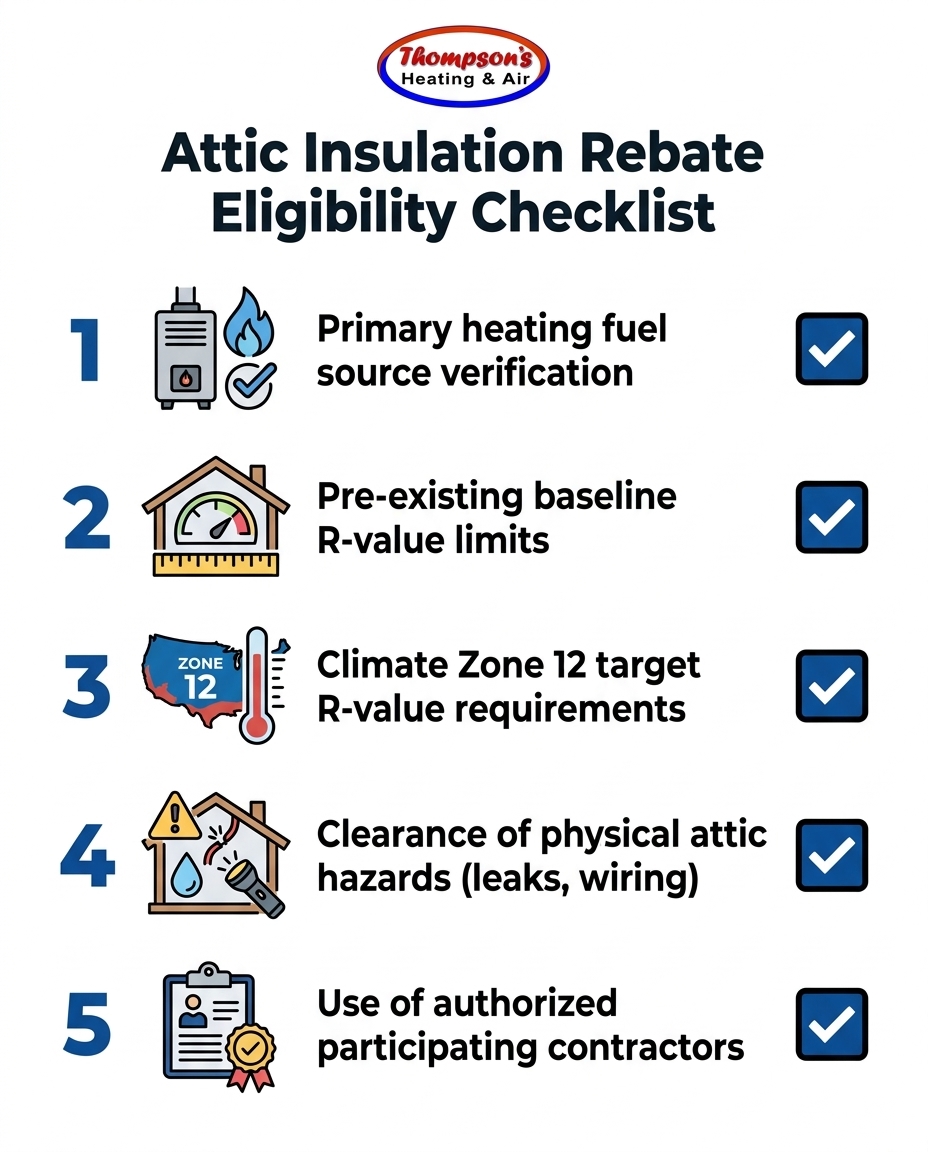
Upgrading your attic insulation before temperatures drop significantly offers immediate financial and comfort benefits. However, figuring out how to offset the initial investment can be confusing. Many homeowners know that utility incentives exist, but they struggle to determine if their specific home and planned upgrades actually qualify under strict utility guidelines. Before you can claim any incentives, you have to prove that your home meets a very specific set of physical baseline criteria.
To navigate this process successfully, evaluating the physical conditions in your attic is the mandatory first step. Utility programs do not blindly approve upgrades; they require proof that the work will yield measurable energy savings against the damp, chilly winters typical of the Sacramento Valley region.
For professional Heating Services and expert heating installation, our team is ready to help you prepare your home for the months ahead.
Navigating California Title 24 and Climate Zone 12 Standards
Before diving into utility-specific rules, you have to understand the state regulations that govern energy efficiency. California Title 24 energy standards dictate exactly how residential thermal envelopes must perform. These are not merely suggestions; they are rigorous building codes designed to reduce statewide energy consumption.
The Climate Zone 12 Mandate
The state is divided into distinct climate regions, and Woodland CA and greater Yolo County fall squarely into Climate Zone 12. This specific designation carries strict R-value mandates for attic insulation. The R-value measures how effectively a material resists heat flow. The higher the number, the better the insulation performs. In Climate Zone 12, the baseline requirements are significantly higher than in milder coastal areas.
There is a massive difference between simply rolling out some fiberglass batts you bought at a hardware store and actually meeting the state's specific energy-efficiency thresholds. Utility programs align their incentive criteria directly with these state-mandated climate zone standards. If your planned upgrade does not meet the Title 24 requirements for Zone 12, the utility will not approve the incentive.
• Code Adherence — Basic Insulation Addition: Often falls short of regional mandates — Title 24 Compliant Upgrade: Meets or exceeds local building codes
• R-Value Target — Basic Insulation Addition: Based on homeowner guesswork — Title 24 Compliant Upgrade: Strictly adheres to Climate Zone 12 minimums
• Rebate Eligibility — Basic Insulation Addition: Typically disqualified — Title 24 Compliant Upgrade: Eligible for utility program review
• Air Sealing — Basic Insulation Addition: Usually ignored — Title 24 Compliant Upgrade: Mandatory component of the upgrade
Navigating these complex regulations can be overwhelming. Having worked on countless residential HVAC and thermal envelope upgrades throughout the area, our technicians at Thompson's Heating & Air are uniquely positioned to help Sacramento Valley residents understand these codes. We ensure that any planned HVAC services in Yolo and subsequent thermal upgrades meet the exact standards required for both comfort and compliance.
Why Your Primary Heating Source Matters for Utility Incentives
One of the most misunderstood aspects of utility incentives is the fuel source rule. Utility programs are designed to reduce the load on their specific energy grids or gas lines. Therefore, utility incentives for winterization typically require the home to be heated primarily by the utility providing the rebate.
The Logic Behind Fuel Source Rules
If PG&E is offering an incentive to improve your home's heat retention, they expect to see a reduction in the natural gas or electricity they supply to your property. If your home relies on a non-qualifying secondary heat source as its primary way of staying warm, you will likely face eligibility hurdles. For example, if you heat your home primarily with an unpermitted wood stove, a freestanding propane heater, or off-grid space heaters, the utility provider does not reap the energy-saving benefits of your new insulation.
Most homeowners in Woodland CA and greater Yolo County use central forced-air gas furnaces or electric heat pumps, which generally align well with utility requirements. However, if your home has a mixed-fuel setup, you must verify how the utility classifies your primary heating source.
Verifying Your Account Status
The easiest way to check this is by reviewing your recent utility statements. Look at your account type and note which fuel source carries the highest usage during the winter months. Before you purchase materials or hire a crew, you must confirm that your specific heating fuel alignment matches the current program guidelines. Proceeding without this verification is a common way homeowners end up denied for incentives they thought were guaranteed.
Assessing Your Pre-Existing Insulation Levels
Utility companies do not pay to upgrade homes that are already adequately insulated. They focus their funds on homes that are wasting the most energy. This is why your current attic R-value can completely disqualify a home from receiving upgrade incentives.
Understanding the Baseline R-Value
The "baseline R-value" is the measurable thermal resistance currently present in your attic before any new work begins. Utilities measure existing insulation to ensure the home actually needs the upgrade. Homes already possessing insulation above a certain threshold are typically disqualified from utility upgrade incentives, even if the homeowner feels the house is drafty.
During the September pre-heating season, it is crucial to find out exactly where your attic stands. In our years of inspecting Yolo County attics, we routinely see several common factors that drastically reduce the effective R-value of older insulation:
1. Settling and Compression: Blown-in cellulose and fiberglass naturally settle over time. What was once twelve inches of fluffy insulation might now be compacted down to four inches, drastically reducing its effectiveness.
2. Moisture Damage: Roof leaks or poor ventilation can introduce moisture into the insulation. Wet insulation loses its thermal resistance and often clumps together, leaving bare spots on the attic floor.
3. Pest Activity: Rodents and insects frequently nest in attic insulation, displacing the material and creating pathways for heat to escape.
4. Previous Maintenance Disturbances: Plumbers, electricians, or cable technicians walking through the attic often compress the insulation or move it aside without replacing it properly.
Because of these variables, visual guessing is never enough. Looking into your attic and deciding it "looks a little thin" will not satisfy utility requirements. We strongly recommend a professional evaluation to accurately measure current R-values, ensuring you have the precise documentation needed to move forward with a rebate claim.
Physical Attic Conditions That Complicate Insulation Upgrades
Even if your pre-existing insulation is low enough to qualify for an upgrade, the physical state of your attic can bring the entire project to a halt. There are strict safety and performance standards that must be met before new insulation can be installed. Resolving these physical issues is a prerequisite for both safety and utility compliance.
During our pre-heating season inspections across Woodland CA, our installation crews frequently encounter these primary physical hurdles that must be addressed:
• Active roof leaks: Water is the enemy of insulation. If you have a roof leak, it must be repaired before any new material is laid down. Installing fresh insulation under a leaky roof will instantly degrade the new material and violate installation standards.
• Knob-and-tube wiring: Common in older homes throughout Woodland CA and greater Yolo County, active knob-and-tube wiring is a major fire hazard when covered by insulation. It must be decommissioned or legally bypassed by a licensed electrician before an upgrade can proceed.
• Inadequate attic ventilation: Proper airflow is mandatory. Without it, trapped moisture from damp winter conditions can degrade insulation rapidly. If ventilation issues aren't addressed prior to upgrading, the new insulation will absorb condensation, leading to mold growth and structural rot.
• Unsealed bypasses and air leaks: Dropping new insulation over open gaps, recessed lighting fixtures, and plumbing chases is ineffective. Air sealing these gaps and cracks is required before laying down new insulation to meet performance standards.
• Exhaust flues and chimneys: Proper clearances must be maintained around heat-producing fixtures to prevent fire risks.
Addressing these conditions often requires comprehensive indoor air quality solutions and structural preparations. If a utility inspector finds that new insulation was installed over active hazards, the rebate claim will be instantly denied.
Protecting Your Heating System from Winter Overwork
Improving your thermal envelope is not just about utility compliance; it is directly tied to the lifespan and reliability of your HVAC equipment. A poorly insulated attic forces the heating system to run longer, harder cycles to maintain your desired indoor temperature. When heat constantly escapes through the ceiling, the thermostat constantly calls for more warm air.
The Cost of Continuous Strain
This continuous strain on the HVAC system increases the likelihood of unexpected mid-winter breakdowns. Parts wear out faster, motors overheat, and energy bills skyrocket. A pattern we see often is the cascade effect of poor insulation on furnace longevity. For instance, one local homeowner reached out to us during a previous winter when their heater completely failed on a cold Sunday morning. Our technicians were dispatched immediately and repaired the unit so it was operational the next day. However, emergency failures like this are almost always the downstream result of a system that has been overworked for years trying to heat a drafty, under-insulated house.
Framing your insulation upgrade as a critical preventative measure for the upcoming heating season is the best way to protect your equipment. When you pair proper, code-compliant insulation with a well-maintained, high-efficiency heating system, you maximize overall energy savings and indoor comfort. Taking action during the September pre-heating season ensures your system won't have to fight a losing battle against heat loss once the winter freeze arrives.
Working with Authorized Contractors for Rebate Compliance
If your goal is to offset the cost of your upgrade through utility incentives, who you hire matters just as much as what you install. Utility programs almost universally require installations to be performed by authorized participating contractors to qualify for incentives.
The Role of the Energy Audit
An authorized contractor does more than just blow fiberglass into an attic. They perform a professional home energy audit to document pre-existing conditions, measure the baseline R-value, and identify any physical hazards. This documentation is required by the utility company. After the installation, the contractor verifies the post-installation performance, ensuring the new thermal envelope meets Climate Zone 12 standards.
We strongly warn against DIY insulation attempts if the goal is to claim specific utility rebates. Even if you purchase the correct materials and install them perfectly, the lack of professional pre- and post-installation documentation will lead to an automatic denial of your claim. Utilities simply do not write checks based on a homeowner's word and a stack of hardware store receipts.
Homeowners in Woodland CA and greater Yolo County should schedule their evaluations early in the fall. The administrative process of documenting the attic, submitting the initial paperwork, and scheduling the installation takes time. To learn more about how this process impacts your home year-round, you can read about Claiming PG&E Insulation Rebates to Reduce Your Woodland Cooling Bills, which highlights how these same upgrades protect you in the summer.
Verify Your Eligibility and Prepare Your Home for Fall
Securing utility incentives for home energy upgrades requires attention to detail. Qualifying for these programs requires meeting strict baseline R-values, adhering to primary fuel source rules, and resolving any physical attic conditions that could compromise the installation. It is a rigorous process, but the long-term payoff in reduced energy consumption and increased home comfort is well worth the effort.
The window to act is right now, during the early fall transition period. Waiting until your heater is running nonstop in December means you will have already missed months of potential energy savings, and contractor schedules will be heavily booked with emergency repairs.
We encourage you to consult with a local professional to evaluate your attic space and verify current program guidelines before the September pre-heating season ends. By taking a proactive approach, evaluating PG&E rebate eligibility for attic insulation upgrades in Yolo County becomes a straightforward process rather than a mid-winter headache. Reach out today to schedule your comprehensive assessment and ensure your home is fully prepared for the cold weather ahead.
Frequently Asked Questions
What are the physical requirements for PG&E insulation rebates?
To qualify for utility incentives, your attic must be free of active hazards and meet specific baseline conditions. This means resolving any roof leaks, removing or bypassing active knob-and-tube wiring, and ensuring the space has adequate ventilation. Additionally, all major air bypasses and gaps must be professionally sealed before new insulation is installed to meet safety and performance standards.
Does my current attic insulation disqualify me from PG&E rebates?
It certainly can, depending on the current measurable thermal resistance in your attic. Utility programs are designed to help homes with severely deficient insulation, so they set a maximum "baseline R-value." If your existing insulation is already above this threshold, the utility will consider the home adequately insulated and disqualify it from receiving upgrade incentives.
What R-value is required for attic insulation in California Climate Zone 12?
California Title 24 sets strict minimum thermal performance standards based on regional climate zones. For Climate Zone 12, which includes Yolo County, the required R-value for new attic insulation upgrades is significantly higher than in milder parts of the state. A professional contractor will calculate the exact depth and density of material needed to hit this mandated target.
How do I know if my Woodland home qualifies for a PG&E attic upgrade?
The most accurate way to determine eligibility is by scheduling a professional home energy audit with an authorized participating contractor. They will evaluate your primary heating fuel source, measure your current baseline R-value, and inspect the attic for physical hazards. This professional documentation is required by the utility to process any incentive claims.
Can I claim utility rebates if my primary heat source is not PG&E?
Generally, utility companies require that they supply the primary heating fuel in order to provide incentives for winterization upgrades. If your home's primary heat comes from an off-grid source, such as a wood stove or unpermitted propane heater, you may face eligibility issues. You should always verify your account type and primary fuel source with the utility before beginning any work.


.avif)
.avif)
.png)
