
When to Repair a Leaking Evaporator Coil vs. Replacing the Entire Air Handler

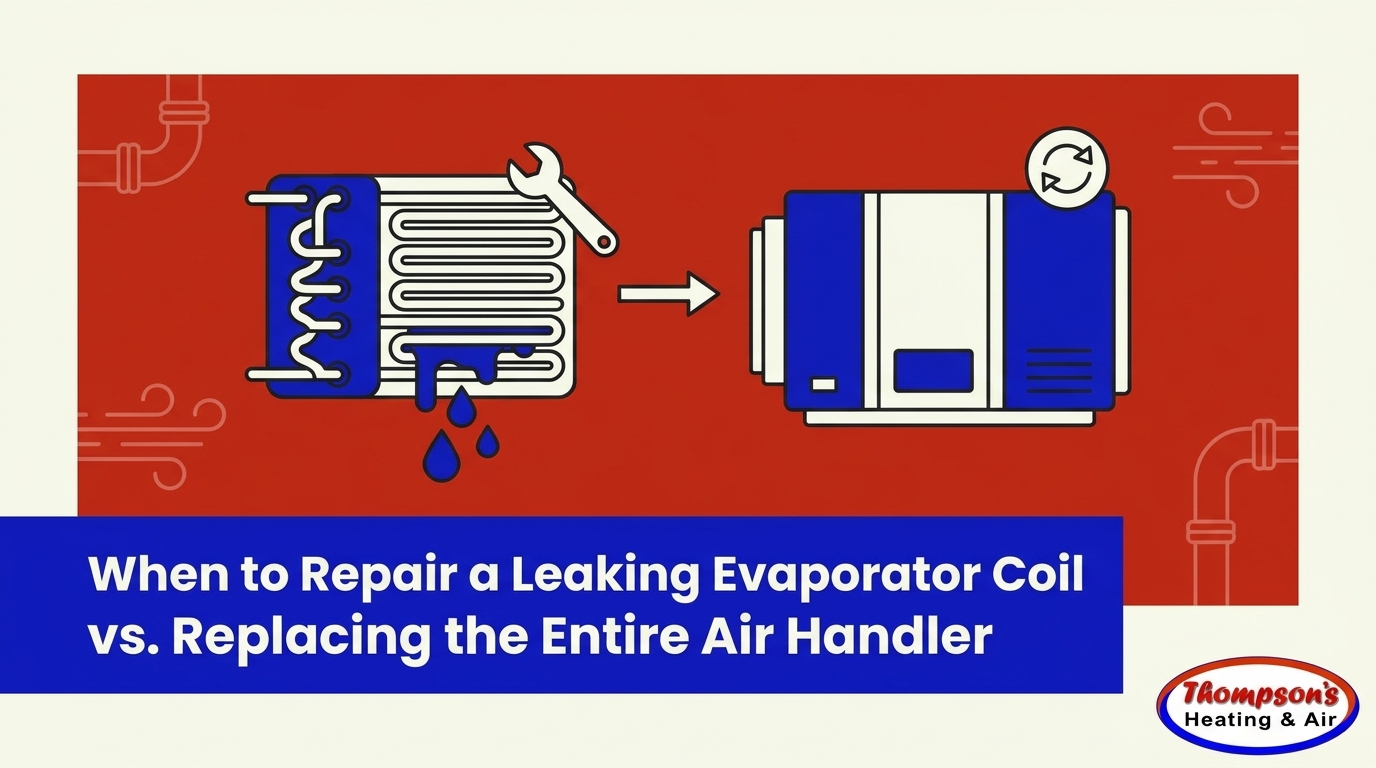
The Myth That Every Refrigerant Leak Requires a New System
At Thompson's Heating & Air, we find that many homeowners believe knowing exactly when to repair a leaking evaporator coil vs. replacing the entire air handler is a trick question, assuming that any refrigerant leak automatically means buying a brand-new system. That misconception often leads to unnecessary panic, especially when your air conditioning starts blowing warm air right in the middle of a brutal summer heat wave. The reality we see in the field is far more nuanced. A leak in your indoor cooling coil is a serious mechanical issue, but it does not always dictate a total system overhaul.
When you are facing a sudden breakdown during the July peak cooling load, the stress of a hot house can push you toward rushed decisions. However, evaluating whether to patch the leak or replace the aging air handler requires looking at objective criteria rather than reacting to the immediate discomfort. Making the right choice ensures long-term reliability without spending money unnecessarily on a premature replacement. By understanding the specific factors that dictate a repair versus a replacement, you can navigate this frustrating situation with confidence and clarity.
For reliable Air Conditioning solutions and expert AC repair services, our team is ready to help you make the most cost-effective choice for your home.
Understanding the Evaporator Coil's Role and Why It Leaks
Before making any major decisions about your HVAC system, it helps to understand exactly what the evaporator coil does and why it is susceptible to leaking in the first place. This component sits inside your home, usually attached to your furnace or integrated into the air handler. Its primary job is not actually to create cold air, but to remove heat and humidity from your indoor air.
In our years serving Woodland and the broader Sacramento Valley, our technicians have seen firsthand how frequent 100-plus degree days force local systems to run almost continuously. This relentless operation accelerates wear and tear, exposing hidden weaknesses like microscopic leaks. Here is a breakdown of how the process works and where it goes wrong:
1. Heat absorption: Warm indoor air is blown across the chilled metal fins of the evaporator coil. The cold liquid refrigerant inside the copper or aluminum tubing absorbs the heat, turning into a gas in the process.
2. The threat of formicary corrosion: Over time, volatile organic compounds (VOCs) from everyday household items—like cleaning sprays, air fresheners, and off-gassing furniture—mix with the natural condensation on the coil. This chemical reaction causes formicary corrosion, creating microscopic pinhole leaks in the metal.
3. Loss of refrigerant pressure levels: As refrigerant slowly escapes through these microscopic holes, the system loses its precise pressure balance. Air conditioners are sealed systems designed to operate at exact refrigerant pressure levels. Even a minor drop severely impacts the unit's cooling capacity.
4. Compressor strain: Running a system with incorrect pressure forces the outdoor compressor to work twice as hard to achieve the same cooling effect. This overworking rapidly degrades the compressor, risking a catastrophic and highly expensive failure.
Because these leaks are often microscopic and hidden within the densely packed fins of the coil, finding and addressing them requires specialized equipment. Ignoring the structural degradation of the metal only guarantees that the problem will multiply over time.
When Repairing the Evaporator Coil Makes the Most Sense
Finding a leak does not mean your system is destined for the scrap heap. In many scenarios we encounter, repairing or patching the evaporator coil is the most financially and mechanically sound choice you can make. The decision to repair hinges on the overall vitality of your equipment and the specific nature of the leak itself.
Based on the patterns we see most often in the field, our team typically recommends a targeted repair if your system meets the following criteria:
• Age of the unit: Systems that are under eight to ten years old generally have plenty of life left in them. Replacing the entire air handler on a relatively young system is often an inefficient use of your resources.
• Refrigerant type: If your system utilizes current, widely available refrigerants, topping off the system after a successful patch is highly viable. You are not fighting against industry phase-outs or scarcity issues.
• Overall system health: An evaporator coil does not operate in isolation. If your outdoor condenser is running smoothly and your indoor blower motor is in excellent condition, a targeted coil repair preserves your initial investment in the system.
• Severity of the leak: Minor, highly accessible leaks can sometimes be successfully sealed by a professional technician. If the corrosion is isolated to a single, reachable joint rather than spread across the entire coil face, a repair holds a much higher chance of long-term success.
Warranty Considerations for Newer Units
One of the biggest factors our technicians look for in favor of repairing a newer system is the manufacturer's warranty. Most modern HVAC equipment comes with a standard parts warranty that lasts for several years, provided the system was registered properly after installation.
You should always check if the air handler is still under this original coverage. If the coil fails while under warranty, the manufacturer typically covers the cost of the replacement part. In this scenario, replacing just the coil—which functions as a major repair for the whole system—becomes highly cost-effective. You are only responsible for the labor and the fresh refrigerant, making the decision to repair an easy one.
When Replacing the Entire Air Handler is the Only Viable Option
While repairing is ideal for newer units, there comes a point where patching a failing coil transforms into a risky, temporary band-aid. Continuing to sink funds into a deteriorating system often leads to compounding failures. Knowing when to walk away from an old air handler protects your home from sudden breakdowns and poor indoor comfort during peak summer months.
The Problem: Older systems begin to fail across multiple components simultaneously. When an evaporator coil develops widespread formicary corrosion, our team usually identifies it as a symptom of overall system fatigue rather than an isolated incident.
The Cause: Several factors converge to make older systems obsolete. First is the simple reality of mechanical aging; air handlers over 10 to 15 years old are nearing the end of their operational lifespan. Second, the EPA's AIM Act is actively phasing down R-410A refrigerant. This regulatory shift means that maintaining older, leaky systems that rely on phased-out refrigerants becomes a growing liability as supplies dwindle.
The Solution: At Thompson's Heating & Air, our technicians often evaluate the repair cost relative to the age of the equipment to remove guesswork. As a general rule, if the cost of patching the leak and recharging the system approaches half the value of a new unit—especially on an air handler over a decade old—replacement is generally recommended. Furthermore, installing a brand-new coil into a severely degraded, 15-year-old air handler often leads to mismatched efficiency. The new coil cannot perform optimally if the old blower motor is weak. In these cases, opting for a complete AC replacement in Woodland is the only viable way to restore reliable, energy-efficient cooling to your home. Upgrading may also qualify you for generally applicable federal tax credits or local utility incentive programs for high-efficiency cooling installations, making a replacement even more sensible. (Always verify current programs with your utility or a tax professional).
The Risks of Delaying Action During Peak Summer Heat
When you notice your air conditioner struggling to keep up, the worst thing you can do is ignore the symptoms. Delaying a professional diagnosis during the intense heat of summer puts your entire HVAC system in jeopardy. The strain of the July peak cooling load demands near-continuous operation, and a compromised system simply cannot handle that level of thermal stress.
Many homeowners hope that a quick, over-the-counter leak sealant will solve the problem. However, temporary leak sealants often fail under the intense pressure and continuous operation required during a heat wave. These chemical additives can sometimes gum up the internal components, causing more harm than good.
Ignoring a slow leak inevitably leads to a chain reaction of mechanical failures. As the refrigerant drops, the coil gets too cold and freezes over. This frozen coil blocks airflow entirely. When the system eventually shuts off and the ice melts, the resulting water damage can overflow the drain pan, ruining ceilings or floors. Most critically, running the system without exact refrigerant pressure levels starves the compressor of the cool vapor it needs to prevent overheating, leading directly to compressor burnout.
During consecutive 100-plus degree days in Woodland, an underperforming AC is not just uncomfortable; it is a severe disruption to your home life. Our team at Thompson's Heating & Air has seen this exact scenario play out. During a brutal stretch of extreme temperatures last summer, one local homeowner's system failed completely. With technicians fully booked across the region, our owner personally went out to fix the AC unit immediately, providing much-needed relief. Immediate professional intervention is the only way to prevent a minor leak from turning into a total system loss.
Side-by-Side Comparison: Repair vs. Replace Decision Matrix
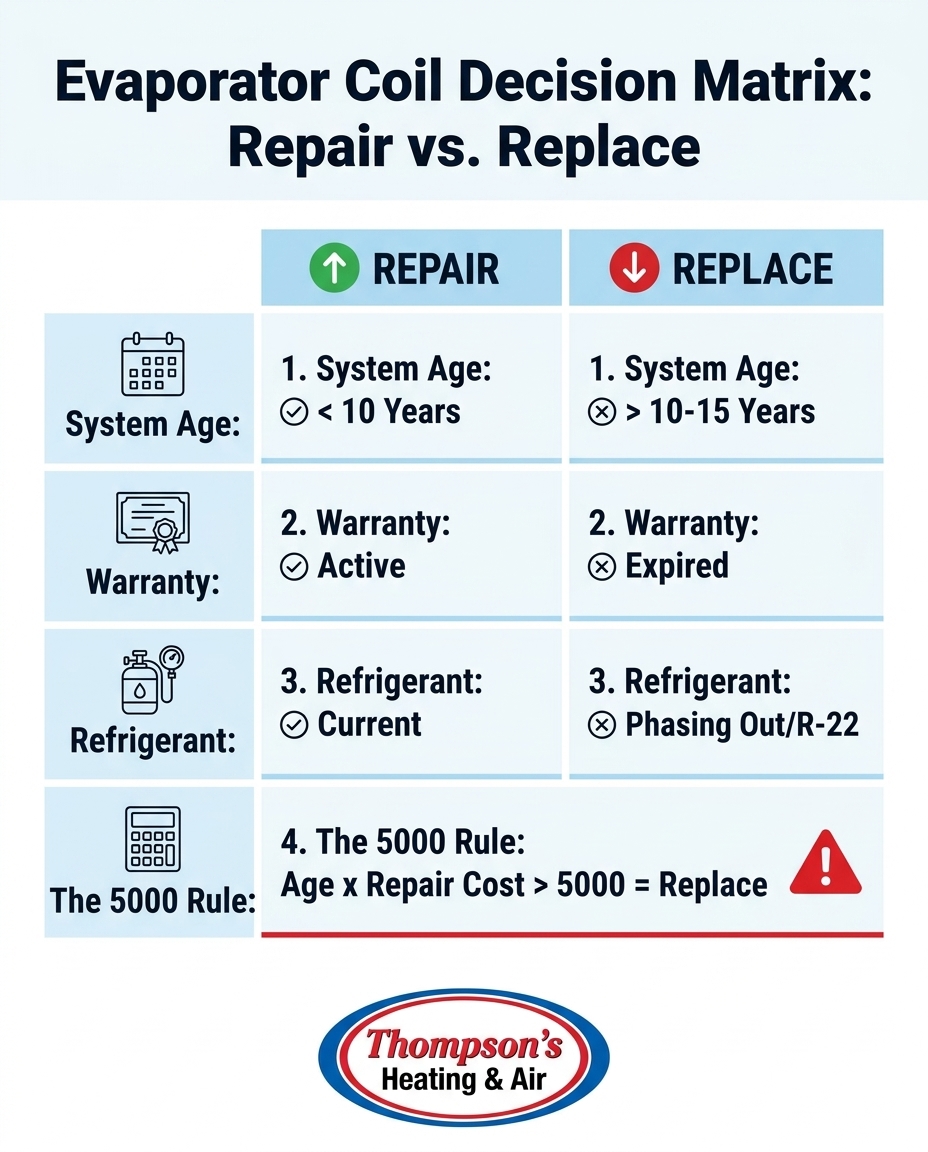
When you are sweating in your living room, it is easy to make a reactive choice. To help you navigate this complex mechanical issue, our experts at Thompson's Heating & Air have synthesized the core criteria we use in the field into a straightforward decision matrix. This framework removes emotion and sales pressure from the equation, relying purely on mechanical and financial logic.
By weighing these four critical factors against your current system's condition, you can clearly see which path offers the best long-term value for your home.
• System Age — Lean Toward Repair (Coil Patch/Swap): Under 10 years old — Lean Toward Replace (Full Air Handler): Over 10 to 15 years old
• Warranty Status — Lean Toward Repair (Coil Patch/Swap): Active manufacturer parts warranty — Lean Toward Replace (Full Air Handler): Expired warranty coverage
• Refrigerant Type — Lean Toward Repair (Coil Patch/Swap): Current, widely available formula — Lean Toward Replace (Full Air Handler): Phased-out or heavily restricted formula
• Leak Severity — Lean Toward Repair (Coil Patch/Swap): Minor, accessible, isolated pinhole — Lean Toward Replace (Full Air Handler): Severe, widespread corrosion, inaccessible
If your system falls predominantly in the repair column, a targeted fix is a solid investment. If the factors align heavily in the replace column, continuing to patch the unit will likely result in ongoing frustration and repeated service calls.
Partnering with an Honest Professional for Your Assessment
A proper diagnosis of an evaporator coil leak is not something that can be guessed by simply looking at the unit. It requires specialized diagnostic tools, such as electronic leak detectors and ultraviolet dye tests, to pinpoint the exact location of the escaping refrigerant and assess the overall health of the system.
This is where partnering with a trusted advisor becomes critical. You need a transparent assessment that prioritizes your long-term comfort and household budget over pushing an unnecessary system upgrade. An honest professional will evaluate the blower motor, the control board, and the outdoor condenser before making any recommendations. At Thompson's Heating & Air, we pride ourselves on providing clear, criteria-based evaluations so you understand exactly what is happening inside your equipment.
Sometimes, what seems like a fatal system flaw can actually be resolved with a targeted, honest repair strategy. For example, one local homeowner was convinced their older air conditioning system was completely dead and was fully prepared to purchase a new one. However, after a thorough examination, our technician determined it only needed a minor tune-up. That single, honest repair extended the life of their system by another nine years.
You should always seek evaluations from technicians who present all options clearly. For more insights on evaluating your equipment's true condition, read our guide on Signs Your HVAC Needs Replacing and Not Just Another Band-Aid.
Make the Right Call for Your Air Handler Today
Knowing the exact criteria for patching a leak versus replacing the air handler brings tremendous peace of mind. You no longer have to guess if you are making a wise investment or throwing money at a sinking ship. By evaluating the unit's age, warranty status, and refrigerant compatibility with a trusted local professional, you take control of your home's comfort.
If your system is struggling to keep up with the summer heat, do not wait for a total breakdown. Schedule a professional evaluation with Thompson's Heating & Air to determine your system's exact needs. Taking prompt action ensures you can restore reliable, leak-free cooling and get back to enjoying a comfortable home.
Frequently Asked Questions
Can a leaking evaporator coil be repaired permanently?
In our experience, while repairs can be highly effective, they are rarely permanent if the underlying cause is widespread corrosion. If the leak is isolated to a single accessible joint, a professional braze can hold up for years. However, if the coil is suffering from formicary corrosion across the metal fins, patching one hole usually means another will open up soon after. A thorough professional assessment is required to determine if a patch will actually hold.
Is it worth replacing an evaporator coil on an older unit?
Replacing a coil on a unit older than 10 to 15 years is generally not recommended by our technicians. Older systems often use phased-out refrigerants, and the remaining components, like the blower motor, are likely nearing the end of their lifespan as well. Putting a brand-new coil into a degrading system can lead to mismatched efficiency and further mechanical failures down the line. In these cases, a full system replacement is usually the better financial decision.
How long does an evaporator coil typically last?
Across the Woodland area, we find that most evaporator coils are designed to last between 10 and 15 years under normal operating conditions. However, this lifespan can be significantly shortened by poor maintenance, heavily polluted indoor air (which accelerates corrosion), or continuous operation in extreme climates. Regular tune-ups and frequent air filter changes help minimize the stress on the coil and extend its functional life.
Does a new evaporator coil require a new condenser?
You do not always have to replace the outdoor condenser when installing a new indoor coil, but they must be completely compatible. The indoor and outdoor units are designed to work together at specific efficiency ratings and with specific refrigerants. If your outdoor unit is old and uses an outdated refrigerant, you cannot simply attach a modern coil to it; in that scenario, both components must be replaced together.
What are the symptoms of a leaking evaporator coil?
The most common sign we see is an air conditioner blowing warm or room-temperature air despite running continuously. You might also notice ice building up on the copper refrigerant lines or directly on the indoor coil itself. Additionally, a leak often causes the system to short-cycle, turning on and off rapidly as it struggles to manage the incorrect internal pressure levels.
How does the R-410A phase-down affect my repair options?
The EPA's phase-down of R-410A means that this specific refrigerant will become increasingly scarce in the coming years. If your current older system relies on R-410A and develops a severe leak, investing heavily in a repair might not make long-term sense. As supplies dwindle, topping off leaky systems will become more difficult, making a full upgrade to a system using modern, compliant refrigerants a safer bet.



.avif)
.avif)
.png)
