
Troubleshooting a Goodman AC Unit That Trips the Breaker Repeatedly

The Danger of the "Quick Reset": Why Your Goodman AC Breaker Keeps Tripping
Flipping a switch back on seems like a harmless fix, but troubleshooting a Goodman AC unit that trips the breaker repeatedly requires much more than a quick reset. In our years of servicing HVAC systems at Thompson's Heating & Air, we've seen firsthand that a tripped breaker is not a simple nuisance; it is a critical safety mechanism doing exactly what it was designed to do—stopping the flow of electricity before it causes a fire. When your electrical panel cuts power to your air conditioner, it usually points to a concrete problem: an aging Goodman compressor is drawing excessive amperage on startup.
As a homeowner, you now face an important decision point. You need to determine if this power surge is a simple electrical fix, like a worn-out part, or a sign of terminal compressor failure. Ignoring the warning signs and forcing the system to run by repeatedly resetting the breaker puts your home at serious risk. Professional diagnostics are required to safely resolve the issue without risking an electrical fire or permanently destroying your equipment.
If you are dealing with a breaker that refuses to stay on, it is time to schedule professional AC repair to find the root cause.
Understanding LRA: Why Your AC Compressor Pulls Too Much Power on Startup
To understand why your breaker keeps tripping, you need to understand how your Goodman AC unit consumes electricity. Air conditioners have two different types of electrical demand: running amps and startup amps. Running amps represent the steady flow of electricity your system uses while actively cooling your home. Startup amps, technically known as Locked Rotor Amps (LRA), represent the massive jolt of electricity required to get the heavy compressor motor turning from a complete standstill.
The physics of startup power: During the first fraction of a second when your thermostat calls for cooling, your compressor can draw three to five times its normal running amperage. In a healthy system, the electrical components handle this brief surge effortlessly. However, as internal components age, they face increased physical friction. The motor has to work much harder to overcome this resistance, forcing the system to pull even more electricity from the panel just to turn over.
When that electrical draw exceeds the safety limit of your circuit breaker—often 30 to 50 amps for a central AC system—the breaker trips to prevent the wires from overheating and melting. Because this involves high-voltage electricity, you should never attempt DIY electrical testing on your HVAC system. Testing live voltage without proper training and insulated tools is extremely dangerous.
At Thompson's Heating & Air, we see this scenario frequently during the hottest parts of the year. One Woodland customer reached out to us when their AC system broke down right as record high temperatures were predicted. Our team was able to come out the same day to provide Woodland AC repair services, diagnosing the excessive power draw and getting the system safely back online before the heat peaked.
Failing Capacitors: The Most Common Culprit Behind Hard Starts
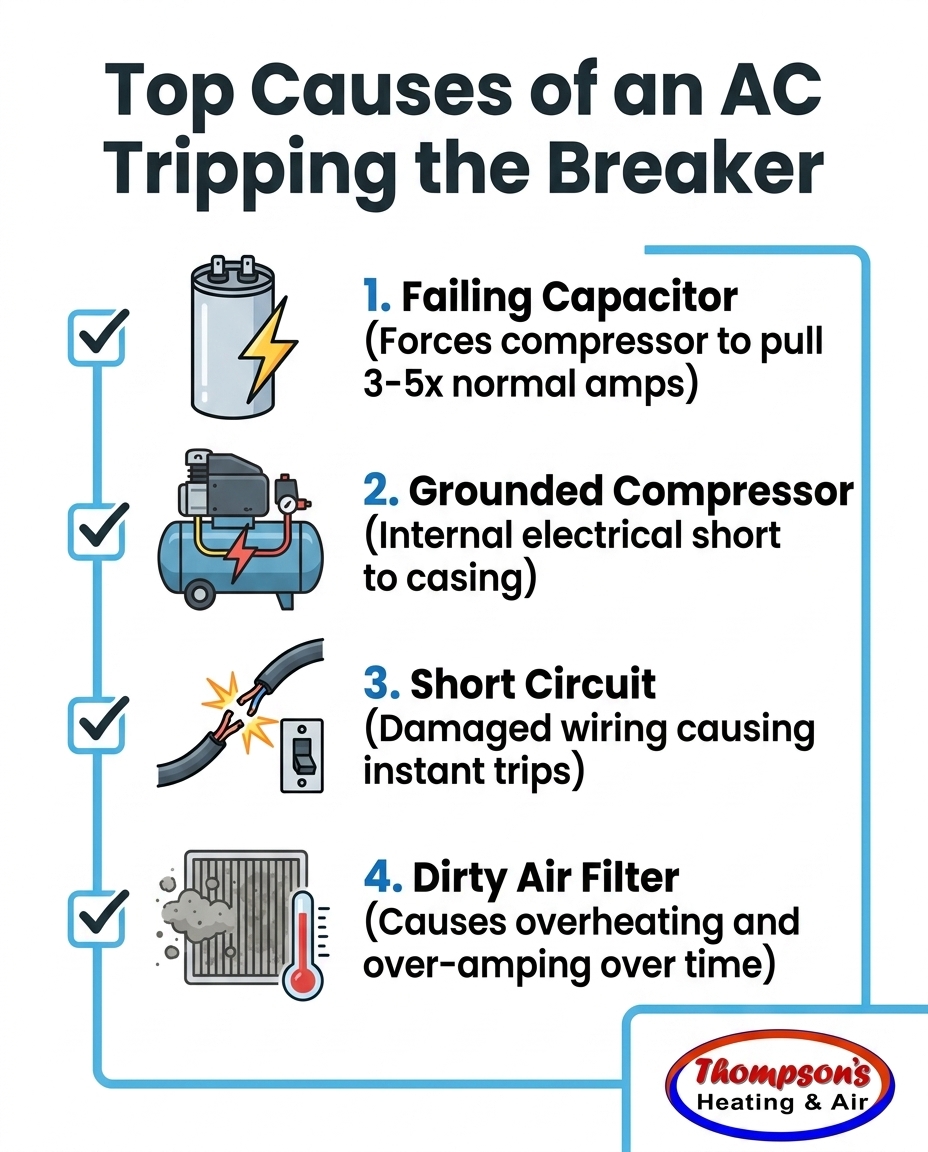
If your Goodman AC unit is tripping the breaker, the most frequent cause our technicians find is a failing run capacitor. This small, cylindrical component acts like a powerful battery that stores energy and delivers it to the compressor precisely when it needs to start.
What is the role of the run capacitor?
The run capacitor provides the initial, massive jolt of electricity required to overcome the resting inertia of the compressor motor. By delivering this stored energy, the capacitor takes the heavy lifting off your home's electrical panel. Once the compressor is running, the capacitor continues to provide a steady, even flow of voltage to keep the motor spinning smoothly.
How does a degraded capacitor cause a breaker trip?
Over time, capacitors lose their ability to store and hold a charge. We see this constantly during August end-of-season cooling wear, when systems have been running non-stop for months. When a weakened capacitor fails to provide that crucial startup boost, the compressor is forced to pull all the necessary startup voltage directly from your electrical panel. This sudden, massive demand overloads the circuit, causing the breaker to trip instantly.
What are the visible signs of a failing capacitor?
While you should never open the electrical panel on your AC unit yourself, our technicians look for several clear physical signs of capacitor failure during an inspection:
• Bulging tops: The flat top of the capacitor swells outward, looking like a bloated tin can.
• Leaking fluid: The oily dielectric fluid inside the capacitor begins to seep out down the sides.
• Rust and corrosion: Heavy rust on the electrical terminals prevents a clean connection.
• Clicking sounds: A distinct clicking noise from the outdoor unit when the system tries to start.
How can preventative care stop this problem?
Capacitors rarely fail without warning; they degrade slowly over time. Connecting your system to routine AC maintenance allows a technician to test the microfarad reading of your capacitor. If it is testing weak, it can be replaced cheaply and easily before it ever causes an emergency breaker trip or damages your compressor.
Grounded Compressors and Short Circuits: When the Problem is Severe
While a bad capacitor is a relatively simple fix, a tripping breaker can also point to a severe, terminal failure within the system. Understanding these major electrical faults helps clarify why we always stress that professional diagnostics are absolutely necessary.
Here is exactly what happens when the internal electrical components of your Goodman AC unit suffer a catastrophic failure:
1. The insulation breaks down: Inside the heavy steel shell of your compressor, copper electrical windings are coated in a thin layer of protective insulation. Over years of use, heat, and acidic buildup, this insulation can burn away or deteriorate.
2. The compressor becomes grounded: Once the insulation is gone, the bare electrical wiring touches the metal casing of the compressor. This creates a "grounded compressor." The electricity bypasses its intended path and shoots directly into the metal frame of the unit.
3. The breaker trips instantly: Because the electricity is flowing directly to the ground without resistance, it creates a massive, instantaneous power surge. The circuit breaker detects this dead short and trips the very second your thermostat calls for cooling.
4. Short circuits in the wiring: Similarly, if the external wiring connecting the unit to the house is chewed by rodents, frayed by vibration, or melted by a loose connection, the bare wires can touch. This creates a short circuit that also instantly trips the breaker.
A grounded compressor is an unrepairable component failure. You cannot open a sealed compressor to rewind the copper wiring. If a compressor is grounded, you must replace the compressor itself or the entire condensing unit. Thompson's Heating & Air differentiates by measuring exact compressor amp draw to provide honest diagnostics, rather than guessing or simply resetting the system. We use advanced multimeters to test the electrical resistance of the windings, giving you absolute proof of the failure before recommending a replacement.
How Late-Summer Heat Multiplies Strain on Aging HVAC Systems
Mechanical failures rarely happen in a vacuum. They are heavily influenced by the environment and the workload placed on the system. As Woodland's local HVAC experts, we know firsthand how the Sacramento Valley's sustained 100+ degree days push aging HVAC electrical components past their failure thresholds during the late summer months.
Cumulative thermal stress: By the time August arrives and kids are heading back to school, your air conditioner has likely been running continuously for months. This creates a phenomenon known as August end-of-season cooling wear. The copper windings inside the compressor expand and contract with the heat every single day. Over time, this constant thermal stress weakens the structural integrity of the internal components. An aging system that performed perfectly fine during the milder days of June may finally cross its breaking point after weeks of relentless, triple-digit heat.
Sustained high temperatures also degrade the dielectric fluid inside your capacitors much faster. Heat is the natural enemy of electrical storage. As the ambient temperature around the outdoor unit rises, the capacitor loses its ability to shed heat, causing the internal fluids to boil, expand, and eventually fail.
We see the impact of this seasonal strain constantly. Another local homeowner noticed their air conditioning was working poorly just as a major heat wave approached. Our technicians came out the next day, showed up right on time, and fixed the underlying electrical problem before the sustained heat could cause the breaker to trip or the compressor to fail entirely. Recommending proactive system checks before predicted heat waves is the best way to avoid sudden, uncomfortable power outages.
The Severe Safety Hazards of Repeatedly Resetting Your Breaker
One of the most dangerous habits a homeowner can develop is treating a tripped breaker like a mild inconvenience. If your air conditioner trips the breaker, it is sending you a very clear, urgent warning. Repeatedly flipping that switch back on is a severe safety hazard that can escalate a minor repair into a catastrophic emergency.
Forcing high voltage into a compromised circuit: Every time you reset a tripped breaker, you are intentionally forcing 240 volts of electricity back into a system that has already told you it cannot handle it. If the issue is a grounded compressor or a short circuit, that electricity has nowhere safe to go. It will instantly arc, spark, and generate massive amounts of heat.
Repeated resets can cause permanent terminal blowout on the compressor. This happens when the electrical terminals on the side of the compressor literally melt and blow out of the steel casing, venting pressurized refrigerant and highly flammable oil into the air. Furthermore, constantly surging your electrical panel creates a very real risk of electrical fires. The wires connecting the breaker to the AC unit can overheat, melting their protective insulation and igniting the surrounding materials inside your walls.
The rule of thumb is simple and non-negotiable: If the breaker trips once, you can safely reset it to see if it was just a random power fluctuation. If it trips a second time, leave it off immediately and call a professional. You can troubleshoot an AC that is not cooling properly by checking your air filter or thermostat settings, but you must never force a system to run through a persistent electrical fault.
Repair vs. Replacement: Navigating Your Options
When you are dealing with a Goodman AC unit that repeatedly trips the breaker, the diagnostic results will force you to make a choice. Understanding when a repair makes sense and when a replacement is inevitable helps you make an informed, confident decision for your home.
• Failing Capacitor — Viable Repair Options: Replacing the bad capacitor is a fast, common repair that instantly restores the proper startup voltage to the compressor. — When Replacement is Necessary: Not applicable unless the dying capacitor has already caused permanent damage to the compressor motor.
• Electrical Short — Viable Repair Options: Fixing a loose wire, replacing a burnt contactor, or repairing chewed wiring near the outdoor unit. — When Replacement is Necessary: If the short has melted multiple internal components or damaged the main control board on an out-of-warranty unit.
• Grounded Compressor — Viable Repair Options: None. A grounded compressor cannot be repaired or rewired. — When Replacement is Necessary: Requires replacing the compressor itself, or upgrading the entire outdoor condensing unit if the system is older.
• August end-of-season cooling wear — Viable Repair Options: Installing a hard start kit to give an aging, high-friction compressor an extra boost of power. — When Replacement is Necessary: If the system is over 10-15 years old, uses obsolete R-22 refrigerant, and is pulling excessive power on every cycle.
If your system has suffered a major electrical failure like a grounded compressor, you must weigh the cost of a major repair against the long-term efficiency benefits of upgrading an aging, power-hungry unit. Newer systems draw significantly less amperage and handle late-summer heat far better than older models. If you decide to pursue AC replacement, our team can help you identify generally applicable energy rebates or federal tax credits for high-efficiency upgrades, as these programs can help offset the initial investment of a modern system. Always verify current incentive programs with your utility provider or a tax professional.
Frequently Asked Questions About Tripping AC Breakers
Why does my Goodman AC trip the breaker after a few minutes?
If the breaker trips after the system has been running for several minutes, it usually indicates the compressor is overheating and drawing too much amperage as it runs. This is often caused by a severely dirty air filter restricting airflow, which forces the system to work harder to breathe. It can also be a symptom of a failing run capacitor that is struggling to maintain a steady voltage to the motor. Turn the system off at the thermostat, check your air filter, and call a professional if the filter is clean.
Is it safe to turn a tripped AC breaker back on?
It is generally safe to reset a tripped breaker exactly once to see if the trip was caused by a temporary, fluke power surge from the utility company. However, if the breaker trips a second time, it is absolutely unsafe to reset it again. A breaker that refuses to stay on is actively protecting your home from a dead short or a massive power overload. Forcing it back on creates a severe risk of melting the wires in your electrical panel and starting a fire.
Can a bad capacitor cause the AC breaker to trip?
Yes, a bad capacitor is one of the most common causes of a tripping breaker in residential HVAC systems. A weak or degraded capacitor fails to provide the massive startup boost the compressor needs to overcome resting friction. Without that boost, the compressor pulls all the necessary excessive amps directly from the electrical panel, instantly overloading the circuit and tripping the breaker. A technician can easily test and replace a weak capacitor during a routine service visit.
How do I know if my AC compressor is shorted?
If your AC compressor is shorted or grounded, the breaker will typically trip instantly the exact moment the thermostat tries to turn the air conditioner on. You will not hear the system run for a few minutes; the power cut will be immediate. Diagnosing a shorted compressor requires a licensed technician using a specialized multimeter to safely test the electrical resistance of the internal windings. Homeowners should never attempt to test high-voltage compressor terminals themselves.
Will a hard start kit stop my breaker from tripping?
A hard start kit can help an aging compressor overcome startup friction, significantly reducing the initial amp draw and taking the strain off your electrical panel. However, it is a bandage for a dying compressor, not a permanent cure for a grounded electrical system. If your compressor is mechanically failing or has an internal short, a hard start kit will not solve the problem. A technician must measure your system's amp draw to determine if a hard start kit is a viable solution.
Get Expert Diagnostics for Your Tripping AC Breaker
A tripping breaker is a loud, clear cry for help from your HVAC system. Whether your Goodman AC unit is struggling with August end-of-season cooling wear, a swollen capacitor, or a grounded compressor, ignoring the problem will only lead to more expensive and dangerous outcomes. The severe danger of forcing repeated resets cannot be overstated—your electrical panel is trying to protect your home from a fire.
Do not gamble with high-voltage electricity or let an aging compressor ruin your comfort during the hottest days of the year. Scheduling a professional diagnostic allows a trained technician to safely measure the exact amp draw, identify the root cause of the electrical fault, and present you with honest, clear solutions. If you are a Woodland resident dealing with a stubborn breaker, reach out to our team at Thompson's Heating & Air today to restore your peace of mind and get your cooling system running safely again.



.avif)
.avif)
.png)
