
AC Repair in Woodland CA: Troubleshooting Your System Before the October Heating Startup

Transitioning Your System: From Summer Cooling to the First Fall Startup
The first cold snap hits, you flip the thermostat to "heat," and suddenly you are frantically searching for home maintenance tips and troubleshooting advice because a burning smell is filling your home. At Thompson's Heating & Air, our dispatch center receives countless calls during this exact moment. That strange odor coming from your vents is not going away on its own, and it leaves you wondering if your system is completely broken or just waking up from a long hibernation. The October heating-startup is a notorious time for HVAC systems, especially after they have spent the last several months working overtime to battle intense summer heat. We consistently see that moving from extreme cooling strain to the very first furnace cycle of the season puts unique stress on your equipment.
If you need immediate assistance, our Air Conditioning Services team is ready to help, including comprehensive AC repair in Woodland CA to ensure your entire HVAC system transitions smoothly into the colder months.
During the long, hot summer, your cooling system takes a heavy toll. The compressor runs relentlessly, the blower motor pushes thousands of cubic feet of air daily, and the internal components face significant wear and tear. When the weather finally shifts and you demand heat for the first time, our technicians often encounter homeowners facing anxiety when the startup produces strange smells, unusual noises, or uneven heating. You might hear a loud clunk, smell something burning, or notice that some rooms remain stubbornly cold while others heat up too quickly.
Setting the right expectations:
• Sensory shifts are normal: A system that has been dormant for months will naturally produce some minor smells and sounds as it fires up.
• Not all smells are safe: While a brief toasted odor is expected, acrid or electrical smells indicate a serious problem that requires a professional eye.
• Proactive checks save money: Identifying lingering summer wear-and-tear now prevents a catastrophic mid-winter breakdown when you rely on your heater the most.
Establishing a baseline for what is normal versus what requires immediate attention is the key to a stress-free transition. Proactive troubleshooting allows you to address leftover cooling issues and prepare your heating components before the freezing temperatures arrive.
How Sacramento Valley Summers Impact Your HVAC Equipment
To understand why your heater might struggle during the fall transition, you have to look at what your system endured over the summer. In our years of providing HVAC services across the Woodland CA and Central Valley region, our team has seen firsthand how the extreme dry heat impacts equipment. Air conditioners often run through consecutive 100-plus degree days here, and this relentless mechanical strain wears down shared components, particularly the blower motor and the electrical capacitors that keep the system running.
The mechanical toll of extreme heat:
When an air conditioner operates in triple-digit heat, the internal pressures skyrocket. The outdoor condenser works furiously to release heat, while the indoor blower motor runs continuously to circulate conditioned air. This constant operation degrades lubricants in the motor bearings and pushes electrical components to their limits. A system that barely survived August is already in a weakened state. If those stressed components are not addressed, we frequently see them fail when asked to perform the entirely different task of distributing heated air in October.
The impact of agricultural dust:
Beyond the heat, the specific climate of the Sacramento Valley introduces heavy agricultural dust into the equation. Throughout the dry summer and the busy harvest season, massive amounts of airborne particulate matter are kicked up into the air. Even with a good air filter, microscopic dust particles make their way into your ductwork and settle on the internal components of your HVAC system.
While your air conditioner was running, your furnace's heat exchanger was sitting completely idle. For months, this critical heating component acted as a settling ground for fine agricultural dust, pet dander, and household debris. When you finally turn on the heat, the burners ignite, and that heat exchanger rapidly warms up to hundreds of degrees. All that accumulated Woodland summer dust instantly bakes onto the metal surface.
Addressing this leftover cooling wear-and-tear through professional AC maintenance is the best way to clear out the summer debris and ensure the shared blower motor is ready for the heavy lifting of the winter heating season.
That First-Use Burning Smell: Normal Dust Burn-Off vs. Safety Hazards
Our technicians find that the most common reason homeowners panic during the October heating-startup is the sudden, unmistakable smell of burning coming from their air vents. Because the heat exchanger has collected a layer of dust over the summer, the first time it heats up, that dust literally cooks off the metal. However, knowing how to distinguish between a harmless dust burn-off and a dangerous electrical or gas issue is critical for your family's safety.
Identifying Normal Dust Burn-Off
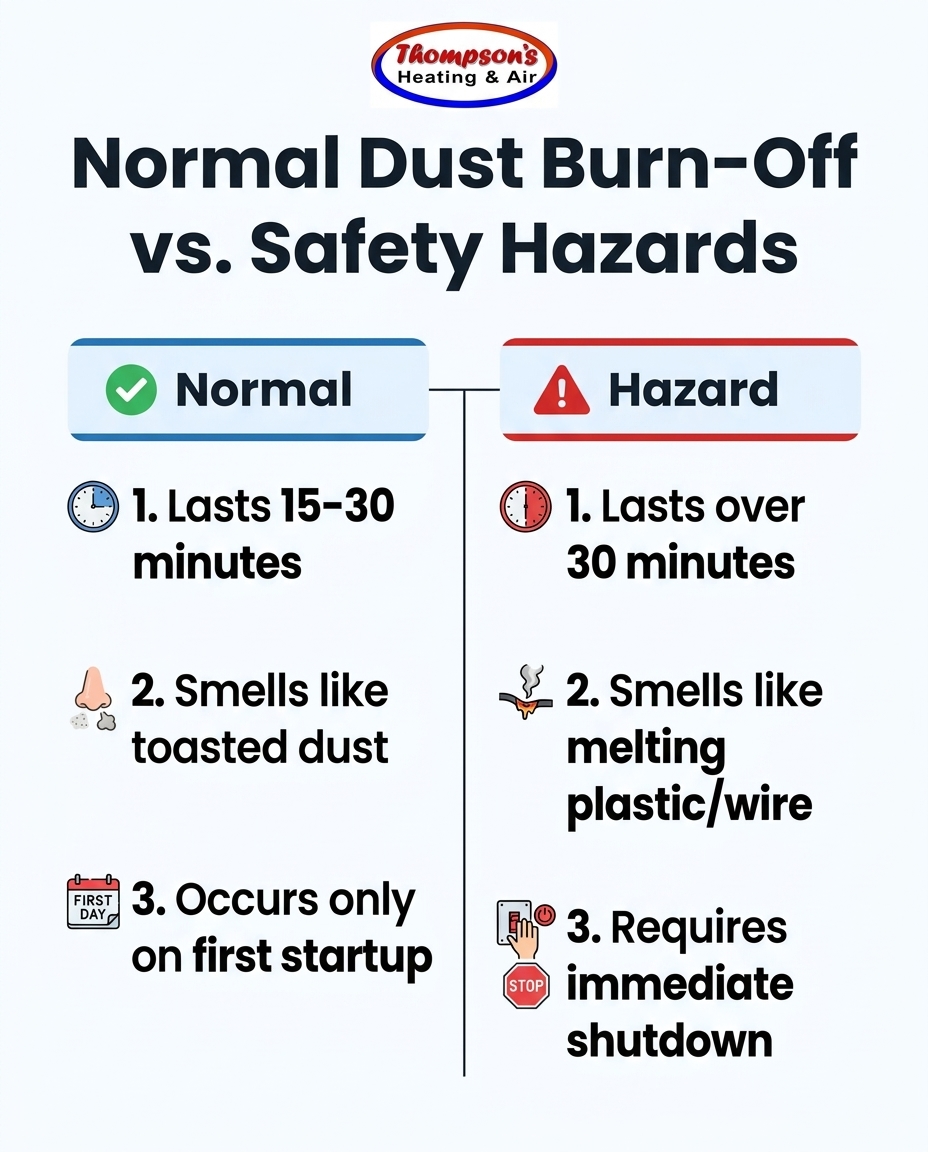
Normal dust burn-off is a temporary, harmless process. It typically smells like toasted dust or a slightly warm, earthy odor. The most defining characteristic of dust burn-off is its duration. It should only last between 15 to 30 minutes during the very first heating cycle of the season. Once the accumulated debris has burned away, the smell will dissipate, and subsequent heating cycles will be odor-free.
Identifying Safety Hazards
If the smell coming from your vents is acrid, chemical, or persists long after the initial startup, you are likely dealing with a safety hazard. These odors indicate that something inside the system is failing, melting, or leaking.
• Melting plastic or rubber: Usually indicates a failing blower motor, a slipped belt, or a foreign object lodged in the ductwork near the heating element.
• Electrical wire or ozone: Smells sharply metallic or like a burning circuit board. This points to an overheating motor, a failing capacitor, or frayed wiring arcing inside the cabinet.
• Rotten eggs or sulfur: This is the unmistakable scent added to natural gas. If you smell this, you have a gas leak. Shut off the system immediately, leave the house, and call your utility company.
When to Take Action
• Toasted, dusty odor — Likely Cause: Summer dust accumulation burning off the heat exchanger — Required Action: Wait 15-30 minutes. If it fades, no action is needed.
• Burning plastic or rubber — Likely Cause: Failing motor or melted component — Required Action: Turn off system immediately at the thermostat and call a pro.
• Sharp electrical / ozone — Likely Cause: Overheating wiring or failing circuit board — Required Action: Shut off power at the breaker panel and request diagnostic service.
• Rotten eggs / sulfur — Likely Cause: Natural gas leak — Required Action: Evacuate the home and call the gas company immediately.
If you experience any of the hazard smells, do not wait to see if they go away. Turn the system off immediately and wait for a licensed professional from our team to inspect the unit.
Lingering Cooling Problems? Why You Shouldn't Wait for Winter
Many homeowners make the mistake of ignoring minor air conditioning issues at the end of the summer, assuming they can just switch to heating and deal with the AC next spring. However, we always warn our customers that heating and cooling systems are not entirely separate entities. They share critical components, meaning an unresolved summer cooling issue will almost certainly impact your winter heating performance in the Woodland CA area.
The shared anatomy of your HVAC system:
While the outdoor condenser handles the cooling and the internal burners generate the heat, both systems rely entirely on the exact same blower motor, control board, and ductwork to distribute air throughout your home. If your system was struggling to push cold air evenly in August, it will struggle to push warm air evenly in November. A blower motor that is drawing too much amperage due to worn bearings during cooling season will likely overheat and trip a breaker when you switch to heating mode.
Real-world consequences of delaying repairs:
One of our local customers noticed their air conditioning was working poorly right as a late-summer heat wave was approaching. Rather than waiting it out, they reached out for help. Our technician arrived the next day, showed up on time, and fixed the lingering airflow problem. Because they addressed the issue proactively, they not only restored their cooling capacity but also ensured their shared blower motor was in perfect condition for the upcoming winter. If you are experiencing similar airflow issues, taking time to troubleshoot an AC not cooling properly now is the best way to protect your heating cycle later.
Minor tune-ups vs. catastrophic failures:
Our professional diagnostics often reveal that lingering performance issues are caused by minor, easily correctable problems. A weak capacitor, a dirty flame sensor, or a clogged blower wheel can all be resolved with a basic tune-up. However, if you force a struggling system to run through the demanding winter months, those minor electrical and airflow strains compound, frequently resulting in a catastrophic failure on the first freezing night of the year.
Airflow, Filters, and Combating Agricultural Particulates
The single most effective step we recommend you take to prepare your system for the fall transition requires no tools and no specialized training: managing your airflow and replacing your air filter. In the Woodland CA / Central Valley region, the air filter plays a massive role in protecting both the AC coil during the summer and the furnace heat exchanger during the winter.
During the Sacramento Valley harvest season, the amount of dust, pollen, and agricultural particulate matter in the air increases dramatically. Your HVAC filter acts as the only barrier between this airborne debris and the sensitive mechanical components inside your system. When a filter becomes clogged, it acts like a wall, choking off the airflow. This forces the blower motor to work twice as hard, leading to overheating, short-cycling, and significantly higher energy bills.
Steps for managing your filters during the fall transition:
1. Locate your filter housing: This is typically found at the return air grille inside your home, or in a slot directly attached to the HVAC air handler in the garage or attic.
2. Inspect the current filter: Pull the filter out and hold it up to a light source. If you cannot see light passing through the media, the filter is completely clogged and must be replaced.
3. Choose the right replacement: Look for a filter with a MERV rating between 8 and 11. This provides excellent filtration for household dust and agricultural particulates without restricting the airflow.
4. Avoid overly restrictive filters: Do not buy the thickest, highest-MERV filter available (like MERV 14 or higher) unless your system was specifically designed for it. High-restriction filters can choke older systems, causing the furnace to overheat and shut down on the high-limit safety switch.
5. Install with the correct orientation: Ensure the arrows printed on the edge of the new filter point toward the HVAC unit (in the direction of the airflow).
Checking and replacing your filters before the first major heating cycle clears the path for proper airflow, ensuring your heat exchanger can operate at a safe temperature without overheating.
When to Call a Professional for Diagnostic Services
While changing filters and monitoring for brief dust burn-off smells are great proactive steps, there is a strict line between basic homeowner maintenance and issues that require a licensed professional. Modern HVAC systems utilize high-voltage electricity, combustible natural gas, and complex circuit boards. Attempting to diagnose or repair these components yourself is not only dangerous, but it can also void your manufacturer warranty.
Specific symptoms requiring professional dispatch:
• Persistent burning smells: If a burning odor lasts longer than 30 minutes during the October heating-startup, shut the system down.
• Short-cycling: If the heater turns on, runs for two minutes, and abruptly shuts off before the house is warm, the system is likely tripping a safety sensor.
• Cold air from vents: If the thermostat is set to "heat" but the vents are blowing cold air, you may have a failed igniter, a dirty flame sensor, or a malfunctioning gas valve.
• Loud mechanical noises: Grinding, squealing, or heavy banging sounds indicate failing bearings or a cracked heat exchanger.
The value of honest diagnostics:
When you encounter these symptoms, you need an expert who will provide honest advice. At Thompson's Heating & Air, our team believes in explicit transparency—we will gladly tell you when a service call isn't needed (like during a harmless 15-minute dust burn-off) and we never push for a full system replacement when a targeted, minor repair will solve the problem. Diagnosing electrical or combustion issues requires sophisticated tools to measure gas pressure, test microfarads on a capacitor, and analyze carbon monoxide levels. A licensed professional ensures these vital safety checks are performed accurately.
Rapid response when it counts:
When extreme temperatures hit, a broken system is more than an inconvenience. One of our local customers called at 6 a.m. during a period of intense hot weather because their system had failed overnight. A technician was dispatched rapidly, diagnosed the electrical failure, and completed the repair by 1 p.m. the very same day. If your system completely fails during a temperature swing, reaching out for professional Woodland HVAC repair ensures you get that same level of rapid, reliable service to restore your home's comfort safely.
Frequently Asked Questions About Fall HVAC Transitions in Woodland
Is it normal for a heater to smell like burning dust?
Yes, our technicians frequently reassure homeowners that for the first 15 to 30 minutes of the season, a burning dust smell is entirely normal. This is caused by summer dust that has settled on the heat exchanger over the past few months. When the burners ignite for the first time in the fall, that accumulated dust simply toasts and burns off, creating a temporary odor that will quickly fade.
How long does dust burn off take?
Dust burn-off typically takes 15 to 30 minutes during the very first heating cycle of the year. Once the initial layer of debris is cleared from the heat exchanger, the smell should disappear completely. If the odor lasts longer than half an hour, or if it returns on subsequent days, you should turn the system off and give our team a call to have it inspected.
What does an electrical fire smell like in a furnace?
An electrical fire in a furnace smells sharply of melting plastic, ozone, or burning wire, which is distinctly different from the earthy smell of toasted dust. This odor indicates a serious hazard, such as an overheating blower motor, a failing capacitor, or arcing wires. If you detect this scent, shut off the power to the HVAC system immediately at the breaker panel and call a professional.
Why is my heater blowing cold air on the first use?
If your heater is blowing cold air on the first use, it could be due to a delayed ignition, a thermostat communication error, or a dirty flame sensor that is preventing the gas valve from opening. Because the blower motor turns on to circulate air, you feel a breeze, but without the burners firing, the air remains cold. This requires a licensed technician to diagnose safely, as it involves the combustion components of the system.
When should I call a professional for my furnace?
You should call a professional if your furnace emits a burning smell for more than 30 minutes, makes loud grinding or banging noises, short-cycles rapidly, or fails to reach the temperature set on your thermostat. Additionally, scheduling a pre-winter inspection with our team before the heavy cold arrives is always recommended to ensure the system is operating safely and efficiently.
Can agricultural dust damage my HVAC system?
Yes, the heavy agricultural dust common in the Woodland CA / Central Valley area can significantly impact your HVAC system. When fine dust bypasses a clogged air filter, it coats the indoor coil, the blower motor, and the heat exchanger. This restricts airflow, forces the system to work harder, reduces energy efficiency, and can ultimately lead to premature component failure if not cleaned regularly.
Ensure Reliable Comfort This Season with Thompson's Heating & Air
Transitioning your home from the grueling heat of summer to the chilly nights of fall doesn't have to be a stressful experience. By understanding the difference between normal dust burn-off and genuine safety hazards, you can approach the October heating-startup with confidence. The peace of mind that comes with knowing your system is fully inspected, clean, and operating safely is invaluable as the winter months approach.
Whether you need to address lingering cooling issues from August or you want to ensure your furnace is ready for December, proactive care is the answer. Applying these home maintenance tips and troubleshooting strategies will protect your equipment, but when you need expert hands, our team at Thompson's Heating & Air is here for you. Do not wait for the first freezing night to find out your heater needs help. Contact us today to schedule your pre-winter inspection or book your AC repair in Woodland CA, and ensure your family enjoys reliable comfort all season long.



.avif)
.avif)
.png)
