How Professional Technicians Clean the Sparkler Assembly in Gas Fireplaces

The Frustration of a Clicking Fireplace on the First Chilly Night
You turn the wall switch or press the remote on the first cold evening of the year, expecting instant warmth, but your system refuses to light. Understanding how professional technicians clean the sparkler assembly in gas fireplaces is the first step to solving this exact issue. Instead of a roaring fire, you hear a repetitive, metallic clicking sound echoing from the hearth. The gas might be flowing, but the flame never catches. This is one of the most common and frustrating experiences homeowners face right at the start of the September pre-heating season.
Need immediate assistance with your home's warmth? Explore our heating services or schedule professional heating maintenance to keep your system running reliably all winter long.
That endless clicking isn't just an annoyance; it is your fireplace's ignition system actively trying—and failing—to do its job. After sitting dormant for months, the internal components of your gas fireplace undergo subtle environmental changes. The sparkler assembly, which acts as the heart of the ignition process, is highly sensitive to these changes. When it fails, it requires specialized knowledge and precision calibration rather than simple guesswork.
Why the Clicking Happens Now
Many homeowners wonder why a fireplace that worked perfectly in March suddenly refuses to operate in September. The answer lies in the long period of disuse. Gas fireplaces are not sealed vacuums. They breathe the ambient air of your home, which means they are exposed to everything that floats through your living room during the spring and summer. When the temperature finally drops and you demand immediate heat, those accumulated months of dormancy reveal themselves through a failure to ignite. Fixing this specific issue requires professional intervention because the components involved are delicate, highly calibrated, and tied directly to your home's gas supply.
The Hidden Impact of Summer Dormancy on Ignition Systems
Six or more months of non-use leaves the internal components of a gas fireplace entirely vulnerable to environmental accumulation. While you are enjoying the summer, your fireplace is quietly collecting microscopic debris. This is especially true for homes in the Woodland, CA area, where the dry, dusty agricultural summer creates a unique environment for indoor air quality. The heavy particulate matter common to the Sacramento Valley inevitably finds its way inside dormant fireplaces.
When a fireplace sits idle, several types of debris settle directly on the delicate sensors of the sparkler assembly:
• Agricultural dust: Fine, dry particulate matter from regional farming activities that easily penetrates home envelopes.
• Spider webs: Arachnids love the dark, undisturbed environment of a dormant gas fireplace, often spinning webs directly across the gas pilot hood.
• Pet dander: Microscopic skin flakes and hair from household pets that circulate through the air and settle on cold metal surfaces.
• Ambient household dust: Everyday particulate matter that accumulates over half a year of non-use.
This buildup creates a powerful insulating effect. The dust and webs form a physical barrier over the spark electrode and the heat sensors. Because the ignition system relies on microscopic electrical currents and precise heat transfer, even a fraction of a millimeter of dust can prevent the spark from reaching the gas flow. Clearing this specific type of dormant buildup requires significantly more than just a surface-level dusting with a household rag.
Anatomy of the Sparkler Assembly: What Exactly is Clicking?
To understand why your fireplace is struggling during the September pre-heating season, it helps to understand the anatomy of the sparkler assembly itself. This is not a simple lighter; it is a highly calibrated, millivolt-sensitive system where even a tiny disruption causes total failure.
The clicking sound you hear is the spark electrode attempting to arc. It is actively sending a pulse of electricity, trying to bridge a tiny gap to ignite the pilot gas. However, because the precise conditions for ignition aren't met—usually due to an insulated sensor or a misaligned gap—the spark never catches the gas stream, and the system just keeps clicking.
Core Components of the Ignition System
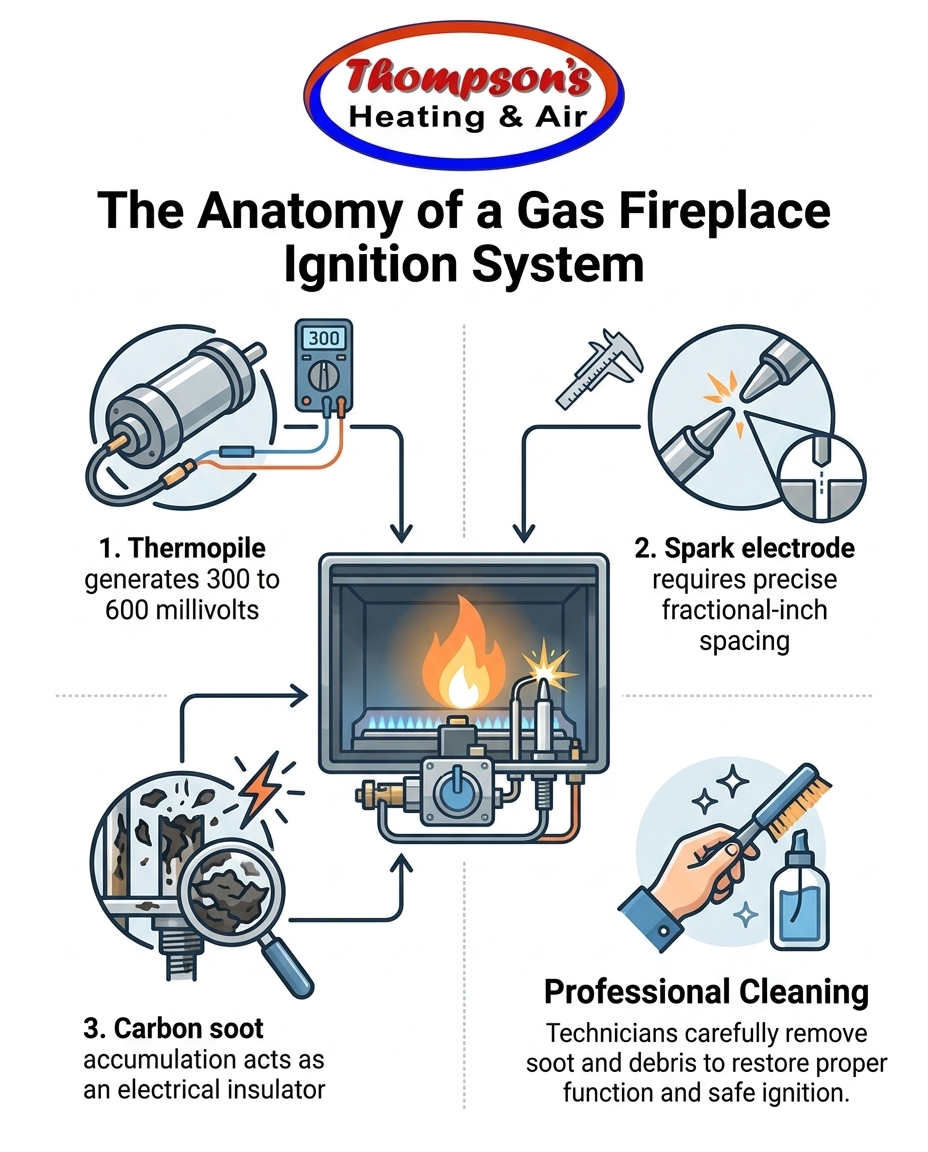
• Spark Electrode — Primary Function: Generates the electrical arc needed to ignite the pilot gas stream. — Why It Fails: Carbon soot or dust insulates the metal, preventing the spark from arcing across the gap.
• Thermopile — Primary Function: Generates a microscopic electrical current (300 to 600 millivolts) when heated by the pilot flame. — Why It Fails: Buildup prevents the pilot flame from heating the sensor enough to generate the required millivolts.
• Pilot Hood — Primary Function: Directs the flow of gas precisely toward the spark and the sensors. — Why It Fails: Spider webs or debris block the tiny gas orifices, disrupting the flow direction.
The science of the thermopile is particularly fascinating. It doesn't plug into your wall; it generates its own electricity through heat. When the pilot flame warms the thermopile, it creates between 300 to 600 millivolts of electricity. This tiny current is just enough to signal the main gas valve to open. If the thermopile is dirty, it can't feel the heat, the millivolts drop, and the gas valve stays firmly shut for your safety.
The Danger of DIY: Why a Simple Scrub Causes Permanent Damage
When faced with a clicking fireplace in Woodland, CA, the common homeowner temptation is to grab a piece of sandpaper, a wire brush, or a household chemical cleaner to scrub off the visible soot or rust. This is one of the most costly mistakes you can make with a gas fireplace.
The sensors inside the sparkler assembly are highly delicate. The outer casing of a thermopile is designed to absorb heat at a very specific rate. Improper cleaning creates micro-scratches on the metal surface. These microscopic abrasions permanently alter how the metal absorbs heat, effectively ruining the thermopile's ability to generate those crucial millivolts. Once the casing is compromised by a wire brush, the sensor is permanently damaged.
The risks of DIY cleaning include:
• Micro-scratches: Abrasive materials permanently damage the heat absorption capabilities of the thermopile.
• Electrode Misalignment: Scrubbing can accidentally bend the spark electrode. Improper spacing by even a fraction of an inch prevents the electrical arc from hitting the gas stream.
• Chemical Residue: Household cleaners leave behind flammable or corrosive residues that react dangerously when the fireplace finally does ignite.
Attempting to clean these components yourself often turns a routine maintenance visit into an expensive parts replacement. Protecting these delicate instruments is exactly why professional calibration is strictly recommended.
The Microscopic Precision of Professional Calibration
When you call for heating repair services, you aren't just getting someone to wipe down the inside of your firebox. Professional technicians approach the sparkler assembly with meticulous, safety-first precision. This is a delicate calibration process, not just a surface scrub.
A typical pattern we see in Woodland during fall involves persistent ignition issues that require exact diagnostic procedures. For instance, during a recent winter, a local customer required a fireplace sparkler replacement, but intermittent clicking issues persisted after a month. Our team returned promptly, diagnosed an underlying microscopic alignment issue with the spark gap, and calibrated the system perfectly at no additional charge. This level of exactness is what ensures the system lights on command.
1. Visual and Diagnostic Inspection: Technicians first examine the pilot assembly for spider webs, carbon soot, and agricultural dust accumulation.
2. Precision Soot Removal: Instead of harsh wire brushes, professionals use specialized, non-abrasive materials—like ultra-fine emery cloth used with very specific, gentle techniques—to clear carbon soot without abrading the metal surface of the sensors.
3. Orifice Clearing: The tiny gas ports in the pilot hood are carefully cleared of microscopic debris to ensure the gas flows directly over the thermopile.
Measuring Millivolt Output
Professional technicians don't just clean; they diagnose underlying issues that might cause persistent ignition failures. Using sensitive multimeters, technicians verify that the thermopile is generating the necessary 300 to 600 millivolts when heated. If the reading is too low (for example, hovering around 150 millivolts), the technician knows the main gas valve will not stay open safely, and further adjustments are required. This confirms the cleaning was successful and the system is electronically sound.
Electrode Alignment
The spark gap must be adjusted to exact manufacturer specifications. Technicians ensure the spark electrode is spaced at the precise fractional inch required so that the electrical arc hits the exact right spot in the gas stream. If the gap is too wide, the spark won't jump; if it's too narrow, the spark won't ignite the fuel.
Final Safety Checks for Reliable Autumn Heating
Once the sparkler assembly is meticulously cleaned and calibrated, the professional process moves into the critical reassembly and safety phase. A gas fireplace is a sealed combustion appliance, meaning the way it is put back together is just as important as how it is cleaned.
The reassembly process involves securing the logs in their exact manufacturer-specified positions. If logs are placed incorrectly, they can impinge on the flames, creating excessive carbon soot that will quickly ruin the freshly cleaned sparkler assembly. More importantly, technicians ensure the glass front is perfectly seated and sealed. This glass seal must be absolutely airtight to prevent carbon monoxide and combustion exhaust from leaking into your Woodland, CA living space.
The Test-Fire Phase:
• Flame Color: Technicians look for a healthy, vibrant flame (mostly yellow and orange with a small blue base) rather than a lazy, entirely blue, or excessively sooty flame.
• Flame Height: Ensuring the flames reach the appropriate height without overwhelming the firebox or disappearing entirely.
• Steadiness: Verifying that the pilot flame remains strong and steady, fully engulfing the top third of the thermopile.
A comprehensive professional check provides total peace of mind that the unit will light reliably on demand. For homeowners who find themselves constantly battling an aging, inefficient system, a technician can also discuss alternative heating upgrades, such as the benefits of gas fireplace inserts versus traditional wood burning, to improve both aesthetics and winter efficiency.
Frequently Asked Questions About Gas Fireplace Ignition
Why is my gas fireplace clicking but not lighting?
A clicking gas fireplace usually means the spark electrode is firing, but the gas isn't igniting due to carbon buildup, dust, or a misaligned spark gap. Over the summer, spider webs and particulate matter can insulate the sensors or block the pilot gas flow. When the spark cannot reach the gas, or the thermopile cannot sense heat, the system clicks repeatedly without producing a flame.
Is it safe to clean a gas fireplace igniter yourself?
No, it is highly recommended to avoid DIY cleaning on gas fireplace igniters. The sensors, particularly the thermopile, are incredibly delicate and require specific millivolt outputs to operate safely. Using household tools like wire brushes or sandpaper can create micro-scratches that permanently ruin the sensor, leading to expensive parts replacements and potential gas safety hazards.
How often should a gas fireplace sparkler assembly be professionally cleaned?
You should have your gas fireplace and its sparkler assembly professionally cleaned and inspected once a year, ideally during the early fall or late summer. An annual pre-season tune-up clears away the dust and webs accumulated during summer dormancy, ensuring the fireplace operates safely and reliably on the first cold night of the year.
What is the difference between a thermocouple and a thermopile in a fireplace?
Both are heat sensors, but they generate different amounts of electricity. A thermocouple generates a very small amount of electricity (around 25 to 30 millivolts) just to keep a standing pilot light gas valve open. A thermopile is essentially a larger bundle of thermocouples that generates significantly more power (300 to 600 millivolts), which is enough to operate the main gas valve and a wall switch or remote control.
Can summer dust really stop my fireplace from working in the fall?
Yes, absolutely. Because the ignition system relies on microscopic electrical currents and highly sensitive heat transfer, even a thin layer of agricultural dust or a single spider web can act as an insulator. This summer accumulation blocks the heat from reaching the thermopile, preventing the gas valve from opening and stopping your fireplace from working in the fall.
Ensuring Your Fireplace is Ready for Winter
A clicking fireplace is a clear, undeniable sign that precision maintenance is required. When you hear that repetitive metallic sound during the September pre-heating season, it is your system telling you that summer dust, carbon buildup, or a microscopic misalignment is preventing safe combustion. Understanding how professional technicians clean the sparkler assembly in gas fireplaces reveals exactly why this is not a weekend DIY project.
Reaching for a wire brush or sandpaper puts your delicate thermopile at extreme risk of permanent damage. By relying on meticulous, professional calibration, you protect the intricate millivolt system that keeps your family safe and warm. Don't wait until the deepest freeze of the year to discover your system won't light. Schedule professional heating maintenance today to ensure your fireplace provides reliable, safe, and beautiful warmth all season long.



.avif)
.avif)
.png)
