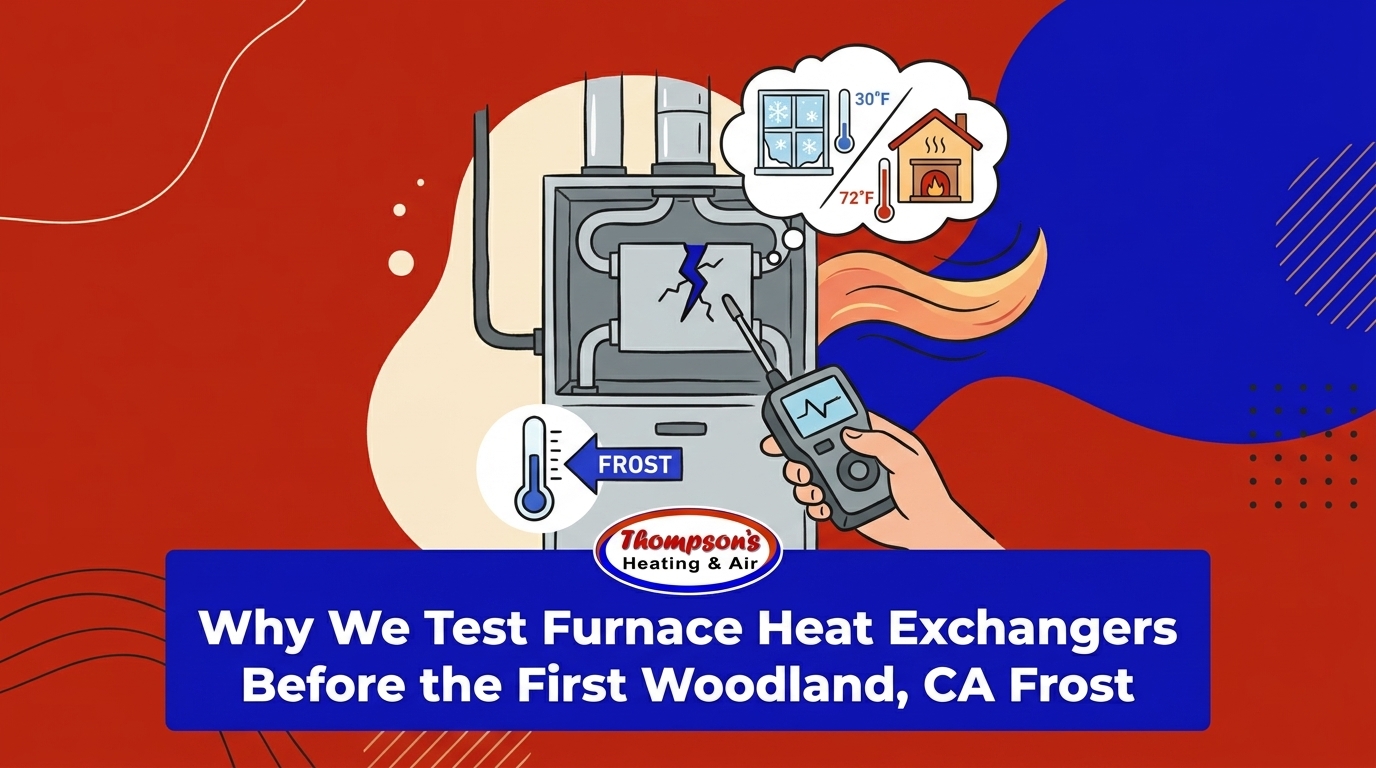
Why We Test Furnace Heat Exchangers Before the First Woodland Frost

The Hidden Danger Lurking in Dormant Late-Summer Furnaces
As August signals a distinct seasonal shift in the Central Valley and families settle into back-to-school routines, homeowners often ask us exactly Why We Test Furnace Heat Exchangers Before the First Woodland Frost. The intensely hot days are still dominating the forecast, but the calendar reminds us that the cooling season is slowly winding down. While your air conditioner has been working overtime, your furnace has been sitting completely dormant for months in the dark, dusty corners of your home. This long period of inactivity is precisely when unseen vulnerabilities—specifically in the heat exchanger—can silently worsen.
For proactive homeowners, securing professional heating services during this late-summer (August) transition is the smartest way to protect your household before the weather turns.
During Woodland's intensely hot summers, your heating equipment is completely forgotten. However, the sudden, sharp transition to chilly fall nights is closer than it appears. When a furnace sits dormant, the microscopic weaknesses that developed during the previous winter's heating cycles remain hidden. The metal components settle, and subtle vibrations from your air conditioning blower can actually exacerbate existing stress points. The critical decision point is right now: verifying the integrity of your system before you are forced to turn it on during a near-freezing overnight low.
The reality of hidden furnace damage:
• Dormancy conceals flaws: A furnace that turned off normally in spring may not be safe to turn on in autumn.
• Visual checks fail: A casual glance with a flashlight cannot detect microscopic breaches in the metal.
• The transition window is narrow: Once the first cold snap hits, emergency service calls skyrocket.
True safety requires rigorous, professional verification. Relying on the assumption that your heater is fine simply because it worked last year is a gamble that risks your family's comfort and health.
Understanding Thermal Stress and Heat Exchanger Fatigue
To understand why proactive furnace maintenance is non-negotiable, you have to understand the physical mechanics of how a heater actually works. The heat exchanger is the most critical component inside your furnace. It acts as the physical barrier between the toxic combustion process (where the gas burns) and the clean breathing air that gets pushed into your living space. As long as this metal barrier is solid, your home is safe and warm.
However, this metal undergoes extreme punishment every single time the thermostat calls for heat. When the burners ignite, the metal rapidly heats to hundreds of degrees, causing it to expand. When the cycle finishes, the blower cools the metal down rapidly, causing it to contract. This constant expansion and contraction is known as thermal stress.
Over the years, this relentless cycle leads to metal fatigue. Think of bending a paperclip back and forth; eventually, the metal weakens and snaps. In a furnace, this fatigue manifests as invisible micro-cracks. While the system sits dormant during the Woodland, CA summer, these weakened areas remain static, waiting for the sudden thermal shock of the first autumn heating cycle to split wide open.
The Anatomy of a Micro-Crack
The most dangerous aspect of heat exchanger fatigue is how stealthy it is. When the furnace is turned off and the metal is cold, these stress fractures close up tight. They often start microscopic, making them completely invisible to the naked eye. They only open up fully when the furnace is running and the metal is hot. This is why a cold, visual inspection by an untrained eye is entirely inadequate.
• Healthy Heat Exchanger — Metal Behavior Under Heat: Expands uniformly, maintains a solid barrier between exhaust and breathing air. — Safety Risk Level: Low - Safe for operation.
• Fatigued (Uncracked) Metal — Metal Behavior Under Heat: Expands with localized stress points; rust or discoloration may be visible. — Safety Risk Level: Moderate - Requires close monitoring.
• Micro-Cracked Metal — Metal Behavior Under Heat: Fissures open up as metal expands, allowing toxic gases to escape into the blower stream. — Safety Risk Level: Severe - Immediate hazard.
Carbon Monoxide: The Invisible Consequence of Compromised Metal
The primary reason professionals are so rigid about heat exchanger integrity comes down to one specific threat: carbon monoxide (CO). According to data from the Centers for Disease Control and Prevention (CDC), carbon monoxide is an entirely odorless, colorless, and tasteless gas. It is a natural byproduct of burning natural gas or propane, and it is completely impossible to detect without specialized equipment.
If your heat exchanger has a micro-crack, the barrier is broken. The toxic combustion gases—which are supposed to be vented safely out of your roof—can now mix directly with the clean air being blown through your ductwork. This turns your heating system into a delivery mechanism for compromised air. Ensuring your home has clean, safe breathing air starts at the source, which is why comprehensive indoor air quality services always begin with verifying the integrity of your combustion equipment.
Many homeowners rely on standard ceiling-mounted carbon monoxide detectors to keep them safe. While these devices are absolutely essential, they are a last line of defense, not a substitute for proactive equipment testing. Store-bought detectors are designed to sound an alarm only when CO reaches relatively high parts-per-million (PPM) thresholds to prevent false alarms. A cracked heat exchanger can leak low levels of carbon monoxide into your home for weeks—causing headaches, fatigue, and nausea—long before the standard alarm ever triggers.
The Risk of Reactive Heating Repairs: The Sunday Morning Freeze
Human nature dictates that we rarely think about our heaters until we are shivering. The common homeowner habit is to ignore the furnace entirely throughout the late-summer (August) transition, waiting until the first freezing morning to flip the thermostat to "heat." This reactive approach is precisely what leads to overwhelming stress, sudden breakdowns, and unsafe operating conditions.
Woodland's first frost often catches homeowners completely off guard. A pattern we see often at Thompson's Heating & Air is a massive surge in emergency service calls across the region the morning after the first major temperature drop. When you wait for the cold to test your system, a compromised heat exchanger doesn't just mean a broken heater—it means an immediate safety hazard right when you need warmth the most.
The reality of waiting for a breakdown is highly stressful. One Woodland homeowner found themselves in exactly this situation when their heater failed completely on a cold Sunday morning in early spring. Because her husband had a serious heart condition, restoring the heat immediately was an absolute emergency. Our technicians were dispatched right away, successfully repairing the unit and ensuring the home was warm and safe before the next day. While emergency heating repair in Woodland, CA is always available when you need it, the calm, thorough nature of proactive late-summer testing prevents this kind of weekend crisis entirely.
Why proactive testing beats reactive repairs:
• Zero rush: Technicians have the time to be meticulous without the pressure of a freezing house.
• Parts availability: If a safety issue is found in August, there is plenty of time to source replacement parts before the cold arrives.
• Peace of mind: You know your system is safe before you ever actually need to rely on it.
Inside Our Uncompromising Furnace Testing Methodology
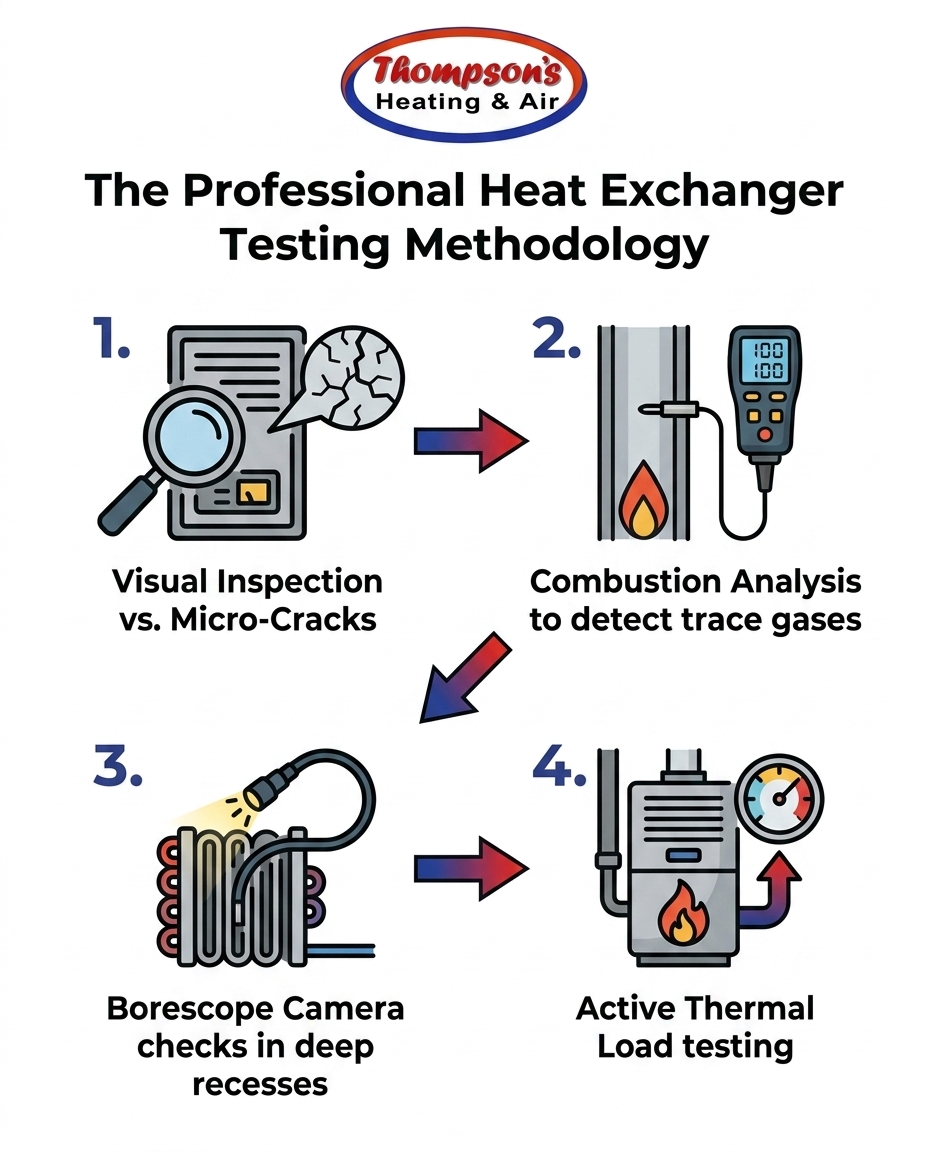
Inspecting a heat exchanger is strictly licensed professional work, not a weekend DIY task. The tools and training required to verify combustion safety go far beyond what a homeowner can do with a flashlight and a screwdriver. In our years of providing heating services to the local community, our team at Thompson's Heating & Air typically sees that visual inspections alone miss dangerous micro-cracks. That is why our uncompromising safety-first approach means our technicians refuse to skip steps during late-summer tune-ups. We utilize a rigorous, scientific methodology to guarantee your equipment is secure.
1. Initial Visual Assessment: The technician inspects the exterior of the heat exchanger for obvious signs of metal fatigue, rust, soot buildup, or flame rollout scorch marks.
2. Combustion Analysis: We use highly sensitive, professional-grade combustion analyzers. A probe is inserted into the exhaust flue while the system is running. This tool measures the exact chemical makeup of the exhaust gases, detecting trace amounts of carbon monoxide or oxygen imbalances that indicate a breach in the metal long before it becomes visible.
3. Borescope Camera Inspection: Because heat exchangers have complex curves and deep recesses, we utilize specialized articulating cameras (borescopes). This allows the technician to visually navigate deep inside the metal chambers, putting eyes on sections of the metal that are otherwise impossible to see.
4. Active Thermal Load Testing: The system is tested under active heat. Because micro-cracks only open when the metal expands, we must observe how the system behaves when it reaches its maximum operating temperature.
Why Visual Glances Aren't Enough
A quick flashlight check cannot reveal hairline cracks. The metal inside a furnace is dark, curved, and heavily shadowed. Rigorous methodology requires scientific measurement of combustion byproducts. If a technician simply looks at your furnace and declares it safe without using an analyzer or a camera, they are guessing. We do not guess with your family's safety.
Special Considerations for Aging Heating Equipment
While all heating systems require rigorous testing, older equipment is particularly vulnerable to thermal fatigue. The simple math is that the older the unit, the more thermal cycles the metal has endured. A furnace that has been operating in Woodland CA for 15 years has expanded and contracted tens of thousands of times. That level of repetitive stress eventually takes a toll on even the highest quality steel.
Older styles of heating equipment and wall units have specific design vulnerabilities. The heat exchangers in older models were often manufactured using a "clamshell" design, where two pieces of metal were crimped together. Over time, these crimped seams are notorious for splitting. Modern tubular heat exchangers are more resilient, but no metal is immune to decades of extreme heat.
For systems that are over 10 to 15 years old, our testing protocols become even more stringent. We pay special attention to the known failure points of specific legacy brands and models. If your home utilizes older heating technology, reviewing the protocols for older wall heater safety is highly recommended. It is important to note that age alone does not automatically mean you need a replacement, but it absolutely mandates uncompromising safety verification before every heating season. Upgrading an aging, compromised system may also qualify for generic utility rebates or federal tax credits, making proactive replacement a smart financial move before winter hits.
Securing Your Home During the August Transition Window
The brief window of the late-summer (August) transition is the absolute optimal time to secure your home's heating safety. Acting now bridges the gap between Woodland's hot summer and the inevitable winter frost. Scheduling your inspection during this quiet period ensures that if a problem is discovered, you have ample time to make necessary corrections without shivering through a cold weekend.
What to expect when our professional arrives:
• Thorough diagnostics: We will hook up the combustion analyzer and run the system through a full cycle.
• Camera inspection: The technician will carefully scope the interior metal components.
• Transparent reporting: You will receive a clear, plain-English explanation of exactly what we found.
• No alarmism: We provide facts and safety data, not fear-mongering sales pitches.
This rigorous process is ultimately about peace of mind. Knowing that the metal barrier protecting your family's air supply is solid allows you to turn on the heat with complete confidence when that first freezing morning finally arrives.
Frequently Asked Questions
How do professionals test a furnace heat exchanger?
Professionals test a furnace heat exchanger using a combination of specialized tools. First, a combustion analyzer measures the exhaust gases to detect trace amounts of carbon monoxide or oxygen imbalances that indicate a leak. Then, a borescope camera is used to visually inspect the deep, hidden recesses of the metal for micro-cracks while the system is cold, followed by an active test while the system is hot.
Can a cracked heat exchanger be repaired?
No, a cracked heat exchanger cannot be safely repaired with welding or sealants. Because the metal undergoes extreme expansion and contraction during every heating cycle, any patch will rapidly fail and leak toxic gases. If the heat exchanger is cracked, the component itself must be entirely replaced, or the entire furnace must be replaced if the unit is older.
What happens if a heat exchanger is cracked?
If a heat exchanger is cracked, the barrier between the toxic combustion gases and your home's breathing air is broken. When the furnace runs, the blower pushes air over the cracked metal, drawing carbon monoxide and other exhaust gases into the ductwork. This contaminated air is then distributed directly into your living spaces.
Is a cracked heat exchanger dangerous?
Yes, a cracked heat exchanger is an immediate and severe safety hazard. It is the primary cause of carbon monoxide leaks in residential heating systems. Because carbon monoxide is odorless and colorless, a cracked heat exchanger can poison the air inside a home without any obvious warning signs, making it a life-threatening issue.
Why is carbon monoxide dangerous in a furnace?
Carbon monoxide is dangerous because it displaces oxygen in the bloodstream, leading to tissue damage and potentially fatal consequences. In a furnace, it is a natural byproduct of burning fuel. If the system is venting properly and the heat exchanger is intact, the gas is safely expelled outdoors; if the system is compromised, that toxic gas is pushed into the home.
How often should a heat exchanger be inspected in Woodland, CA?
A heat exchanger should be professionally inspected at least once every year, ideally during the late summer or early fall before the heating season begins. Annual inspections are critical because a heat exchanger that was perfectly safe last winter may have developed micro-cracks due to thermal fatigue or settling during the dormant summer months.
Schedule Your Late-Summer Safety Verification
Understanding exactly Why We Test Furnace Heat Exchangers Before the First Woodland Frost is the first step toward a safer home. Do not wait for the sudden drop in temperatures to find out if your heating system is compromised. Schedule your comprehensive safety inspection today to ensure you have a clear, non-alarmist understanding of your equipment's health, giving you total peace of mind before the cold weather arrives.



.avif)
.avif)
.png)
