
Central Air vs Mini Split for Sacramento Valley Homes

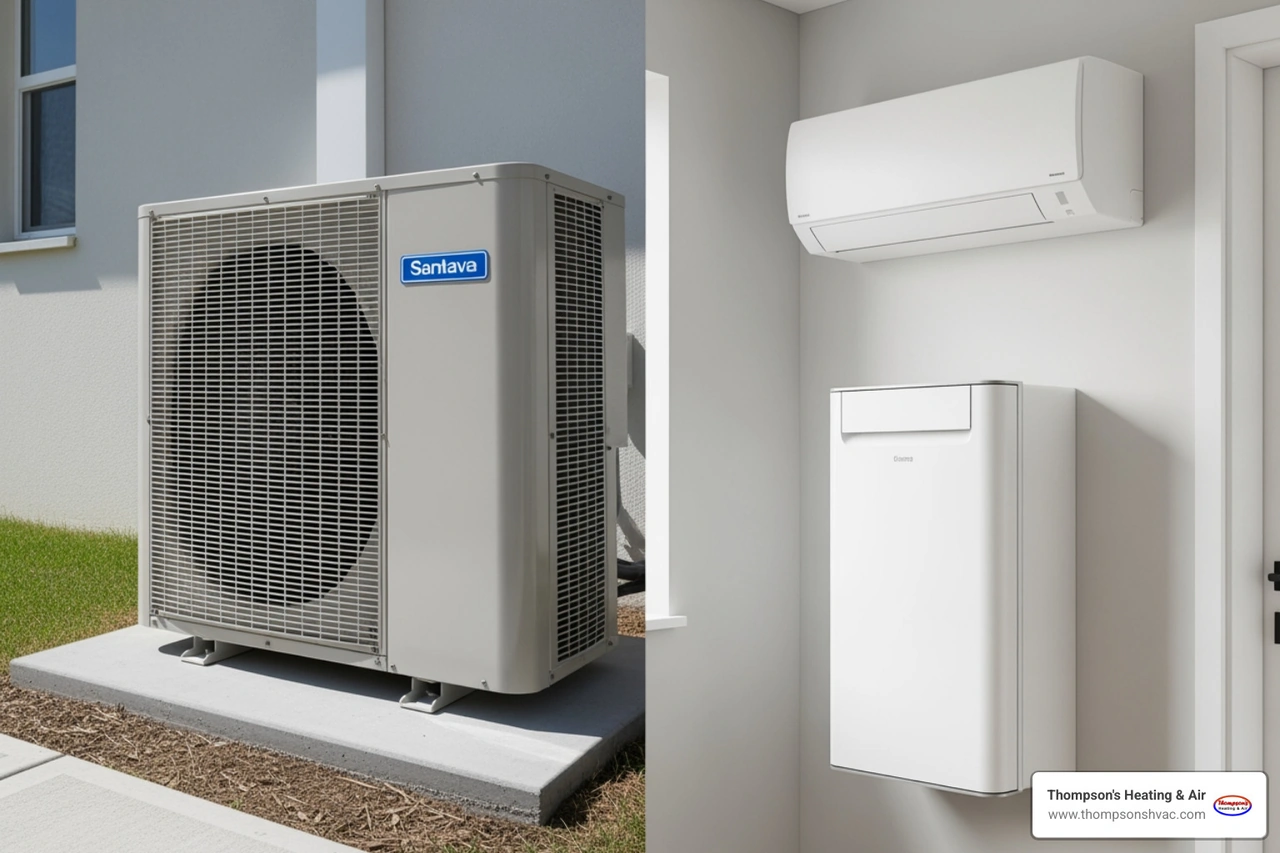
How Central Air and Mini Splits Work in Sacramento Valley Homes
: What You Need to Know First
When it comes to central air vs mini split for the Sacramento Valley homes, the right choice depends on a few key factors: whether your home already has ductwork, how many rooms you need to cool, and how much control you want over your comfort.
Sacramento Valley summers are no small thing. Temperatures regularly push past 100°F, attics can reach 150°F or higher, and wildfire smoke has become a seasonal reality. Your cooling system isn't a luxury here — it's a necessity.
Here's a quick comparison to help you understand the core difference between the two options:
• Requires ductwork — Central Air: Yes — Mini Split: No
• Energy efficiency (SEER) — Central Air: 13–21 — Mini Split: 16–30+
• Zoned temperature control — Central Air: Limited — Mini Split: Yes, room by room
• Best for — Central Air: Homes with existing ducts, large open layouts — Mini Split: Older homes, additions, ADUs, problem rooms
• Indoor noise level — Central Air: Moderate (air rushing through vents) — Mini Split: Very quiet (19–30 dB)
• Heating capability — Central Air: Paired with furnace or heat pump — Mini Split: Built-in heat pump
• Duct energy loss — Central Air: 20%–30% loss possible — Mini Split: None
• Wildfire smoke filtration — Central Air: Strong (whole-house MERV filters) — Mini Split: Basic (washable filters)
• Typical lifespan — Central Air: 12–15 years — Mini Split: 15–20 years
Both systems can keep your home comfortable through a Sacramento summer. But they work very differently, and choosing the wrong one for your home's layout can mean higher energy bills, uneven temperatures, and unnecessary expense.
This guide breaks down how each system works, which one performs better in valley heat, and how to figure out which one fits your home.
Central air and mini splits both move heat out of your home in summer and, when set up as heat pumps, can also move heat back in during winter. The big difference is how they deliver that comfort.
A central air system uses one outdoor unit and pushes conditioned air through ductwork to vents around the house. It is designed for broad, whole-home airflow. In many homes around Woodland, Davis, Dixon, West Sacramento, and nearby communities, central air works well when the duct system is already in place and in good condition.
A mini split uses an outdoor unit connected to one or more indoor air handlers. Instead of sending air through ducts, it delivers cooled or heated air directly into each room or zone. That makes it especially useful for homes without ducts, older floor plans, additions, converted garages, and ADUs.
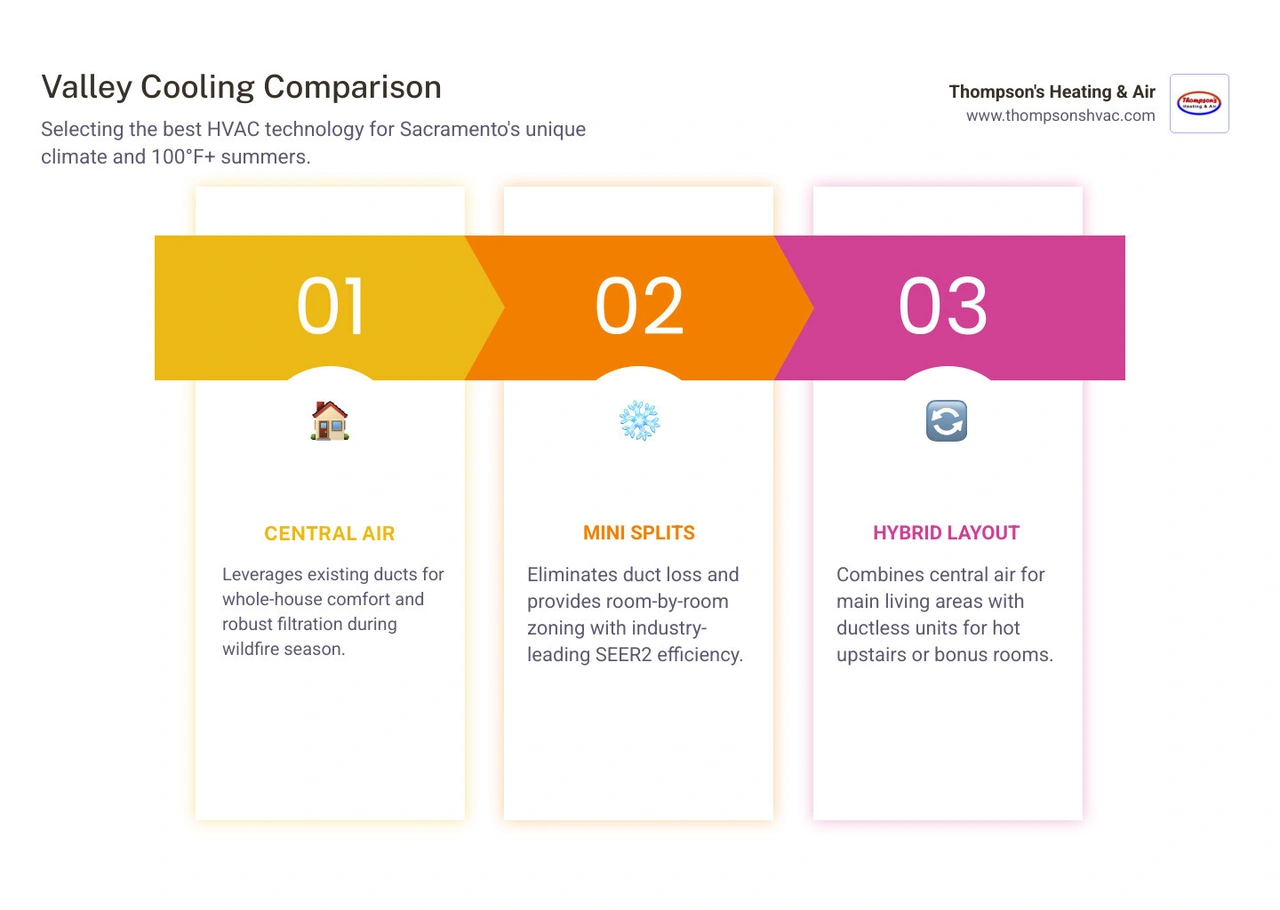
Central Air vs Mini Split for the Sacramento Valley Homes: Core System Differences
The simplest way to think about it is this:
• Central air cools the whole house from one main system.
• Mini splits cool specific rooms or zones exactly where needed.
With central air, one thermostat usually controls the house, though zoning can be added in some systems. With mini splits, each indoor unit can have its own temperature setting. That is great for households where one bedroom always feels too hot, the upstairs runs warm, or someone likes the home office cooler than the rest of the house.
Another major difference is duct loss. Traditional ducted systems can lose 20% to 30% of their energy through leaks or poor insulation. In the Sacramento Valley, that matters even more because attic temperatures can reach 150°F or more. If your ducts are running through that oven-like attic, some of your cooled air may be fighting a losing battle before it even reaches the room.
Mini splits avoid that problem because there are no ducts to leak conditioned air. Many also use inverter technology, which allows the compressor to ramp up and down instead of running full blast and shutting off over and over. That usually means steadier temperatures and better efficiency.
For a broader side-by-side breakdown, see our Central AC vs Ductless Mini Split Comparison.
How Each System Handles Cooling and Heating
For cooling, both systems can absolutely handle Sacramento Valley heat when they are correctly sized and installed.
For heating, the answer depends on the equipment type:
• Central air is often paired with a furnace, or it may be part of a central heat pump system.
• Most mini splits are heat pumps, so they provide both cooling and heating in one system.
That heat pump feature matters here. Our winters in Yolo County and surrounding communities are mild compared with colder regions, so heat pumps usually operate very efficiently. That makes mini splits especially attractive for homeowners who want year-round comfort without separate cooling and heating equipment in certain spaces.
If you want to learn more about why heat pumps work well in our area, read Heat Pump Benefits for Sacramento Valley Homeowners.
Central Air vs Mini Split for the Sacramento Valley Homes: Which Performs Better in Valley Heat?
Sacramento Valley conditions are tough on HVAC equipment. We are not talking about a few warm afternoons. We are talking about long stretches of triple-digit heat, hot attics, intense sun exposure, and smoke season layered on top. That local climate changes the comparison.
• Triple-digit heat response — Central Air: Strong when sized well and ducts are sealed — Mini Split: Strong when sized well and zones are matched properly
• Impact of attic heat — Central Air: Can be significant if ducts run through hot attic — Mini Split: Minimal duct-related impact
• Hot upstairs bedrooms — Central Air: May struggle without zoning or duct balancing — Mini Split: Excellent for room-specific correction
• Efficiency in part-time spaces — Central Air: Less efficient if cooling unused rooms — Mini Split: Very efficient through zoned cooling
• Smoke-season filtration — Central Air: Better whole-house filtration options — Mini Split: Depends on unit filtration and room coverage
• Noise indoors — Central Air: More noticeable air movement — Mini Split: Usually much quieter
Energy Efficiency, Duct Loss, and Sacramento Utility Use
If efficiency is your top concern, mini splits usually have the edge.
Research consistently shows mini split systems often deliver higher efficiency ratings, commonly around 16 to 30 SEER, while traditional central systems often fall in the 13 to 21 range. That does not automatically make every mini split better than every central system, but it does show where the technology tends to lead.
The bigger issue in our region is not just equipment efficiency on paper. It is real-world delivery. A ducted system with leaky or poorly insulated ducts can lose 20% to 30% of cooling energy. In a super-heated attic, those losses can add up fast.
That is why many Sacramento Valley homeowners report noticeable reductions in cooling use after switching to ductless zoning. Research points to energy savings in the 25% to 40% range compared with traditional systems, especially when homeowners stop cooling empty rooms all day.
Mini splits also pair well with how many homeowners actually live:
• Cooling bedrooms more at night
• Keeping guest rooms lighter on conditioning
• Running a home office during the day without overcooling the whole house
• Matching runtime to solar production or time-of-use utility plans
Central air can still be efficient if the ductwork is well designed, sealed, insulated, and matched to the home. But if the ducts are old, undersized, disconnected, or baking in the attic, efficiency suffers.
Indoor Comfort, Noise, and Air Quality Differences
Comfort is not just about the thermostat reading. It is about whether the house actually feels even, quiet, and breathable.
Mini splits shine in rooms that are hard to keep comfortable. They are also very quiet. Many indoor units operate in the 19 to 30 decibel range, which is whisper-quiet territory. That makes them a strong option for bedrooms, nurseries, and home offices where the sound of rushing air can get old fast. Fast.
Central air is usually louder indoors because you hear airflow through vents and returns, even when the equipment itself is outside. It is not necessarily noisy, but it is more noticeable.
For air quality, central air often has the advantage. A ducted system can support stronger whole-house filtration, including higher-efficiency media filters and other indoor air quality upgrades. During wildfire season, that can be a major plus for homeowners who want more robust smoke-particle capture.
Mini splits do offer filtration and dehumidification, but their standard washable filters are typically more basic. They help, but they are not usually a substitute for whole-house smoke-focused filtration.
So if your top priority is room-by-room comfort and quiet, mini splits often win. If your top priority is whole-home filtration and hidden air delivery, central air often has the advantage.
Which System Fits Your Home Layout Best?
This is where the decision usually gets easier. The right system is often the one that matches the home you actually have, not the one that sounds best in theory.
When Mini Splits Make More Sense
Mini splits are often the better fit when:
• Your home does not have existing ductwork
• You live in an older or historic home and want to avoid major wall or ceiling disruption
• You have a garage conversion, sunroom, bonus room, or ADU
• One or two rooms are always too hot or too cold
• You want independent temperature control in different spaces
• You need a retrofit option that preserves the character of the home
Because mini splits only need a small wall penetration for line sets, they are much easier to retrofit into older homes than building out full duct systems. That is a big deal in neighborhoods with older housing stock or homes that were never designed for central forced air.
They are also ideal for problem rooms. If your upstairs bedroom feels like summer camp and the rest of the house feels fine, a mini split can solve that targeted comfort issue without overhauling everything.
When Central Air Makes More Sense
Central air is often the better fit when:
• Your home already has usable ductwork
• You want one system delivering air to the whole house
• You have a larger open floor plan
• You prefer hidden equipment rather than visible indoor wall units
• You want more traditional whole-home airflow and filtration
In larger homes with good ducts, central air can provide very consistent comfort across many rooms. It also tends to appeal to homeowners who want the cooling system to be mostly out of sight.
If the ductwork is properly sized, sealed, and insulated, central air can still be an excellent solution for Sacramento Valley homes.
When a Hybrid Setup Is the Smartest Choice
Sometimes the best answer is not central or mini split. It is both.
A hybrid setup can work well when:
• The main home already has central air
• One addition or converted space needs separate comfort control
• You have a persistent hot upstairs room
• An ADU or detached room needs independent heating and cooling
• You want to reduce strain on the main system during extreme weather
This approach lets central air handle the main living areas while a mini split fills the gaps. It is especially practical in homes where extending ductwork would be inefficient or where the main system was never designed for added square footage.
Sizing, Installation, and Long-Term Reliability
No matter which system you choose, proper design matters more than brand hype or brochure promises. A great system installed poorly can still perform badly. A correctly sized system installed well can make a huge difference in comfort and reliability.
Why Proper Sizing Matters More Than System Type
An oversized system can short cycle, turning on and off too quickly without running long enough to control temperature and humidity properly. An undersized system can run constantly and still struggle on the hottest afternoons.
That is why we always recommend a professional load calculation rather than guessing by square footage alone. Window area, insulation, orientation, ceiling height, occupancy, and room layout all matter.
This applies to both central systems and mini splits. In fact, mini splits can be especially sensitive to poor zone planning. Too much capacity in a small room can create uneven comfort, while too little capacity leaves the space lagging behind.
For more on this, see:
• Getting the Right Size HVAC for the Sacramento Valley Homes
• How Proper HVAC Sizing Affects Comfort
• How Improperly Sized Systems Shorten Equipment Life
Maintenance Needs and Expected Lifespan
Both systems need maintenance. Neither one is a magic box you can ignore until the hottest day of July. We wish that were true too.
In general:
• Mini splits often last around 15 to 20 years
• Traditional central AC systems often last around 12 to 15 years
Mini splits may last longer partly because inverter-driven operation is gentler than repeated full-speed on/off cycling. But lifespan still depends heavily on installation quality, usage, maintenance, and local conditions such as dust and heat.
Maintenance is different for each system:
For central air:
• Replace filters regularly
• Inspect and seal ductwork as needed
• Clean coils and condensate drains
• Schedule annual professional service
For mini splits:
• Clean washable filters regularly, often every few weeks during heavy use
• Keep indoor heads and outdoor coils clean
• Check drains and refrigerant performance
• Schedule annual professional service
Helpful maintenance resources:
• How to Maintain Your Heating and Cooling System
• Annual HVAC Maintenance Complete Guide
• Is an HVAC Maintenance Plan Worth It
Should You Replace or Upgrade Your Existing System?
If your current system is struggling, the question may not just be central air versus mini split. It may be whether you should repair what you have, upgrade part of the home, or replace the system entirely.
Signs it may be time to reassess include:
• Uneven cooling from room to room
• Rising energy use
• Frequent repairs
• Hot spots upstairs or in additions
• Aging equipment
• Ductwork that is damaged, leaking, or poorly routed
Sometimes the best move is replacing an old central system with a newer ducted system. Sometimes it is adding a mini split to solve a specific problem area. And sometimes it makes sense to move away from a ducted setup entirely, especially if the duct network is the real weak point.
For guidance, read Should I Repair or Replace My HVAC System.
Frequently Asked Questions About Central Air vs Mini Split for the Sacramento Valley Homes
Are mini splits more energy-efficient than central air in the Sacramento Valley?
Often, yes. Mini splits usually offer higher efficiency ratings and avoid the 20% to 30% energy losses that can happen in ductwork. In our climate, where attics get extremely hot and cooling seasons are long, that can make a real difference. They are especially efficient when you only need to cool certain rooms instead of the whole house.
Do central air systems have better filtration than mini splits during wildfire season?
Usually, yes. Central systems can support stronger whole-house filtration options, including higher-efficiency media filters that are better suited for smoke events. Mini splits help keep windows closed and can filter air to a degree, but their standard filters are generally more basic. If smoke-season indoor air quality is one of your top concerns, filtration strategy should be part of the decision.
Can a mini split cool multiple rooms or replace central air completely?
Yes. A multi-zone mini split can cool several rooms, and in the right home layout it can replace central air completely. The best fit depends on the number of rooms, how open or closed the floor plan is, and where comfort problems exist. Mini splits are especially effective in smaller homes, older homes without ducts, additions, and homes where room-by-room control matters more than one-temperature-for-everyone cooling.
Conclusion: How to Choose the Right HVAC System for Your Home
When homeowners compare central air vs mini split for the Sacramento Valley homes, the best answer usually comes down to layout, duct condition, comfort priorities, and how you use each room.
Choose central air when:
• You already have good ductwork
• You want traditional whole-home airflow
• You prefer stronger whole-house filtration
• Your layout benefits from one hidden, centralized system
Choose mini splits when:
• You do not have ducts
• You want better zoning and efficiency
• You need to fix hot or cold rooms
• You are conditioning an addition, garage conversion, or ADU
Choose a hybrid approach when:
• Your main house does well with central air
• Specific rooms do not
• You want targeted comfort without reworking the whole home
The good news is that both systems can work very well in our area when they are properly sized and installed. The wrong fit can be frustrating. The right fit can mean quieter comfort, better efficiency, more even temperatures, and a system that supports your home for years.
If you are thinking about upgrading, it also helps to understand How a New HVAC System Increases Home Value.
At Thompson's Heating & Air, we have served local homeowners since 1992 with reliable HVAC solutions built around real home layouts and real Sacramento Valley conditions. If you want help comparing your options, exploring system upgrades, or planning the right comfort strategy for your home, visit More info about HVAC services.



.avif)
.avif)
.png)
