How Honest Advice on an Aging Furnace Can Delay Replacement for Years

The High-Pressure Reality of Fall Furnace Inspections
Understanding how honest advice on an aging furnace can delay replacement for years is critical when you schedule a routine tune-up, only to be met with a high-pressure sales pitch instead of a simple cleaning. Every September, our team at Thompson's Heating & Air talks to Woodland homeowners who called a professional for peace of mind before the cold weather sets in, only to receive a shocking diagnosis. Instead of a basic inspection, a technician takes one look at the manufacturing date on your unit and declares your system a total loss. Suddenly, you are forced into a stressful decision point: do you authorize a complete, overwhelming replacement before the heating season begins, or do you seek an honest safety assessment to explore targeted repairs? For homeowners navigating this exact situation, finding reliable heating services that prioritize your best interests is the first step toward a solution.
The rush of the season: The September pre-heating season is a notoriously vulnerable time for homeowners. As temperatures begin to drop, heating companies experience a surge in service calls. Unfortunately, we often see the industry push for full system replacements during these early fall tune-ups rather than exploring strategic, cost-effective repairs. It is frequently easier and more profitable for commission-based technicians to swap out an entire unit than it is to carefully diagnose and fix a complex mechanical issue.
The age myth: A common tactic is using the age of your equipment against you. You might hear that because your system has reached a certain birthday, it is a ticking time bomb. However, in our daily fieldwork, we know that age alone is not a definitive reason to condemn a heating system. Many older units possess heavy-duty components that, with the right care, can outlast newer, lighter-weight models. The key is separating normal wear and tear from actual safety hazards.
Buying valuable time: An honest assessment can safely buy a homeowner significantly more time. When our technicians take the time to thoroughly test your system's safety mechanisms and operational limits, we can often identify minor, manageable issues. By addressing these small problems now, you can keep your current system running safely and efficiently, allowing you to plan for a future upgrade on your own terms, rather than in a moment of panic.
Evaluating 12-15 Year Old Heating Systems: Wear vs. Safety Hazards
When evaluating 12-15 year old heating systems, the most critical step is understanding the difference between normal age-related wear and a genuine, dangerous failure. If you are looking for honest furnace and heating repair in Woodland, you need a technician who knows exactly what to look for and what to leave alone. Our experienced crew takes pride in doing just that.
When Age is Just a Number
The expected lifespan: A well-maintained modern gas furnace typically lasts 15 to 20 years, and sometimes even longer. Just because your system falls into the 12-15 year window does not mean it is automatically at the end of its life. Like a reliable older car, a furnace of this age will certainly show signs of use. We frequently inspect Woodland systems that aren't operating at day-one peak efficiency, but we always remind customers that efficiency loss is very different from a safety hazard.
The power of maintenance: Why might a 15-year-old unit still have reliable years left? The answer usually comes down to airflow and maintenance. Systems that have received regular filter changes, proper airflow management, and routine cleanings experience far less internal stress. When the blower motor does not have to fight against a clogged filter, and the internal components are kept free of dust, the mechanical parts simply last longer. Minor wear on belts or bearings is a normal, repairable part of aging.
The Non-Negotiable Safety Checks
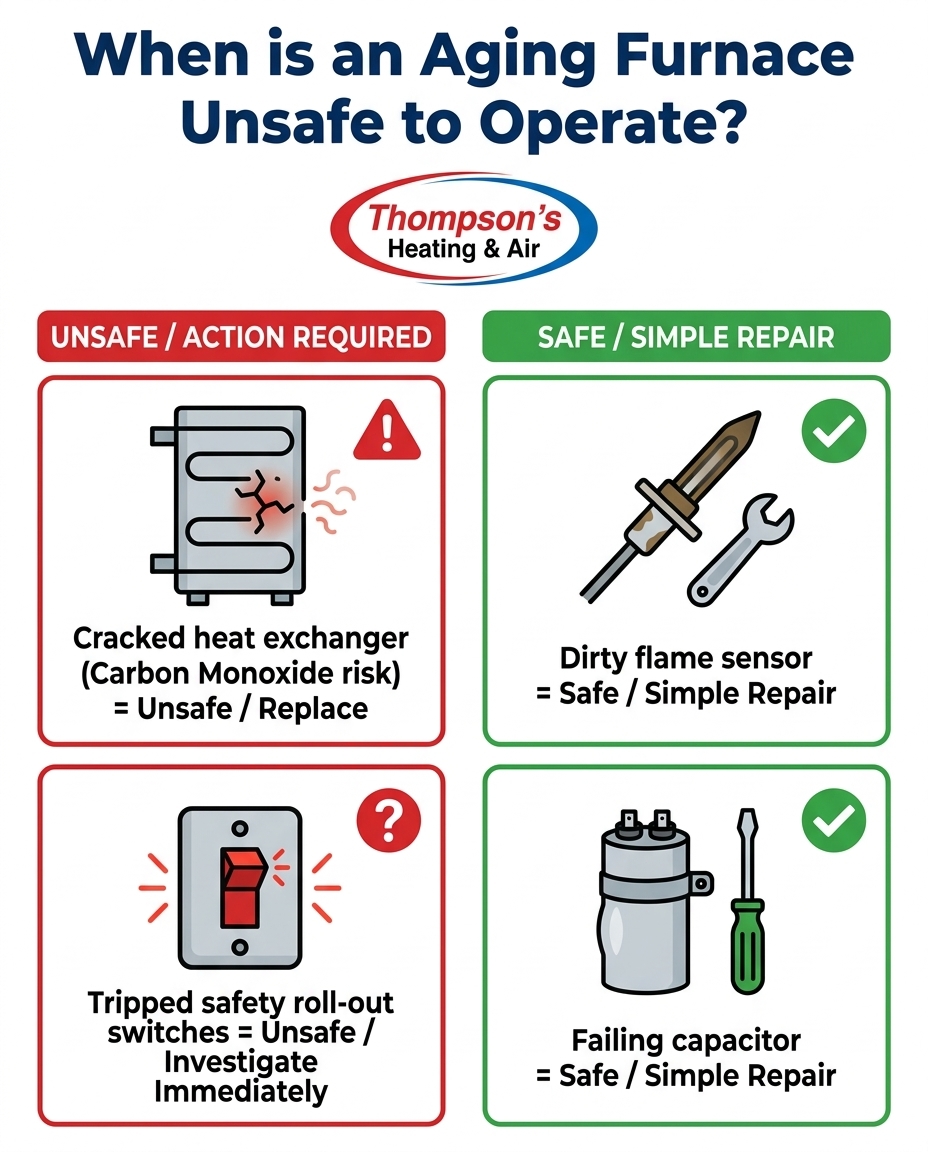
The real danger zones: While efficiency loss is a matter of comfort and utility bills, a cracked heat exchanger is a non-negotiable safety failure. The heat exchanger is the metal shield that separates the toxic combustion gases from the clean air blowing into your home. Over thousands of heating cycles, the metal expands and contracts. Eventually, this constant thermal stress can cause the metal to crack.
Carbon monoxide risks: A cracked heat exchanger necessitates immediate replacement due to the severe risk of carbon monoxide leaking into your living space. This is not a component that can be patched or safely ignored. Honest technicians will perform rigorous carbon monoxide testing and visual inspections using specialized cameras to verify the integrity of this part.
The baseline for safety: The true deciding factors for replacement are these specific safety tests. If a professional inspects your older system and confirms that the heat exchanger is solid, the venting is clear, and the safety roll-out switches are intact, the system is likely completely safe to operate. Normal wear and tear can be managed with targeted repairs, keeping your family warm without compromising your safety.
Common Minor Furnace Issues Misdiagnosed as Fatal Breakdowns
One of the most frustrating experiences for a homeowner is being told their system is dead, only to find out later it was a minor, easily fixable part. Many specific, repairable components often cause a unit to fail to start, perfectly mimicking a dead system. This is why proactive heating maintenance is so vital; it catches these small issues before they are used as leverage for a major sale. In fact, our technicians see these easily correctable problems almost every week during the early fall.
The dirty flame sensor: A very common culprit is the flame sensor. This small metal rod sits in the path of the burner flame. Its only job is to tell the control board that a fire is actually burning. Over time, carbon buildup coats the sensor. When this happens, the sensor cannot detect the flame, causing the system to rapidly cycle off or fail to ignite altogether. To a homeowner, this looks like a complete, catastrophic breakdown. To an honest technician, it is a simple cleaning task that takes only minutes to resolve.
Electrical component failures: Failing capacitors are another frequent issue. A capacitor acts like a battery, giving the blower motor the extra jolt of energy it needs to start spinning. When a capacitor loses its charge, the motor will hum, struggle, or fail to start, and no air will circulate through your home. Similarly, minor blower motor issues, such as a worn-out belt or a loose wire, can halt the entire heating process. Neither of these issues means the core of your heating system is broken. They are standard, easily replaceable parts.
• System turns on, then shuts off immediately — Actual Minor Cause: Dirty flame sensor covered in carbon — What a Dishonest Tech Might Say: "The control board is fried and the unit is too old to fix."
• No air blowing from the vents, but unit hums — Actual Minor Cause: Failing run capacitor on the blower motor — What a Dishonest Tech Might Say: "The main motor is dead, you need a whole new system."
• System won't respond to the thermostat at all — Actual Minor Cause: Tripped breaker or blown low-voltage fuse — What a Dishonest Tech Might Say: "The internal wiring has failed due to old age."
• Strange rattling noises during startup — Actual Minor Cause: Loose panel or worn blower belt — What a Dishonest Tech Might Say: "The internal components are falling apart."
The value of thorough diagnostics: A thorough diagnostic process should isolate these minor parts rather than condemning the whole system. Proactive care and honest troubleshooting prevent these minor issues from escalating into false emergencies. When a technician takes the time to test individual components with a multimeter, they can pinpoint the exact point of failure, saving you from an unnecessary overhaul.
How Mild Winters Reduce the Strain on Aging Equipment
Context matters immensely when evaluating the lifespan of home appliances. The climate you live in plays a massive role in how much wear and tear your equipment actually experiences over a decade. In our region, furnaces can often safely outlast national averages simply because they do not work as hard. We always remind our customers of this local climate advantage.
The local climate advantage: Consider the harsh snow-belt winters of the Midwest or Northeast, where heating systems must run continuously for months just to keep indoor temperatures livable while outside temperatures plummet below zero. Now, contrast that with our local climate. Woodland CA and Yolo County winter lows typically hover in the upper 30s to low 40s. While you certainly need reliable heat to stay comfortable, the overall heating loads are significantly lower.
Reduced thermal stress: Because your furnace does not have to run continuously to combat sub-zero temperatures, the internal components experience far less thermal stress. The heat exchanger goes through fewer extreme expansion and contraction cycles. The blower motor runs for shorter durations, reducing friction and heat buildup in the bearings. The entire system gets more downtime to rest between cycles.
Lower risk for strategic repairs: In a milder climate, strategic repairs on an older unit carry significantly less risk of leaving a family freezing in a dangerous situation. If an older component does fail on a 40-degree night, it is an inconvenience, but rarely a life-threatening emergency. This regional reality means that keeping an aging system running safely for a few extra years is a highly practical and reasonable strategy for local homeowners.
The Ethical Approach: Refusing Unnecessary Sales
In an industry where high-pressure sales are unfortunately common, prioritizing repairs over premature replacements stands out as a core philosophy. A truly ethical company operates on the framework of refusing to sell homeowners equipment they do not actually need.
A history of honesty: Thompson's Heating & Air has built a long history on this exact ethical framework. We believe in being an ethical ally to our community. What does an honest technician look for during an inspection? They focus entirely on safety and cost-effective longevity. They look for clean burners, solid heat exchangers, and functional safety switches. If those elements are sound, their goal is to tune the system up, not tear it out.
Real-world proof: In our experience, age alone is rarely the whole story. Consider a situation our team encountered with a homeowner during a scorching summer heat wave. Their air conditioning system was 28 years old, and they were fully convinced it was completely dead and required a massive, expensive replacement. Instead of seizing a massive sale, our technician performed a minor tune-up. That "dead" system went on to provide an additional nine years of reliable cooling before finally needing a minor cooling part replaced.
Applying the philosophy: This approach applies across all HVAC equipment, from summer cooling to winter heating. By thoroughly evaluating the actual mechanical state of the equipment rather than just looking at the calendar, an honest professional saves homeowners from premature overhauls and builds trust that lasts for decades.
Strategic Repairs vs. Planning for the Future
There is a delicate balance between keeping an older system running safely and knowing when it is finally time to start planning for the future. Delaying a replacement does not mean ignoring reality; it means taking control of the timeline.
How Honest Advice on an Aging Furnace Can Delay Replacement for Years
Weighing the viability of a repair: When a component fails on a 15-year-old system, our technicians help you weigh the viability of the repair against the overall condition of the unit. If the heat exchanger is solid, the safety switches are operational, and the required repair is a simple electrical part, fixing it is almost always the smarter move. A targeted repair restores function without the massive upfront commitment of a new unit. If you are unsure where to draw the line, reviewing a decision framework for HVAC systems 10+ years old can provide excellent guidance.
Buying time to plan: The greatest benefit of a strategic repair is that it buys you time. Replacing a whole-home heating system is a major project. When you are forced to do it during a breakdown in the middle of winter, you are making decisions under extreme pressure. You might settle for whatever equipment is available that day, rather than researching the best options. By repairing a safe, aging system, you buy yourself months or even years to plan, budget, and research without a looming emergency.
Clear, evidence-based reasons: Of course, systems do not last forever. When a system is genuinely unsafe or entirely beyond repair, an honest technician will not just tell you it is broken; they will show you exactly why. They will provide clear, evidence-based reasons—like a failed carbon monoxide test or a visually confirmed crack in the heat exchanger—so you know the recommendation for a new system is based on facts, not sales quotas.
Why You Should Always Get a Second Opinion
If you ever feel pressured into a major purchase during a routine maintenance visit, you have the power to hit the pause button. Empowering yourself with actionable advice can save you from a massive, unnecessary project.
Steps to take when pressured:
1. Ask for visual proof: If a technician claims your system is "too old" or "unsafe," ask them to show you exactly what has failed. An honest professional will gladly show you the cracked metal, the failed test reading, or the broken component.
2. Do not sign same-day agreements: High-pressure tactics often involve "today only" discounts. A reputable company will honor their assessment tomorrow just as they do today. Take a breath and step back.
3. Request a safety-specific explanation: Ask directly, "Is this a safety hazard, or is it just losing efficiency?" Force the conversation away from age and toward actual mechanical safety.
4. Call for a second set of eyes: Before committing to a full heating installation, have a different, independent local company evaluate the heat exchanger and safety switches. Do not tell the second company what the first one said; let them do a blind diagnostic.
The difference a second look makes: Reaching out for a second opinion is the smartest move a homeowner can make. Time and time again, our team at Thompson's Heating & Air sees situations where a second set of eyes reveals that a "fatal breakdown" was actually just a dirty sensor or a loose wire. A second opinion can literally be the difference between a simple, fast repair and a massive, disruptive project.
Answers to Common Questions About Aging Heating Systems
Is it worth repairing a 15-year-old furnace?
Yes, our technicians usually say it is highly worth it if the core safety components are intact. If the heat exchanger is solid and the repair involves a minor electrical part like a sensor or capacitor, fixing it makes financial sense. A simple repair can safely extend the life of the unit for several more years, allowing you to avoid a sudden, major expense.
How do you know if your furnace is unsafe?
A system is genuinely unsafe if it poses a fire risk or a carbon monoxide risk. The most common indicators of an unsafe unit are a cracked heat exchanger, tripped roll-out switches, or failed combustion tests. An honest technician will use specialized tools to verify these specific safety hazards rather than guessing based on the equipment's age.
Can a furnace last 25 years?
Yes, with meticulous maintenance and a mild climate, some systems can absolutely reach the 25-year mark. Regular filter changes, annual cleanings, and prompt attention to minor repairs drastically reduce the internal wear and tear that usually destroys equipment. While a 25-year-old unit will not be as energy-efficient as a modern one, it can still provide safe, reliable heat.
What is the most common reason for furnace failure?
The most common reason for a system failing to start is actually a dirty flame sensor. This small metal rod gets coated in carbon over time and fails to read the burner flame, causing the system to shut down protectively. Fortunately, this is a very minor issue that a professional can clean and resolve in just a few minutes.
How does a mild winter affect furnace lifespan?
A mild winter significantly extends the lifespan of your heating equipment by reducing operational hours. Because the system does not have to run continuously to fight freezing temperatures, the internal parts experience far less thermal expansion and mechanical friction. This reduced strain means older units in mild climates often outlast the national average lifespan expectations.
What should I do if a technician says my furnace is too old to fix?
You should immediately ask for concrete, visual proof of a safety failure, such as a cracked heat exchanger. If they cannot provide evidence and are only citing the manufacturing date, do not agree to a replacement on the spot. Instead, call an independent, reputable local company for a second opinion and a dedicated safety assessment.
Making an Informed, Pressure-Free Decision This Fall
Understanding the true safety criteria of an older system gives you the power to make informed, confident decisions about your home. You do not have to accept the premise that an aging unit must be replaced immediately just because the calendar says it is time. By learning the difference between normal wear and tear and actual safety hazards, you protect your household and your budget.
As the primary keyword of our discussion reminds us, how honest advice on an aging furnace can delay replacement for years is a reality that benefits the homeowner, not the high-pressure salesperson. At Thompson's Heating & Air, our priority is giving you clear, safety-verified assessments rather than pushing seasonal sales quotas. Having clear criteria on how an honest professional determines if an older unit is actually unsafe versus just aging gives you the confidence to seek a second opinion and choose a strategic, sensible repair.



.avif)
.avif)
.png)
