
The Mechanics of Rebalancing Your HVAC Dampers for the Heating Season

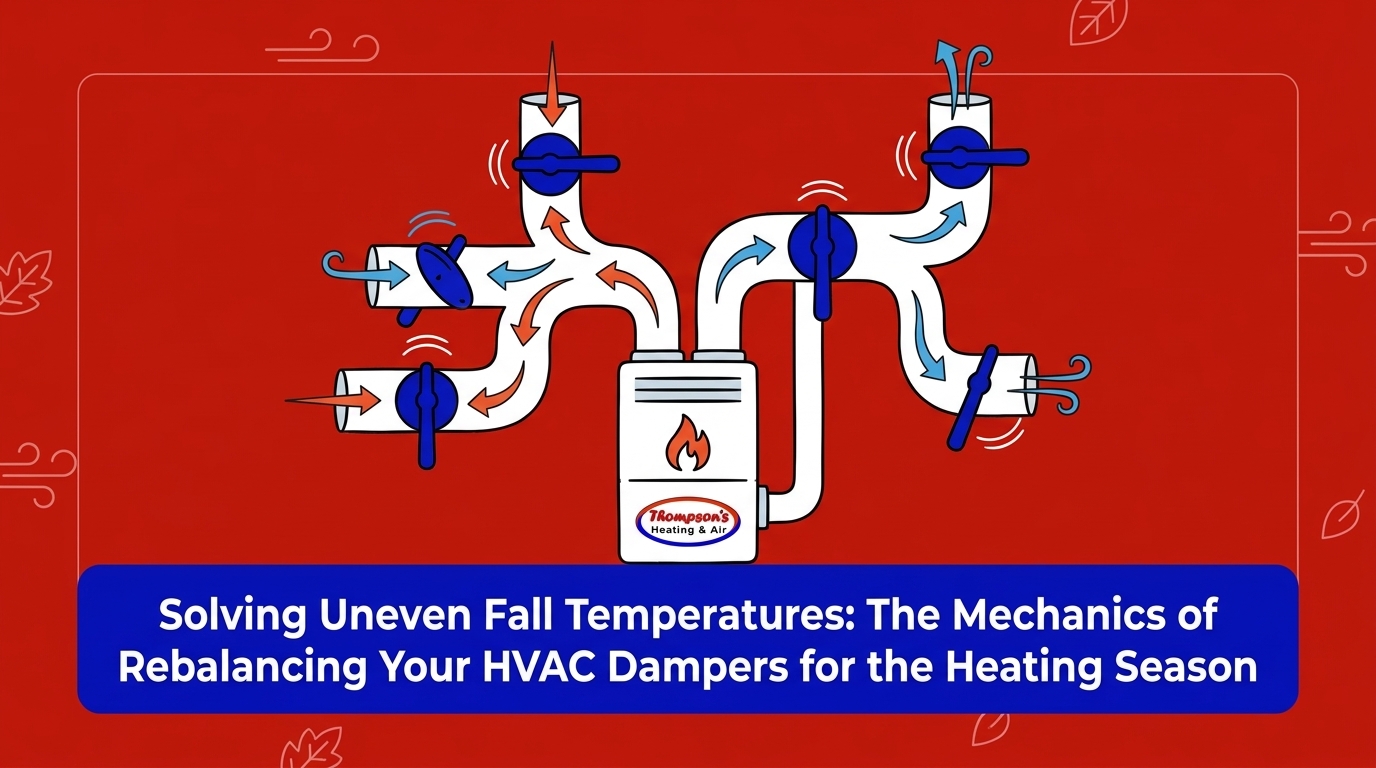
The September Shift: Why Your Multi-Level Home Needs an Airflow Strategy Update
Understanding the mechanics of rebalancing your HVAC dampers for the heating season is the missing piece to solving the uneven temperature puzzle when September mornings in the Sacramento Valley carry that sudden, distinct chill. As the hot, dry summer ends, you wake up, feel the cold floorboards downstairs, and realize the September pre-heating season is officially here. But when you turn on the furnace for the first time, you might notice a frustrating pattern: the ground floor remains freezing while the upstairs bedrooms turn into a stuffy sauna.
If you are ready to prepare your system for the cold weather, explore our Heating Services or schedule your Heating Maintenance today.
Many homeowners assume that simply adjusting the thermostat will fix temperature imbalances. Unfortunately, your thermostat only controls when the system runs, not where the conditioned air actually goes. During the summer, your ductwork was optimized to push cold air upstairs. Now that the weather is shifting, those physical airflow pathways need to change.
Manual duct dampers are the physical solution to this seasonal comfort challenge. These small, built-in valves allow you to direct airflow exactly where your home needs it most. By taking a proactive approach and preparing your system's airflow strategy now, you can prevent major discomfort as the deep winter chill approaches. It is a straightforward adjustment that completely transforms how your multi-level home feels.
Understanding the Physics of Residential Airflow
To understand why your home feels so uneven, we have to look at the basic thermodynamics at play. In our years of servicing multi-level homes across Woodland, CA, our team at Thompson's Heating & Air consistently finds that the root cause of most temperature imbalances comes down to a simple scientific principle: the buoyancy effect. Warm air is less dense than cold air, meaning it naturally rises to the highest point in your house. Conversely, cold, dense air naturally sinks to the lowest levels.
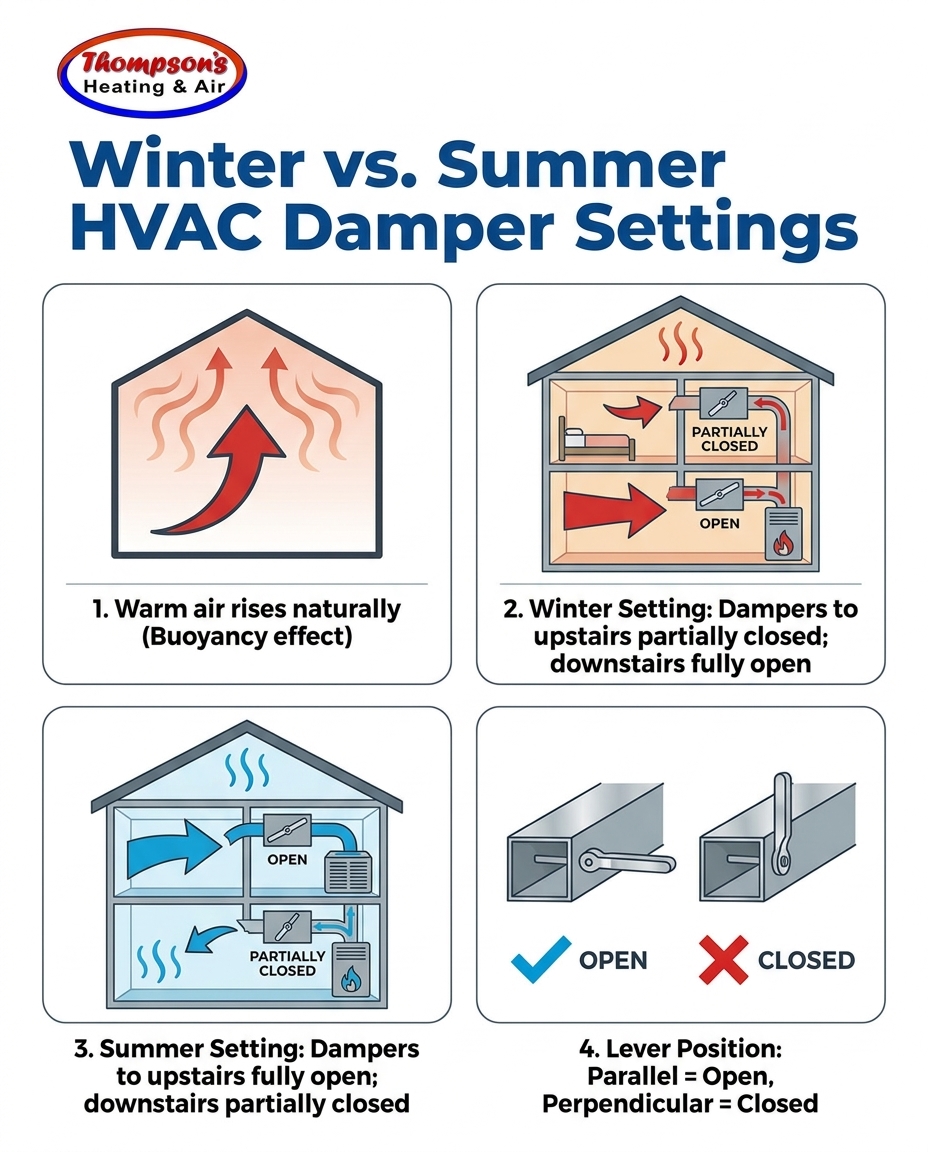
During the summer months, this physics principle works against your air conditioner. To combat the rising heat, your HVAC system has to forcefully push heavy, cold air to the upper floors so it can cascade down. But during the winter, the script flips entirely. Your furnace produces warm air that already wants to rise. If you leave your ductwork configured for summer cooling, you are actively pushing warm air upstairs, where it will pool at the ceiling and leave your downstairs living areas freezing.
• Summer — Natural Physics: Heat rises, cold air sinks to the bottom floor. — HVAC Goal: Cool the notoriously hot upper bedrooms. — Required Airflow Strategy: Push maximum cold air upstairs; restrict downstairs airflow.
• Winter — Natural Physics: Warm air rises naturally to the second floor. — HVAC Goal: Keep the main lower living areas warm and comfortable. — Required Airflow Strategy: Push maximum warm air downstairs; allow it to rise naturally.
Leaving your dampers in their summer positions during the heating season forces your system to work against the laws of physics. The furnace runs longer trying to satisfy the downstairs thermostat, while the upstairs bakes. Properly balanced airflow improves overall HVAC efficiency, prevents the equipment from overworking, and ensures a consistent temperature on every floor. This is especially critical when matching a heat pump to your existing ductwork, as heat pumps rely on precise airflow volumes to maintain peak efficiency.
The 'Traffic Cop' Analogy for Ductwork
It helps to think of your ductwork as a major highway system, and the manual dampers as the traffic cops. Dampers do not just block air; they redirect it to where it is needed most. When you close a damper leading to the upstairs, that air does not simply disappear. The blower motor continues pushing the same volume of air, but the "traffic" is forced to take the open exit leading to your downstairs living room. By managing this traffic flow, you ensure the right amount of heat reaches the right rooms at the right time.
How to Locate the Manual Dampers on Your Supply Plenum
Before you can adjust your airflow, you need to know exactly where to look. Manual dampers are located at the source of the airflow, not at the vent covers in your ceiling or floor. You will find them installed directly into the main ductwork near your indoor air handler or furnace.
• Locate the supply plenum: The supply plenum is the large metal box sitting directly above or beside your furnace. This is the central hub where freshly heated air exits the unit before branching off into individual ducts.
• Identify the supply ducts: Look for the large, round, or rectangular metal tubes branching out from the plenum. These are the supply lines. (Note: The return ducts, which pull air back into the system, usually do not have dampers and should be left alone).
• Look for the levers: Manual dampers are controlled by small metal handles or levers located on the outside of the duct pipe. They often look like a metal wing nut attached to a threaded rod, sitting flush against the ductwork.
• Trace the pathways: Follow the ducts visually to determine which ones head toward the main floor and which ones travel up into the walls toward the second story.
When inspecting your exposed ductwork, always prioritize safety. You should be able to see and reach the damper levers without disturbing any fiberglass insulation or breaking the mastic seal around the duct joints. If your ductwork is heavily wrapped and the levers are buried beneath thick layers of foil tape and insulation, do not rip the insulation away. Proceed carefully, feeling for the metal wing nuts on the exterior of the pipe.
Step-by-Step: Adjusting Damper Levers for Winter Heating
Once you have located the manual dampers on your supply plenum, rebalancing the system for the winter is a straightforward process. Follow these steps to optimize your multi-level home for the heating season.
1. Identify your heating zones: Determine which duct branches feed the upstairs and which feed the downstairs. If they are not labeled, you may need a helper. Turn the furnace fan on, adjust one lever, and have your helper stand near an upstairs vent to feel if the airflow increases or decreases.
2. Understand the lever positions: The position of the metal handle tells you what the internal valve is doing. When the lever is parallel (in line) with the duct pipe, the damper is fully open, allowing maximum airflow. When the lever is perpendicular (crossing) the duct pipe, the damper is fully closed, blocking the air.
3. Set the downstairs dampers: Locate the dampers controlling the first-floor ducts. Turn these levers so they are completely parallel with the ductwork. You want these fully open to push as much warm air as possible into the lower levels.
4. Adjust the upstairs dampers: Locate the dampers controlling the second-floor ducts. Turn these levers so they are partially closed—usually at a 45-degree angle. Do not close them completely. You still want a small amount of heat reaching the upstairs, and the natural buoyancy of the warm air rising from downstairs will do the rest of the work.
5. Mark your settings: Once you find the perfect balance, use a permanent marker to draw a line on the ductwork indicating the "Winter" position and the "Summer" position. This saves you from having to use trial and error next year.
Safe DIY Boundaries for Homeowners
While adjusting damper levers is a safe DIY task, there are strict boundaries you must respect to protect your equipment. The levers should turn easily. If a wing nut is rusted or a damper feels stuck, never force it with pliers or a wrench. Forcing a stuck damper can break the internal rod, leaving the valve permanently jammed in the wrong position.
Furthermore, never completely close off too many ducts at once. Your HVAC system is designed to move a specific volume of air. If you shut down all the upstairs dampers completely, the blower motor will struggle against the massive buildup of static pressure. This can cause the furnace to overheat, trip safety switches, or severely damage the blower motor itself.
The Limits of DIY: When Airflow Issues Require Professional Assessment
Sometimes, manually adjusting the dampers isn't enough to solve persistent hot and cold spots. If you have followed the steps above and your downstairs is still freezing, you are likely dealing with complex static pressure issues that require a professional touch. Static pressure refers to the resistance to airflow within your duct system. Think of it like blood pressure for your HVAC system—if the pressure is too high or too low, the "heart" (your blower motor) cannot circulate air properly.
There are several clear signs that your airflow issues go beyond simple damper adjustments. If you hear a high-pitched whistling sound coming from your return vents, the system is starved for air. If your furnace runs for only a few minutes, shuts off, and turns back on shortly after (a process called short-cycling), it may be overheating due to restricted airflow. In these scenarios, continuing to fiddle with the manual dampers will not fix the root cause and may actually worsen the strain on the equipment.
In our experience resolving complex static pressure issues, our Thompson's Heating & Air technicians frequently see how a minor imbalance can escalate. That is why we expertly assess overall system pressure and airflow balance during every comprehensive fall maintenance visit. We use specialized diagnostic tools to measure the exact volume of air moving through your ductwork, ensuring the blower motor is operating within safe parameters.
Ignoring these deeper airflow issues can lead to catastrophic equipment failure right when you need heat the most. We often remind our customers of a local homeowner who experienced this firsthand when their heater went out entirely on a freezing Sunday morning during a bitter cold snap. Because prompt, reliable service is critical in those moments, our technicians arrived quickly, managed to restore a neighboring unit first, and had the homeowner's system fully repaired the very next day. If your DIY adjustments aren't delivering results, it is time to rely on professional Heating Repair in Woodland before a minor imbalance becomes a major breakdown.
How Proper Damper Balancing Impacts Your Home's Atmosphere
Rebalancing your HVAC dampers does more than just keep your toes warm; it fundamentally changes the overall atmosphere and health of your home. When airflow is properly distributed, heated air circulates evenly throughout every room. This constant, balanced movement eliminates stagnant air pockets that often develop in unused guest bedrooms or secluded corners of the house.
Enhanced Filtration: Balanced distribution also helps your HVAC filter do its job effectively. Your system relies on a steady return of air to pull dust, pet dander, and airborne particles through the filter media. If the dampers are incorrectly set and the air in the upper levels becomes stagnant, those airborne contaminants simply settle onto your furniture instead of being captured by the filter. Proper airflow is a foundational component of good Indoor Air Quality.
System Longevity: Reducing unnecessary strain on the blower motor by maintaining proper damper positioning can significantly improve your system's overall longevity. When the motor doesn't have to fight against extreme static pressure caused by improperly closed dampers, it draws less electricity, runs cooler, and experiences less mechanical wear and tear. We encourage all homeowners to view seasonal damper adjustments not just as a quick fix for a cold room, but as part of a holistic approach to total home comfort and system health.
Frequently Asked Questions About Seasonal Damper Adjustments
Should HVAC dampers be open or closed in winter?
For winter heating, the dampers leading to your downstairs levels should be fully open, while the dampers leading upstairs should be partially closed. Because warm air naturally rises, pushing the majority of the heat to the lower floor allows it to drift upward, warming the entire house evenly. Never close the upstairs dampers completely, as this can cause dangerous pressure buildup in the ductwork.
How do I adjust my HVAC dampers for heating?
You adjust your dampers by locating the small metal levers on the main supply ductwork near your furnace. Turn the levers controlling the downstairs vents so they run parallel to the duct pipe, which opens them fully. Turn the levers controlling the upstairs vents to a 45-degree angle to partially restrict the airflow, forcing more heat to the ground floor.
Which way do you turn duct dampers?
The direction you turn the lever depends on whether you want to open or close the valve. Turning the lever so it sits parallel (in line) with the ductwork opens the damper completely. Turning the lever so it sits perpendicular (across) the ductwork closes it. Always turn the levers gently; if they resist, do not force them.
Why is my downstairs colder than my upstairs in the winter?
Your downstairs is colder because of the natural buoyancy of warm air, which causes heat to rise to the upper levels of your home. If your HVAC dampers are still in their summer cooling positions, the system is actively pushing heat upstairs, compounding the problem. Rebalancing the dampers to direct airflow downward counters this physical effect.
How do you balance airflow in a two-story house?
Balancing airflow in a two-story house requires adjusting the manual dampers at the supply plenum to account for seasonal physics. In winter, push heat downstairs and let it rise; in summer, push cold air upstairs and let it fall. If manual adjustments fail to balance the temperatures, a professional technician can measure static pressure and evaluate the ductwork sizing.
Can adjusting dampers incorrectly damage my HVAC system?
Yes, adjusting dampers incorrectly can cause significant damage to your HVAC system. If you fully close too many dampers at once, the blower motor will push against extreme static pressure. This restriction can cause the furnace heat exchanger to overheat and crack, or cause the blower motor to burn out prematurely. Always leave dampers at least partially open.
Secure Your Winter Comfort with a Pre-Season Tune-Up
While manual damper adjustments are a fantastic way to solve uneven temperatures, professional oversight is the only way to guarantee peak efficiency and safety. Rebalancing your airflow is just one step in preparing your home for the changing seasons. A comprehensive inspection ensures that your blower motor can handle the adjusted static pressure and that your furnace is operating safely before the deep winter chill sets in.
Don't wait until the first freezing night to discover your system is struggling. Schedule your Heating Maintenance today to secure your winter comfort. By combining your DIY airflow adjustments with professional tuning, you ensure a clear, practical path to optimizing your home's heating without the stress of an unexpected mid-winter service call.



.avif)
.avif)
.png)
