
Why We Refuse to Install Undersized HVAC Systems Just to Win a Bid

The Temptation of the Lowest Bid During Peak Season
When your system fails in the middle of a brutal stretch of weather, understanding exactly why we refuse to install undersized HVAC systems just to win a bid might not be your first priority—you just want your house cool again. Your air conditioner is running nonstop, but the house still feels incredibly warm, and you know it is time for a replacement. You call a few local contractors, and the quotes start rolling in. Two of the bids look fairly similar in scope and equipment size, but the third bid comes in significantly lower. For any homeowner sweating through August late-summer heatwaves as the kids head back to school, that bottom-line number is incredibly tempting.
It is easy to assume that all air conditioning units are created equal and that the lowest bidder is simply offering a better deal on the same outcome. However, in our years of diagnosing failed systems across Woodland and the surrounding Central Valley, our team at Thompson's Heating & Air sees a very different reality. Cheaper bids frequently achieve their attractive price tag by quoting smaller-capacity, undersized equipment that is simply not equipped to handle the thermal load of your home. If you are looking for reliable air conditioning services, you need a system that can actually keep up with the weather. We see the aftermath of these cheap bids every single season, which is why we take a strict ethical stance on professional HVAC installation. We refuse to participate in the practice of installing inadequate equipment just to secure a quick sale.
The Illusion of Savings: Why Contractors Quote Smaller Units
To understand why a contractor would recommend a unit that is too small for your home, you have to look at the mechanics of the HVAC bidding process. Contractors know that the easiest way to win a job is to present the lowest upfront number. When a homeowner is desperate for relief, they are often looking at the bottom line rather than the technical specifications of the equipment.
By dropping a system size by a half-ton or a full ton, a contractor significantly reduces their own equipment costs. This allows them to present a highly attractive bid that undercuts the competition. However, a pattern we see often is that this practice does not actually eliminate the cost of cooling your home; it simply shifts the financial burden from the installation date to your future utility bills and inevitable repair costs. The initial savings you think you are getting evaporate within the first few seasons of operation.
What You See vs. What the Contractor Knows
• Equipment Capacity — Properly Sized Bid: Matched exactly to your home's thermal load — Undersized Cheap Bid: Dropped by 0.5 to 1 ton to lower contractor costs
• Operating Cycles — Properly Sized Bid: Normal resting intervals to protect the compressor — Undersized Cheap Bid: Runs non-stop during peak afternoon heat
• Long-Term Costs — Properly Sized Bid: Predictable utility bills and standard maintenance — Undersized Cheap Bid: High energy usage and premature component failure
• Home Comfort — Properly Sized Bid: Even cooling and proper humidity control — Undersized Cheap Bid: Struggles to reach the thermostat set point
In Woodland CA and Central Valley homes, the extreme thermal load exposes these undersized units very quickly. A system that might scrape by in a mild coastal climate will be pushed far beyond its limits here. When you invest in an AC replacement, you are paying for the capacity to remove heat from your home effectively. If that capacity is compromised from day one, the illusion of savings will quickly turn into a massive liability.
The Physics of Failure: What Happens to an Undersized Air Conditioner
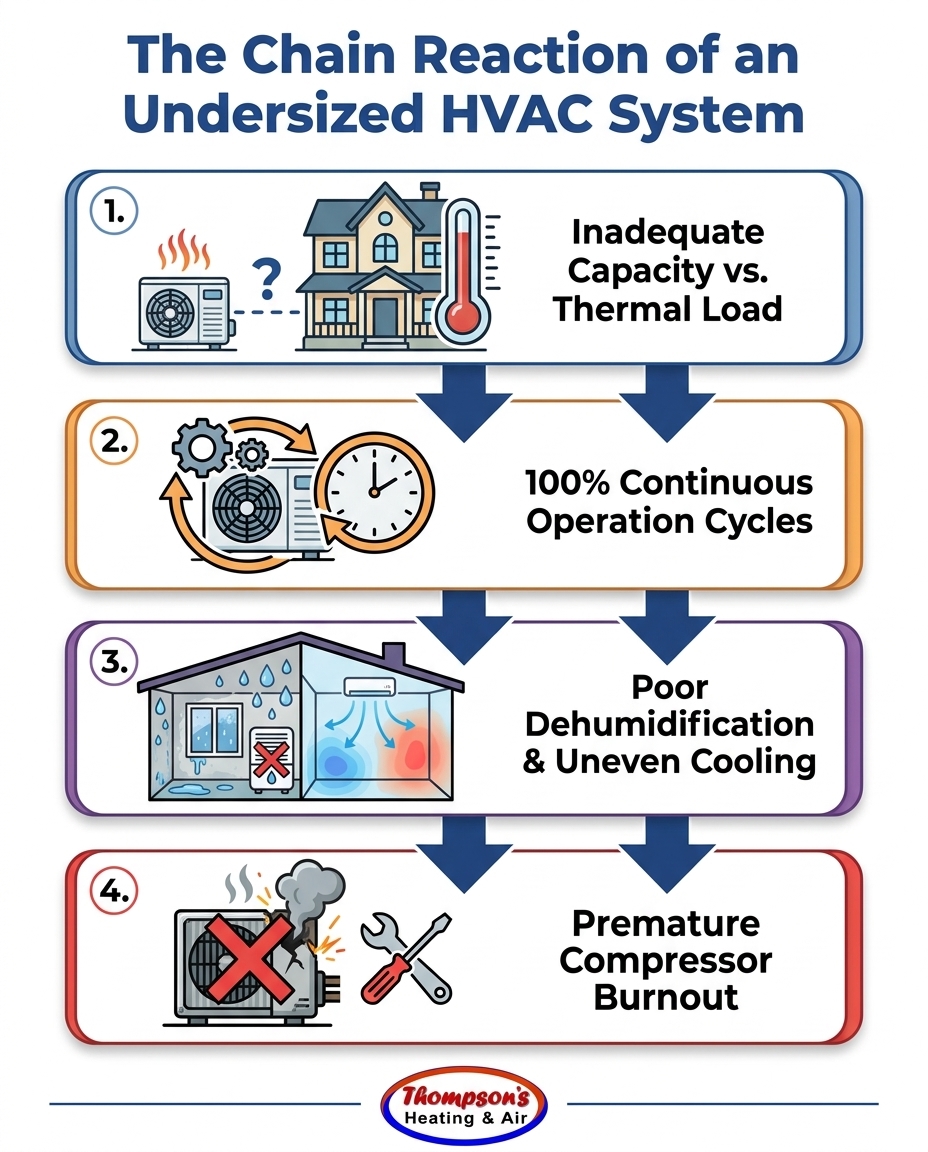
An air conditioner does not actually "create" cold air; it removes heat from the inside of your home and transfers it outside at a fixed rate. If your home gains heat from the sun, the roof, and the windows faster than the AC can remove it, the system will never shut off. This is the fundamental physics problem of an undersized unit.
Our technicians see the brutal reality of system failures during extreme weather all the time. One local homeowner found themselves completely without air conditioning for three consecutive days during a stretch of 100-plus degree weather due to an incorrect address mix-up by another company. Our owner went out personally and fixed the issue immediately to restore their cooling. When temperatures soar into the triple digits, that extreme heat is exactly what pushes vulnerable, undersized equipment past its breaking point, leaving families stranded.
The Danger of 100% Runtime
A properly sized air conditioner is designed to run in cycles. On a hot day, it should turn on, cool the house down to the thermostat set point, and then shut off to rest. This resting period is critical for the longevity of the mechanical components.
When our team inspects burned-out units, we frequently find that they were too small for the house and forced into continuous operation cycles (100% runtime). The system turns on in the late morning and simply never shuts down until the sun goes down and the outside air cools off.
• Compressor Strain: The compressor is the heart of your AC system, pumping refrigerant through the lines. It is not designed to run for 12 hours straight without a break.
• Electrical Wear: Capacitors and contactors degrade much faster when subjected to the constant electrical load and extreme heat generated by non-stop operation.
• Blower Motor Fatigue: The indoor blower motor is forced to push air continuously, leading to premature bearing failure and overheating.
This mechanical toll leads directly to premature compressor burnout, which is often the most extensive and complex repair on an HVAC unit. Tragically, these catastrophic failures almost always occur at the worst possible time—right in the middle of a major heatwave when the system is pushed to its absolute limit.
Why Manual J Load Calculations Are Non-Negotiable
If guessing the size of an air conditioner based purely on the square footage of a home worked, we wouldn't see so many failed systems across Yolo County. The reality is that square footage is only one small piece of a much larger puzzle. The only national standard for accurately sizing residential HVAC equipment is the Air Conditioning Contractors of America (ACCA) Manual J calculation.
When a contractor skips this step and uses a "rule of thumb" to size your equipment, they are doing you a massive disservice. A proper Manual J calculation takes into account a wide variety of factors that dictate how much heat your home actually retains and loses.
Critical Factors in a Load Calculation:
• Insulation Levels: The R-value of your attic, walls, and floors determines how easily heat transfers into your living space.
• Window Quality and Orientation: Single-pane windows facing west will let in drastically more heat than double-pane windows facing north.
• Thermal Envelope: How well sealed your home is against outside air infiltration.
• Regional Extremes: The calculation must account for the specific climate data of the area, not just national averages.
In Woodland CA and Central Valley homes, skipping this calculation is the primary reason homes end up with undersized equipment. The extreme afternoon sun creates a unique thermal load that a generic square-footage guess will always underestimate. If you want to dive deeper into how this works in our specific region, understanding the mechanics of getting the right size HVAC for Sacramento Valley homes is a great next step. At Thompson's Heating & Air, we consider the Manual J calculation absolutely non-negotiable because it is the only way to guarantee your new system will actually do its job.
The Late-Summer Comfort Penalty
Beyond the looming threat of mechanical failure, living with an undersized unit carries an immediate, daily penalty: your home simply will not be comfortable. You are paying maximum utility costs to run a machine all day long, yet you are still sweating in your own living room.
We recently helped a customer whose air conditioning was working poorly just as a massive back-to-school heat wave was approaching. Our team came out the next day, showed up on time, and fixed the problem before the worst of the temperatures hit. When a system is struggling before the peak heat even arrives, it is a clear warning sign that the equipment lacks the necessary capacity.
During August late-summer heatwaves, an undersized system will typically fall behind the thermostat set point by early afternoon. If you set your thermostat to 72 degrees, you might watch the temperature climb to 76 or 78 degrees by 4:00 PM. The unit will not catch back up until late at night when the outside temperatures finally drop.
Furthermore, an undersized system struggles with adequate dehumidification. Even if the air blowing out of your vents feels cold to the touch, the overall environment inside the home can feel sticky and clammy. True comfort requires both temperature control and humidity control, and an undersized unit fails at both when pushed to its limits.
Our Ethical Stance: Choosing Reliability Over a Quick Sale
Quoting a smaller unit to win a bid is easy. Dealing with the fallout when that unit fails three years later is a nightmare for the homeowner. At Thompson's Heating & Air, we refuse to compromise on Manual J load calculations because we prioritize your long-term reliability over making a quick, cheap sale.
In our experience, prioritizing long-term performance means we sometimes have to walk away from jobs where a homeowner insists on installing an inadequate system based on a competitor's low bid. We view our strict adherence to proper sizing as a protective measure. We are saving you from the frustration of constant breakdowns, the discomfort of continuous operation cycles (100% runtime), and the massive repair liabilities that inevitably follow. Additionally, properly sized and installed equipment is often a prerequisite for taking advantage of generally applicable energy rebates or federal tax credits for qualifying high-efficiency heat pumps and ACs. We always advise our customers to verify current programs with their utility provider or a tax professional.
This philosophy applies to every piece of equipment we touch. Whether we are preparing your home for the late-summer heat or handling your upcoming winter heating installation, the physics of proper sizing remain exactly the same. Doing the job right the first time is the only way we operate.
Frequently Asked Questions About HVAC Sizing
What happens if I install an undersized AC?
If you install an undersized AC, the system will lack the capacity to remove heat as fast as your home absorbs it. This forces the unit to run continuously without resting, leading to accelerated wear on the compressor and blower motor. Ultimately, you will experience poor cooling performance, high utility bills, and a significantly shortened equipment lifespan.
Can an undersized AC effectively cool a house?
An undersized AC might effectively cool a house on mild spring or fall days, but it will fail during extreme weather. When late-summer temperatures peak, the system will fall behind your thermostat setting, leaving the house warm and humid. It simply does not have the mechanical power to overcome a heavy thermal load.
Why do contractors quote different size HVAC units for the same home?
Contractors quote different sizes because many still rely on outdated "rules of thumb" based purely on square footage rather than performing a scientific load calculation. Additionally, some contractors intentionally quote smaller units to lower their equipment costs and present a cheaper bid. A reputable contractor will always use a Manual J calculation to determine the exact size needed.
Will an undersized AC run constantly during the summer?
Yes, an undersized AC is highly likely to run constantly during peak summer heat. Because it cannot reach the temperature set on the thermostat, the system's sensors will never tell it to shut off. This continuous operation cycles (100% runtime) is one of the clearest indicators that a unit lacks the proper capacity for the home.
How does a Manual J load calculation prevent premature AC failure?
A Manual J load calculation prevents premature failure by ensuring the equipment is perfectly matched to the home's specific heat gain and loss. By accounting for insulation, windows, and regional climate, the calculation guarantees the unit is large enough to cool the home efficiently but not so large that it short-cycles. This balance allows the system to operate in normal resting intervals, protecting the compressor from burning out.
Protect Your Home with a Properly Sized System
Accepting a lower bid might feel like a victory on installation day, but it is a long-term liability if it relies on undersized equipment. When August late-summer heatwaves push your system to the brink, you need to know that your equipment has the capacity to keep your family comfortable without destroying itself in the process.
We strongly encourage every homeowner to demand a proper load calculation before accepting any quote for new equipment. Protect your home, your comfort, and your peace of mind by exploring professional installation options that prioritize the long-term lifespan of your system over a quick, cheap sale.



.avif)
.avif)
.png)
