
Addressing the Clanking Sound When Your AC Condenser Fan Blade Loosens

That Terrifying Metal-on-Metal Noise: Why You Must Act Immediately
You hear a harsh, rhythmic banging erupt from your backyard, and suddenly you find yourself addressing the clanking sound when your AC condenser fan blade loosens. That sharp, metal-on-metal racket coming from your outdoor unit is not just a minor annoyance that will fade away on its own. In our years serving the Woodland community, our team at Thompson's Heating & Air has seen firsthand that this noise is a critical warning sign of a severe mechanical failure in progress. When a heavy metal component breaks its designated path and begins striking the surrounding housing, every single rotation brings your entire cooling system closer to catastrophic damage.
If you are dealing with a sudden system emergency, our AC repair experts provide fast, reliable AC repair in Woodland, CA to protect your equipment from permanent destruction.
In Woodland CA and the surrounding Central Valley, the intense late-summer heat makes a sudden AC shutdown incredibly stressful. Your first instinct might be to let the system keep running just to maintain a little bit of airflow inside the house. However, as our technicians always warn, running a clanking condenser unit guarantees a much longer, hotter breakdown. The immediate decision you must make is to walk straight to your thermostat and shut the system off entirely. This single action stops the motor from spinning and prevents the loose fan blade from causing further destruction.
To understand what you are hearing, it helps to recognize the specific symptoms of a failing fan assembly that our crew typically sees in the field:
• Sudden onset: The noise usually starts abruptly, rather than building up slowly over several weeks.
• Rhythmic metallic striking: The sound matches the spinning rhythm of the motor, resembling a heavy stick hitting a metal trash can.
• Cabinet vibration: You may actually see the entire outdoor condenser unit shaking violently while the noise occurs.
• Changing pitch on shutdown: As the fan motor winds down after you turn the system off, the clanking slows down and changes pitch until the blade stops completely.
The most common culprit for this terrifying noise is a loose condenser fan blade. While it sounds like the entire machine is tearing itself apart, catching it early and leaving the unit off keeps the repair isolated to a simple mechanical realignment.
The Mechanics of Motor Vibration and Mechanical Fatigue
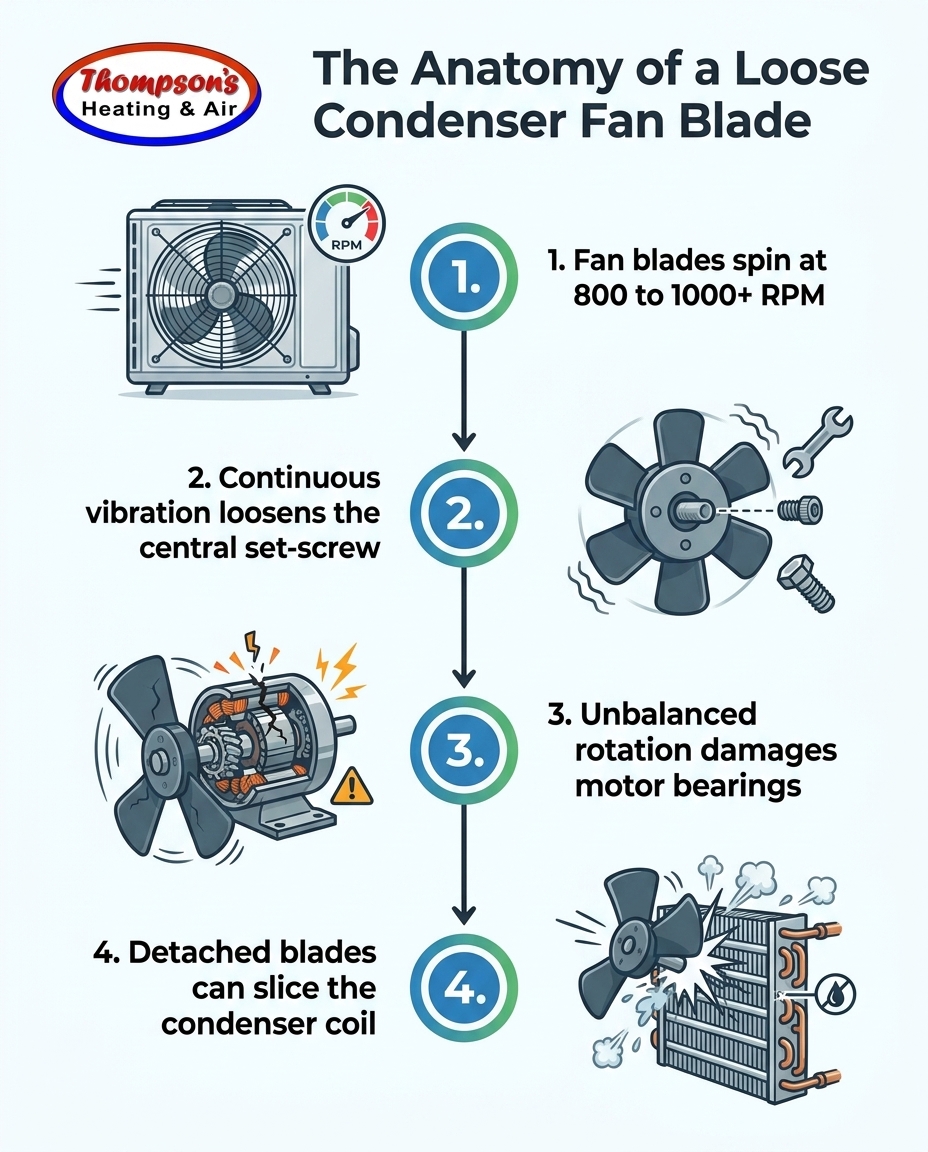
To fully grasp why this failure happens, you have to look at the immense physical forces operating inside your outdoor condenser unit. The large fan you see through the top grate is responsible for pulling massive volumes of air through the condenser coils to release the heat absorbed from your home. To move that much air, the fan blade spins at 800 to well over 1000 revolutions per minute (RPM). At these high speeds, even a microscopic imbalance creates significant centrifugal force.
If you are currently decoding your AC's strange noises, understanding the concept of mechanical fatigue is essential. Our technicians regularly explain to customers that your air conditioner is not a static object; it is a dynamic machine subjected to continuous vibration. Over extended duty cycles—especially during the August late-summer peak cooling season—this constant, low-level vibration takes a toll on the hardware holding the system together. The fan blade is secured to the motor shaft by a small but critical component known as a set-screw.
Months of continuous operation lead to a gradual loosening process. The set-screw slowly backs out of its secure position on the flat edge of the motor shaft. Once it loosens by just a fraction of a millimeter, the blade begins to wobble. That wobble increases the vibration, which in turn loosens the screw even faster. It is a compounding cycle of wear and tear that ultimately results in the blade slipping out of alignment.
Why the Set-Screw Fails
Mechanical vibration is only one part of the equation. The outdoor environment also plays a massive role in hardware fatigue. The set-screw is constantly battling two invisible forces:
• Thermal expansion and contraction: The metal components heat up significantly during the heat of the day and while the motor is running, causing the metal to expand. At night, the unit cools and the metal contracts. These daily temperature swings cause microscopic shifting between the screw threads and the motor shaft.
• Centrifugal stress: As the heavy metal fan blades spin, they pull outward away from the center hub. The set-screw is the only thing resisting that force, keeping the blade anchored safely to the rotating shaft.
When these forces combine over the course of a long, hot summer, mechanical loosening becomes a highly predictable pattern.
What Happens Inside the Condenser When the Blade Detaches
Ignoring the clanking sound is the most dangerous mistake a homeowner can make. When the fan blade loosens, a rapid chain reaction of destruction begins inside the cabinet. The initial clanking noise you hear is the edge of the unbalanced fan blade striking the metal fan shroud or the protective wire cage. Because the blade is spinning at nearly 1000 RPM, it strikes the metal housing dozens of times per second.
As the blade wobbles, it exerts immense, uneven centrifugal force directly onto the fan motor bearings. These bearings are designed to handle perfectly smooth, balanced rotation. When subjected to violent, off-center jerking, the internal bearings can shatter in a matter of minutes. Once the bearings are destroyed, the entire fan motor must be replaced, transforming a minor hardware adjustment into a major component failure.
The worst-case scenario occurs when the set-screw backs out completely while the unit is running. The heavy fan blade sheers off the motor shaft entirely, becoming a high-speed metal projectile trapped inside the cabinet. It will immediately slice into the delicate aluminum fins and copper tubing of the condenser coils. If the blade punctures the copper tubing, the system will instantly vent all of its chemical refrigerant into the atmosphere, requiring a massive, extensive repair or even a total unit replacement.
When this kind of failure strikes, time is of the essence. We recently had a local Woodland homeowner reach out to us at 6 AM when their system suddenly started making a terrible racket, and they knew they needed same-day repair. Our technicians were dispatched and arrived by 1 PM, ensuring the A/C was repaired on the exact same day it was reported. Taking fast action and calling a professional to shut the unit off immediately prevents a loose piece of hardware from tearing the unit apart.
Why DIY Fan Blade Tightening is a Dangerous Mistake
When you discover that the problem is simply a loose screw, it is incredibly tempting to grab a wrench and attempt to fix it yourself. At Thompson's Heating & Air, we explicitly warn against opening the condenser cabinet or attempting to tighten the set-screw on your own. A pattern we see often is well-meaning homeowners trying a quick fix, only to cause more damage. Proper fan blade alignment requires precise positioning on the motor shaft to ensure adequate airflow, and improper balancing carries severe consequences.
The fan blade cannot simply be shoved onto the shaft and tightened arbitrarily. It must be positioned at the exact correct depth within the fan shroud. If it sits too high or too low, it will not pull air efficiently across the condenser coils, causing the compressor to overheat and trip the system's safety limits. Furthermore, the set-screw must be tightened flat against a specific milled edge of the motor shaft. If you tighten it against the rounded portion of the shaft, it will immediately vibrate loose again upon startup.
The quick fix is never the safe fix: Over-tightening the hardware or failing to balance the blade correctly can instantly destroy the fan motor bearings the moment the system turns back on. You also face severe safety risks. The outdoor condenser houses high-voltage electrical components, including the dual run capacitor, which stores a lethal electrical charge even after the power is turned off at the breaker.
• A loose screw that needs tightening — What Professionals Measure: Precise torque specifications for the set-screw
• A fan blade that looks straight — What Professionals Measure: Exact depth placement within the fan shroud
• A motor that spins when pushed — What Professionals Measure: Bearing integrity and electrical resistance testing
• Power turned off at the thermostat — What Professionals Measure: High-voltage capacitors safely discharged
Especially during the August late-summer peak cooling season, when the equipment is already stressed, relying on guesswork for mechanical alignment is a dangerous gamble. Our team always recommends leaving high-speed rotational hardware to licensed professionals.
The Importance of Rapid, Expert Diagnostics
When you call a licensed professional to address a clanking condenser, they do much more than just turn a wrench. During our diagnostic visits, our technicians perform a comprehensive safety check of the entire outdoor unit. We safely secure the loose components, realign the blade to factory specifications, and thoroughly test the motor bearing integrity to ensure no permanent damage occurred while the blade was wobbling.
Our team's commitment to rapid, expert diagnostics at Thompson's Heating & Air means we prioritize securing loose components before they sheer off and cause catastrophic system damage. We know from experience that catching the loose blade early turns a potentially disastrous coil failure into a straightforward component realignment. By utilizing specialized tools to measure the rotational balance and electrical draw of the fan motor, our professionals ensure the system is completely stable before restoring power.
We take summer emergencies seriously. During a brutal summer stretch with 100-degree weather, we had a local customer whose AC had not been working for three days before they called us. Despite a fully booked schedule and an initially incorrect address, our owner went out personally and fixed the system right away. Resolving the issue and restoring comfort promptly is what we do best. This level of dedication ensures you get the peace of mind that comes with knowing the system is safely restored to handle the remaining back-to-school season heat.
If you live in Woodland CA and the surrounding Central Valley, ensuring your system is mechanically sound is vital for surviving the hotter months. Trusting an expert for your AC repair in Woodland, CA guarantees that the repair is done safely, correctly, and permanently.
Preventing Mechanical Fatigue Before the End of the Season
While rapid repair is essential when a breakdown occurs, proactive prevention is always the better strategy. In our experience servicing Central Valley homes, routine inspections catch loosening set-screws long before they start clanking against the metal shroud. When a Thompson's Heating & Air technician examines your system during a scheduled visit, checking component tightness is a standard, non-negotiable part of our process.
Late-summer peak cooling demands mean that your outdoor unit has been vibrating continuously for months. By the time August arrives and kids are heading back to school, the accumulated mechanical fatigue is at its highest point of the year. This makes end-of-season checkups highly valuable. Our technicians will physically test the fan blade, inspect the motor shaft, and verify that the set-screw is torqued to the correct specifications, preventing an unexpected emergency.
We strongly recommend scheduling proactive care to ensure the system can handle prolonged duty cycles without vibrating apart. Investing in routine AC maintenance is the single best defense against sudden, terrifying noises. By catching microscopic wear and tear early, you keep your system running smoothly, efficiently, and safely through the toughest heatwaves of the year.
Frequently Asked Questions
Why is my AC making a loud clanking noise?
A loud clanking noise usually means a heavy metal component has vibrated loose and is striking the inside of the cabinet. The most common cause we see is a loose condenser fan blade hitting the metal fan shroud. Because the blade spins at high speeds, this creates a harsh, rhythmic banging that changes pitch as the motor spins down.
Is it safe to run my AC if it's making noise?
No, it is never safe to run an air conditioner that is making a metal-on-metal clanking sound. Allowing the system to run with a loose fan blade will quickly destroy the motor bearings. In the worst-case scenario, the blade can sheer off entirely and slice into the delicate condenser coils, causing catastrophic damage.
What happens if an AC fan blade comes loose?
When a fan blade comes loose, it immediately loses its rotational balance and begins to wobble violently. This wobble exerts immense centrifugal force on the motor, shattering the internal bearings. If the blade detaches completely while spinning, it acts as a high-speed projectile that can destroy the entire outdoor unit.
Can a loose AC fan blade be tightened?
Yes, a loose fan blade can be tightened, but this must be done by a licensed professional. The blade must be positioned at the exact correct depth on the motor shaft to ensure proper airflow and balanced rotation. Improper DIY tightening can instantly destroy the motor bearings upon startup.
How long do condenser fan motors and blades typically last?
With routine maintenance and proper care, condenser fan motors and blades often last over a decade. However, their lifespan is heavily dependent on continuous mechanical balance. If a blade is allowed to operate while unbalanced, it can destroy a brand-new motor in a matter of hours.
Why do AC components vibrate loose at the end of summer?
Months of continuous operation during extreme heat cause significant mechanical fatigue and constant vibration. Additionally, daily thermal expansion and contraction cause the metal hardware to shift slightly over time. By late summer, these combined forces often cause set-screws and mounting bolts to finally back out of place.
Protect Your System from Catastrophic Failure
A sudden clanking noise is your system's final warning before a minor hardware issue turns into a major breakdown. Don't wait for the fan blade to sheer off and destroy your condenser coil. Reach out to the team at Thompson's Heating & Air to schedule your expert diagnostic visit today. We'll secure your system and restore your peace of mind before the next late-summer heatwave hits.



.avif)
.avif)
.png)
