
The Ultimate Guide to Efficiency Ratings for Homeowners

What Efficiency Ratings for Homeowners Actually Mean (And Why It Matters)
Understanding efficiency ratings explained for homeowners starts with one straightforward idea: these numbers tell you how much useful heating or cooling you get for every dollar you spend on energy. If you've ever stared at a yellow EnergyGuide label or heard a contractor mention "SEER2" or "AFUE" and felt completely lost, you're not alone.
Here's a quick breakdown of the most important efficiency ratings you'll encounter:
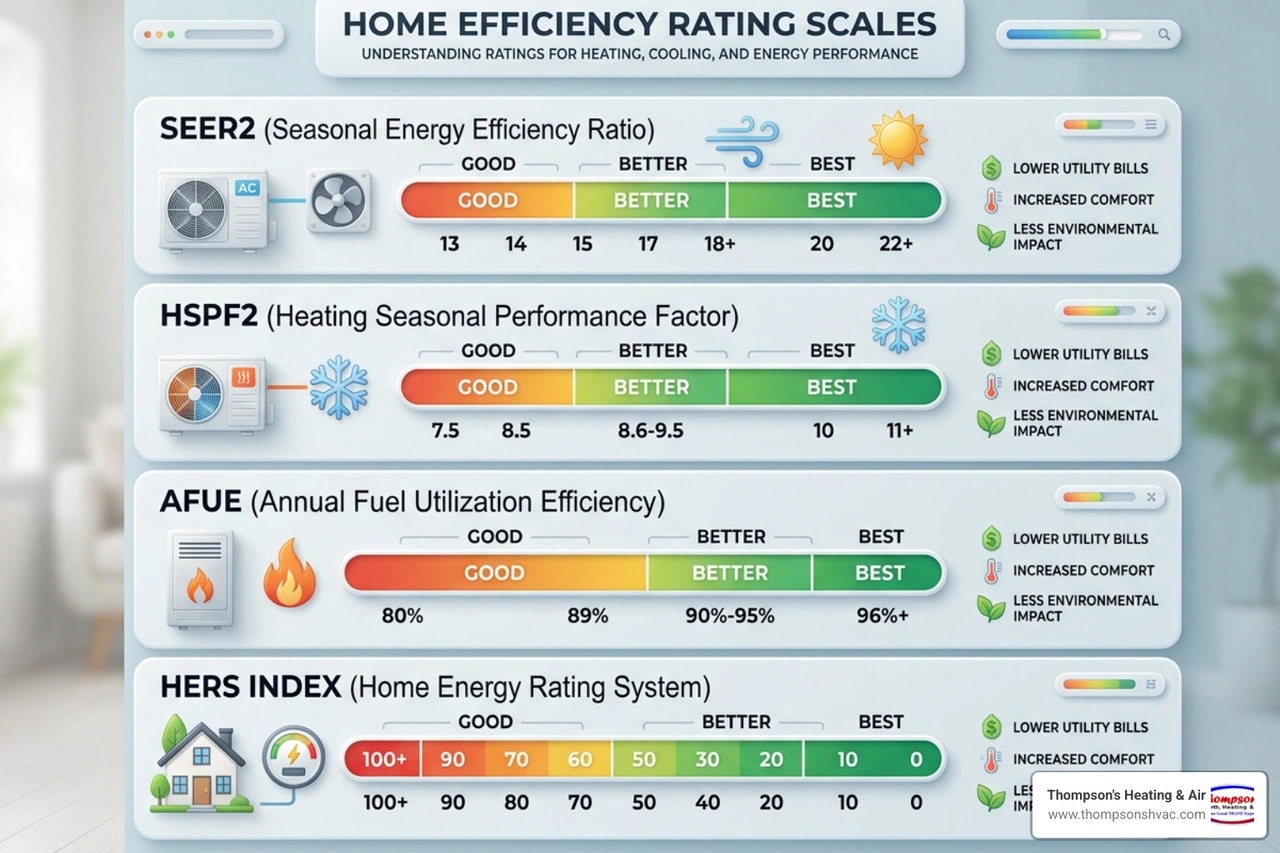
• SEER2 — What It Measures: Air conditioner / heat pump cooling efficiency — Better Score =: Higher number
• HSPF2 — What It Measures: Heat pump heating efficiency — Better Score =: Higher number
• AFUE — What It Measures: Furnace fuel-to-heat conversion — Better Score =: Higher %
• HERS Index — What It Measures: Whole-home energy performance — Better Score =: Lower number
• ENERGY STAR — What It Measures: Top ~25% of products in efficiency — Better Score =: Certified or not
For Woodland and the broader Sacramento Valley, where summers regularly push triple digits and winters bring genuine heating demand, choosing the right efficiency rating isn't just an eco-friendly talking point — it's a direct line to lower monthly utility bills and a more comfortable home year-round.
A high-efficiency furnace rated at 95% AFUE converts 95 cents of every dollar spent on gas into actual heat. An older unit running at 60–70% AFUE wastes 30 to 40 cents of every dollar. That gap adds up fast over a California heating season. Similarly, an air conditioner with a higher SEER2 rating does the same work while pulling significantly less electricity from the grid.
The challenge is that these ratings can feel like alphabet soup — and the numbers on the label don't always match what you experience in your home. Proper installation, ductwork condition, insulation levels, and regular maintenance all play a major role in whether your system actually performs at its rated efficiency.
This guide breaks it all down in plain language so you can make confident decisions about your HVAC system in Woodland, CA.
Efficiency Ratings Explained for Homeowners: Why They Matter in 2026
As we navigate the warm summer days of June 2026, home efficiency is no longer just a niche topic for green-living enthusiasts. With rising utility rates across Northern California and increasingly strict state environmental codes, understanding how your home consumes energy is a financial necessity.
When you invest in a modern climate control system, the efficiency ratings stamped on the equipment directly influence three major areas of homeownership:
• Monthly Utility Bills: Space heating and cooling account for more than 50% of the average home's utility costs. Upgrading from an outdated system to a modern, high-efficiency setup can reduce your cooling energy consumption by more than 35% overnight.
• Property Value and Market Appeal: Energy efficiency is a premium selling point in today's real estate market. Studies show that residential properties with documented energy efficiency ratings sell for an average of 2.7% more than unrated homes. Furthermore, homes featuring premium efficiency systems often achieve a 3% to 5% higher selling price. To learn more about how these upgrades translate to equity, check out our detailed guide on How a New HVAC System Increases Home Value.
• Selling Speed: Homebuyers in 2026 are highly sensitive to the total cost of homeownership. A modern, highly rated heating and cooling system acts as a major insurance policy against unexpected post-purchase expenses. For insights on attracting buyers, read our analysis on whether a Does a New HVAC Help Sell Your Home Faster.
• Environmental Footprint: Modern high-efficiency systems consume less power and utilize the latest, eco-friendly A2L refrigerants (such as R-454B or R-32), which have been phased in to replace older options. Upgrading a low-efficiency fossil-fuel furnace to a condensing unit or electric heat pump can eliminate up to 2.5 tons of carbon dioxide emissions per year.
Decoding the Core HVAC Metrics: SEER2, HSPF2, and AFUE
Before purchasing new heating or cooling equipment, you need to understand the primary metrics used to measure performance. The Federal Department of Energy (DOE) updated testing standards to better reflect real-world operating conditions, introducing the "2" suffix to several traditional ratings.
The older testing methods assumed residential ductwork was perfectly sealed and had minimal resistance to airflow. In reality, almost every home has some level of static pressure resistance. The newer SEER2 and HSPF2 testing protocols use a static pressure standard that is five times higher than the old tests, making the resulting ratings 5% to 7% more accurate to what actually happens in your home.
To make sense of these numbers, it helps to understand two basic terms:
• BTU (British Thermal Unit): The standard unit of heating or cooling energy. One BTU is the amount of energy required to raise the temperature of one pound of water by one degree Fahrenheit.
• Watt-Hour: The unit of electrical energy consumed by your equipment.
• SEER2 — Full Name: Seasonal Energy Efficiency Ratio 2 — Primary Equipment: Central ACs & Heat Pumps — How It Is Calculated: Total cooling BTUs produced divided by total watt-hours consumed over a typical cooling season. — Good 2026 Standard: 15.0 to 17.0 (Highly efficient systems reach 20.0+)
• HSPF2 — Full Name: Heating Seasonal Performance Factor 2 — Primary Equipment: Heat Pumps (Heating Mode) — How It Is Calculated: Total heating BTUs produced divided by total watt-hours consumed over a typical heating season. — Good 2026 Standard: 8.1 to 9.0 (Premium units reach 10.0+)
• AFUE — Full Name: Annual Fuel Utilization Efficiency — Primary Equipment: Gas & Oil Furnaces — How It Is Calculated: Percentage of fuel converted directly into usable heat versus fuel wasted through the exhaust. — Good 2026 Standard: 95% to 98% (Condensing models)
Cooling Performance: SEER2 and EER2
When evaluating cooling systems, you will see both SEER2 and EER2 on the yellow EnergyGuide label. While they sound similar, they measure different things:
• SEER2 (Seasonal Energy Efficiency Ratio 2): This is a seasonal average. It calculates how efficiently the system operates across a simulated cooling season with varying outdoor temperatures ranging from 65°F to over 100°F. It is the best indicator of your overall summer power bills.
• EER2 (Energy Efficiency Ratio 2): This measures steady-state efficiency at a single, extreme temperature point—specifically 95°F. It tells you how well your system performs during the absolute hottest days of the year when the electrical grid is under maximum stress.
For homeowners in Winters, Davis, or Dixon, where summer temperatures regularly soar, having a solid EER2 rating is just as important as a high SEER2 rating to prevent massive peak-demand energy spikes. To see how standard units stack up against premium options, explore our Standard Efficiency vs High Efficiency HVAC Comparison.
Heating Efficiency: AFUE and HSPF2
For winter heating, the efficiency metrics depend entirely on whether you use a gas furnace or an electric heat pump:
• AFUE (Annual Fuel Utilization Efficiency): Expressed as a percentage, AFUE applies to combustion systems like gas furnaces. An older 80% AFUE furnace sends 20% of its heat straight up the chimney as waste gas. A modern 96% AFUE condensing furnace uses a secondary heat exchanger to extract heat from the exhaust moisture, wasting only 4% of the fuel.
• HSPF2 (Heating Seasonal Performance Factor 2): This applies to heat pumps operating in heating mode. Because heat pumps move existing heat from the outdoor air into your home rather than generating heat from combustion or electrical resistance, they are incredibly efficient. A system with an HSPF2 of 9.0 can deliver up to three to four times more heat energy than the electrical energy it consumes.
If you are curious about transitioning away from gas heating, you can learn more about the Heat Pump Advantages Over Traditional HVAC and get a clear picture of the mechanics in our guide on How Does a Heat Pump Work.
Whole-Home Performance: HERS Index and ENERGY STAR
Beyond individual equipment labels, whole-home performance standards look at how your entire house operates as a single system:
• The HERS Index (Home Energy Rating System): Administered by RESNET, the HERS Index is the industry standard for measuring a home's overall energy performance. A score of 100 represents a standard reference home built to 2006 building codes. Each 1-point reduction below 100 represents a 1% increase in energy efficiency. For example, a home with a HERS score of 70 is 30% more efficient than the baseline, while a HERS score of 0 represents a Net Zero Energy Home.
• ENERGY STAR Certification: Managed by the EPA, this label identifies appliances and HVAC equipment that rank in the top 25% of their class for efficiency. For central air conditioners and heat pumps in 2026, the ENERGY STAR minimums require at least 15.2 SEER2 and 8.1 HSPF2.
Upgrading your heating and cooling systems to meet these whole-home benchmarks offers substantial advantages. For a complete look at these perks, read about the New HVAC Benefits Beyond Comfort.
Real-World Factors That Affect Your System's Actual Efficiency
It is a common misconception that buying a system with a high rating on the box guarantees low utility bills. In reality, those ratings are established in controlled laboratory environments. Once the system is installed in your home, several critical real-world factors dictate whether it actually achieves those numbers.
Sizing and Installation Quality
An oversized air conditioner or furnace is one of the most common causes of efficiency loss. When a system is too large for a home, it undergoes a process called short cycling—turning on, rapidly cooling or heating the space, and shutting off before completing a full, balanced cycle.
Short cycling prevents the system from reaching its optimal operating efficiency, places extreme wear on electrical components, and fails to remove humidity from the air. To prevent this, professional HVAC contractors use manual calculations to determine the exact heating and cooling loads of your home.
To understand how we calculate these needs, take a look at How HVAC Load Calculations Work and read our guide on Getting the Right Size HVAC for the Sacramento Valley Homes.
Ductwork, Insulation, and Maintenance
Your HVAC system relies on your home's structural envelope to deliver and retain conditioned air. If these elements are neglected, even a 20 SEER2 system will perform like a budget unit.
• Ductwork Integrity: The EPA estimates that the average home loses 20% to 30% of its conditioned air through leaks, gaps, and poorly connected joints in the ductwork. Sealing and insulating ducts ensures that the air you pay to heat or cool actually reaches your living spaces.
• Attic and Wall Insulation: Without proper insulation, heat continuously transfers through your ceiling and walls. Upgrading attic insulation to modern standards acts as a thermal barrier, reducing the workload on your HVAC system.
• Air Filter Cleanliness: A dirty, clogged air filter restricts airflow, forcing the blower motor to work twice as hard and causing a drop in operating efficiency of 10% or more in a single season.
• Regular Professional Maintenance: Annual tune-ups keep coils clean, electrical connections tight, and refrigerant levels precise. A system undercharged by just 10% can lose up to 20% of its cooling efficiency.
To understand how proper system design and upkeep impact your indoor climate, explore How Proper HVAC Sizing Affects Comfort.
Maximizing Savings with Rebates and Tax Credits
Transitioning to high-efficiency equipment is highly supported by state and federal programs in 2026. Homeowners can take advantage of several incentives to lower their upfront investment:
• Federal Tax Credits (Section 25C): Under the Inflation Reduction Act, homeowners can claim up to $2,000 annually in federal tax credits for qualifying heat pumps and heat pump water heaters, and up to $600 for high-efficiency gas furnaces and central air conditioners.
• Local Utility Rebates: PG&E offers various rebate programs for smart thermostats, heat pump upgrades, and home insulation.
• State Incentives: Programs like TECH Clean California provide additional financial support for switching from gas-powered appliances to highly efficient electric heat pumps.
To navigate these savings, check out our resources on Inflation Reduction Act Benefits for California Homeowners, our comprehensive PGE Rebates Guide Sacramento Valley Homeowners, and our guide to California Energy Rebates for HVAC and Fireplace Upgrades.
Frequently Asked Questions About Home Energy Efficiency
What is a good SEER2 rating for Sacramento Valley homes?
For homes in Woodland, Davis, and surrounding Yolo County areas, we recommend a minimum of 15.0 to 16.0 SEER2 for standard replacements. However, because our summer temperatures frequently exceed 100°F, stepping up to a 17.0 to 20.0 SEER2 system equipped with a two-stage or variable-speed compressor is highly beneficial. These advanced systems run at lower, highly efficient speeds for longer periods, providing superior humidity control and consistent indoor comfort during extreme heatwaves.
How are heating efficiency ratings explained for homeowners calculated?
Heating efficiency calculations depend on the system type:
• AFUE Formula: Calculated by dividing the total BTUs of heat energy delivered to your living space by the total BTUs of fuel consumed by the furnace, then multiplying by 100 to get a percentage.
• HSPF2 Formula: Calculated by taking the total heating output of a heat pump over the entire winter season (measured in BTUs) and dividing it by the total electrical energy consumed during that same period (measured in watt-hours).
How can I find the efficiency ratings explained for homeowners on my current HVAC unit?
You can easily check your current system's ratings using these steps:
1. Check the EnergyGuide Label: Look for the bright yellow sticker on the side of your outdoor condenser unit or indoor furnace.
2. Locate the Manufacturer's Data Plate: If the yellow sticker is missing, look for the metal data plate on the unit. Write down the model number and serial number.
3. Search Online: Enter the model number into the AHRI (Air-Conditioning, Heating, and Refrigeration Institute) directory or a standard search engine to find the official SEER2, HSPF2, or AFUE ratings.
4. Examine the Venting: For furnaces, if you see a metal exhaust pipe, your system is likely an older standard-efficiency unit (80% AFUE or lower). If you see white PVC exhaust pipes, you have a high-efficiency condensing furnace (90% AFUE or higher).
Conclusion
Navigating home efficiency ratings doesn't have to be overwhelming. By understanding metrics like SEER2, HSPF2, and AFUE, you can make smart, cost-effective decisions that protect your comfort and your wallet. In the hot, dry climate of the Sacramento Valley, investing in properly sized, highly rated equipment is one of the most impactful upgrades you can make for your home.
At Thompson's Heating & Air, we have been serving Woodland, CA, and our neighboring Northern California communities since 1992. As a family-owned business, we specialize in helping local homeowners select, install, and maintain the perfect high-efficiency systems for our unique climate.
Ready to lower your utility bills and elevate your indoor comfort? Schedule your high-efficiency consultation today and let our experienced team help you maximize your home's energy savings.



.avif)
.avif)
.png)
